
Vinyl Sales Cross $1.4 Billion as Gen Z Drives a Sustainable Physical Music Revival
Vinyl records have achieved their 19th consecutive year of growth, driven by younger listeners seeking tangible connections to music in an era of AI-generated streaming. The boom has also sparked innovations in sustainable manufacturing and eased long-standing production bottlenecks.
By Factlen Editorial Team
- Gen Z Collectors
- Value physical ownership and direct artist support over digital convenience.
- Independent Artists
- Rely on the high profit margins of physical media to sustain their careers.
- Sustainable Manufacturers
- Focus on eliminating toxic PVC from the booming physical music supply chain.
- Streaming Skeptics
- Warn that AI saturation and algorithmic playlists are degrading the value of digital music.
What's not represented
- · Major Streaming Executives
- · Audiophile Purists
Why this matters
As streaming platforms become saturated with AI-generated tracks, the continued explosion of vinyl proves that fans still crave tangible, authentic connections to artists. For independent musicians, this physical revival provides a crucial, sustainable revenue stream that digital fractions of a penny cannot match.
Key points
- US vinyl sales have crossed $1.4 billion, marking 19 consecutive years of global growth.
- Gen Z is driving the boom, with 76% of young fans purchasing records monthly.
- Half of recent buyers do not own a turntable, treating records as art and direct artist support.
- The rise of AI-generated streaming tracks has accelerated the demand for authentic physical media.
- Manufacturers are introducing sustainable bioplastics to replace toxic PVC in record production.
In an era where streaming algorithms dictate taste and artificial intelligence floods digital platforms, a decidedly analog counter-movement has reached a historic milestone. Vinyl record sales have officially crossed the $1.4 billion mark in the United States, cementing their 19th consecutive year of global growth.[1][2]
According to mid-2026 industry reports analyzing Recording Industry Association of America (RIAA) and International Federation of the Phonographic Industry (IFPI) data, vinyl now accounts for over 70% of all physical music revenue. The format moved nearly 47 million units in the US alone over the last tracking year, outperforming CDs and digital downloads by a massive margin.[1][2][6]

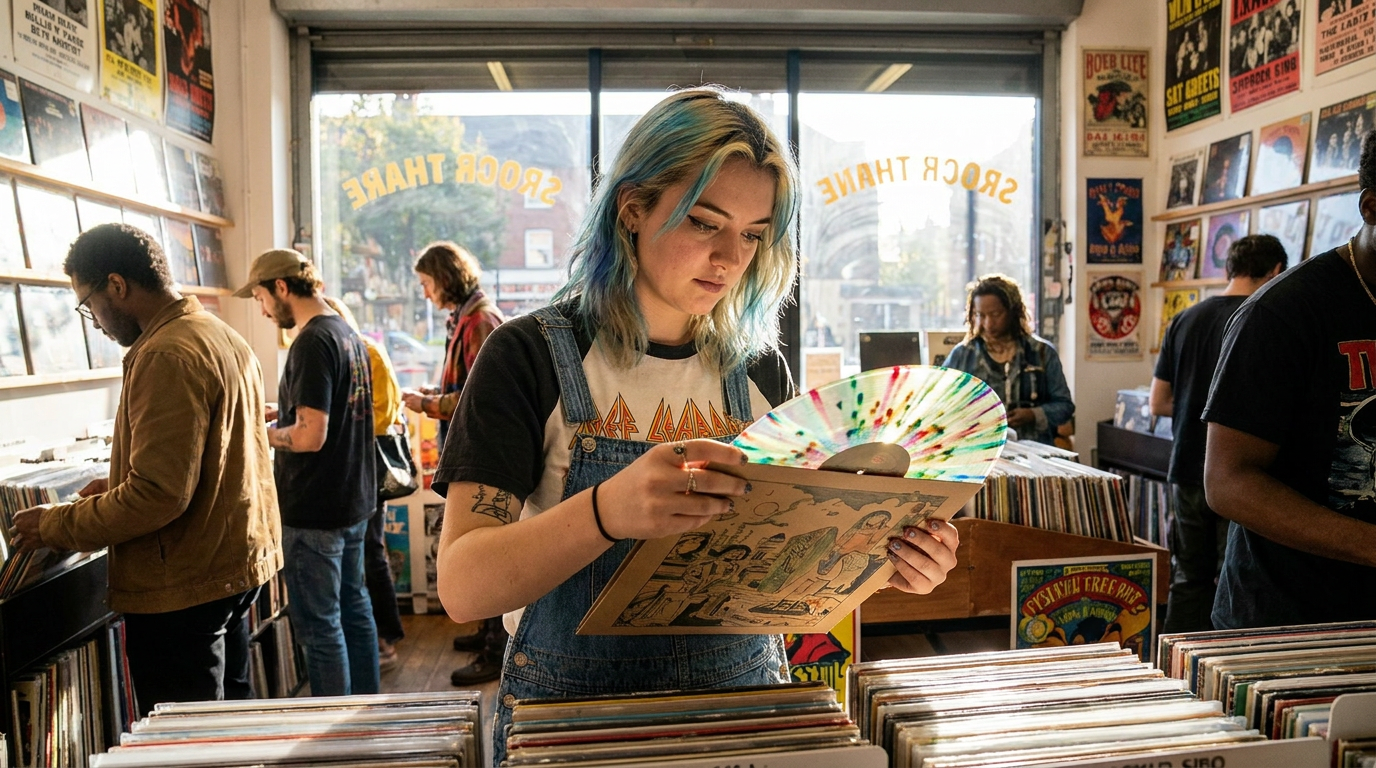
The driving force behind this analog renaissance is not nostalgic baby boomers replacing worn-out classic rock records, but rather Generation Z. Recent demographic data shows that 76% of Gen Z vinyl fans purchase a record at least once a month, actively seeking out physical media as a primary way to engage with their favorite artists.[2]
For younger listeners, vinyl offers a tangible connection to artists that a digital stream cannot replicate. A striking 50% of recent buyers do not even own a turntable; instead, they purchase records as physical artifacts, large-format art pieces, and a means of direct financial support for musicians.[2]

This physical boom coincides with growing consumer fatigue over digital platforms. With the Independent Society of Musicians reporting in May 2026 that AI-generated music now makes up at least 44% of daily uploads on streaming services, fans are actively seeking authenticity. Vinyl provides a verifiable, human-made product in an increasingly synthetic landscape.[4][6]
This physical boom coincides with growing consumer fatigue over digital platforms.
The surge in demand previously crippled the industry's supply chain, with independent artists waiting up to 18 months for their records to be pressed in 2021 and 2022. Today, global pressing capacity has expanded to an estimated 160 million units annually. Major plants like GZ Media and United Record Pressing have scaled their operations, bringing typical lead times back down to a manageable six to nine months.[1]

However, the boom has also forced the music industry to reckon with its environmental footprint. Traditional records are manufactured using PVC, a toxic plastic that relies heavily on fossil fuels. In response, companies like UK-based Evolution Music have introduced "Evovinyl," a bioplastic alternative derived from sugarcane waste.[3]
Evolution Music's fossil-fuel-free records recently earned a nomination at the 2026 Music Week Awards, signaling mainstream industry acceptance of eco-friendly manufacturing. Labels and pressing plants are increasingly adopting these sustainable polymers, proving that the analog revival does not have to come at an ecological cost.[3]

On the retail front, independent record stores are thriving as community hubs, while major retailers and independent shops alike report massive sales across genres. The best-selling charts feature a healthy mix of heritage acts like Fleetwood Mac alongside modern pop stars like Harry Styles and Olivia Dean, proving the format's broad, multi-generational appeal.[5]
For independent artists, the vinyl resurgence offers a vital revenue stream that streaming fractions of a penny simply cannot match. As the music industry navigates the complexities of the AI era, the spinning black circle remains a powerful symbol of music's enduring physical value and the unbreakable bond between artist and fan.[1][6]
How we got here
1987
The last time vinyl sales previously crossed the billion-dollar mark before the rise of CDs.
2007
Vinyl sales begin their 19-year streak of consecutive year-over-year growth.
2021-2022
Supply chain bottlenecks cause massive delays, with indie artists waiting up to 18 months for vinyl pressings.
May 2026
AI-generated music hits 44% of daily streaming uploads, accelerating the consumer push toward verifiable physical media.
June 2026
Industry reports confirm vinyl has crossed $1.4 billion in US revenue, driven heavily by Gen Z buyers.
Viewpoints in depth
Gen Z Collectors
Younger listeners view vinyl as a necessary physical anchor in a digital world.
For this demographic, music is increasingly seen as an identity marker that deserves physical space. They argue that streaming reduces art to background noise, whereas buying a record—even without a turntable—is a deliberate act of fandom and financial support for the artist. The physical object serves as a badge of honor and a tangible connection to the music they love.
Sustainable Manufacturers
Eco-conscious innovators are pushing the industry away from toxic PVC.
Companies developing bioplastics argue that the vinyl revival cannot be sustainable if it relies on fossil fuels. By utilizing sugarcane waste and natural polymers, they are proving that physical media can thrive without contributing to environmental degradation, aiming to make eco-vinyl the new industry standard and eliminate the ecological guilt of collecting.
Independent Artists
Musicians rely on physical sales to survive the economics of streaming.
With streaming payouts remaining notoriously low, independent artists view vinyl as a crucial lifeline. A single record sale can generate the equivalent revenue of thousands of streams, allowing musicians to fund tours, pay for studio time, and maintain their independence in a top-heavy industry that increasingly favors algorithmic hits.
What we don't know
- Whether the shift toward sustainable bioplastics will fully replace traditional PVC across major label releases.
- How streaming platforms will adjust their payout models if physical media continues to capture more consumer spending.
- If the trend of buying records without owning a turntable will eventually lead to a massive spike in hardware sales.
Key terms
- PVC (Polyvinyl Chloride)
- A synthetic plastic polymer traditionally used to manufacture records, known for its durability but criticized for its heavy reliance on fossil fuels.
- Evovinyl
- A sustainable, bioplastic alternative to PVC made from sugarcane waste and natural polymers.
- Pressing Capacity
- The total number of vinyl records that manufacturing plants worldwide can produce in a given year.
- Content ID
- A digital fingerprinting system used by platforms like YouTube to identify and manage copyrighted music.
Frequently asked
Why are people buying vinyl if they don't own a record player?
Many fans, particularly Gen Z, buy records as physical merchandise, large-format art, and a way to directly financially support their favorite artists.
Is vinyl actually better for the environment?
Traditional PVC vinyl is not eco-friendly, but the industry is rapidly shifting toward sustainable bioplastics like Evovinyl, which are made from natural waste products.
Are vinyl records still hard to get manufactured?
The massive delays of 2021 and 2022 have largely subsided. Global pressing capacity has expanded, reducing wait times from 18 months to around six to nine months.
How does AI music affect vinyl sales?
As streaming platforms become flooded with AI-generated tracks, consumers are increasingly turning to vinyl as a guarantee of authentic, human-made art.
Sources
Source coverage
6 outlets
4 viewpoints surfaced






[1]ChartlexIndependent Artists
Vinyl sales 2026 industry report: RIAA revenue, Luminate unit sales, pressing plant capacity
Read on Chartlex →[2]Inspired By BeatzGen Z Collectors
Vinyl Boom 2026: Why Gen Z Loves the Format
Read on Inspired By Beatz →[3]Evolution MusicSustainable Manufacturers
Industry recognition and genuine product progress
Read on Evolution Music →[4]ISMStreaming Skeptics
AI Music News: May 2026
Read on ISM →[5]Viking RecordsGen Z Collectors
The Best Selling Vinyl Albums of 2026
Read on Viking Records →[6]MAT MagStreaming Skeptics
Vinyl Record Sales Reach $1 Billion as we Declare 2026 the year of Physical Music Media
Read on MAT Mag →

Every angle. Every day.
Get entertainment stories with full source coverage and perspective breakdowns delivered to your inbox.