
The Science of Produce Storage: How to Make Fruits and Vegetables Last Weeks Longer
By understanding the biological forces of ethylene gas and transpiration, households can organize their refrigerators to dramatically reduce food waste and save money.
By Factlen Editorial Team
- Food Scientists & Researchers
- Focuses on the biological mechanisms of decay, emphasizing that produce remains biologically active after harvest.
- Appliance Manufacturers
- Focuses on hardware and engineering solutions to automate preservation through controlled airflow.
- Sustainability Advocates
- Views proper food storage as a critical climate intervention to reduce global greenhouse gas emissions.
What's not represented
- · Agricultural Producers
- · Grocery Supply Chain Managers
Why this matters
Roughly a third of the food supply is wasted, costing the average household hundreds of dollars a year. Applying basic food science to your kitchen storage can drastically cut this waste while ensuring your produce tastes better and retains its nutritional value.
Key points
- Fresh produce continues to respire and react to its environment long after being harvested.
- Transpiration causes thin-skinned vegetables to wilt in the dry air of a refrigerator.
- Ethylene gas is a natural plant hormone that accelerates ripening and can cause nearby sensitive produce to rot.
- Crisper drawers regulate airflow to create high-humidity zones for wilters and low-humidity zones for gas producers.
- Storing heavy ethylene producers away from sensitive vegetables is the most effective way to extend shelf life.
The frustration of buying vibrant, fresh produce only for it to turn into a mushy, unrecognizable mess a few days later is a universal kitchen experience. Consumers often blame themselves for not cooking fast enough, or they blame the grocery store for selling subpar ingredients. But this rapid decay is rarely just bad luck or poor planning; it is the direct result of biological processes that continue to operate long after a fruit or vegetable has been harvested from the ground. When produce is severed from its root system or parent plant, it does not immediately die. Instead, it remains biologically active, respiring, consuming its own stored energy, and reacting to the temperature and gases in its immediate environment.[1]
The macro scale of this household problem is staggering, carrying massive economic and environmental consequences. According to estimates from the Department of Agriculture, between 30 and 40 percent of the entire United States food supply ultimately goes to waste, much of it rotting in residential crisper drawers. Globally, the impact is even more severe; discarded food generates roughly 8 percent of all greenhouse gas emissions, creating a carbon footprint that is larger than the entire global airline industry. When a head of lettuce rots, it isn't just the vegetable that is wasted, but all the water, fertilizer, transportation fuel, and human labor required to bring it to the kitchen counter.[2]

The solution to this massive environmental and financial drain does not require buying less food or adopting extreme preservation methods, but rather applying basic principles of food science at home. The core realization is that a refrigerator is not a magic box that simply pauses time; it is a dynamic environment with distinct temperature zones, humidity levels, and airflow patterns. By understanding how different types of produce interact with these variables, consumers can strategically organize their kitchens to interrupt the cycle of spoilage before it even begins.[5]
The battle for freshness is primarily waged against two invisible, relentless biological forces: transpiration and ethylene gas. Every piece of produce you bring home is fighting a losing battle against one of these two elements. Understanding which of these forces threatens a specific type of fruit or vegetable is the fundamental secret to extending its lifespan and preserving its nutritional value. Treating all produce the same is the fastest way to ensure that half of it ends up in the compost bin.[3][5]
To simplify this science, food researchers and culinary experts often divide produce into two distinct, easy-to-remember camps: the "wilters" and the "rotters". Wilters are vegetables that are highly vulnerable to moisture loss and dehydration, while rotters are fruits and vegetables that are either heavy producers of, or highly sensitive to, ripening gases. Recognizing which camp your groceries fall into dictates exactly where and how they must be stored to survive the week.[3][5]

Transpiration is the biological process of water loss through a plant's surface, and it is the primary enemy of the wilters. In the cold, exceptionally dry air of a standard refrigerator, thin-skinned vegetables like leafy greens, fresh herbs, celery, and asparagus lose their internal moisture rapidly. This rapid dehydration causes the plant cells to collapse, which is why these items go limp, losing both their satisfying crisp texture and a significant portion of their water-soluble nutritional value.[3][5]
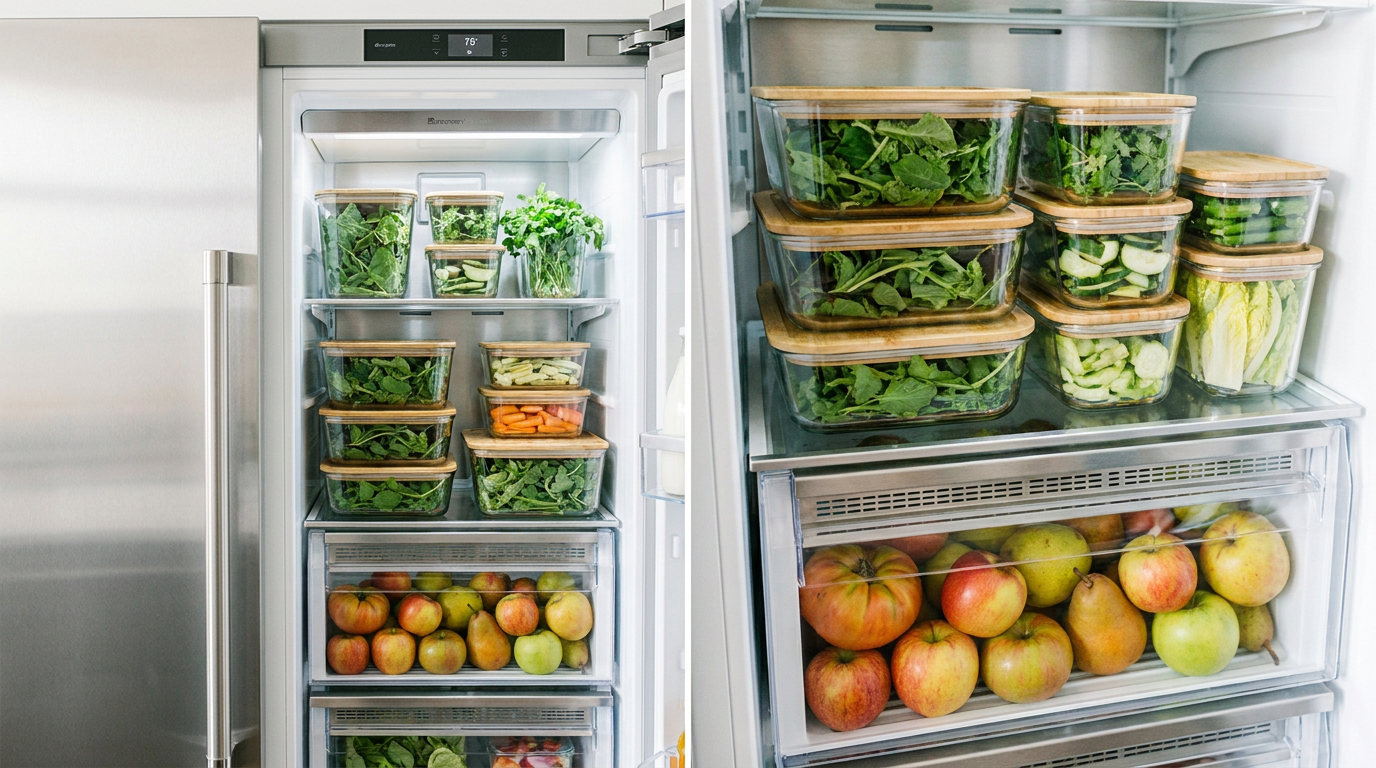
To combat the devastating effects of wilting, these vulnerable vegetables require a high-humidity microclimate that prevents their internal water from evaporating into the dry fridge air. This specific environmental need is precisely what the refrigerator crisper drawer was originally engineered to provide, though a vast majority of consumers completely misunderstand its actual function. It is not merely a convenient organizational bin designed to keep loose carrots and celery stalks from rolling around the main shelves; it is a specialized tool.[4]
It is not merely a convenient organizational bin designed to keep loose carrots and celery stalks from rolling around the main shelves; it is a specialized tool.
A modern crisper drawer is actually an adjustable airflow regulator designed to create distinct atmospheric zones. When the slider on the drawer is set to "high humidity," the physical vent at the back or top of the bin closes completely. This traps the natural moisture released by the respiring produce inside the enclosed space, creating a humid sanctuary that prevents thin-skinned vegetables from dehydrating and shriveling over time.[4][6]

The second major threat to fresh food is ethylene, a naturally occurring plant hormone that exists as an invisible, odorless gas. Ethylene acts as a powerful biological signal that triggers and accelerates the ripening process in many different types of fruits. In nature, this gas helps a tree coordinate the ripening of its fruit, but in the confined space of a modern kitchen, it becomes an agent of rapid decay.[2][3]
High-ethylene producers include common kitchen staples like apples, bananas, avocados, pears, peaches, and tomatoes. While this gas is incredibly useful when you want to encourage a rock-hard avocado or a green banana to soften and sweeten, it becomes highly destructive when it is allowed to concentrate in an enclosed space alongside other vulnerable items.[3][5]
When ethylene-sensitive produce—such as broccoli, cucumbers, carrots, cabbage, and delicate leafy greens—is exposed to this concentrated gas, it reacts poorly. The exposure causes these vegetables to yellow, soften, wilt, and decay at an artificially accelerated rate. Therefore, the absolute golden rule of food storage is strict isolation: never store heavy ethylene producers in the same drawer or container as sensitive vegetables.[1][3]
To effectively manage ethylene gas inside the refrigerator, the second crisper drawer should always be set to the "low humidity" position. This setting physically opens the vent on the drawer, allowing the ripening gas emitted by apples and pears to escape into the broader refrigerator cavity rather than building up to toxic levels and rotting the fruit from the inside out.[4][5]
For households with older refrigerators that only feature a single crisper drawer, experts recommend a strategy known as "drawer zoning." In this setup, you set the main drawer to low humidity to serve as the designated venting zone for gas-producing fruits. Then, you store your wilt-prone greens in tightly sealed plastic or glass containers on a standard shelf, which effectively creates independent, high-humidity microclimates outside of the drawer system.[5][6]
Countertop storage requires a similar level of strategic zoning to prevent premature spoilage. Creating a designated "ripening runway" allows you to group firm, ethylene-producing fruits together in a single bowl to efficiently accelerate their softening. Crucially, this runway must be kept strictly separated from a designated "eat me now" zone, ensuring that perfectly ripe produce isn't pushed into over-ripeness by its gassy neighbors.[5]

For those looking to maximize the longevity of their groceries even further, specialized technological tools can provide an extra layer of defense. Ethylene absorbers, which utilize specific chemical compounds to actively bind to the gas and pull it out of the surrounding air, can significantly slow the ripening process when placed strategically inside a refrigerator drawer or a countertop fruit bowl.[2]
Beyond hardware and chemical absorbers, simple physical adjustments to how food is placed can make a remarkable difference. Storing delicate fresh herbs wrapped loosely in a damp tea towel locks in essential moisture without drowning them, while placing leafy greens upside down in a container prevents excess water from pooling at the base of the stems, which is a primary cause of premature rotting.[6]
Ultimately, mastering these distinct microclimates transforms the refrigerator from a passive, chaotic holding zone into an active, highly efficient preservation engine. By simply aligning daily storage habits with the fundamental biological needs of the food, households can dramatically reduce their environmental footprint, save hundreds of dollars a year, and enjoy consistently better-tasting meals.[1][2][4]
Viewpoints in depth
Food Scientists & Researchers
Focuses on the biological mechanisms of decay, emphasizing that produce remains biologically active after harvest.
This perspective views the kitchen as a biological environment rather than just a storage space. Food scientists emphasize that because fruits and vegetables continue to respire after harvest, their decay is predictable and manageable. By understanding the specific respiration rates and ethylene production of different crops, this camp advocates for designing storage environments that actively suppress these biological processes, thereby extending the nutritional viability of the food.
Appliance Manufacturers
Focuses on hardware and engineering solutions to automate preservation through controlled airflow.
Appliance engineers approach food waste as a design problem that can be solved with better technology. This camp focuses on developing refrigerators with adjustable humidity sliders, dedicated temperature zones, and specialized airflow systems. Their goal is to automate the preservation process, making it easier for consumers to maintain the precise microclimates required by different types of produce without needing a degree in food science.
Sustainability Advocates
Views proper food storage as a critical climate intervention to reduce global greenhouse gas emissions.
For sustainability experts, the crisper drawer is the front line of climate action. This camp highlights that extending the shelf life of produce directly reduces the massive greenhouse gas footprint associated with agricultural waste and landfills. They argue that teaching consumers how to properly store food is one of the most immediate and cost-effective ways to lower global emissions, as it prevents the unnecessary expenditure of water, fuel, and labor used to grow food that is ultimately thrown away.
What we don't know
- How emerging smart-fridge technologies that automatically detect and vent ethylene will perform in real-world household conditions.
- The exact economic impact of consumer-level food waste reduction on broader agricultural supply chains.
Key terms
- Ethylene gas
- A naturally occurring plant hormone that triggers and accelerates the ripening process in many fruits.
- Transpiration
- The biological process of water loss through a plant's surface, which causes produce to wilt and dehydrate.
- Crisper drawer
- A specialized refrigerator bin designed to control airflow and manage humidity levels for optimal food storage.
- Microclimate
- A small, distinct storage zone with specific temperature and humidity conditions tailored to the needs of certain foods.
Frequently asked
Should I store apples and leafy greens together?
No. Apples produce high amounts of ethylene gas, which will cause sensitive leafy greens to yellow and decay rapidly.
How do I use a fridge with only one crisper drawer?
Set the single drawer to low humidity for ethylene-producing fruits, and store wilt-prone greens in sealed containers on a regular shelf to trap their moisture.
Should I wash my produce before storing it?
Generally, no. Excess moisture encourages bacterial growth and rot. It is best to wash most fruits and vegetables right before you plan to eat them.
Do ethylene absorbers actually work?
Yes. These packets contain chemical compounds that bind to ethylene gas, pulling it out of the air and slowing the ripening process for nearby produce.
Sources
Source coverage
6 outlets
3 viewpoints surfaced






[1]Factlen Editorial TeamFood Scientists & Researchers
Synthesis by Factlen editorial team
Read on Factlen Editorial Team →[2]The Washington PostSustainability Advocates
Can a simple packet keep your produce fresh longer?
Read on The Washington Post →[3]Canadian Produce Marketing AssociationFood Scientists & Researchers
Home Storage Guide for Fresh Fruits & Vegetables
Read on Canadian Produce Marketing Association →[4]MaytagAppliance Manufacturers
What is a Crisper Drawer and How Does it Work?
Read on Maytag →[5]Mess Brands Food ScienceFood Scientists & Researchers
Beyond the Crisper Drawer: The Real Science of Produce Storage
Read on Mess Brands Food Science →[6]Daily ExpressSustainability Advocates
Fridge expert shares 1-minute hack to make food last longer and save money
Read on Daily Express →
Every angle. Every day.
Get home stories with full source coverage and perspective breakdowns delivered to your inbox.