
The Science of Induction Cooking: How Electromagnetism is Replacing the Gas Stove
Induction cooktops use magnetic fields to turn pots and pans into their own heat source, offering unprecedented efficiency and eliminating indoor combustion pollutants.
By Factlen Editorial Team
- Public Health & Environmental Advocates
- Argue that transitioning away from gas is a critical public health intervention to reduce childhood asthma and cut residential carbon footprints.
- Culinary Professionals & Home Chefs
- Praise induction for its unmatched speed and precise temperature control, despite the initial learning curve of losing visual flame cues.
- Engineers & Appliance Manufacturers
- Focus on the dramatic improvements in thermal transfer efficiency and safety, while acknowledging installation costs as a barrier to adoption.
What's not represented
- · Renters and Low-Income Households
- · Natural Gas Utilities
Why this matters
Understanding how induction cooking works empowers homeowners to make informed decisions about their next appliance upgrade, balancing upfront electrical costs against long-term energy savings, superior cooking speed, and the elimination of harmful indoor air pollutants.
Key points
- Induction cooktops use electromagnetism to heat the pan directly, bypassing the glass surface.
- The technology achieves up to 90% thermal efficiency, compared to just 40% for traditional gas stoves.
- Induction eliminates indoor combustion pollutants like nitrogen dioxide and benzene, which are linked to asthma.
- Cookware must be ferromagnetic (like cast iron or magnetic stainless steel) to function on an induction surface.
- Switching from gas often requires installing a dedicated 240-volt electrical circuit, adding to upfront costs.
The kitchen stove has become the center of a profound technological and environmental transition. For decades, the open blue flame of a gas range was considered the gold standard for serious home cooks, while traditional electric coils were widely viewed as a sluggish, imprecise compromise. But a third technology is rapidly rewriting the rules of culinary physics and reshaping modern kitchen design. Induction cooking, which relies on the principles of electromagnetism rather than combustion or radiant heat, is surging in popularity across North America and Europe. By turning the cookware itself into the heat source, induction offers a level of speed, precision, and energy efficiency that fundamentally outpaces traditional cooking methods. As homeowners increasingly weigh the environmental and health impacts of their appliances, understanding the science behind this invisible heat has never been more relevant.[8]
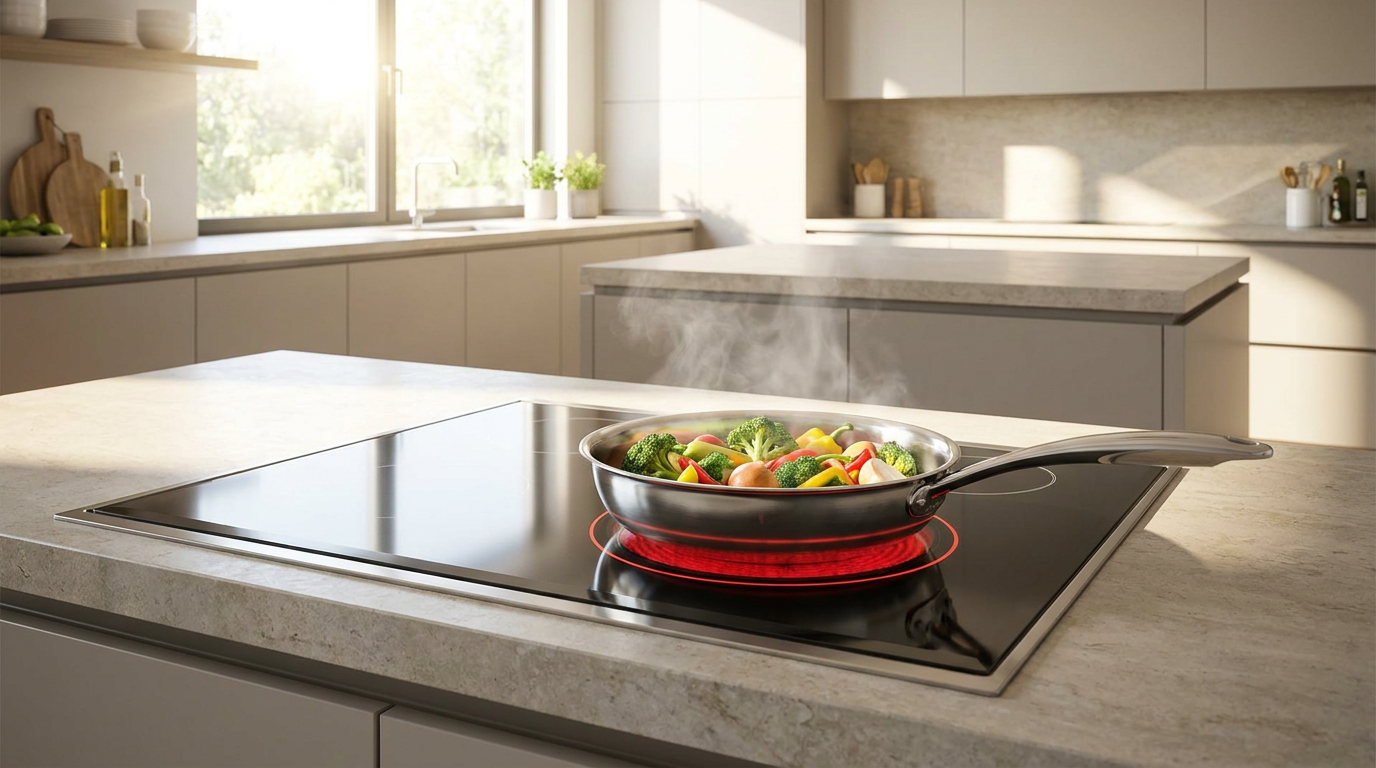
To understand the appeal of induction, one must look beneath its sleek, flat glass surface. Unlike a traditional electric stove that uses electrical resistance to heat a metal coil—which then transfers heat to the glass, and finally to the pan—an induction cooktop bypasses the surface entirely. When the appliance is turned on, electricity flows through a tightly wound copper coil located just underneath the ceramic glass. This alternating electrical current generates a rapidly fluctuating magnetic field that extends just a few millimeters above the surface of the cooktop. The glass itself remains completely unaffected by this magnetic field, which is why an induction burner turned on without a pan will not generate any heat.[4][7]
The actual cooking heat is created only when a compatible pan is placed onto the active cooking zone. As the magnetic field penetrates the metal base of the cookware, it induces whirling loops of electrical current, known to physicists as eddy currents, inside the pan's material. Because the metal of the pan has electrical resistance, these rapidly moving currents create microscopic friction, which instantly generates intense heat. In a matter of seconds, the pan itself becomes the heating element. The heat then flows directly from the metal of the cookware into the food or water inside it, completely bypassing the intermediate step of heating the surrounding air or the cooktop surface.[4][7]
Because the heat is generated internally within the cookware, the thermal transfer efficiency of induction is staggering. Recent data from energy analysts and the U.S. Department of Energy indicates that induction cooktops deliver between 84 and 90 percent of their consumed energy directly into the food. In stark contrast, traditional gas stoves are remarkably inefficient from a thermodynamic perspective. Open flames lose a massive amount of heat to the surrounding air, slipping up the sides of the pan and achieving a thermal transfer efficiency of only 32 to 40 percent. This massive loss of energy is why kitchens with gas ranges get noticeably hotter during meal preparation, often requiring additional electricity to power air conditioning and ventilation systems.[1][3]

This direct energy transfer also translates to unprecedented speed and responsiveness, fundamentally changing the rhythm of meal preparation. A standard induction element can bring a large pot of water to a rolling boil in roughly half the time of a high-end commercial gas burner. Furthermore, the dynamic response latency—the exact time it takes for the pan's temperature to react when a user adjusts the control dial—is nearly instantaneous. Testing shows that induction responds in less than a third of a second, whereas gas requires several seconds for the flame to ramp up and the heavy iron grates to change temperature. This allows for incredibly precise simmering and searing, giving home cooks a level of control previously reserved for professional kitchens.[6]
This direct energy transfer also translates to unprecedented speed and responsiveness, fundamentally changing the rhythm of meal preparation.
Beyond raw performance metrics, the accelerating shift toward induction is increasingly driven by urgent public health research regarding indoor air quality. Gas stoves operate by combusting fossil fuels directly inside the home, a process that emits significant levels of nitrogen dioxide (NO2), carbon monoxide, and fine particulate matter into the kitchen environment. Peer-reviewed health studies have linked the routine use of unventilated gas stoves to a 42 percent increased risk of childhood asthma, with NO2 concentrations frequently exceeding the World Health Organization's outdoor air quality guidelines. Recent environmental measurements have also detected benzene, a known carcinogen, leaking from gas ranges even when the appliance is turned off.[1]
Induction cooktops, by their very definition, produce zero indoor combustion byproducts, entirely eliminating these specific respiratory hazards from the home. This health benefit is compounded by significant safety advantages inherent to the technology's design. Because the cooktop itself does not generate radiant heat, the ceramic glass surface remains relatively cool to the touch, warmed only by the residual heat radiating backward from the resting pan. This drastically reduces the risk of accidental contact burns, particularly for households with young children, and completely eliminates the danger of open flames catching fire to dish towels, loose clothing, or spilled cooking oil.[1][2]
However, the transition to magnetic cooking comes with a specific physical requirement that catches many first-time users off guard: the cookware must be ferromagnetic. Because the entire technology relies on the interaction of magnetic fields, materials like pure aluminum, solid copper, glass, and ceramic will not heat up on an induction surface. The alternating magnetic field simply passes through these materials without inducing the necessary eddy currents. For consumers, this means that upgrading to an induction range might require retiring beloved but incompatible pots and pans, adding a hidden cost to the appliance transition.[5][7]

Fortunately, verifying cookware compatibility is a simple process that does not require specialized equipment. Consumers can perform the standard "magnet test" by holding a common refrigerator magnet to the bottom exterior of a pan. If the magnet sticks firmly to the metal, the pan is induction-ready and will work perfectly. Classic heavy cast iron skillets, enameled Dutch ovens, and most high-quality, multi-clad stainless steel sets are naturally ferromagnetic. Recognizing the market shift, nearly all major cookware manufacturers now embed magnetic steel plates into the bases of their aluminum and copper pans, ensuring they function seamlessly across all modern cooktops.[5]
Despite the clear scientific and environmental benefits, adopting induction technology requires overcoming a few logistical and financial hurdles. Homeowners switching from a traditional gas range to an induction model typically need to cap their existing gas line and install a dedicated 240-volt electrical circuit. Depending on the age of the home and the distance to the main breaker panel, this electrical upgrade can add several hundred to over a thousand dollars to the total installation cost. While the appliances themselves have dropped significantly in price over the last decade, the required infrastructure updates remain a barrier for many retrofits.[2]
There is also a distinct cognitive shift required for cooks who have spent decades relying on visual cues. Without a visible blue flame to gauge heat levels, users must learn to trust digital numbered settings and adapt their timing to the sheer speed of the appliance. Pans preheat in seconds rather than minutes, meaning ingredients must be prepped and ready before the stove is even turned on. While this learning curve can be initially frustrating, most users quickly adapt to the new rhythm, finding that the precision and consistency of the digital controls ultimately make cooking more predictable.[5][8]

As national electrical grids continue to decarbonize and the push for residential electrification accelerates, induction is widely poised to become the new global standard for kitchen infrastructure. For consumers, the technology represents a rare and appealing convergence: an environmentally friendly upgrade that does not require a sacrifice in performance. By harnessing the invisible power of electromagnetism, induction cooktops simultaneously deliver a superior, safer, and more precise culinary experience, proving that the future of home cooking is not just cleaner, but fundamentally better engineered.[1][8]
How we got here
1820
Hans Christian Ørsted discovers electromagnetism, laying the foundational physics for induction.
2006
Consumer Reports tests early residential induction models, noting their impressive speed but prohibitively high cost.
2022
Major public health studies link indoor gas stove usage to elevated childhood asthma rates, accelerating the push for electrification.
2026
Induction technology reaches mainstream adoption as production scales, prices drop, and energy efficiency becomes a priority.
Viewpoints in depth
Public Health & Environmental Advocates
Focus on the elimination of indoor NO2 and benzene emissions.
This camp views the transition away from gas stoves as a critical public health intervention. Citing peer-reviewed studies that link gas combustion to a 42 percent increase in childhood asthma risk, advocates argue that induction is the only safe path forward for indoor air quality. Furthermore, as the electrical grid increasingly relies on renewable energy, they emphasize that induction cooking drastically reduces a household's overall carbon footprint.
Culinary Professionals & Home Chefs
Focus on the performance metrics, precision, and speed of the technology.
While some traditionalists mourn the loss of the visual feedback provided by an open flame, many modern chefs praise induction for its unmatched speed and precise temperature control. They highlight the ability to boil water in half the time and the nearly instantaneous response when adjusting heat levels. Additionally, commercial kitchens favor induction because it prevents massive amounts of wasted heat from escaping into the room, keeping the cooking environment significantly cooler.
Engineers & Appliance Manufacturers
Focus on the engineering superiority and the market adoption hurdles.
Manufacturers emphasize the dramatic improvements in thermal transfer efficiency, noting that induction delivers up to 90 percent of its energy directly into the food. However, they acknowledge that the upfront costs—specifically the need for 240-volt electrical upgrades in older homes—remain the primary barrier to mass consumer adoption. The industry is actively working to lower the cost of entry while educating consumers on the long-term energy savings.
What we don't know
- How quickly the secondary market for used induction ranges will develop to make the technology accessible to lower-income households.
- Whether future building codes will universally ban new residential gas hookups, a policy currently facing intense legal and political battles in several states.
Key terms
- Electromagnetism
- The physical interaction between electric currents and magnetic fields, used in induction to generate heat.
- Eddy Currents
- Loops of electrical current induced within the metal of a pan by an alternating magnetic field, creating friction and heat.
- Ferromagnetic
- Materials like iron or certain steel alloys that are highly susceptible to magnetization, a strict requirement for induction cookware.
- Thermal Transfer Efficiency
- The percentage of energy consumed by an appliance that actually goes into heating the food, rather than escaping into the surrounding air.
Frequently asked
Do I need to buy all new pots and pans?
Not necessarily. If a standard magnet sticks firmly to the bottom of your current cookware, such as cast iron or magnetic stainless steel, it will work perfectly on an induction cooktop.
Are induction cooktops safe to touch?
Yes. The cooktop itself does not generate heat. While the glass can get warm from the hot pan resting on it, it cools rapidly once the pan is removed and poses no open-flame fire risk.
Will I need to upgrade my kitchen's electrical wiring?
Switching from a gas stove to an induction range usually requires installing a dedicated 240-volt electrical circuit, a job that must be completed by a licensed electrician.
Sources
Source coverage
8 outlets
3 viewpoints surfaced








[1]Energy SolutionsPublic Health & Environmental Advocates
Induction vs Gas Cooktops: The Definitive Health, Efficiency & Economic Analysis
Read on Energy Solutions →[2]Consumer ReportsCulinary Professionals & Home Chefs
The Complete Guide to Induction Cooking
Read on Consumer Reports →[3]U.S. Department of EnergyPublic Health & Environmental Advocates
Energy Efficiency of Induction Cooktops
Read on U.S. Department of Energy →[4]Explain That StuffEngineers & Appliance Manufacturers
How induction cooking works
Read on Explain That Stuff →[5]Kitchen MarksCulinary Professionals & Home Chefs
What Is Induction Cookware? How It Works
Read on Kitchen Marks →[6]FOTILE GlobalEngineers & Appliance Manufacturers
Compare 2025 stats on induction, gas, and electric ranges
Read on FOTILE Global →[7]KaTom Restaurant SupplyCulinary Professionals & Home Chefs
How Induction Cooking Works
Read on KaTom Restaurant Supply →[8]Factlen Editorial TeamEngineers & Appliance Manufacturers
Synthesis by Factlen editorial team
Read on Factlen Editorial Team →
Every angle. Every day.
Get home stories with full source coverage and perspective breakdowns delivered to your inbox.