
The Rise of the Plyscraper: How Mass Timber is Rewriting the Rules of Architecture
Engineered wood is replacing steel and concrete in modern skyscrapers, offering a faster, carbon-negative way to build the cities of the future.
By Factlen Editorial Team
- Environmental Advocates
- Championing mass timber as a critical carbon-capture technology to decarbonize the construction sector.
- Urban Developers
- Focused on the economic benefits of faster construction, lighter foundations, and premium aesthetics.
- Traditional Materials Industry
- Emphasizing the established scale of concrete and steel while questioning timber's long-term supply chain.
- Architects & Designers
- Celebrating the return of biophilic design and the ability to digitally fabricate complex, warm structures.
What's not represented
- · Local forestry communities
- · Firefighter unions
Why this matters
The built environment is responsible for nearly 40% of global carbon emissions. Transitioning from concrete to mass timber transforms buildings from massive carbon emitters into long-term carbon sinks, fundamentally altering the climate impact of urban growth.
Key points
- Milwaukee's Neutral Edison tower will become the world's tallest mass timber building at 31 stories in 2026.
- Cross-Laminated Timber (CLT) achieves steel-like strength by gluing wood layers at alternating 90-degree angles.
- Mass timber acts as a carbon sink, storing emissions rather than generating them like concrete production.
- Prefabricated timber panels drastically reduce on-site construction time, labor, and waste.
- Thick timber panels char during a fire, insulating the structural core and maintaining load-bearing capacity.
- New innovations like Dowel-Laminated Timber allow for curved, glue-free architectural shells.
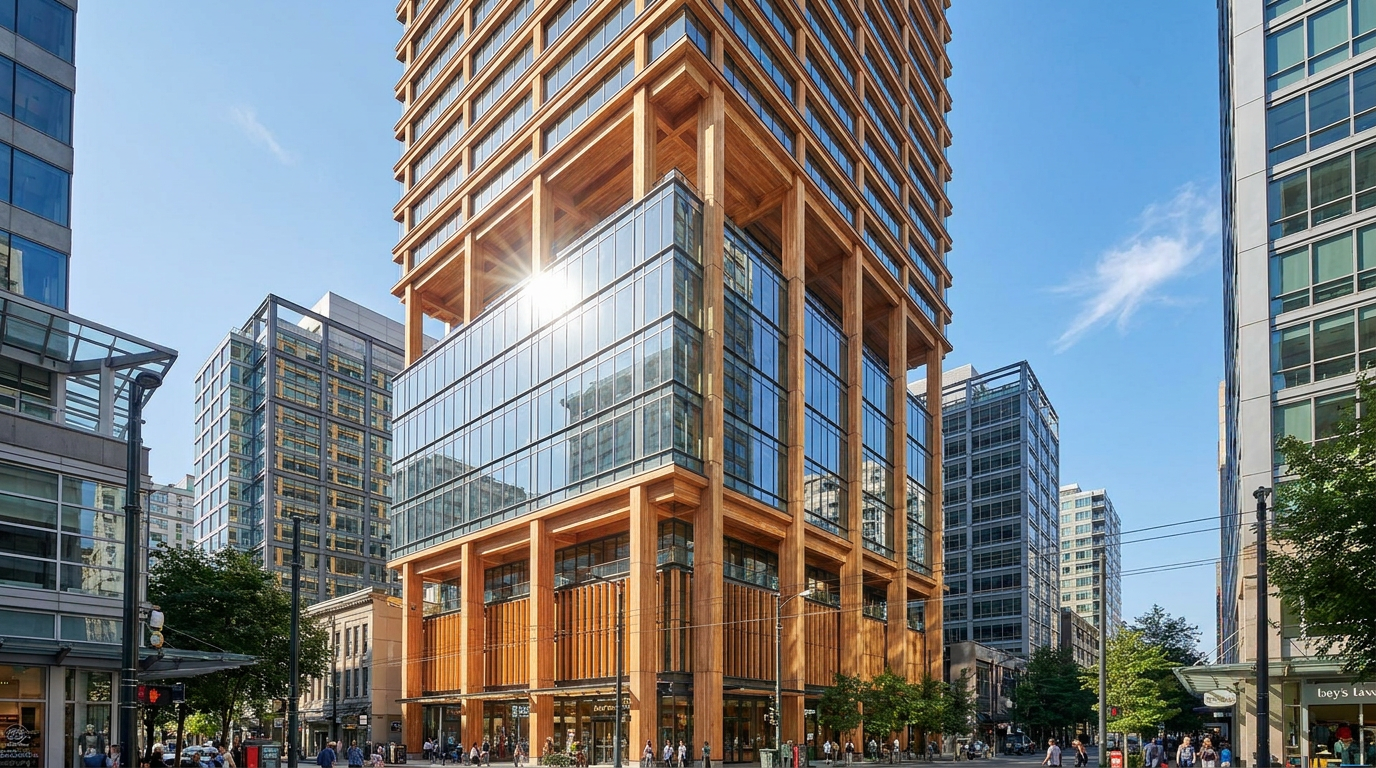
The skyline of Milwaukee is undergoing a quiet, carbon-sequestering revolution. Construction crews are currently assembling Neutral Edison, a 31-story residential and commercial tower that is set to become the world's tallest mass timber building when it tops out in 2026. Reaching 362 feet, the $200 million project represents a massive leap forward for engineered wood, proving that timber can compete with steel and concrete in the high-rise arena.[1]
Neutral Edison is not an isolated experiment. It sits less than a mile from Ascent MKE, the previous 25-story record-holder completed in 2022, creating a unique ten-block urban canopy of wooden skyscrapers. Beyond Wisconsin, the global race to build "plyscrapers" is accelerating. In Toronto, the 14-story Academic Wood Tower is slated to finish in 2026, becoming Canada's tallest mass timber structure and a landmark for hybrid steel-timber engineering. From Sydney to London, developers are increasingly looking to the forest to build the future.[1][2][3]
The engine driving this architectural shift is a material known as Cross-Laminated Timber, or CLT. Originally developed in Europe in the 1990s, CLT has steadily gained traction in North America as building codes adapt to its capabilities. Unlike traditional two-by-fours used in residential homebuilding, CLT is an engineered panel product designed for heavy structural loads, capable of replacing concrete floor slabs and load-bearing walls.[5]
The manufacturing process is what gives CLT its remarkable strength. Lumber boards are stacked in alternating directions—usually three, five, or seven layers thick—and bonded together under massive hydraulic pressure. Regular timber is anisotropic, meaning it is strong in one direction but weak in another. By gluing the layers at 90-degree angles, CLT achieves structural rigidity in both directions, mimicking the multidirectional strength of steel-reinforced concrete.[5][6]

The primary catalyst for the mass timber boom is the urgent need to decarbonize the construction industry. Cement production alone is responsible for roughly 8% of global carbon emissions. Traditional building materials require immense amounts of fossil fuels to mine, process, and transport. Wood, by contrast, is a renewable resource that actively removes carbon dioxide from the atmosphere as trees grow.[3][5]
When a tree is harvested and turned into a CLT panel, that captured carbon remains locked inside the building's structure for decades, or even centuries. A single large-scale mass timber building can store up to 2,000 tons of carbon dioxide. Preliminary calculations for some modern timber projects show a reduction in embodied carbon of over 60% compared to conventional concrete and steel structures.[5][7]
However, this environmental math comes with a critical caveat. The sustainability of mass timber relies entirely on responsible forestry practices. If the demand for CLT outpaces the capacity of sustainably managed forests, the industry risks incentivizing deforestation rather than combating climate change. Experts stress that timber must be sourced from certified forests where replanting outpaces harvesting, and where smaller, lower-grade trees can be utilized to thin out wildfire risks.[5]

However, this environmental math comes with a critical caveat.
Beyond the environmental benefits, urban developers are flocking to mass timber for its sheer efficiency on the job site. CLT panels are prefabricated in off-site factories, cut to millimeter precision using 3D digital modeling and CNC routers. Every joint, window opening, and drill hole is planned before the wood ever leaves the manufacturing facility.[6]
When the panels arrive at the construction site, they are assembled more like flat-pack furniture than a traditional building. This prefabrication drastically reduces the need for on-site labor and accelerates the construction timeline. During the construction of early CLT showcases, crews were able to install thousands of square feet of flooring in a matter of hours—a process that would take weeks using poured concrete. The sites are also significantly quieter and produce a fraction of the waste.[5][6]

Despite these advantages, the most common public hesitation regarding wooden skyscrapers is intuitive: fire safety. The idea of a 31-story wooden tower naturally evokes fears of catastrophic infernos. Yet, mass timber behaves fundamentally differently than the light-frame wood used in single-family homes, requiring specialized permitting and rigorous life-safety testing.[1]
In the event of a fire, the thick, solid panels of CLT do not easily ignite. Instead, the outer layer of the wood chars. This char layer acts as a natural insulator, protecting the inner structural core of the wood from the heat and allowing the building to maintain its load-bearing capacity. In many fire tests, mass timber has been shown to withstand extreme heat longer than unprotected steel, which can warp and buckle under high temperatures.[1][7]
Aesthetically, mass timber is fundamentally changing how interior spaces feel. Because the structural panels are visually appealing, architects often leave the wood exposed on ceilings and walls. This eliminates the need for drywall and drop ceilings, reducing material costs while introducing biophilic design elements into urban environments. The natural warmth of exposed wood has been linked to improved occupant well-being, making these buildings highly attractive to commercial tenants and residents alike.[6][7]
As the industry matures, engineers are pushing the material beyond flat, rectilinear panels. At the 2026 Mass Timber Conference in Portland, Oregon, architecture firm Lake Flato and engineering group Structurecraft unveiled a groundbreaking pavilion made of Dowel-Laminated Timber (DLT). Unlike CLT, DLT uses no glue or nails, relying entirely on the friction of hardwood dowels to hold softwood panels together.[4]

The 2026 pavilion demonstrated that mass timber can be bent into active shell structures, creating sweeping, curved geometries on site. By utilizing the flexibility of the wood, engineers achieved structural efficiency through curvature rather than sheer mass. "Mass timber is no longer flat," noted Lucas Epp, head of engineering at Structurecraft, signaling a new era of organic, complex wooden architecture.[4]
As steel tariffs fluctuate and carbon taxes loom in various global markets, mass timber is rapidly approaching cost-neutrality with traditional building methods. By combining the ancient appeal of wood with cutting-edge digital fabrication, the architecture industry is not just changing how buildings look, but fundamentally rewriting the environmental footprint of the modern city.[1][7]
How we got here
1990s
Cross-Laminated Timber (CLT) technology is first developed and utilized in Europe.
2016
Albina Yard in Oregon becomes an early US showcase for domestically produced CLT.
2022
Ascent MKE in Milwaukee is completed, setting the world record for tallest mass timber building at 25 stories.
2025
Construction begins on the $200 million Neutral Edison project in Milwaukee.
2026
Neutral Edison is expected to top out at 31 stories, claiming the title of the world's tallest mass timber structure.
Viewpoints in depth
Environmental Advocates
Viewing mass timber as a vital tool for decarbonization.
Climate advocates point to the built environment as one of the hardest sectors to decarbonize, with cement and steel production accounting for massive global emissions. By shifting to mass timber, buildings transform from carbon emitters into long-term carbon vaults. However, these advocates stress that the environmental math only works if the timber is sourced from strictly certified, sustainably managed forests to prevent ecological degradation.
Urban Developers
Focusing on the economic and logistical advantages of building with wood.
For developers, the appeal of mass timber extends beyond green marketing. The prefabrication of CLT panels means buildings go up significantly faster, requiring smaller crews and generating less neighborhood disruption. Furthermore, the aesthetic premium of exposed wood interiors allows developers to command higher rents and attract tenants looking for biophilic, wellness-oriented workspaces.
Traditional Materials Industry
Defending the established reliability of concrete and steel.
Representatives from the concrete and steel sectors argue that their materials offer unmatched durability, scale, and established supply chains. They frequently raise questions about the long-term moisture resistance and acoustic performance of timber high-rises, while pointing out that steel and concrete remain essential for the foundations and elevator cores of even the tallest hybrid timber towers.
Architects & Designers
Embracing a return to structural expression and digital craftsmanship.
Architects celebrate mass timber for allowing them to reclaim control over the building process. Because CLT panels are cut via CNC routers directly from digital models, designers can dictate every joint and detail with millimeter precision. The material also encourages structural expression—leaving the bones of the building visible rather than hiding them behind drywall—fostering a warmer, more human-centric urban aesthetic.
What we don't know
- Whether the global supply of sustainably managed timber can scale to meet the rapidly growing demand from mega-developers.
- How 30-plus story mass timber buildings will perform acoustically and structurally over a 50-to-100 year lifespan.
Key terms
- Cross-Laminated Timber (CLT)
- An engineered wood panel made from layers of lumber glued together at alternating 90-degree angles for extreme strength.
- Mass Timber
- A category of framing styles using large solid wood panels for wall, floor, and roof construction, replacing steel and concrete.
- Embodied Carbon
- The total greenhouse gas emissions generated to produce, transport, and assemble a building material.
- Glulam
- Glued laminated timber, used primarily for structural columns and beams, with all wood grains running parallel.
- Dowel-Laminated Timber (DLT)
- Wood panels held together entirely by hardwood dowels and friction, using no glue or nails.
Frequently asked
Is mass timber a fire hazard?
No. Thick mass timber panels are designed to char on the outside during a fire, creating an insulating layer that protects the structural core from failing, often outlasting unprotected steel.
Does mass timber contribute to deforestation?
When sourced from certified, sustainably managed forests, mass timber relies on replanting cycles. However, scaling the industry globally will require strict forestry oversight to prevent over-harvesting.
Is building with wood cheaper than steel?
Material costs are currently similar, but mass timber can be cheaper overall because pre-fabricated panels require less on-site labor and significantly speed up construction time.
Sources
Source coverage
7 outlets
4 viewpoints surfaced







[1]Construction BriefingUrban Developers
World's tallest mass timber building breaks ground in Milwaukee
Read on Construction Briefing →[2]Construction CanadaUrban Developers
Canada's tallest mass timber building to be built by 2026
Read on Construction Canada →[3]The GuardianEnvironmental Advocates
Milwaukee plans to build tallest timber building in the world
Read on The Guardian →[4]DezeenArchitects & Designers
Experimental pavilion in Oregon "challenges the rectilinear logic" of mass timber
Read on Dezeen →[5]Lever ArchitectureArchitects & Designers
What is Cross-Laminated Timber?
Read on Lever Architecture →[6]ArchDailyArchitects & Designers
Cross Laminated Timber (CLT): What It Is and How To Use It
Read on ArchDaily →[7]Factlen Editorial TeamEnvironmental Advocates
Synthesis by Factlen editorial team
Read on Factlen Editorial Team →

Every angle. Every day.
Get home stories with full source coverage and perspective breakdowns delivered to your inbox.