
The Rise of Autonomous Code Healing: Why AI is Now Fixing Its Own Software Bugs
As generative AI accelerates software development, a new class of 'autonomous code healing' agents is emerging to automatically detect and resolve bugs without human intervention.
By Factlen Editorial Team

- AI SRE Innovators & Analysts
- Argue that autonomous healing is the only viable way to manage the flood of AI-generated code.
- Enterprise Observability Incumbents
- View AI bug resolution as the natural evolution of system monitoring, moving from alerting to acting.
- Security & Governance Advocates
- Emphasize the need for human-in-the-loop approvals to prevent AI from introducing vulnerabilities.
What's not represented
- · Junior developers who traditionally learn by debugging and may lose training opportunities
- · Open-source maintainers managing the influx of AI-generated pull requests
Why this matters
The sheer volume of AI-generated code is overwhelming human reviewers, leading to software instability and delayed deployments. Autonomous code healing promises to eliminate this bottleneck, making enterprise applications significantly more reliable and freeing engineers to focus on innovation rather than tedious debugging.
Key points
- Elastic is acquiring AI site reliability engineering startup DeductiveAI for up to $85 million.
- The deal highlights a shift from AI that writes code to AI that autonomously fixes software bugs.
- Generative AI has increased code review times by 91%, creating a bottleneck that autonomous agents aim to solve.
- Healing agents analyze continuous integration failures, write validated fixes, and commit them directly to the codebase.
- Enterprise deployments maintain security by requiring human-in-the-loop approvals for AI-generated code patches.
The software development industry is colliding with a phenomenon increasingly known as the speed paradox. Over the past two years, generative artificial intelligence tools have allowed engineers to write code at unprecedented velocities, flooding enterprise systems with new features, complex logic, and rapid iterations. Yet, this acceleration at the top of the funnel has created a severe bottleneck further down the pipeline. Human reviewers and site reliability engineers are struggling to manually check, test, and debug the sheer volume of AI-authored code entering production, leading to delayed deployments and mounting technical debt.[7]
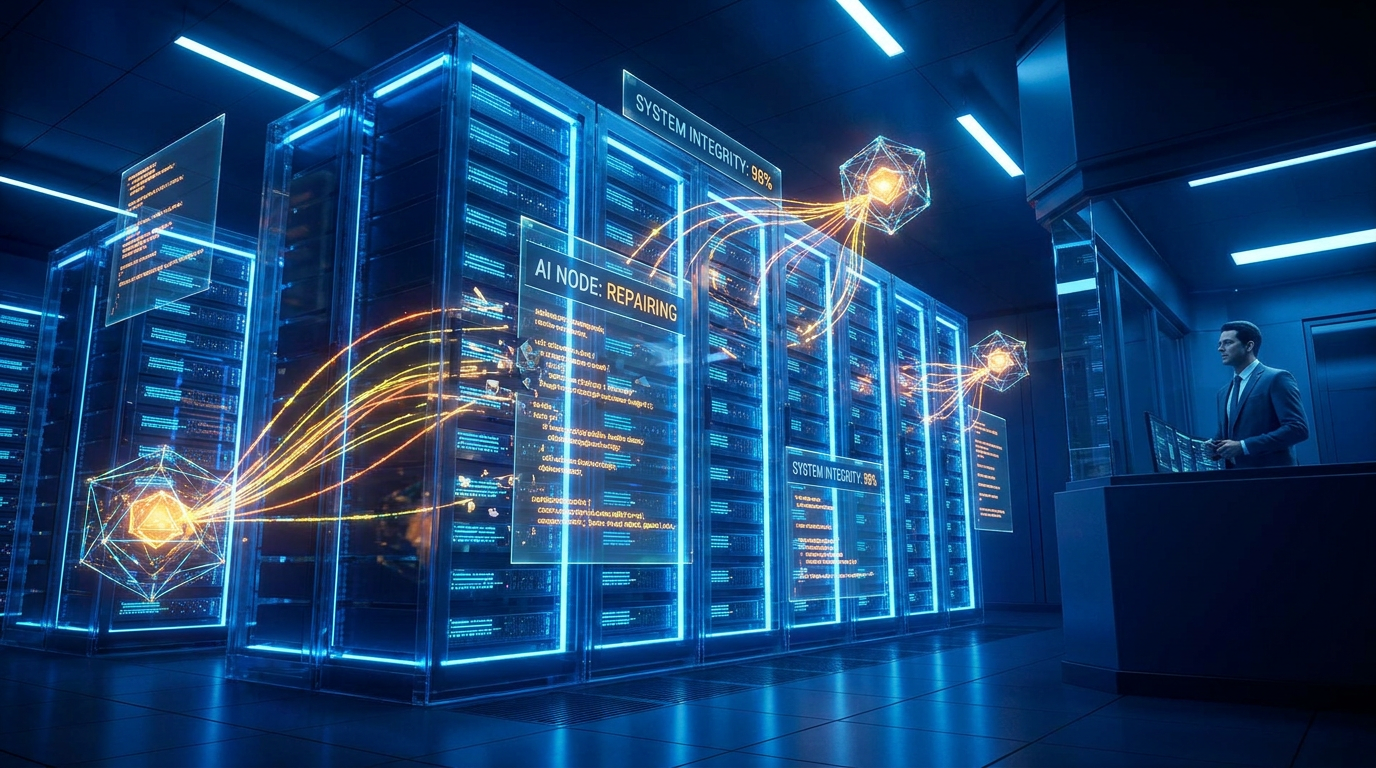
To solve this crisis, the technology sector is rapidly pivoting from AI that simply writes code to AI that autonomously fixes it. This emerging discipline, known as AI site reliability engineering (SRE) or autonomous code healing, represents a fundamental shift in how enterprise software is maintained. Rather than relying on human developers to hunt down the root cause of a system crash, specialized AI agents are now being deployed to detect errors, write the necessary patches, and deploy fixes in real time. This transition promises to eliminate the review bottleneck, ensuring that software reliability scales alongside code generation.[5][6]
The urgency of this transition was underscored this week when Elastic, the publicly traded enterprise search and analytics giant, agreed to acquire the AI-native SRE startup DeductiveAI for up to $85 million. The deal is notable not just for its price tag, but for its rapid timing. DeductiveAI was founded in late 2023 and emerged from stealth mode less than a year ago with a $7.5 million seed round led by CRV. In a matter of months, the startup positioned itself as a highly coveted asset in the race to automate software reliability.[1][3]
At the time of the acquisition, DeductiveAI had reportedly reached approximately $1 million in annual recurring revenue. Industry analysts note that Elastic's willingness to pay an $85 million premium for such a young company indicates that they are acquiring the engineering team and the strategic roadmap, rather than an established revenue stream. The founders bring significant pedigree, with prior engineering leadership roles at Databricks, Meta, and ThoughtSpot. The acquisition validates the automated incident response sector as a critical new layer in the enterprise software stack, one that major incumbents are eager to own.[2][3]

Elastic has built its multi-billion-dollar business on observability—providing the foundational tools that allow companies to monitor their data, track system performance, and log errors across vast cloud architectures. Historically, observability platforms have functioned as highly sophisticated alarm systems. When a server crashes, a database query fails, or latency spikes, the software alerts a human engineer, often waking them up in the middle of the night to manually diagnose and resolve the problem. While effective for visibility, this reactive model is increasingly unsustainable in an era where AI-generated code is constantly altering the production environment.[2][4]
By integrating DeductiveAI's technology, Elastic aims to completely close that operational loop. The strategic goal is to transform its platform from a passive monitoring tool into an active, agentic responder. When the system detects a performance degradation or a software bug, the embedded AI will automatically analyze the error logs, cross-reference the entire codebase to understand the context, and generate a validated fix without requiring immediate human intervention. This shift from alerting to acting represents the holy grail of modern site reliability engineering.[1][4]
By integrating DeductiveAI's technology, Elastic aims to completely close that operational loop.
The mechanics of autonomous code healing go far beyond the suggestion-only capabilities of early coding assistants like GitHub Copilot. In a traditional workflow, a developer submits a pull request, and an automated continuous integration pipeline tests the code. If the build fails, the developer must manually dig through terminal logs to figure out why. Recent industry benchmarks indicate that this manual review and debugging process has increased by 91% as codebases swell with AI-generated contributions, creating a massive drag on engineering velocity.[5]
Modern healing agents, such as those developed by DeductiveAI and competitors like Gitar, intercept these continuous integration failures instantly. The AI agent reads the error output, identifies the specific boundary issue or logic flaw, and writes a targeted patch. Crucially, the agent then tests its own fix to guarantee a successful build before committing the changes directly to the repository. This autonomous loop transforms code review from a tedious manual chore into an automated problem-resolution engine.[5]

This capability is already scaling to massive enterprise environments. Platforms in the AI SRE space are currently managing codebases exceeding 50 million lines of code for major technology companies like Pinterest. The financial implications of this automation are substantial; automated continuous integration resolution can save a standard 20-person engineering team hundreds of thousands of dollars annually by reducing the time spent on manual debugging from several hours to just minutes per day.[5]
The broader market for AI site reliability engineering is expanding rapidly alongside DeductiveAI's exit. Sector peer Resolve AI recently secured a $40 million Series A extension, propelling its valuation to a staggering $1.5 billion. Established technology incumbents are recognizing that as generative AI accelerates code production, owning the automated remediation layer will be essential to maintaining enterprise software stability. The race is on to embed these agentic capabilities before larger competitors can build them in-house.[3]
Despite the clear efficiency gains, the deployment of autonomous healing agents introduces new complexities regarding security and governance. The primary risk is the potential for false positives and negatives. An AI agent might successfully resolve a functional bug that is causing a system crash, but in doing so, it could inadvertently introduce a subtle security vulnerability or violate strict compliance standards. Managing this risk is the central challenge for the next generation of AI SRE tools.[6]
To mitigate these risks, enterprise deployments heavily emphasize human-in-the-loop approval workflows. While the AI agent operates autonomously to diagnose the issue and write the code, it typically submits the final patch to a senior human engineer for a one-click approval before it merges into the main branch. This ensures that the AI acts as a hyper-capable assistant rather than an unsupervised operator, maintaining strict adherence to enterprise security frameworks like SOC 2 and ISO 27001.[5][6]

Looking ahead, the architecture of software development is moving toward sophisticated multi-agent collaboration. In the near future, specialized AI agents will work in concert across different domains. One agent will be responsible for generating new product features based on business requirements, a second will autonomously write and execute the testing suite, and a third will monitor the live production environment to heal any defects that slip through the cracks.[7]
Ultimately, the rise of autonomous code healing signifies a maturation in the artificial intelligence boom. The initial wave of generative AI focused entirely on creation, prioritizing speed and volume above all else. The current wave is focused on reliability, ensuring that the massive digital infrastructure being built by machines can also be maintained, secured, and repaired by them. As companies like Elastic integrate these capabilities, the software industry is taking a major step toward truly autonomous systems.[1][2]
How we got here
Late 2023
DeductiveAI is founded, joining a new wave of startups focused on AI site reliability engineering.
Nov 2025
DeductiveAI emerges from stealth with a $7.5 million seed round led by CRV.
Apr 2026
Rival AI SRE firm Resolve AI secures a $40 million Series A extension, reaching a $1.5 billion valuation.
Jun 2026
Elastic agrees to acquire DeductiveAI for up to $85 million to integrate automated bug resolution into its observability platform.
Viewpoints in depth
AI SRE Innovators & Analysts
Startups and industry analysts building and tracking autonomous healing agents.
Companies like DeductiveAI, Resolve AI, and Gitar argue that the traditional software development lifecycle is fundamentally broken in the generative AI era. With developers using tools like Copilot to generate code at unprecedented speeds, human reviewers have become the primary bottleneck. These innovators assert that 'suggestion-only' AI is no longer sufficient; enterprise systems require autonomous agents capable of analyzing continuous integration failures, writing validated fixes, and committing them directly to the codebase to maintain velocity.
Enterprise Observability Incumbents
Established monitoring platforms seeking agentic capabilities.
For giants like Elastic, the integration of AI site reliability engineering represents a strategic leap up the value chain. Historically, observability platforms have functioned as sophisticated alarm systems—detecting anomalies, analyzing logs, and paging human engineers when a server crashes. By acquiring AI-native startups, these incumbents aim to transform their dashboards from passive monitors into active responders, creating closed-loop systems that not only identify performance degradation but automatically deploy the necessary code to resolve it.
Security & Governance Advocates
Risk managers focused on the dangers of autonomous code execution.
While the efficiency gains of code healing are undeniable, security professionals caution against fully removing humans from the loop. Their primary concern is the 'hallucination' of fixes—where an AI agent might resolve a functional bug but inadvertently introduce a subtle security vulnerability or compliance violation. This camp advocates for strict guardrails, such as SOC 2 compliance, hierarchical memory constraints, and mandatory human-approval gates for critical infrastructure, ensuring that autonomous agents act as hyper-capable assistants rather than unsupervised operators.
What we don't know
- How much of Elastic's $85 million acquisition price is contingent on future performance milestones.
- Whether autonomous healing agents can effectively resolve complex architectural flaws rather than just localized bugs.
- How regulatory frameworks will adapt to software environments where code is written, tested, and deployed entirely by AI.
Key terms
- Autonomous Code Healing
- The process by which artificial intelligence automatically detects, diagnoses, and writes fixes for software bugs without requiring manual human intervention.
- Site Reliability Engineering (SRE)
- A software engineering discipline that applies automation and operational practices to ensure enterprise systems remain scalable, reliable, and highly available.
- Continuous Integration (CI)
- A development practice where code changes are automatically built and tested in a shared repository to catch errors early.
- Observability
- The ability to measure the internal state of a software system based on the data it generates, such as logs, metrics, and traces.
Frequently asked
Why is Elastic buying DeductiveAI?
Elastic plans to integrate DeductiveAI's automated bug-fixing technology into its existing observability platform, allowing customers to not only monitor system failures but resolve them automatically.
How does AI code healing actually work?
When a software build fails, an AI agent analyzes the error logs, cross-references the entire codebase to understand the context, generates a validated code fix, and submits it for approval or automatic merging.
Will this replace human software engineers?
No. The goal is to free human engineers from tedious debugging and incident response, allowing them to focus on proactive product development and complex architectural decisions.
Is it safe to let AI fix code automatically?
Most enterprise platforms use a 'human-in-the-loop' approach, where the AI prepares the fix but a human engineer must approve it before it goes live, mitigating the risk of introducing new vulnerabilities.
Sources
Source coverage
7 outlets
3 viewpoints surfaced







[1]TechCrunchEnterprise Observability Incumbents
Source: Elastic agrees to buy CRV-backed DeductiveAI for up to $85M
Read on TechCrunch →[2]AI WeeklyAI SRE Innovators & Analysts
Elastic's $85M bet on automated incident response
Read on AI Weekly →[3]Hyper.aiAI SRE Innovators & Analysts
Elastic acquires AI-native SRE startup DeductiveAI for $85M
Read on Hyper.ai →[4]BeamstartEnterprise Observability Incumbents
Elastic Reportedly Buying AI Startup DeductiveAI for Up to 85 Million Dollars
Read on Beamstart →[5]GitarAI SRE Innovators & Analysts
2026 AI Code Review and Autonomous Healing Benchmarks
Read on Gitar →[6]TechAheadSecurity & Governance Advocates
The Complete Software Development Guide for Enterprises: Self-Healing Code
Read on TechAhead →[7]SmartMaya AIAI SRE Innovators & Analysts
The Speed Paradox: How Vibe Coding Delivered an Enterprise AI Platform
Read on SmartMaya AI →


Every angle. Every day.
Get technology stories with full source coverage and perspective breakdowns delivered to your inbox.