
The Evidence Pack: How Saffron Supplementation Matches SSRIs in Treating Mild-to-Moderate Depression
Recent meta-analyses of dozens of clinical trials reveal that standardized saffron extract is as effective as conventional antidepressants for mild-to-moderate depression, but with a significantly lower rate of adverse side effects.
By Factlen Editorial Team
- Integrative Psychiatrists
- View saffron as a validated first-line or adjunctive treatment for patients seeking natural alternatives or struggling with SSRI side effects.
- Clinical Researchers
- Emphasize the strong meta-analytic data showing non-inferiority to SSRIs, but caution that larger, longer-term trials are needed to confirm durability.
- Nutraceutical Regulators
- Focus on standardizing extracts to ensure consistent dosing of active compounds and securing formal health claims based on safety data.
What's not represented
- · Primary Care Physicians
- · Health Insurance Providers
Why this matters
Millions of people discontinue traditional antidepressants due to intolerable side effects like weight gain and emotional blunting. The clinical validation of a highly tolerable, natural alternative provides a new first-line option for managing mild-to-moderate mood disorders.
Key points
- Recent meta-analyses show saffron extract is as effective as SSRIs for treating mild-to-moderate depression and anxiety.
- Patients taking saffron experience significantly fewer adverse side effects compared to those on conventional antidepressants.
- Saffron's active compounds, crocin and safranal, inhibit the reuptake of serotonin and dopamine in the brain.
- Clinical trials typically use a standardized dose of 30 milligrams per day.
- Saffron is also showing promise as an adjunctive therapy to help treat stubborn symptoms like anhedonia.
- South Korea recently approved a formal stress-relief health claim for a standardized saffron extract.
The global burden of depression and anxiety is massive, affecting an estimated 280 million and 300 million people worldwide, respectively. For decades, the primary pharmacological interventions have been Selective Serotonin Reuptake Inhibitors (SSRIs) and Serotonin-Norepinephrine Reuptake Inhibitors (SNRIs).
While these medications are life-saving for many, their clinical utility is frequently limited by their tolerability. A significant percentage of patients experience adverse side effects—including weight gain, sexual dysfunction, gastrointestinal distress, and emotional blunting—which often lead to high rates of treatment discontinuation.
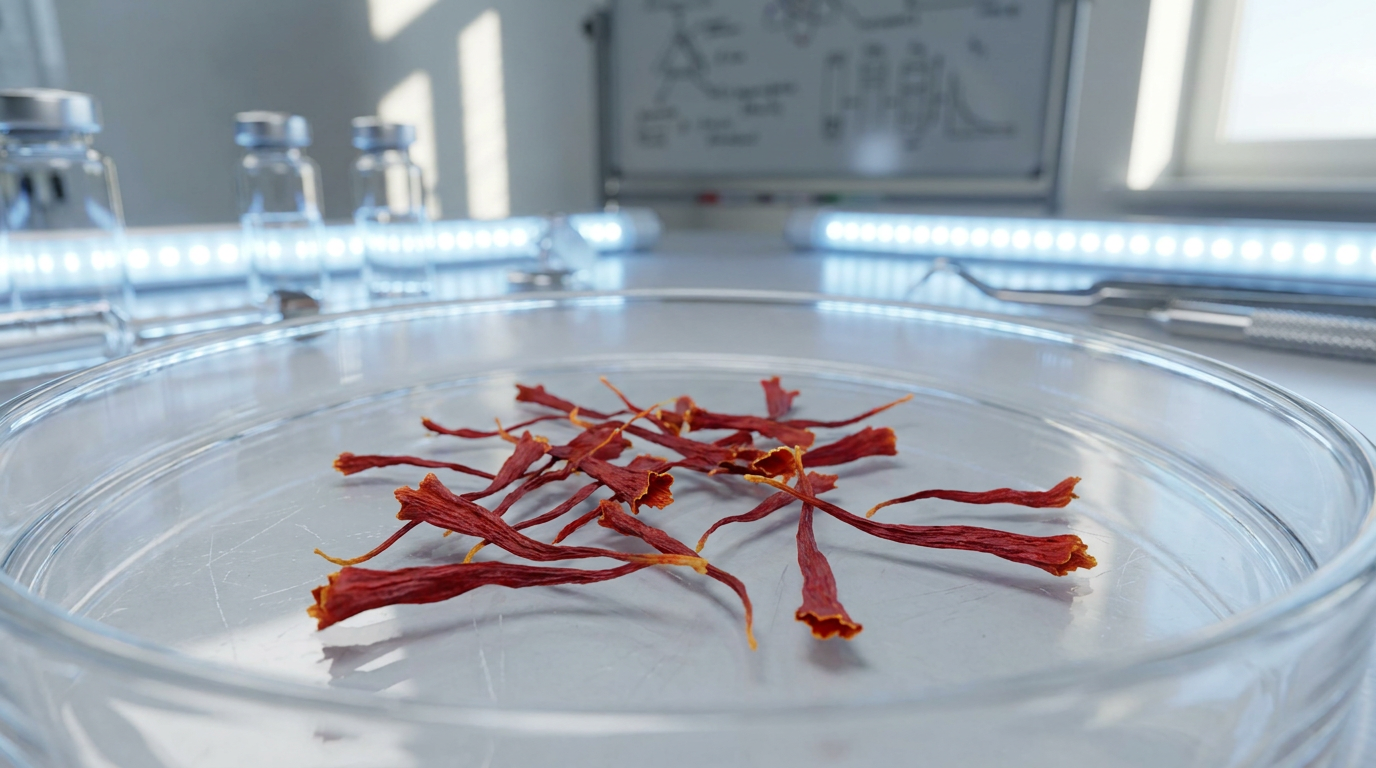
The search for effective, well-tolerated alternatives has increasingly led researchers to Crocus sativus, commonly known as saffron. Once prized strictly as a culinary luxury and the world's most expensive spice, this "red gold" is now at the center of rigorous psychiatric and neurological research.[3]
A wave of recent meta-analyses published in 2025 and 2026 has elevated saffron from a traditional folk remedy to an evidence-based medical intervention, demonstrating clinical efficacy that rivals standard pharmaceuticals.[1][2]
A landmark 2026 GRADE-assessed systematic review published in Nutritional Neuroscience evaluated 34 randomized controlled trials involving 1,769 adult participants, making it one of the most comprehensive analyses of the botanical to date.[2]
The researchers found that saffron supplementation significantly reduced scores on both the Beck Depression Inventory (BDI) and the Beck Anxiety Inventory (BAI), providing moderate-certainty evidence for its use in alleviating mild-to-moderate mood disorders.[2]
Even more compelling is how the extract performs head-to-head against conventional prescription drugs. A rigorous meta-analysis published in Nutrition Reviews directly compared saffron to standard SSRIs, such as fluoxetine and imipramine.[1]
The data revealed no significant difference in symptom reduction between the saffron and SSRI groups. In clinical terms, the botanical extract was just as effective at alleviating the core symptoms of depression and anxiety as the synthetic pharmaceuticals.[1]

Crucially, the safety profile heavily favored the natural intervention. Participants receiving the saffron extract experienced a 6% lower rate of adverse events compared to those on SSRIs, successfully avoiding the systemic side effects that often derail traditional psychiatric treatment.[1]
Crucially, the safety profile heavily favored the natural intervention.
How does a culinary spice mimic the effects of a pharmaceutical? The answer lies in saffron's unique bioactive compounds, primarily crocin, crocetin, and safranal.[3]
These compounds act directly on the brain's monoaminergic pathways. Much like SSRIs, they inhibit the reuptake of serotonin, dopamine, and norepinephrine, keeping these critical mood-regulating neurotransmitters active in the synaptic cleft for longer periods.[3]
Beyond neurotransmitter modulation, saffron exerts potent antioxidant and anti-inflammatory effects. Chronic neuroinflammation is increasingly recognized by psychiatrists as a root physical cause of depression, and saffron's ability to cross the blood-brain barrier allows it to directly neutralize this oxidative stress.[3]

Animal models also suggest that saffron increases levels of Brain-Derived Neurotrophic Factor (BDNF). Often referred to as "miracle-gro" for the brain, BDNF is a protein essential for neuroplasticity and neuronal growth that is frequently depleted in patients suffering from chronic depression.[3]
Saffron is also showing significant promise as an adjunctive therapy. For patients who only partially respond to their current SSRI prescriptions, adding saffron to their regimen has been shown to improve stubborn, difficult-to-treat symptoms like anhedonia—the profound inability to feel joy or pleasure.[3]
The clinical standard for these trials is remarkably consistent: 30 milligrams per day of a standardized extract, most often divided into two 15-milligram doses taken morning and night.[3][4]
Because saffron requires immense manual labor to harvest, adulteration of the raw spice is common. To ensure clinical reliability, the nutraceutical industry has developed patented, standardized extracts—such as Affron—which guarantee precise, consistent concentrations of crocin and safranal in every dose.[4][5]

Regulatory bodies are beginning to formally recognize this mounting clinical data. In early 2026, South Korea's Ministry of Food and Drug Safety (MFDS) officially approved a stress-relief health claim for Affron, following a rigorous review of clinical trials involving over 1,000 participants.[5]
Despite the overwhelmingly positive data, clinical researchers caution that the evidence base still has limitations. Most trials are relatively short-term, typically lasting six to twelve weeks, leaving the long-term durability of saffron's antidepressant effects somewhat unclear.[1][2]
Furthermore, trials often use different parts of the plant—some utilize the potent red stigma, while others use the less expensive petals—which complicates direct comparisons and broad generalizability across all over-the-counter supplements.[1][2]
Nevertheless, the convergence of ancient botanical tradition and modern clinical validation is reshaping nutritional psychiatry. For millions navigating the difficult terrain of mild-to-moderate depression, standardized saffron now offers a scientifically backed, highly tolerable path forward.[6]
How we got here
2019
Early meta-analyses begin suggesting saffron's efficacy against placebo in treating mild depression.
2023
Researchers begin publishing head-to-head trials comparing saffron directly to SSRIs like fluoxetine.
2024
A major meta-analysis in Nutrition Reviews confirms saffron matches SSRIs in efficacy with fewer side effects.
2025
Studies demonstrate saffron's ability to treat anhedonia when used as an adjunct to traditional antidepressants.
Feb 2026
South Korea's MFDS approves the first scientifically backed stress-relief health claim for a standardized saffron extract.
May 2026
A 34-trial GRADE-assessed systematic review confirms moderate-certainty evidence for saffron in treating depression and anxiety.
Viewpoints in depth
Integrative Psychiatrists
Advocating for saffron as a validated, low-risk intervention for mood disorders.
Integrative and functional psychiatrists view saffron as a crucial bridge between natural wellness and rigorous pharmacology. Because SSRI side effects—such as weight gain and sexual dysfunction—frequently cause patients to abandon treatment, these practitioners value saffron as a highly tolerable first-line option for mild-to-moderate cases. They also highlight its utility as an adjunctive therapy, noting that adding saffron to an existing SSRI regimen can help resolve lingering symptoms like anhedonia without increasing the pharmaceutical burden.
Clinical Researchers
Emphasizing the strong meta-analytic data while calling for longer-term studies.
The clinical research community acknowledges that the data supporting saffron is unusually robust for a botanical extract, pointing to multiple meta-analyses that demonstrate non-inferiority to standard antidepressants. However, researchers caution against declaring it a complete replacement for SSRIs just yet. They note that most trials have been relatively short (under 12 weeks) and often feature small sample sizes. They are calling for large-scale, multi-center, year-long trials to confirm whether saffron's antidepressant effects are durable over the long term and to establish definitive safety profiles for prolonged use.
Nutraceutical Regulators
Focusing on the standardization of extracts to ensure consumer safety and efficacy.
For regulatory bodies and industry watchdogs, the primary concern with saffron is quality control. Because it is the world's most expensive spice, the risk of adulteration or sub-potent dosing in over-the-counter supplements is high. Regulators are increasingly favoring patented, standardized extracts (like Affron) that guarantee specific concentrations of the active compounds crocin and safranal. This push for standardization recently culminated in South Korea's MFDS granting the first formal stress-relief health claim to a saffron extract, signaling a shift toward treating the botanical with pharmaceutical-grade oversight.
What we don't know
- The long-term durability of saffron's antidepressant effects beyond 12 weeks of continuous use.
- How the efficacy of extracts derived from the plant's petals compares definitively to those derived from the more expensive stigma.
- The precise safety profile and potential rare side effects of taking high-dose saffron over a period of several years.
Key terms
- Crocin
- A water-soluble carotenoid compound responsible for saffron's red color and many of its neuroprotective and antidepressant effects.
- Safranal
- The organic compound responsible for saffron's aroma, which has been shown to interact with the brain's neurotransmitter receptors.
- Anhedonia
- The inability to feel pleasure in normally pleasurable activities, a common and notoriously difficult-to-treat symptom of depression.
- SSRIs
- Selective Serotonin Reuptake Inhibitors, a common class of antidepressant drugs that work by increasing serotonin levels in the brain.
- BDNF
- Brain-Derived Neurotrophic Factor, a protein that promotes the survival and growth of neurons, essential for learning, memory, and mood regulation.
Frequently asked
How much saffron is used in clinical trials for depression?
Most clinical trials use a standardized dose of 30 milligrams per day, often split into two 15-milligram doses taken in the morning and evening.
Can I just eat culinary saffron to get these benefits?
While culinary saffron contains the active compounds, it is difficult to achieve a consistent, therapeutic dose through food alone. Clinical trials rely on standardized extracts to guarantee exact concentrations of crocin and safranal.
Does saffron interact with other medications?
Saffron is generally safe, but it may interact with blood thinners and anti-hypertensive medications. It should not be used as a replacement for prescribed psychiatric medication without consulting a doctor.
What are the side effects of saffron supplements?
Saffron is well-tolerated. The most commonly reported side effects are mild and transient gastrointestinal upset or headaches, which occur significantly less frequently than the side effects associated with SSRIs.
Sources
Source coverage
6 outlets
3 viewpoints surfaced






[1]Nutrition ReviewsClinical Researchers
Effect of Saffron Versus Selective Serotonin Reuptake Inhibitors (SSRIs) in Treatment of Depression and Anxiety: A Meta-analysis of Randomized Controlled Trials
Read on Nutrition Reviews →[2]Nutritional NeuroscienceClinical Researchers
Effect of saffron on depression, anxiety and mood disorder: a GRADE assessed systematic review and meta-analysis of 34 randomized controlled trials
Read on Nutritional Neuroscience →[3]Psychiatry RedefinedIntegrative Psychiatrists
Saffron in Action: A Herbal Boost for Mental Health
Read on Psychiatry Redefined →[4]NutraIngredientsNutraceutical Regulators
Saffron extract shows potential for mood and sleep in older women
Read on NutraIngredients →[5]Nutrition InsightNutraceutical Regulators
South Korea MFDS approves Pharmactive Biotech's saffron extract stress relief health claim
Read on Nutrition Insight →[6]Factlen Editorial TeamIntegrative Psychiatrists
Synthesis by Factlen editorial team
Read on Factlen Editorial Team →
Every angle. Every day.
Get health stories with full source coverage and perspective breakdowns delivered to your inbox.