
The Circular Car: How New EU Law Mandates Recycled Content and Design-for-Disassembly in Every New Vehicle
The European Parliament has officially adopted a landmark regulation requiring all new vehicles to hit strict recycled plastic targets and be engineered for easy dismantling by 2032.
By Factlen Editorial Team
- European Policymakers
- Focused on securing strategic autonomy, reducing reliance on imported materials, and ending the environmental leakage of scrap vehicles.
- Global Automakers
- Concerned about the feasibility, cost, and supply chain readiness required to meet strict recycled content quotas.
- Auto Recyclers & Dismantlers
- Welcoming the guaranteed supply of materials but wary of the massive investments required for advanced sorting compliance.
What's not represented
- · Consumers facing potential short-term vehicle price increases
- · Non-EU developing nations that currently rely on imported used vehicles
Why this matters
This regulation fundamentally ends the 'produce and dispose' era of car manufacturing. By forcing global automakers to use recycled materials and design cars that can be easily taken apart, the EU is setting a new worldwide standard that will change how every future vehicle is engineered, priced, and recycled.
Key points
- The EU Parliament approved a regulation mandating strict circular economy rules for all new vehicles.
- New cars must be designed for easy disassembly to recover batteries, motors, and electronics.
- Within 10 years, 25% of the plastic in new vehicles must be recycled.
- A 'closed loop' rule requires 20% of that recycled plastic to come directly from scrapped cars.
- Automakers will be financially responsible for the collection and recycling of their vehicles.
- The law bans the export of non-roadworthy scrap vehicles to non-EU countries.
On June 18, 2026, the European Parliament overwhelmingly approved a sweeping legislative package that fundamentally rewrites how automobiles are built, sold, and scrapped. The Automotive Circular Economy Regulation—often referred to as the End-of-Life Vehicles (ELV) Regulation—passed with 437 votes in favor, 112 against, and 20 abstentions. It replaces decades of fragmented recycling directives with a unified, legally binding framework that covers a vehicle's entire lifecycle. For the first time, automakers cannot simply sell a car and walk away; they are now legally tethered to the vehicle from the drafting board to the scrapyard.[1][3][7][8]
The core problem the European Union is attempting to solve is massive resource leakage. The European automotive sector is a voracious consumer of raw materials, accounting for 42% of the bloc’s aluminum demand, 44% of its magnesium, and a rapidly growing share of rare earth elements. Yet, the end of a vehicle's life has historically been a black hole. Of the roughly 6.5 million vehicles that reach the end of their service life in Europe each year, an estimated one-third simply disappear from official records. They are either dismantled illegally or exported as scrap to developing nations with lax environmental standards, draining Europe of critical resources while exporting pollution.[3][8]
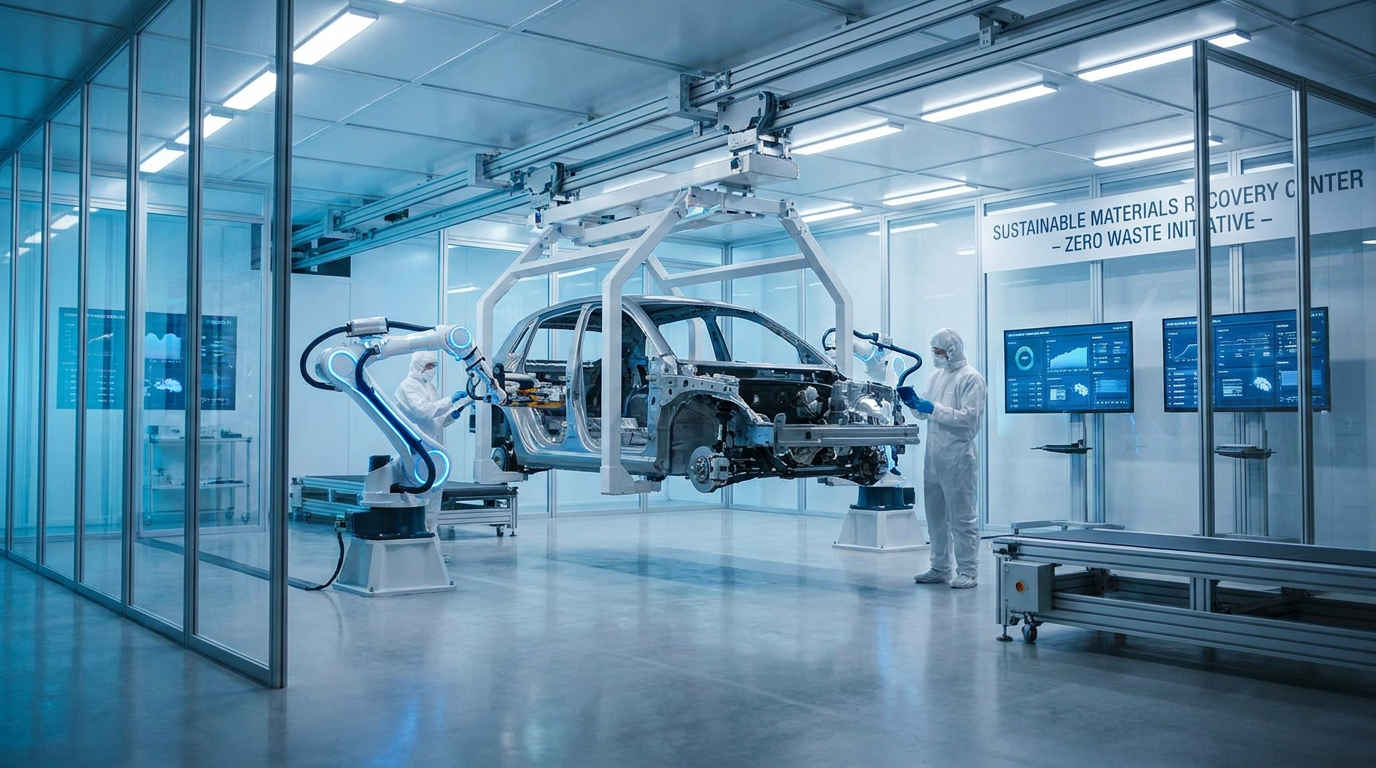
To close this loop, the new regulation attacks the problem at the source: vehicle engineering. Under the new "design for disassembly" mandate, manufacturers must engineer new vehicles so that valuable components—particularly batteries, electric motors, and electronic control units—can be easily extracted by authorized treatment facilities. This marks a sharp departure from modern manufacturing trends, which have increasingly relied on structural adhesives, gigacasting, and integrated battery packs that are notoriously difficult to separate without destroying the underlying materials.[3][8]

Automakers will now be required to develop and submit a formal circularity strategy for every new vehicle type. This is not a voluntary sustainability pledge, but a strict legal prerequisite for market approval. Engineers must prove that the vehicle can be dismantled efficiently and that its constituent materials can be recovered at high purity levels. If a manufacturer uses a composite material that cannot be economically separated at the end of the car's life, that design will likely fail the new European compliance checks.[2][4]
The most immediate and heavily debated mechanism in the regulation is the mandatory inclusion of recycled plastics. Within six years of the law entering into force—effectively by 2032—every new vehicle type must contain at least 15% recycled plastic by weight. Within ten years, that threshold jumps to 25%. This creates a massive, guaranteed market for recycled automotive polymers, shifting the economic calculus away from virgin petrochemicals and forcing a redesign of interior trims, bumpers, and dashboards.[1][5][6][7][8]
Crucially, the EU is not just asking for any recycled plastic; it is demanding a "closed loop." The regulation stipulates that at least 20% of the mandated recycled plastic must be sourced directly from end-of-life vehicles or from parts removed during a car's service life. Automakers cannot simply buy recycled PET water bottles to meet their quotas; they must actively participate in the recovery and reprocessing of automotive-grade plastics.[1][2][5][7][8]

Enforcing these quotas requires an unprecedented level of supply chain transparency. Declaring the use of recycled materials will no longer suffice; manufacturers must trace the exact origin of the plastics. This ties directly into the EU’s upcoming Digital Product Passport initiative, which will require suppliers to digitally document the lifecycle and material composition of every component. A "mirror clause" also ensures that recycled plastics imported from outside the EU are audited every five years by independent bodies to prove they were processed under equivalent environmental standards.[2][5]
Enforcing these quotas requires an unprecedented level of supply chain transparency.
To ensure that European recyclers actually have access to end-of-life vehicles, the regulation introduces a strict export ban. Five years after implementation, it will be illegal to export non-roadworthy vehicles, scrap cars, or vehicles lacking valid registration to non-EU countries. This closes a massive loophole where end-of-life cars were shipped abroad under the guise of "used vehicles," effectively starving the European recycling industry of the very raw materials it now needs to meet the closed-loop quotas.[1][2][3]
The financial burden of this new ecosystem falls squarely on the automakers through Extended Producer Responsibility (EPR). Three years after the rules take effect, manufacturers will be required to cover the costs of collecting and treating vehicles that reach their end-of-life stage anywhere in the EU. This incentivizes automakers to design cars that are profitable to recycle; if a vehicle is difficult and expensive to dismantle, the manufacturer will ultimately pay the price when it is scrapped.[3][7][8]
While plastics are the immediate focus, they are only the beginning. The regulation includes provisions for the European Commission to evaluate and introduce mandatory recycled content targets for steel, aluminum, magnesium, and critical raw materials within two years of the law's enactment. Recyclers are already preparing for stricter sorting requirements, such as the mandate to separate aluminum into four distinct grades to maintain alloy purity, preventing high-grade automotive aluminum from being downcycled into lower-quality products.[5][8]

Because the European car market is one of the largest in the world, this regulation will trigger the "Brussels Effect"—where EU laws become de facto global standards. Global automakers, particularly the wave of Chinese electric vehicle manufacturers currently expanding into Europe, cannot afford to design two different versions of their cars. To sell in the EU, their global supply chains, engineering processes, and material sourcing strategies must align with the circularity mandates, effectively exporting European environmental standards to factories in Asia and North America.[1][5]
Despite the legislative victory, significant uncertainties remain. Automakers have warned that there is currently a severe shortage of high-quality, automotive-grade recycled plastics capable of meeting strict crash-safety and durability standards. The provisional agreement includes a safety valve allowing the European Commission to temporarily revise the targets downward if a lack of availability or excessive prices make compliance impossible. Furthermore, recyclers have questioned whether the mandate to manually remove certain parts will change the economics of shredding, requiring massive new investments in sorting technology.[5][6]
The regulation now awaits formal rubber-stamping by the EU Council before entering into force, with the first major compliance deadlines hitting 24 months later. For the automotive industry, the era of linear manufacturing is officially over. The car of the future will not just be defined by how far it can drive on a single charge, but by how easily it can be taken apart and turned into the next one.[2][7][8]
How we got here
July 2023
The European Commission first proposes the new regulation on circularity requirements for vehicle design.
December 2025
The European Parliament and Council reach a provisional agreement on the rules.
June 2026
The European Parliament officially adopts the ELV regulation with an overwhelming majority.
2029 (Projected)
Extended Producer Responsibility (EPR) rules take effect, making automakers pay for recycling costs.
2032 (Projected)
The first mandate requiring 15% recycled plastic in all new vehicles takes effect.
2036 (Projected)
The mandate increases to require 25% recycled plastic in all new vehicles.
Viewpoints in depth
European Policymakers
Focused on securing strategic autonomy and ending the environmental leakage of scrap vehicles.
For EU regulators, this legislation is as much about geopolitics as it is about the environment. The European automotive sector is heavily dependent on imported raw materials, consuming vast quantities of the bloc's aluminum, magnesium, and rare earth elements. By forcing a closed-loop recycling system and banning the export of scrap vehicles, policymakers aim to create a captive domestic supply of critical materials. They view the historical practice of exporting end-of-life vehicles as a dual failure: a loss of valuable resources and an outsourcing of pollution to developing nations.
Global Automakers
Concerned about the feasibility, cost, and supply chain readiness required to meet strict recycled content quotas.
While generally supportive of sustainability goals, automotive manufacturers are raising alarms about the practical realities of implementation. Their primary concern is the sheer lack of high-quality, automotive-grade recycled plastics available on the market today. Plastics used in cars must meet rigorous crash-safety, thermal, and durability standards that typical recycled packaging cannot match. Automakers warn that forcing a 25% quota before the recycling infrastructure is fully scaled could lead to massive supply bottlenecks, driving up production costs and potentially delaying the rollout of new vehicle models.
Auto Recyclers and Dismantlers
Welcoming the guaranteed supply of materials but wary of the massive investments required for compliance.
The recycling industry stands to be the biggest beneficiary of the new rules, particularly the export ban that will keep millions of scrap cars within the European market. The 'closed-loop' mandate also guarantees a lucrative market for their recovered plastics. However, recyclers emphasize that the regulation demands a technological leap. Mandates to sort materials into highly specific categories—such as separating aluminum into four distinct grades—will require dismantling facilities to invest heavily in advanced robotics, AI-driven sorting, and new chemical recycling technologies to meet the automakers' strict purity requirements.
What we don't know
- Whether the recycling industry can scale up production of high-grade automotive plastics fast enough to meet the 2032 deadlines.
- How the European Commission will enforce the 'mirror clause' audits on recycled materials imported from outside the EU.
- Exactly how much the new design and compliance requirements will increase the retail price of new vehicles.
Key terms
- End-of-Life Vehicle (ELV)
- A vehicle that has reached the end of its useful life and is designated as waste, destined for dismantling and recycling.
- Closed-Loop Recycling
- A manufacturing process where materials from a product are recycled to make the exact same type of product again, rather than being downcycled into lower-quality goods.
- Extended Producer Responsibility (EPR)
- A policy approach where manufacturers are made financially and physically responsible for the disposal and recycling of their products at the end of their lifecycle.
- Design for Disassembly
- An engineering philosophy that prioritizes building products so their components and materials can be easily and economically separated for recycling.
- Digital Product Passport
- An upcoming EU requirement for a digital record that tracks a product's origin, material composition, and environmental impact throughout its entire lifecycle.
Frequently asked
Does this apply to cars manufactured outside of Europe?
Yes. Any automaker wanting to sell vehicles in the European market, regardless of where they are headquartered or manufactured, must comply with these design and material requirements.
Will this make new cars more expensive?
In the short term, compliance and new engineering processes may increase manufacturing costs. However, the EU projects that creating a circular economy will ultimately lower the prices of second-hand parts and secure cheaper domestic raw materials.
What happens to old cars that are no longer roadworthy?
The regulation introduces a strict export ban, meaning non-roadworthy scrap vehicles can no longer be shipped to non-EU countries and must be recycled within Europe's regulated system.
When do these rules actually take effect?
The regulation awaits final formal approval by the EU Council, after which it will enter into force. The first major recycled content mandates (15%) take effect six years after that date.
Sources
Source coverage
8 outlets
3 viewpoints surfaced






[1]Auto in ChinaGlobal Automakers
European Union Introduces Full Lifecycle Automotive Regulation
Read on Auto in China →[2]DPP StrategistAuto Recyclers & Dismantlers
ELV Regulation: European automotive enters the circular economy era
Read on DPP Strategist →[3]European ParliamentEuropean Policymakers
Circular economy: deal on new EU rules for the automotive sector
Read on European Parliament →[4]Auto Recycling WorldAuto Recyclers & Dismantlers
European ELV Regulation approved: a historic step for circular vehicle recycling
Read on Auto Recycling World →[5]Recycling Product NewsAuto Recyclers & Dismantlers
What the ELV Regulation could change about the current market
Read on Recycling Product News →[6]Plastics TodayGlobal Automakers
New EU regulation requires 15% recycled plastic content in vehicles
Read on Plastics Today →[7]Agence Europe
European Parliament approves EU circularity rules covering entire vehicle life cycle
Read on Agence Europe →[8]The European StingEuropean Policymakers
Circular economy: deal on new EU rules for the automotive sector
Read on The European Sting →


Every angle. Every day.
Get automotive stories with full source coverage and perspective breakdowns delivered to your inbox.