
Tencent Embeds Native AI Assistant 'Xiaowei' Into WeChat, Opening Super-App to Hardware Partners
Tencent has begun testing a native AI assistant inside WeChat that can autonomously navigate the super-app's vast ecosystem of services. The rollout introduces a novel 'Agent-to-Agent' protocol that allows smartphone voice assistants to securely execute tasks within WeChat's walled garden.
By Factlen Editorial Team
- Super-App Developers
- Focus on embedding AI directly into existing commercial flows to keep users within their walled garden while maintaining strict data security.
- Hardware Manufacturers
- Seek authorized integration with dominant apps to make their native smartphone voice assistants more useful and competitive in the premium market.
- Third-Party AI Competitors
- Attempt to bypass app restrictions using screen-reading GUI agents, arguing for a more open, OS-level approach to AI automation.
- Ecosystem Partners
- View embedded AI agents as a frictionless new distribution channel to drive e-commerce, food delivery, and travel bookings.
What's not represented
- · Privacy Advocates
- · Independent App Developers
Why this matters
By embedding AI directly into an app used by 1.4 billion people, Tencent is shifting the AI race away from standalone chatbots and toward invisible, frictionless automation. This establishes a new blueprint for how artificial intelligence will execute real-world tasks like booking flights and ordering food without requiring users to learn new software.
Key points
- Tencent is testing 'Xiaowei,' a native AI assistant embedded directly into WeChat.
- The AI can autonomously navigate WeChat's mini-programs to book flights, order food, and shop.
- A new 'Agent-to-Agent' protocol allows smartphone voice assistants to securely trigger WeChat functions.
- The protocol prevents external AI from reading private screens, maintaining Tencent's data security.
- Major partners like JD, Meituan, and Trip.com are already integrating their services into the AI layer.
The artificial intelligence race has largely been defined by standalone chatbots that require users to open a new app, type a prompt, and wait for a text response. But the next frontier of consumer AI is invisible integration—embedding intelligent agents directly into the digital infrastructure billions of people already use every day. Tencent Holdings has officially crossed this threshold, initiating limited testing of a native AI assistant embedded directly into WeChat, China's ubiquitous super-app.[1][7]
The new assistant, internally named "Xiaowei," represents one of the largest single rollouts of consumer AI to date. With over 1.4 billion monthly active users, WeChat serves as the primary gateway to the internet for Chinese consumers, handling everything from messaging and social networking to mobile payments and ride-hailing. By integrating AI at the core of this ecosystem, Tencent is transforming WeChat from a platform where users hunt for services into an intelligent engine that proactively executes tasks on their behalf.[1][2][7]
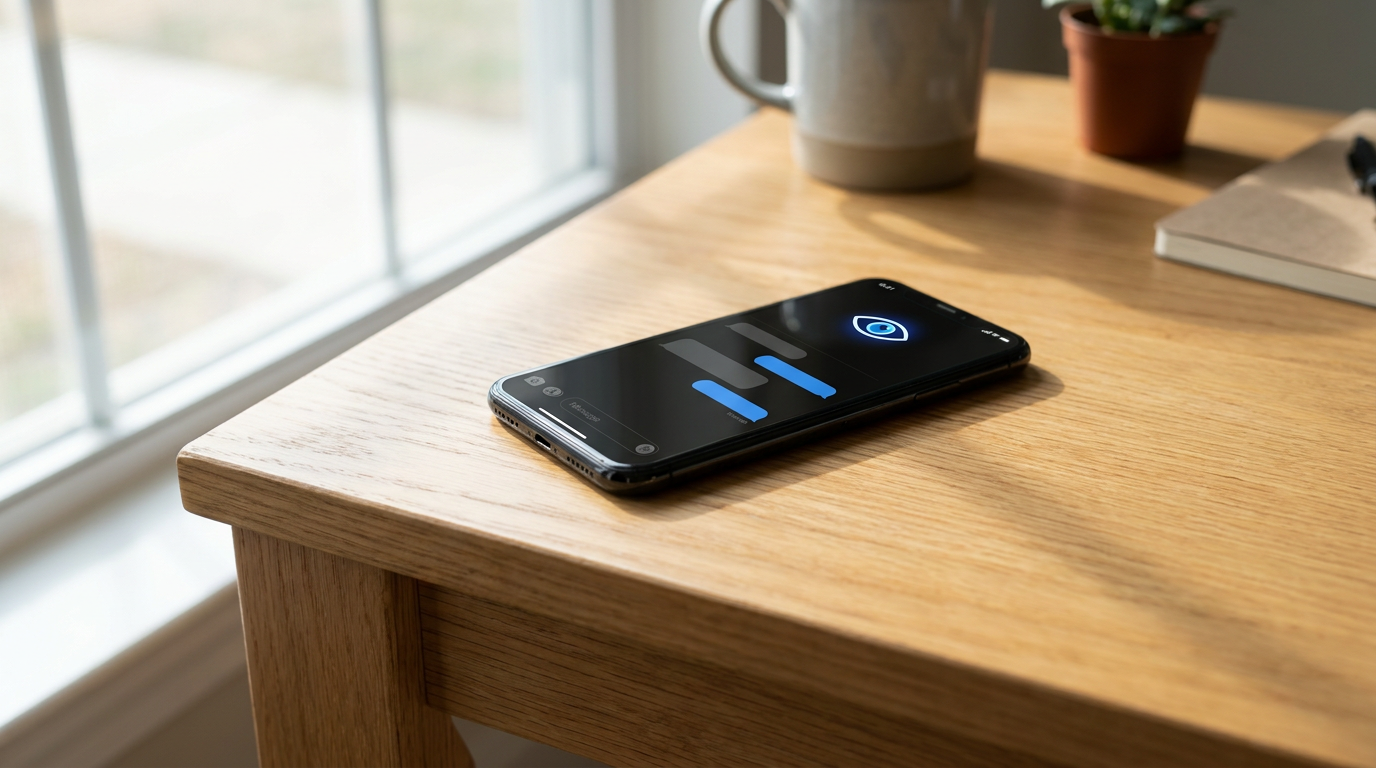
Users participating in the initial "grayscale" testing phase—a software release strategy where features are rolled out gradually to a small percentage of users—can access Xiaowei by tapping a new eye-shaped icon in the upper left corner of the WeChat interface, or by swiping right on the main screen. From there, they can issue natural language commands via text or voice. The assistant is designed to operate WeChat's native functions, allowing users to adjust settings, send messages to specific contacts, or initiate video calls without manually navigating menus.[7]
But Xiaowei's true power lies in its ability to navigate WeChat's massive "mini-program" ecosystem. Mini-programs are lightweight applications built directly inside WeChat, allowing users to access third-party services without downloading separate apps. Tencent has opened its AI ecosystem to developers, allowing companies to plug their services directly into Xiaowei's reasoning engine. If a user asks the assistant to "order a coffee under 30 yuan," the AI can autonomously filter options, select a nearby cafe, and place the order.[5][6]

Major internet companies are already integrating their services into this new AI layer. E-commerce giant JD is deploying AI agents across its shopping and logistics mini-programs, while Meituan is connecting its food delivery network. Travel platform Trip.com has completed integration for flight bookings and itinerary planning, and KFC China is allowing users to place food orders using natural language. This shifts the paradigm of mobile commerce: instead of users tapping through multiple screens, the AI acts as a universal router, translating human intent into executed transactions.[5]
Simultaneously, Tencent is making a rare concession by opening WeChat's closely guarded walled garden to external hardware manufacturers. The company is partnering with major Chinese smartphone brands—including Honor, Huawei, Xiaomi, Oppo, and Vivo—to allow their built-in voice assistants to interact with WeChat. Honor is the first to roll out the integration, allowing users of its Magic series smartphones to use the native "Yoyo" voice assistant to command WeChat to send messages or start calls.[2][3]
Simultaneously, Tencent is making a rare concession by opening WeChat's closely guarded walled garden to external hardware manufacturers.
This cross-platform collaboration relies on a novel technical standard called the "Agent-to-Agent" (A2A) protocol. Historically, tech giants have struggled to allow external AI to operate inside their apps without compromising user privacy or security. The A2A protocol solves this by establishing a secure handshake between the smartphone's operating system and WeChat. When a user speaks to their phone's native assistant, the OS parses the intent and sends a structured, encrypted instruction to WeChat's internal agent. WeChat then executes the action in the background and returns the result to the phone.[3][4][6]
The A2A approach differs fundamentally from the brute-force methods previously attempted by competitors. Earlier this year, ByteDance's Doubao AI phone attempted to control WeChat using a "GUI Agent"—a system that essentially "reads" the screen and simulates human taps to navigate the interface. Tencent swiftly blocked this approach, citing unauthorized third-party interference and severe privacy risks, as screen-reading AI can inadvertently capture sensitive chat logs and payment data.[4][6]

By enforcing the A2A protocol, Tencent maintains absolute control over its ecosystem. The protocol operates on a dual-authorization structure: the user authorizes the phone's operating system, and the app authorizes the specific action. WeChat dictates exactly which capabilities are exposed—currently limited to sending messages and initiating calls—ensuring that external AI assistants cannot scrape private Moments feeds, read chat histories, or manage group chats. The execution and risk control remain entirely within Tencent's domain.[3][4]
For smartphone manufacturers, adopting Tencent's protocol is a strategic necessity. While hardware makers are investing heavily in their own OS-level artificial intelligence, those assistants are severely limited if they cannot interact with the app where Chinese consumers spend the majority of their digital lives. A phone that can place a WeChat video call via voice command holds a distinct competitive advantage in the premium market, forcing hardware brands to play by Tencent's rules rather than attempting to bypass them.[4][6]
The financial markets immediately recognized the magnitude of this architectural shift. When initial reports of the WeChat AI agent surfaced in early June, Tencent's stock surged 10.5% in a single day—its largest single-day gain since January 2021—adding tens of billions of dollars to its market capitalization. Investors, who had previously favored cloud-centric AI narratives from competitors like Alibaba, suddenly saw a concrete, frictionless distribution channel for AI that reaches over a billion consumers.[6]

The development of Xiaowei and the A2A protocol highlights a divergence in global AI strategies. While Western tech giants like Apple are attempting to build OS-level intelligence that reaches down into individual apps, Tencent is leveraging its super-app dominance to build app-level intelligence that dictates terms to the operating system. Because WeChat's mini-program ecosystem functions almost as an operating system itself, Tencent has a structural head start in deploying agentic AI at scale.[6]
Tencent has stated that Xiaowei utilizes a combination of its own proprietary foundation models and high-quality open-source models to process requests. As the grayscale testing expands, the company will monitor how users interact with the assistant and how seamlessly third-party developers can plug their mini-programs into the AI router. The ultimate goal is to reduce friction in existing commercial flows, embedding artificial intelligence so deeply into daily transactions that users barely notice they are interacting with a neural network.[6][7]

While the exact timeline for a full public launch remains unconfirmed, the foundational pieces are now in place. By transforming WeChat from a static interface into a dynamic network of AI agents, Tencent is proving that the most impactful artificial intelligence won't necessarily be the smartest standalone chatbot, but the system with the deepest roots in everyday human life.[6][7]
How we got here
March 2026
Initial rumors surface regarding Tencent developing a highly confidential AI Agent project within WeChat.
May 2026
Tencent President Martin Lau publicly discusses the boundaries between operating system AI agents and app ecosystems.
June 2, 2026
Financial Times reports WeChat is building an AI agent layer, sending Tencent's stock up 10.5%.
June 4, 2026
Tencent confirms partnerships with major Chinese smartphone makers using the new A2A protocol.
June 20, 2026
Tencent customer service officially confirms the small-scale grayscale testing of the native AI assistant 'Xiaowei.'
Viewpoints in depth
Super-App Developers
Platform owners want to embed AI directly into their ecosystems to retain users and protect data.
For companies like Tencent, the rise of artificial intelligence presents both a threat and an opportunity. If smartphone operating systems become too smart, users might bypass apps entirely, relying on OS-level agents to fetch data and execute tasks. By building a native AI assistant and enforcing the Agent-to-Agent (A2A) protocol, Tencent ensures that WeChat remains the indispensable execution layer. This approach allows them to offer frictionless AI automation while keeping users firmly inside their walled garden and preventing external hardware makers from scraping valuable consumer data.
Hardware Manufacturers
Smartphone brands need authorized access to dominant apps to make their native AI assistants useful.
Hardware manufacturers like Honor, Huawei, and Xiaomi are investing heavily in their own voice assistants to differentiate their premium devices. However, an AI assistant is only as useful as the services it can control. Because Chinese consumers spend the vast majority of their digital lives inside WeChat, a phone assistant that cannot send a WeChat message is fundamentally crippled. By adopting Tencent's A2A protocol, these manufacturers gain authorized, secure access to WeChat's core functions, allowing them to market a seamless, voice-activated user experience without triggering Tencent's anti-fraud defenses.
Third-Party AI Competitors
Independent AI developers argue for screen-reading agents to bypass walled gardens.
Competitors outside the WeChat ecosystem, such as ByteDance with its Doubao AI phone, have attempted to use GUI (Graphical User Interface) agents to operate apps on behalf of users. These systems simulate human interaction by 'reading' the screen and tapping buttons, theoretically allowing an AI to control any app without needing official API access. However, this approach is highly fragile and frequently triggers security lockouts. Platform owners argue that GUI agents are a massive privacy risk, as they can inadvertently read private messages and payment details while navigating the screen.
What we don't know
- When the Xiaowei AI assistant will exit 'grayscale' testing and become available to all 1.4 billion WeChat users.
- Whether Tencent will eventually allow external smartphone assistants to access more complex WeChat functions beyond messaging and calling.
- How the integration of AI agents will impact the revenue models of third-party mini-program developers.
Key terms
- Agent-to-Agent (A2A) Protocol
- A secure communication standard that allows different AI assistants (like a phone's built-in AI and an app's internal AI) to exchange instructions without exposing raw user data.
- GUI Agent
- An artificial intelligence system that interacts with software by 'reading' the screen and simulating human taps or clicks, rather than using an official, secure data connection.
- Mini-Programs
- Small, lightweight applications built directly inside a super-app like WeChat, allowing users to access services like ride-hailing or food delivery without downloading separate apps.
- Grayscale Testing
- A software release strategy where a new feature is rolled out gradually to a small percentage of users to monitor performance and fix bugs before a full public launch.
Frequently asked
Do I need to download a new app to use WeChat's AI?
No. The AI assistant, named Xiaowei, is being integrated directly into the existing WeChat interface, accessible via a new icon or swipe gesture.
Can my phone's built-in voice assistant control WeChat?
Yes, if you use a supported device. Tencent has partnered with brands like Honor, Huawei, and Xiaomi to allow their native voice assistants to initiate WeChat calls and messages via a secure protocol.
Is the AI reading my private messages?
Tencent states that the integration uses a 'dual-authorization' structure. The phone's AI sends a structured command to WeChat rather than reading the screen, preventing external assistants from scraping private chat logs.
When will the AI assistant be available to everyone?
Tencent is currently conducting 'grayscale' testing, meaning the feature is only available to a small, randomly selected group of users. A timeline for a full public rollout has not been announced.
Sources
Source coverage
7 outlets
4 viewpoints surfaced







[1]BloombergSuper-App Developers
Tencent Tests AI Assistant for Its Super App WeChat in China
Read on Bloomberg →[2]South China Morning PostSuper-App Developers
WeChat to take commands from AI assistants in major shift for Tencent
Read on South China Morning Post →[3]Caixin GlobalHardware Manufacturers
Tencent Opens WeChat to Handset Makers' AI Assistants
Read on Caixin Global →[4]36KrThird-Party AI Competitors
Fighting for the AI smartphone entry point, Doubao and WeChat are in a fierce competition
Read on 36Kr →[5]China DailyEcosystem Partners
Tencent has started opening WeChat's artificial intelligence ecosystem to mini program developers
Read on China Daily →[6]Voice of ContextEcosystem Partners
WeChat announced an AI agent protocol connecting its mini-program ecosystem to phone operating systems
Read on Voice of Context →[7]PANewsEcosystem Partners
WeChat AI Assistant 'Xiao Wei' Launches in Small-Scale Grayscale Testing
Read on PANews →
Every angle. Every day.
Get technology stories with full source coverage and perspective breakdowns delivered to your inbox.