
SpaceX Options Shatter Records as Historic IPO Pushes Valuation Past $2.5 Trillion
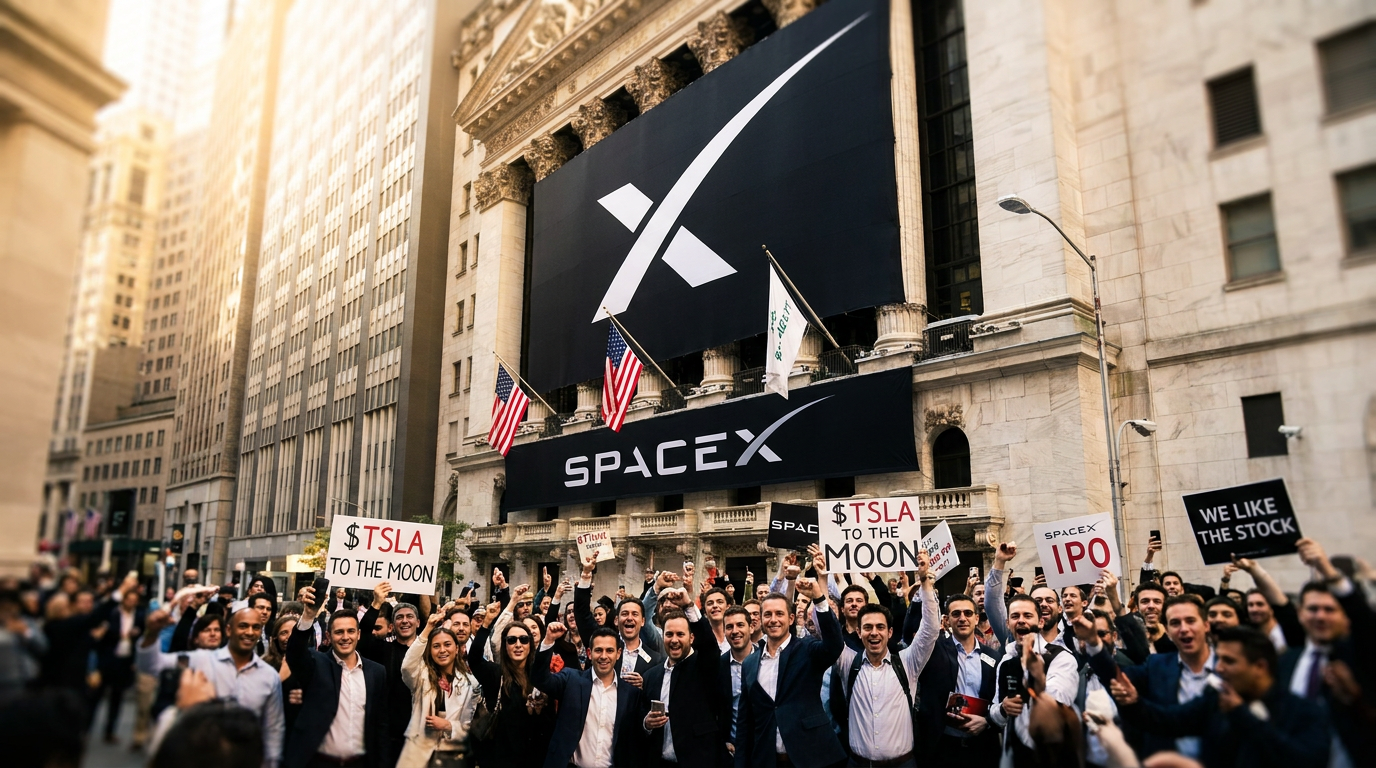
SpaceX's public market debut has rewritten Wall Street record books, driven by massive retail demand, a record-breaking options launch, and a strategic pivot into artificial intelligence.
By Factlen Editorial Team
- Bullish Tech Investors
- Argue that SpaceX's monopoly in launch services, Starlink expansion, and AI pivot justify its unprecedented valuation.
- Cautious Value Analysts
- Warn that pricing a cash-burning aerospace manufacturer at software multiples creates massive downside risk.
- Passive Indexers
- Focus on the mechanical market impacts of the mega-cap listing, emphasizing forced buying by index funds.
What's not represented
- · Competitors in the aerospace sector
- · Regulatory bodies overseeing space launches
Why this matters
SpaceX's mega-listing is reshaping the broader stock market, forcing passive index funds to buy billions in shares and offering everyday investors a direct stake in the future of space infrastructure and AI.
Key points
- SpaceX's IPO valued the company at $1.77 trillion, with shares surging past $200 in the first week.
- The debut of SpaceX options broke all-time records, with 1.8 million contracts traded on the first day.
- Retail investors have driven much of the rally, fueled by a fear of missing out on the mega-cap listing.
- The stock trades at a massive premium, roughly 39 times projected 2027 sales, despite posting a $4.94 billion loss in 2025.
- SpaceX confirmed a $60 billion acquisition of AI startup Anysphere, signaling a major pivot into space-based data centers.
- While excluded from the S&P 500 due to unprofitability, the stock is expected to join the Nasdaq-100 in July.
The launch of SpaceX into the public equity markets has instantly rewritten Wall Street's record books, transforming the aerospace and communications giant into a $2.5 trillion mega-cap juggernaut in its first week of trading. Priced initially at $135 per share—which valued the company at a staggering $1.77 trillion and raised $75 billion in the largest initial public offering in history—the stock surged past the $200 mark within days. The sheer scale of the debut eclipsed previous watershed listings like Saudi Aramco and Alibaba, minting unprecedented wealth and cementing Elon Musk's status as the world's first trillionaire. The market's reception underscores a massive appetite for generational technology companies, with institutional and retail buyers alike scrambling to secure an allocation of the limited public float.[2][4]
The trading frenzy accelerated dramatically on Tuesday when SpaceX options officially debuted, triggering an avalanche of speculative activity that overwhelmed trading desks. Investors exchanged more than 1.8 million contracts in a single session, generating roughly $2.8 billion in premium and shattering the all-time record for first-day options volume on a single stock. Market sentiment was overwhelmingly characterized by momentum-chasing, with bullish call options outstripping protective put options by a 1.3-to-1 ratio. This massive influx of derivatives trading forced market makers to aggressively buy the underlying stock to hedge their exposure, creating a short-term gamma squeeze that further propelled the share price upward during intraday trading.[6]

Retail investors have been a massive driving force behind this historic rally, channeling billions of dollars into space-themed exchange-traded funds in the weeks leading up to the listing. Driven by a profound fear of missing out on the decade's most anticipated market event, individual traders are aggressively utilizing both ETFs and options to gain leveraged exposure to the stock's upward momentum. Brokerage data indicates that roughly 30% of the initial offering was allocated to individual investors through platforms like Fidelity and Robinhood—an unusually large retail footprint for a mega-cap listing. This retail enthusiasm has effectively sucked oxygen and capital away from established tech darlings, temporarily cooling the momentum of the broader Magnificent Seven stocks.[1][4]
Yet, beneath the euphoria of the opening week, traditional valuation metrics are flashing severe warning signs for disciplined value investors. SpaceX is currently trading at roughly 134 times its trailing revenue and an eye-popping 39.2 times its projected 2027 sales, making it vastly more expensive than any current component of the S&P 500. For comparison, even Tesla—long considered one of the market's most richly valued equities—trades at roughly 12.6 times its forward sales estimates. For skeptics, pricing a capital-intensive industrial and aerospace manufacturer at software-like multiples represents a dangerous detachment from financial fundamentals, leaving the stock highly vulnerable to any operational missteps or delays in its ambitious launch schedule.[1][5]

Yet, beneath the euphoria of the opening week, traditional valuation metrics are flashing severe warning signs for disciplined value investors.
The astronomical valuation is further complicated by the fact that SpaceX remains unprofitable on a Generally Accepted Accounting Principles (GAAP) basis. The company posted a $4.94 billion net loss in 2025, despite generating a robust $18.67 billion in top-line revenue. Much of that deficit stems from the immense capital expenditures required to fund the ongoing development of the Starship heavy-lift rocket program, alongside aggressive global expansions of the Starlink satellite broadband network. While Starlink itself has achieved operational profitability, the broader corporate entity is burning billions annually to maintain its technological edge and fund its long-term ambitions for interplanetary transport.[2][4]
However, bullish analysts argue that valuing SpaceX purely as an aerospace company misses the broader strategic picture, pointing to the company's highly capitalized pivot into artificial intelligence. On its fourth day of trading, SpaceX confirmed a binding, $60 billion all-stock acquisition of Anysphere, the parent company of the popular AI coding assistant Cursor. This blockbuster deal represents the largest acquisition of a venture-backed AI startup on record and signals a profound shift in the company's trajectory. Proponents believe SpaceX is laying the groundwork to build orbital compute data centers in space by 2028, leveraging its launch monopoly and Starlink infrastructure to bypass terrestrial power grid constraints.[2][4]

Despite its massive market capitalization, SpaceX will not immediately join the benchmark S&P 500 index. S&P Dow Jones Indices has explicitly refused to waive its strict profitability requirements, meaning the stock will remain excluded from the world's most tracked index until the company achieves consistent GAAP profitability—likely pushing potential inclusion to mid-2027 at the earliest. However, the stock is expected to be fast-tracked into the tech-heavy Nasdaq-100 by early July. This looming index inclusion is creating a powerful mechanical tailwind for the stock, as passive index funds will be forced to purchase an estimated $22 billion to $27 billion worth of shares to match the benchmark's new weightings.[3][4]
For everyday investors, this rapid integration into major indices means that exposure to SpaceX is virtually guaranteed, even for those who strictly avoid picking individual stocks. As the initial public offering dust settles, Wall Street remains sharply divided on the stock's true worth, with analyst price targets ranging from a bearish $63 per share to an ultra-bullish $310—a nearly 400% spread that highlights the unprecedented uncertainty surrounding the company's future cash flows. Wealth advisors are cautioning clients against over-concentrating their portfolios in a single, highly volatile asset, recommending diversified sector funds instead. Ultimately, SpaceX's historic market debut has proven that investor appetite for narrative-driven, frontier technology remains entirely insatiable.[4][5][7]
How we got here
June 12, 2026
SpaceX goes public at $135 per share, achieving a $1.77 trillion valuation in the largest IPO in history.
June 16, 2026
SpaceX options officially begin trading, shattering volume records with 1.8 million contracts exchanged.
June 16, 2026
The company confirms a $60 billion all-stock acquisition of AI coding startup Anysphere.
Early July 2026
SpaceX is expected to be fast-tracked into the Nasdaq-100 index, triggering billions in mandatory passive buying.
Viewpoints in depth
The Bull Case: Orbital Compute & Monopoly
Why tech investors are willing to pay a massive premium for SpaceX shares.
Bullish investors view SpaceX not as a traditional aerospace manufacturer, but as the foundational infrastructure for the next century of technology. By acquiring AI startups like Anysphere and planning 'orbital compute' data centers, SpaceX is positioning itself to bypass terrestrial power grid constraints that currently bottleneck artificial intelligence development. Combined with its near-monopoly on global rocket launches and the rapidly scaling Starlink network, proponents argue the company's $2.5 trillion valuation is a fair price for a business that effectively controls access to Earth's orbit.
The Bear Case: Valuation Detachment
Why value analysts are sounding the alarm on the stock's underlying fundamentals.
Skeptics point to the stark reality of SpaceX's balance sheet: a $4.94 billion net loss in 2025 driven by the immense capital requirements of the Starship program. Trading at nearly 40 times its projected 2027 sales, the stock is priced for absolute perfection over the next decade. Value analysts warn that aerospace is inherently risky and capital-intensive; a single catastrophic launch failure or regulatory delay could shatter the growth narrative. Furthermore, they argue that the current price is artificially inflated by retail FOMO and a limited public float, creating a dangerous bubble that could burst once insider lock-up periods expire.
What we don't know
- Whether SpaceX can achieve GAAP profitability in the near term to qualify for S&P 500 inclusion.
- How the stock will react when early insider lock-up periods expire and more shares flood the market.
- The technical feasibility and timeline of building operational 'orbital compute' data centers.
Key terms
- Gamma Squeeze
- A rapid increase in a stock's price caused by market makers buying the underlying shares to hedge the massive amount of call options they have sold to investors.
- Price-to-Sales Multiple
- A valuation metric that compares a company's stock price to its revenues, often used for unprofitable companies where price-to-earnings ratios cannot be calculated.
- Float
- The number of a company's shares that are actually available for the public to buy and sell on the open market.
Frequently asked
Is SpaceX currently in the S&P 500?
No. SpaceX is excluded from the S&P 500 because it does not meet the index's strict profitability requirements, having posted a net loss in 2025.
Why did SpaceX's stock surge so much after the IPO?
The surge was driven by massive retail demand, a limited supply of publicly available shares, and excitement over the company's expansion into artificial intelligence.
What is 'orbital compute'?
Orbital compute refers to SpaceX's plan to build data centers in space, using its rockets to launch servers and Starlink to connect them, bypassing power limitations on Earth.
Sources
Source coverage
7 outlets
3 viewpoints surfaced







[1]MarketWatchCautious Value Analysts
SpaceX is vastly more expensive than any stock in the S&P 500, fueled by 'FOMO' mentality
Read on MarketWatch →[2]The Guardian
IPO could raise up to $75bn, giving SpaceX market value of $1.77tn as it sets up Musk for extraordinary wealth
Read on The Guardian →[3]The Motley FoolPassive Indexers
Index Investors: Here's How Much SpaceX Stock You're About to Own
Read on The Motley Fool →[4]Disruption BankingBullish Tech Investors
SpaceX's First Five Trading Days: $75 Billion Raised, $2.5 Trillion Priced In
Read on Disruption Banking →[5]Saxo GroupCautious Value Analysts
SpaceX IPO: What are investors really buying?
Read on Saxo Group →[6]TradingKeyBullish Tech Investors
SpaceX (SPCX) options officially began trading this Tuesday
Read on TradingKey →[7]InvestmentNewsPassive Indexers
The SpaceX IPO may have thrust single-stock investing firmly into the spotlight
Read on InvestmentNews →


Every angle. Every day.
Get finance stories with full source coverage and perspective breakdowns delivered to your inbox.