
Rowing Injury Report: Imogen Grant Returns to GB Quad as Elite Scullers Navigate Crucial Rehab Windows
Olympic champion Imogen Grant makes her highly anticipated return to the Great Britain quadruple sculls at Lucerne, highlighting a weekend of significant roster shifts. As athletes manage mid-season setbacks, modern rehabilitation protocols are extending careers and reshaping the global rowing landscape.
By Factlen Editorial Team
- National Federations & Coaches
- Focused on load management, crew optimization, and timing athlete returns perfectly for major regattas.
- Medical & Rehab Specialists
- Advocating for dynamic biomechanical corrections and telemetry monitoring to prevent chronic rowing injuries.
- The Athletes
- Balancing the intense psychological drive to compete with the physical realities of recovery and long-term health.
What's not represented
- · Junior Rowing Coaches
- · Boat and Equipment Manufacturers
Why this matters
For the millions of amateur rowers and fitness enthusiasts who use ergometers daily, the evolution of elite injury protocols—shifting from static planks to dynamic trunk endurance—offers a safer, science-backed blueprint for preventing chronic back pain and extending their own athletic longevity.
Key points
- Olympic champion Imogen Grant has been medically cleared to stroke the Great Britain women's quadruple sculls at World Rowing Cup III.
- France's Emma Lunatti was forced to withdraw from the women's single sculls in Lucerne due to a severe rib injury.
- Australian Paralympic gold medalist Nikki Ayers announced her retirement, concluding a historic career built on rehabilitating a catastrophic knee injury.
- World Rowing has updated its medical guidance, shifting from static core exercises to dynamic trunk endurance to combat lower back injuries.
- Modern telemetry and coordinated physical therapy are drastically reducing recovery timelines for complex rowing injuries across the sport.
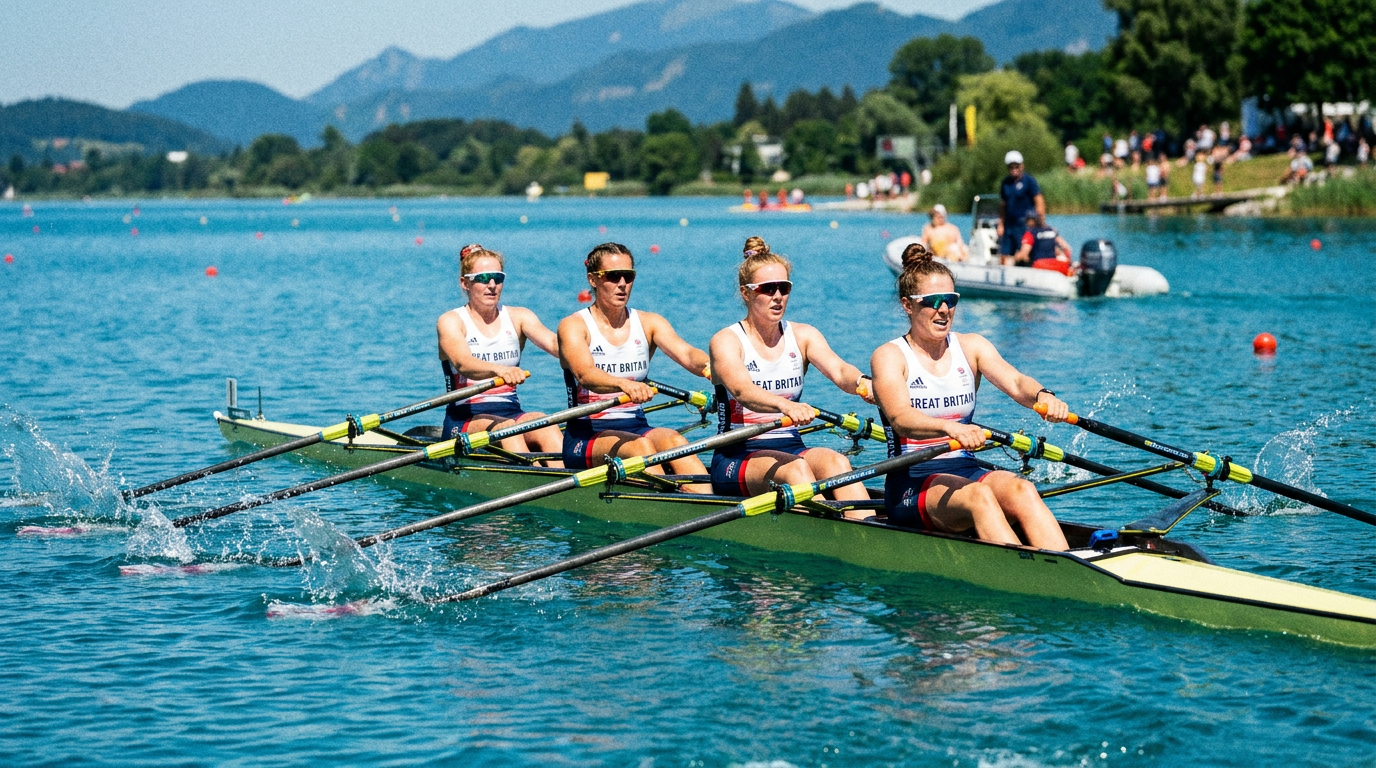
The final push toward the 2026 World Rowing Championships is testing the physical limits of the international peloton, with World Rowing Cup III in Lucerne serving as a crucial proving ground for athletes returning from injury. The pristine waters of the Rotsee will host 42 nations and over 650 athletes this weekend, but much of the pre-regatta focus has centered on the medical tent rather than the boat park. Leading the headlines is Great Britain's Imogen Grant, who makes her highly anticipated return to the water after an early-season medical absence. Her clearance to race injects a massive surge of momentum into the British camp, signaling that their premier athletes are peaking at exactly the right moment in the Olympic cycle's midway point.[1][2]
Grant, who captured Paris Olympic gold in the lightweight women's double sculls, has been officially cleared to stroke the newly configured British women's quadruple sculls. She joins a formidable lineup featuring reigning Olympic champions Lola Anderson and Hannah Scott, alongside rising star Finn Stratton, whose sensational senior debut in Seville resulted in a silver medal. British Rowing's decision to place Grant in the stroke seat—the critical position that dictates the rhythm, cadence, and tactical execution for the entire boat—demonstrates immense confidence in her physical rehabilitation and cardiovascular fitness. The quadruple sculls requires explosive power and flawless synchronization, making it one of the most demanding disciplines for an athlete returning from a layoff.[1][2]
"One change will be made to the crew that won silver in the Women's Quadruple Sculls in Seville," British Rowing confirmed in their official squad announcement, noting that Grant's return provides a significant tactical advantage across their entire fleet. Her insertion into the quad allows 2025 world silver medalist Sarah McKay to shift into the women's double sculls alongside Cam Nyland. This cascading roster adjustment highlights how a single athlete's return to health can optimize a national federation's broader sculling strategy, turning a localized recovery victory into a sweeping competitive edge against rival nations.[2]
While Grant's successful rehabilitation bolsters the British squad, the French national team faces a notable and frustrating setback on the eve of the Lucerne regatta. Emma Lunatti, the standout French sculler who captured silver in the women's double at this exact venue last year, has been forced to formally withdraw from the women's single sculls competition due to a severe rib injury. Rib stress fractures and intercostal muscle strains are notoriously difficult to manage in the sport of rowing, as the repetitive, high-load mechanics of the drive phase make it nearly impossible for an athlete to simply train through the pain without risking long-term structural damage.[1]

Lunatti's absence, combined with the medical withdrawal of Dutch Olympic champion Karolien Florijn due to a back injury, dramatically alters the competitive landscape of the women's single sculls. The sudden vacuum at the top of the field opens a rare window of opportunity for emerging contenders to secure podium finishes. Australia's Tara Rigney, stepping up after a dominant B-final victory in Seville, and Germany's Olympian Alexandra Foester are now primed to capitalize on the reshaped draw. The situation underscores the fragile nature of elite rowing, where months of grueling winter mileage can be instantly derailed by a singular biomechanical failure or stress response.[1]
The immense physical toll of the sport was further highlighted this week by the emotional retirement of Australian Paralympic gold medalist Nikki Ayers. Ayers chose to step away from elite competition on her own terms at age 35, leaving behind a legacy defined by one of the most remarkable injury comebacks in the history of modern athletics. Before she ever picked up an oar, Ayers was a rising star in rugby union until a catastrophic tackle in March 2016 permanently altered the trajectory of her life and athletic career.[3]
The immense physical toll of the sport was further highlighted this week by the emotional retirement of Australian Paralympic gold medalist Nikki Ayers.
During that fateful rugby match, Ayers suffered a devastating knee dislocation that resulted in permanent damage to her peroneal nerve and a severed popliteal artery. The lack of blood supply to her lower leg triggered acute compartment syndrome, a severe condition that required emergency surgery and the removal of dead muscle tissue, ultimately leaving her with permanent foot drop. Told she might never walk properly again, Ayers endured grueling surgeries and months of uncertainty. It was during this dark period of rehabilitation that she discovered Para rowing, utilizing the sport's seated, low-impact mechanics to rebuild her cardiovascular engine and muscular strength without placing destructive shear forces on her compromised knee joint.[3]
"Rowing gave me a place where I felt I belonged," Ayers reflected upon her retirement, noting that her journey was fundamentally about overcoming adversity and finding a renewed sense of identity when her previous athletic dreams were shattered. Her transition from a devastating lower-body trauma to standing atop the podium in Paris as a Paralympic champion stands as a profound testament to the sport's unique rehabilitative properties. Ayers' story is frequently cited by sports physiotherapists as the ultimate case study in how rowing can safely bridge the gap between severe orthopedic trauma and elite cardiovascular performance.[3]

Driven by cases like Ayers and the high injury rates among able-bodied scullers, the broader rowing community is increasingly focusing on advanced rehabilitation protocols to extend athlete longevity. World Rowing's medical commission recently updated its global guidance on back pain—statistically the sport's most frequent and debilitating complaint. The new protocols represent a paradigm shift in sports science, actively moving away from traditional static core exercises, such as isometric planks, in favor of dynamic trunk endurance training that better mimics the continuous flexion and extension of the rowing stroke.[4]
Sports physiotherapists and biomechanists have identified "spinal creep" as a primary culprit in rowing injuries. This physiological phenomenon occurs during long, monotonous ergometer sessions, where prolonged seated flexion temporarily dampens the protective reflex activity of the lower back muscles. When these reflexes slow down, the lumbar spine becomes highly vulnerable to the massive compressive forces generated at the catch phase of the stroke. By optimizing the kinetic chain and ensuring athletes pivot powerfully from the hips rather than bending at the lumbar spine, modern rehab programs are successfully returning athletes to the water faster and safer than in any previous Olympic cycle.[4][7]
This multidisciplinary, data-driven approach to recovery is evident across all levels of the international circuit. In the United States, elite national team rower Alexander Hedge recently detailed his own grueling recovery from a fractured rib—an injury identical to the one currently sidelining France's Lunatti. Hedge utilized advanced boat telemetry, continuous video review, and strict data-driven load management to safely rebuild his stroke mechanics. By precisely measuring the force curve of every single stroke, his medical team ensured he was not overloading the healing bone, allowing him to successfully double up in both the men's four and eight at the World Championships.[5]

At the club and domestic levels, advanced orthopedic care is mirroring these elite, high-tech protocols to save amateur careers. University Orthopedics recently published a comprehensive case study on a competitive club rower who suffered multiple complex elbow fractures and a completely detached triceps tendon during a cycling crash at an international regatta in Amsterdam. Through highly coordinated physical therapy that aligned perfectly with her surgical recovery phases, she returned to competitive rowing in exactly seven months. A year later, she returned to the exact same Amsterdam regatta and secured a gold medal—a timeline and outcome that would have been virtually unthinkable a decade ago.[6]
Whether it is Imogen Grant confidently stepping back into the stroke seat of the British quad at Lucerne, or veterans like Nikki Ayers proving that catastrophic physical trauma does not dictate the end of an athletic dream, the 2026 season is underscoring a vital evolutionary shift in the sport. Elite rowing is no longer defined merely by an athlete's capacity to endure silent suffering and push through structural pain. Instead, it is increasingly defined by mastering the precise science of recovery, utilizing advanced biomechanics, and knowing exactly when to step away so they can row another day.[1][2][3]
How we got here
March 2016
Nikki Ayers suffers a catastrophic knee injury in rugby, eventually leading her to discover Para rowing during her rehabilitation.
August 2024
Ayers and Jed Altschwager win Australia's first Paralympic rowing gold medal in Paris.
June 15, 2026
Ayers officially announces her retirement from elite rowing to focus on her nursing career and family.
June 16, 2026
British Rowing confirms Imogen Grant's medical clearance and return to the Women's Quadruple Sculls.
June 25, 2026
World Rowing Cup III begins in Lucerne, featuring major roster shifts across the international field.
Viewpoints in depth
National Federations & Coaches
Balancing peak performance with athlete welfare.
Coaches face immense pressure to field their fastest boats at World Cup events, but modern federations are increasingly prioritizing long-term health over short-term results. By utilizing telemetry and load-management software, coaches can pinpoint exactly when an athlete like Imogen Grant is ready to return to the stroke seat without risking re-injury ahead of the World Championships.
Medical & Rehab Specialists
Evolving the biomechanics of recovery.
Sports physiotherapists are moving away from traditional static core exercises, such as planks, in favor of dynamic trunk endurance training. Specialists emphasize that because the rowing stroke places repetitive shear forces on the lumbar spine, rehabilitation must focus on kinetic chain connectivity—ensuring the power originates from the hips and legs rather than the vulnerable lower back.
The Athletes
The psychological battle of rehabilitation.
For elite rowers, the physical pain of an injury is often matched by the mental toll of isolation from the squad. Athletes like Nikki Ayers and Alexander Hedge highlight that successful recovery requires immense mental resilience, relying on team support and a shift in identity to navigate the grueling months of stationary bikes and modified ergometer sessions before returning to the water.
What we don't know
- It remains unclear how quickly Emma Lunatti's rib injury will heal ahead of the upcoming World Rowing Championships in Amsterdam.
- The exact long-term impact of Imogen Grant's early-season absence on the British quad's ultimate synchronization is yet to be tested under race conditions.
- How widely the new dynamic trunk endurance protocols will be adopted by junior and club-level programs lacking elite sports science funding.
Key terms
- Quadruple Sculls (Quad)
- A boat class where four rowers propel the shell using two oars each, requiring immense synchronization and power.
- Stroke Seat
- The rower seated closest to the stern of the boat who sets the rhythm, cadence, and race strategy for the rest of the crew.
- Rib Stress Injury
- A common rowing ailment caused by the repetitive high-load pulling motion of the oars, often requiring complete rest from the water to heal.
- Spinal Creep
- The temporary deformation of spinal ligaments and discs after prolonged seated flexion, which can dampen protective muscle reflexes.
- Compartment Syndrome
- A severe medical condition involving dangerously high pressure within a muscle compartment, which can cut off blood flow and cause permanent damage.
Frequently asked
Why did Emma Lunatti withdraw from Lucerne?
The French sculler withdrew from World Rowing Cup III due to a severe rib injury, a restrictive ailment that prevents high-load training.
Who is replacing Imogen Grant's previous substitute?
With Grant returning to the stroke seat of the quad, 2025 world silver medalist Sarah McKay is shifting to the Women's Double Sculls.
Why is rowing used for injury rehabilitation?
Rowing provides low-impact, full-body cardiovascular conditioning, allowing athletes to rebuild strength without placing destructive shear forces on healing lower-body joints.
What is spinal creep in rowing?
It is a physiological phenomenon where prolonged flexion on an ergometer temporarily dampens the protective reflex activity of the lower back muscles.
Sources
Source coverage
7 outlets
3 viewpoints surfaced







[1]Row360The Athletes
Lucerne World Cup III Previews and Withdrawals
Read on Row360 →[2]British RowingNational Federations & Coaches
50 athletes selected for the final World Rowing Cup of the season
Read on British Rowing →[3]Paralympics AustraliaThe Athletes
Courage, Connection And A Life Changed By Rowing
Read on Paralympics Australia →[4]World RowingMedical & Rehab Specialists
Back pain in rowing – update on current understanding
Read on World Rowing →[5]USRowingNational Federations & Coaches
Alexander Hedge's Journey to the National Team
Read on USRowing →[6]University OrthopedicsMedical & Rehab Specialists
How Dr. Green Helped Competitive Rower Return to Water After Serious Elbow Injury
Read on University Orthopedics →[7]ResearchGateMedical & Rehab Specialists
Sports injuries in international rowers
Read on ResearchGate →

More in sports
See all 27 stories →Injury
Figure Skating Injury Report: Hendrickx Prioritizes Health in Retirement as Veterans Showcase the Power of Recovery
6 sources

Standings
Japan's Shimada and Nakata Top ISU Junior World Standings as 2026 Grand Prix Season Approaches
6 sources
Injury
Aleksander Aamodt Kilde Named to Norwegian National Team Following Grueling Injury Rehabilitation
6 sources

Standings
Valentino Guseli and Gaon Choi Surge in June World Snowboard Points List as Southern Hemisphere Chase Begins
6 sources

Every angle. Every day.
Get sports stories with full source coverage and perspective breakdowns delivered to your inbox.