
Intel Shares Surge to Record High Following Apple US Chip Manufacturing Deal
Intel's stock soared over 10% after the announcement of a landmark partnership with Apple to design and manufacture advanced AI chips in the United States. The deal marks a major victory for domestic semiconductor production and accelerates Intel's historic corporate turnaround.
By Factlen Editorial Team
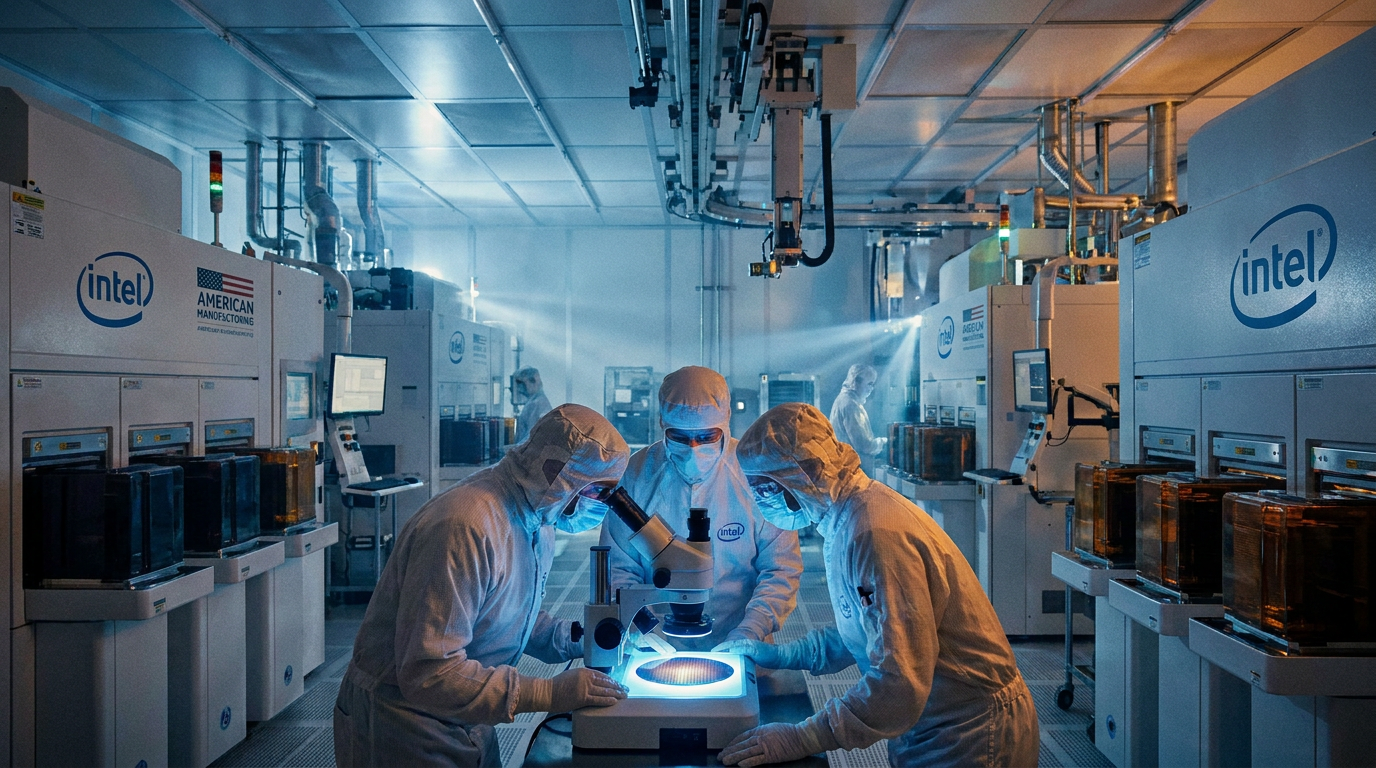
- Tech Industry Analysts
- Market analysts emphasize the practical business necessity of Apple securing a second major chip supplier.
- Domestic Manufacturing Advocates
- Proponents of US industrial policy view the deal as a triumph for national security and supply chain resilience.
- Market Bulls
- Investors are celebrating the financial windfall the partnership represents for Intel's revitalized foundry business.
What's not represented
- · Taiwanese Semiconductor Industry (TSMC)
- · Consumer Electronics Pricing Advocates
Why this matters
This partnership fundamentally reshapes the global technology supply chain, bringing the manufacturing of the world's most advanced consumer chips back to the United States. For consumers and investors, it signals a more resilient tech ecosystem that is less vulnerable to overseas manufacturing bottlenecks and geopolitical tensions.
Key points
- Apple has agreed to partner with Intel to design and manufacture advanced semiconductors in the United States.
- Intel shares surged as much as 12% to a record high of $135.13 following the announcement.
- The deal provides Apple with a crucial second manufacturing source amid severe capacity constraints at TSMC.
- The US government's 10% equity stake in Intel, acquired in 2025, has ballooned in value to roughly $60 billion.
- The broader semiconductor sector, including AMD and Micron, rallied on the news of revitalized domestic hardware production.
Intel Corporation's stock skyrocketed to record highs on Thursday following the revelation of a landmark partnership with Apple to design and manufacture advanced semiconductors in the United States. The agreement marks a watershed moment for the American tech industry, signaling a massive shift in the global supply chain for artificial intelligence and consumer electronics.[1][2]
Shares of the Santa Clara-based chipmaker surged as much as 12% during intraday trading, briefly touching an all-time high of $135.13. The rally extended a historic turnaround for Intel, whose stock has more than tripled over the past year as it aggressively rebuilt its foundry business to compete for external clients.[4][5]
The broader semiconductor sector caught the tailwind, with the Philadelphia Semiconductor Index climbing nearly 5%. Competitors and partners alike, including Micron Technology, Marvell Technology, and AMD, saw significant gains as investors cheered the revitalization of domestic hardware production and the easing of supply chain anxieties.[3][5]

President Donald Trump announced the partnership on social media, framing the Apple-Intel alliance as the culmination of a multi-year effort to repatriate critical technology manufacturing. "Apple has agreed to work with Intel to design and build its Chips in America," the President stated, emphasizing that the technology the world relies on must be built on US soil.[2][3]
For Apple, the pivot to Intel is driven by hard business realities as much as political pressure. The Cupertino giant has historically relied almost exclusively on Taiwan Semiconductor Manufacturing Company (TSMC) for its cutting-edge silicon. However, the explosive global demand for AI infrastructure has left TSMC's fabrication plants severely overbooked.[6]
For Apple, the pivot to Intel is driven by hard business realities as much as political pressure.
During Apple's most recent earnings call, CEO Tim Cook acknowledged that iPhone production had been constrained because TSMC could not output enough chips to meet demand. With TSMC prioritizing massive orders from AI heavyweights like Nvidia, Apple found itself waiting in line, leaving potential sales on the table because its sole supplier was overwhelmed.[6]
Industry analysts note that Intel is currently the only viable second source capable of scaling up advanced capacity to meet Apple's immense volume requirements. By diversifying its supply chain to include a domestic manufacturer, Apple secures a crucial capacity hedge while simultaneously navigating the geopolitical anxieties surrounding Taiwan.[4][6]

The deal represents a crowning achievement for Intel CEO Lip-Bu Tan, who has staked the company's future on opening its fabrication plants to external customers. Recent reports indicate that Intel has already begun risk production on its most advanced manufacturing node, known as 18A-P, proving it can compete at the bleeding edge of silicon technology.[2][4]
The US government's unique role in Intel's resurgence adds an unprecedented layer to the partnership. In 2025, the administration converted billions in CHIPS Act grants into a 10% equity stake in the company. That stake, originally valued at $10 billion, has now ballooned to over $60 billion, making the government a highly successful co-investor.[2][6]
This public-private alignment has transformed Intel into a national champion for the AI era. The Apple agreement follows similar domestic manufacturing commitments from Nvidia and Elon Musk's Terafab project, all of which have chosen Intel's US facilities to build their next-generation hardware.[3][4]

While neither Apple nor Intel has released the specific financial terms or production timelines of the new contract, the market has clearly priced in a massive revenue windfall for Intel's foundry division. The company's recent quarterly results already showed its foundry operating losses narrowing, and a flagship client like Apple is expected to accelerate its path to profitability.[5][7]
Looking ahead, the tech industry will be watching closely to see how quickly Apple can transition its complex silicon architectures to Intel's manufacturing nodes. If executed successfully, the partnership will not only secure Apple's supply chain but permanently cement the United States as a premier hub for advanced semiconductor manufacturing.[1][6]
How we got here
Aug 2022
The US passes the CHIPS and Science Act, allocating billions to revive domestic semiconductor manufacturing.
May 2024
Intel accelerates its foundry business model, aiming to manufacture chips for external clients.
Aug 2025
The US government converts CHIPS Act grants into a 10% equity stake in Intel, valued at $10 billion.
May 2026
Reports emerge of preliminary talks between Apple and Intel for domestic chip production.
Jun 18, 2026
The Apple-Intel partnership is officially confirmed, sending Intel shares to record highs.
Viewpoints in depth
Domestic Manufacturing Advocates
Proponents of US industrial policy view the deal as a triumph for national security and supply chain resilience.
For years, policymakers and defense experts have warned about the strategic vulnerability of relying on a single overseas region for the world's most advanced semiconductors. Advocates for domestic manufacturing see the Apple-Intel pact as the ultimate validation of recent US industrial policy. By successfully repatriating the production of the most ubiquitous consumer technology on the planet, they argue the US has significantly insulated its tech economy from geopolitical shocks and overseas shipping bottlenecks.
Tech Industry Analysts
Market analysts emphasize the practical business necessity of Apple securing a second major chip supplier.
While the political optics are highly favorable, tech analysts point out that Apple's hand was largely forced by the global AI boom. With TSMC's fabrication plants running at maximum capacity to satisfy Nvidia and AMD, Apple could no longer afford to rely on a single supplier without risking severe product shortages. Analysts view Intel as the only company with the capital and technical roadmap capable of scaling up to meet Apple's massive volume requirements, making this partnership a vital capacity hedge.
Market Bulls
Investors are celebrating the financial windfall the partnership represents for Intel's revitalized foundry business.
Wall Street has aggressively rewarded Intel's strategic pivot, driving the stock to record highs. Financial bulls argue that securing Apple as an anchor tenant for Intel's US foundries guarantees years of steady, high-volume revenue. Furthermore, investors are highly optimistic about the government's 10% equity stake in the company, viewing the unprecedented public-private alignment as a guarantee that Intel will receive whatever support it needs to succeed against international competitors.
What we don't know
- The specific financial terms and duration of the Apple-Intel manufacturing contract.
- Exactly which generation of Apple silicon will be the first to roll off Intel's US production lines.
- How TSMC will adjust its capacity allocation in response to losing a portion of Apple's exclusive business.
Key terms
- Foundry
- A semiconductor manufacturing facility that builds chips designed by other companies.
- Node
- A specific generation of semiconductor manufacturing technology; smaller nodes generally indicate more advanced, efficient chips.
- 18A-P
- Intel's cutting-edge manufacturing process, designed to compete with the most advanced chips produced globally.
- Silicon Wafer
- A thin slice of semiconductor material used as the base for fabricating integrated circuits.
- Risk Production
- The early stage of manufacturing a new chip design to test the process before full-scale commercial volume production begins.
Frequently asked
Why is Apple partnering with Intel?
Apple needs a reliable second source for its chips because its primary supplier, TSMC, is heavily backlogged with orders from AI companies like Nvidia.
Does the US government own part of Intel?
Yes, in 2025 the US government converted previous manufacturing grants into a 10% equity stake in Intel, which is now valued at roughly $60 billion.
What does this mean for iPhone production?
The deal is expected to secure a steady supply of advanced chips for future Apple devices, preventing the production bottlenecks the company recently experienced.
Are other companies building chips in the US?
Yes, Intel has also secured commitments to manufacture chips domestically for Nvidia and Elon Musk's Terafab project.
Sources
Source coverage
7 outlets
3 viewpoints surfaced







[1]BloombergMarket Bulls
Intel Surges on Apple Deal | Open Interest 6/18/2026
Read on Bloomberg →[2]Investing.comDomestic Manufacturing Advocates
Intel soars after Trump says Apple agreed to work with chipmaker on US production
Read on Investing.com →[3]Seeking AlphaDomestic Manufacturing Advocates
Apple, Intel strike US chip manufacturing deal, Trump says
Read on Seeking Alpha →[4]Quiver QuantitativeTech Industry Analysts
Intel shares surge after Trump announces Apple chipmaking partnership
Read on Quiver Quantitative →[5]NDTV ProfitMarket Bulls
Apple Deal Effect: Intel Drives AI Chip Rally With 12% Gains; AMD, Micron Join Rally
Read on NDTV Profit →[6]IndMoneyTech Industry Analysts
Intel Stock Jumps 9% on Apple Chip Deal: The Full Story Behind the INTC Rally
Read on IndMoney →[7]GuruFocusMarket Bulls
Intel Corp (INTC) Surges 10.67% Following Apple Partnership Announcement
Read on GuruFocus →

Every angle. Every day.
Get business stories with full source coverage and perspective breakdowns delivered to your inbox.