
How to Write an AI-Proof Resume: The 2026 Guide to Beating ATS Filters
With over 75% of resumes rejected by automated software before reaching a human, optimizing for Applicant Tracking Systems (ATS) is now mandatory. Here is how to format, structure, and write a resume that clears the parsing algorithms and impresses recruiters.
By Factlen Editorial Team
- Career Strategists & Coaches
- Focus on empowering candidates with the right formatting and keyword strategies to bypass automated filters and reach human recruiters.
- Recruiting Technologists
- Focus on the mechanics of parsing, LLM-based semantic matching, and how ATS platforms efficiently process massive volumes of applications.
- Security & Verification Analysts
- Focus on the vulnerabilities of text-based AI screening, highlighting how perfectly optimized resumes can sometimes mask synthetic identities or fraud.
What's not represented
- · Hiring Managers who receive the final shortlisted resumes
- · Candidates who have been unfairly filtered out by algorithmic bias
Why this matters
Understanding how AI and ATS parsers read your resume is the difference between landing an interview and falling into a digital black hole. By stripping away complex formatting and aligning your language with the parsing algorithms, you can ensure your actual qualifications are seen by human decision-makers.
Key points
- Over 75% of resumes are rejected by automated software before a human recruiter ever sees them.
- The most reliable format for passing an ATS is a clean, single-column, reverse-chronological layout.
- Complex graphics, tables, and two-column designs cause parsing failures that merge text into gibberish.
- Candidates must mirror the exact keywords and phrases from the job description to score highly in the ranking layer.
- While AI screening is fast, it struggles with identity verification, allowing 63% of fraudulent applicants to pass the initial filters.
The modern job hunt is no longer just about impressing a hiring manager. It is about surviving a gauntlet of software. When you hit submit on a job application in 2026, your resume does not go directly to a person; it goes to an Applicant Tracking System (ATS).[1][2]
The reality of this digital gatekeeping is stark. Industry data shows that up to 75 percent of resumes are rejected by these systems before a human ever glances at them. This massive filter operates not because the candidates lack the right qualifications, but because their documents are fundamentally unreadable to the software designed to evaluate them.[1][7]
To understand how to build an "AI-proof" resume, you have to understand the audience. A modern resume must survive four distinct readers before an interview is ever scheduled: the document parser, the keyword ranking model, the AI hiring assistant that summarizes the profile, and finally, the human recruiter.[4]
The first hurdle is the parser, and it is where the majority of applicants fail. ATS platforms are designed to extract text from a document and convert it into structured data fields, categorizing your name, contact information, work history, and skills.[1][5]

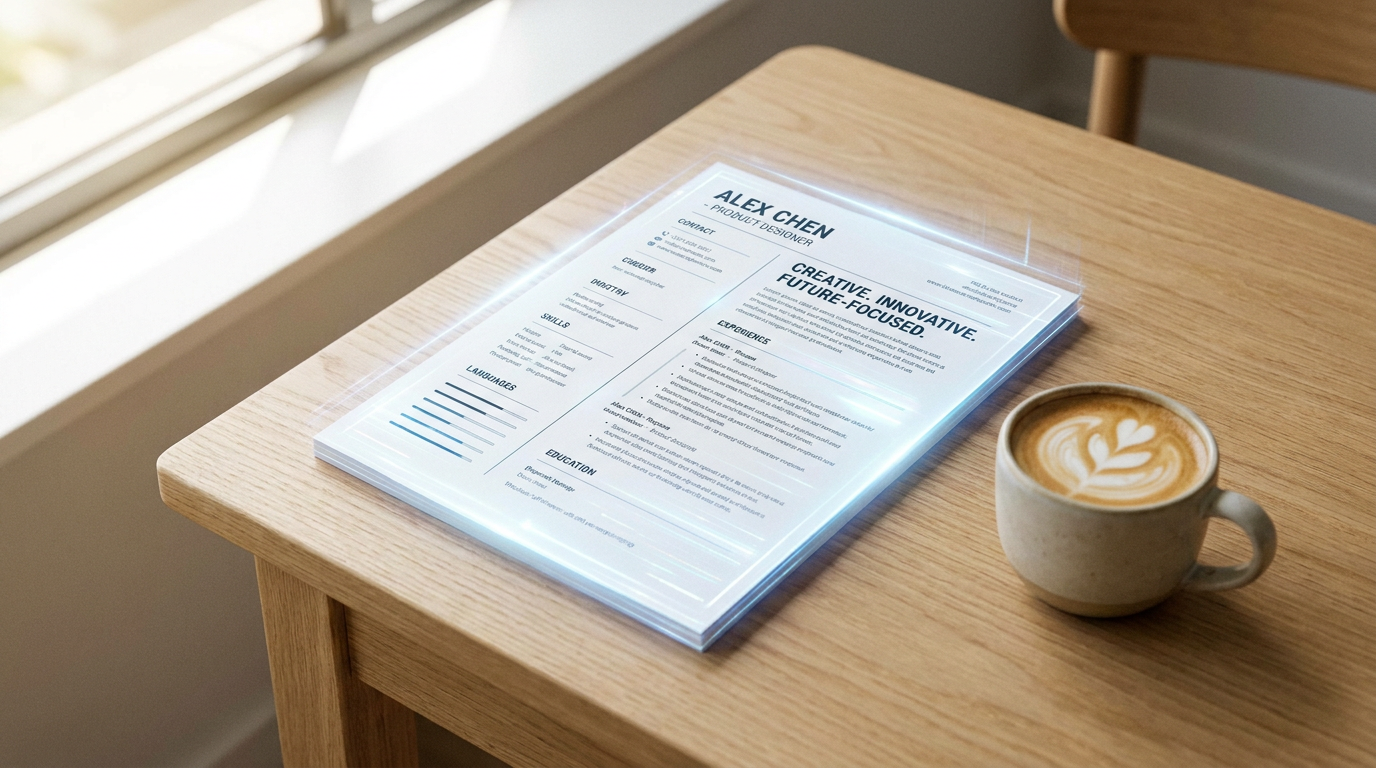
When a candidate submits a highly designed, multi-column resume from a graphic design template, the parser breaks. ATS software reads strictly from top-to-bottom and left-to-right. It cannot process two columns simultaneously, meaning it often merges the text from both sides into an unreadable block of gibberish.[1][3]
The solution is a strict return to simplicity. The most ATS-safe format in 2026 is a single-column, reverse-chronological layout. Testing across major enterprise platforms shows that this clean, linear structure achieves a 95 to 99 percent parse accuracy.[3][7]
Formatting rules for these systems are rigid. Candidates must strip out tables, text boxes, headers, footers, and complex graphics. Even a simple profile photo or a graphical "skill bar" can cause the software to discard the entire section, assuming it is corrupted data.[1][5]
Font choice and file type also play a crucial role in machine readability. Standard system fonts like Arial, Calibri, and Helvetica are universally recognized by parsing engines. Unless a job posting specifically requests a Microsoft Word document, a text-selectable PDF is the safest file format to preserve the layout while remaining perfectly legible to the software.[2][3]

Font choice and file type also play a crucial role in machine readability.
Once the resume is successfully parsed into structured data, it moves to the ranking layer. Here, the ATS scores the candidate's extracted profile against the specific requirements of the job description. This is where keyword optimization becomes the deciding factor.[7]
The system looks for exact matches to validate competency. If a job description asks for "project management" and the resume says "managing projects," legacy ATS parsers may not make the connection. Candidates must mirror the exact phrasing, software names, and certifications listed in the job posting.[1][5]
However, keyword stuffing—the old trick of pasting the entire job description in white text at the bottom of the page—no longer works. Modern AI screening tools easily detect hidden text and will flag the application for manipulation, often resulting in an automatic rejection.[1]
While older ATS platforms rely on rigid, one-to-one keyword matching, the 2026 landscape increasingly features Large Language Models (LLMs). These advanced systems evaluate semantic context, meaning they can assess whether a candidate actually used a skill in a meaningful way or just listed it in a vacuum.[4]
Because of this shift toward semantic understanding, the experience section must focus on outcomes rather than daily duties. Instead of writing that you "managed a sales team," an optimized bullet point reads, "Led a 12-person sales team that exceeded quarterly targets by 23 percent." Numbers provide a strong, undeniable signal to both the AI ranking model and the human recruiter.[5][7]
Standard section headings are equally critical for guiding the parser. Creative titles like "My Journey" or "Superpowers" confuse the algorithm, causing it to miscategorize your experience. Candidates must use universally recognized headers: Professional Summary, Work Experience, Education, and Skills.[1][5]

Interestingly, the rapid adoption of AI screening has created a new vulnerability in the enterprise hiring process: sophisticated fraud. Because ATS software parses text but cannot independently verify identity, synthetic applicants are slipping through the cracks.[6]
Security analysts report that 63 percent of fraudulent applicants—using fabricated employment histories and stolen credentials—successfully pass AI resume screening. They achieve this by submitting perfectly formatted, keyword-optimized documents that score flawlessly against the job description.[6]
This gap between parsing speed and identity verification means that while AI can rank a resume in seconds, it cannot tell if the person behind it is real. As a result, enterprise companies are beginning to layer dedicated fraud-detection software on top of their standard ATS platforms to catch inconsistencies before an interview is booked.[6]
For legitimate job seekers, the takeaway is clear: the goal is not to trick the machine. An AI-proof resume is simply a highly structured document that leaves no room for algorithmic misinterpretation.[4]
By combining a clean, single-column format with exact keyword matching and quantified achievements, candidates can ensure their experience speaks for itself. The software is just the gatekeeper; the ultimate goal is to give the human recruiter exactly what they need to make a confident hiring decision.[8]
How we got here
Early 2000s
Applicant Tracking Systems emerge as basic digital filing cabinets for enterprise HR departments.
2010s
ATS platforms introduce automated keyword parsing, leading to the rise of 'keyword stuffing' tactics by applicants.
2023
Generative AI and Large Language Models (LLMs) are integrated into screening tools, allowing software to evaluate semantic context.
2025
Over 98% of Fortune 500 companies rely on ATS software to manage massive volumes of inbound applications.
2026
AI resume screening becomes the universal standard, prompting a shift back to highly structured, single-column resume formats to ensure machine readability.
Viewpoints in depth
Career Strategists
Advocating for candidate empowerment through strict formatting rules.
Career coaches and resume strategists emphasize that the modern job hunt is fundamentally a technical challenge before it becomes a human one. They argue that highly qualified candidates are routinely discarded simply because they use multi-column templates or creative fonts that break parsing algorithms. Their primary advice is to strip away all design elements, use a single-column reverse-chronological layout, and meticulously mirror the exact keywords found in the job description to ensure the resume reaches a human reader.
Recruiting Technologists
Focusing on the efficiency and evolution of semantic AI screening.
For HR technologists and platform developers, ATS software is a necessary solution to an impossible volume of inbound applications. They point out that enterprise companies simply cannot manually review thousands of resumes per role. Technologists highlight that the industry is rapidly moving away from rigid keyword matching toward Large Language Models (LLMs) that understand semantic context. This means modern systems are getting better at evaluating whether a candidate actually possesses a skill based on their described outcomes, rather than just counting how many times a word appears.
Security Analysts
Warning about the vulnerabilities of text-based algorithmic screening.
Cybersecurity and fraud detection experts view the current ATS landscape as highly vulnerable. Because these systems are designed to parse text and match keywords, they are easily manipulated by bad actors using synthetic identities or AI-generated work histories. Analysts note that a perfectly optimized, keyword-rich resume can easily score in the top percentile, allowing fraudulent applicants to bypass the software entirely. They argue that the hiring stack must evolve beyond text parsing to include robust, upfront identity verification.
What we don't know
- How quickly smaller and mid-sized companies will adopt the advanced LLM-based semantic matching tools currently used by enterprise corporations.
- Whether new anti-fraud verification layers will eventually require candidates to submit biometric or cryptographic proof of identity alongside their resumes.
Key terms
- Applicant Tracking System (ATS)
- Software used by employers to collect, scan, sort, and rank job applications before human review.
- Parsing
- The process where software extracts text from a resume document and converts it into structured data fields like name, experience, and skills.
- Semantic Matching
- An advanced AI screening method that evaluates the context and meaning behind words, rather than just looking for exact keyword matches.
- Reverse-Chronological Format
- A resume layout that lists your most recent work experience first and works backward in time, widely considered the most ATS-friendly structure.
- Synthetic Identity
- A fabricated persona created by combining real and fake information, increasingly used by fraudulent applicants to bypass automated screening.
Frequently asked
Should I use a PDF or a Word document for my resume?
A text-selectable PDF is generally the safest choice because it preserves your formatting across different devices. However, if a job posting specifically requests a .docx file, always follow their instructions.
Do two-column resume templates work with ATS?
No. Most ATS parsers read left-to-right and top-to-bottom, meaning they will jumble the text of a two-column layout into an unreadable mess. Always use a single-column format.
How do I know which keywords to include?
Read the target job description carefully and identify the specific skills, software tools, and methodologies mentioned. Mirror those exact phrases in your resume's skills and experience sections.
Can I use white text to hide keywords in my resume?
No. Modern ATS platforms and AI screening tools easily detect hidden text and will flag your application for manipulation, often resulting in an automatic rejection.
Sources
Source coverage
8 outlets
3 viewpoints surfaced








[1]Dev CommunityCareer Strategists & Coaches
The 7 Rules of ATS-Friendly Resumes
Read on Dev Community →[2]KraftCVCareer Strategists & Coaches
ATS-Friendly Resume Templates and Formatting Rules
Read on KraftCV →[3]QuickResume AICareer Strategists & Coaches
The Best ATS Resume Format for 2026
Read on QuickResume AI →[4]ResumeVeraRecruiting Technologists
The AI-Proof Resume: How to Write a Resume That Survives AI Screening in 2026
Read on ResumeVera →[5]HR TailorCareer Strategists & Coaches
ATS Resume Optimization Guide 2026: Format, Keywords & Checklist
Read on HR Tailor →[6]HireTofuSecurity & Verification Analysts
AI Resume Screening and the Rise of Applicant Fraud
Read on HireTofu →[7]Sensei CopilotCareer Strategists & Coaches
The Best ATS Resume Format (Recommended Structure)
Read on Sensei Copilot →[8]Factlen Editorial TeamRecruiting Technologists
Synthesis by Factlen editorial team
Read on Factlen Editorial Team →

Every angle. Every day.
Get careers work stories with full source coverage and perspective breakdowns delivered to your inbox.