
How Property Rights and Market Incentives Are Being Used to Save Nature
A growing movement known as free-market environmentalism is challenging traditional government regulation, arguing that turning wildlife and habitats into economic assets is the most effective way to protect them.
By Factlen Editorial Team
- Free-Market Environmentalists
- Argue that property rights, market incentives, and deregulation are the most effective tools for conservation, turning wildlife into an asset.
- Traditional Conservationists
- Believe that government regulation, public land ownership, and strict penalties are necessary to protect nature from corporate exploitation.
- Pragmatic Integrationists
- Support using market mechanisms like cap-and-trade, but argue they must operate within a framework of government-set caps or baseline regulations.
What's not represented
- · Indigenous communities managing traditional lands outside of Western property-rights frameworks
- · Environmental justice advocates focused on the localized impacts of pollution trading
Why this matters
Traditional environmental debates often force a choice between economic growth and ecological preservation. By harnessing the profit motive to protect natural resources, this framework offers a cooperative, bipartisan path to solving some of the world's most stubborn conservation challenges.
Key points
- Free-market environmentalism uses property rights and market incentives to protect nature, rather than relying on government regulation.
- Traditional regulations like the Endangered Species Act can inadvertently encourage landowners to destroy habitats to avoid heavy financial penalties.
- Devolving wildlife ownership to local communities in Southern Africa successfully turned endangered species into valuable assets, reducing poaching.
- Tradable catch shares have solved the tragedy of the commons in global fisheries by giving fishers a financial stake in long-term sustainability.
- Market-based cap-and-trade systems successfully reduced the sulfur dioxide emissions causing acid rain at a fraction of the predicted cost.
- Critics note that market solutions struggle with resources that cannot be easily owned, such as the global atmosphere and climate change.
For decades, the standard approach to protecting the environment has relied on a simple mechanism: government regulation. When a river is polluted or a forest is threatened, the instinct of most policymakers is to pass a law, establish an agency, and issue fines to those who break the rules. This command-and-control model birthed the Environmental Protection Agency and landmark legislation like the Endangered Species Act. It operates on the assumption that economic growth and environmental preservation are inherently at odds, and that only strict federal oversight can prevent the destruction of nature.[5]
But a growing movement known as free-market environmentalism is challenging that fundamental assumption. Instead of viewing the free enterprise system as the enemy of ecology, this framework argues that property rights, voluntary contracts, and market incentives are actually the most powerful tools available for conservation. By turning wildlife and natural habitats from financial liabilities into valuable assets, free-market environmentalism seeks to align human economic interests with the health of the planet.[1][7]
The intellectual home of this movement is the Property and Environment Research Center (PERC), a think tank founded in Bozeman, Montana, in 1980. The economists who established PERC posed a provocative question: if free markets are incredibly efficient at producing food, technology, and housing, why couldn't those same market forces be harnessed to produce environmental protection? They argued that environmental degradation is rarely the result of too much capitalism, but rather a failure to properly define who owns a resource.[1][3]
To understand the free-market critique of traditional regulation, one only has to look at the unintended consequences of the Endangered Species Act (ESA). Under the ESA, if a landowner discovers a federally protected animal on their property, the government can immediately restrict how that land is used. The landowner might be barred from harvesting timber, building a home, or planting crops, potentially wiping out their livelihood.[2]
Because the law relies heavily on penalties—including massive fines and potential jail time—it inadvertently creates a perverse incentive. A rare bird nesting in a farmer's field is not viewed as a beautiful natural wonder; it is viewed as a severe financial threat. This dynamic has led to a quiet, destructive phenomenon known in rural communities as "shoot, shovel, and shut up," where landowners preemptively destroy habitats to avoid government detection and regulation.[2][6]

Free-market environmentalists argue that the solution is not more federal policing, but a shift in incentives. If a landowner could somehow profit from harboring an endangered species—perhaps through eco-tourism, hunting leases, or conservation credits—they would actively cultivate the habitat. When an animal is owned or valued by the people who live alongside it, it rarely goes extinct. Cattle and chickens are not endangered precisely because they have immense economic value to their owners.[1][6]
One of the most striking validations of this theory occurred in Southern Africa. Following its independence in 1990, Namibia lacked the resources to enforce a strict, American-style regulatory regime over its vast wilderness. Instead, the government devolved the rights to manage and profit from wildlife to local communities and tribes, encouraging them to form conservancies.[4]
By giving local people a property right over the animals in their region, the government transformed wildlife from a dangerous nuisance into a vital economic engine. Communities began earning substantial revenue from photographic safaris and strictly controlled hunting. Because the animals were now the source of their wealth, locals who might have previously turned a blind eye to poaching—or engaged in it themselves—were hired as highly motivated guards. As a result, populations of black rhinos, elephants, and lions rebounded dramatically.[4]
By giving local people a property right over the animals in their region, the government transformed wildlife from a dangerous nuisance into a vital economic engine.
A similar market-driven revolution has transformed global fisheries. For centuries, the open ocean suffered from the tragedy of the commons. Because nobody owned the fish until they were pulled onto a boat, every fisherman had an incentive to catch as much as possible, as quickly as possible, before a rival fleet could get to them. This race to the bottom led to the catastrophic collapse of fisheries worldwide.[1][5]
The free-market solution was the introduction of catch shares, or Individual Transferable Quotas. Under this system, regulators determine a safe total allowable catch for a season, and then divide that total into percentage shares allocated to individual fishermen. Crucially, these shares are treated as private property that can be bought, sold, or leased.[1][3]
The introduction of property rights instantly changed the economic calculus on the water. Because a fisherman is guaranteed their specific percentage of the catch, the frantic, dangerous race to out-fish competitors ends. More importantly, fishermen now have a vested financial interest in the long-term health of the fish population; if the total biomass grows, the value of their individual share increases. Catch shares have successfully reversed the decline of dozens of major fisheries globally.[1]

In the United States, a new generation of enviropreneurs is applying these principles to land and water conservation. Rather than lobbying politicians to pass new restrictions, these groups use private contracts to achieve their goals. Organizations like the Nature Conservancy frequently purchase commercial fishing rights off the California coast simply to retire them, reducing the pressure on marine life through voluntary exchange rather than legal battles.[6]
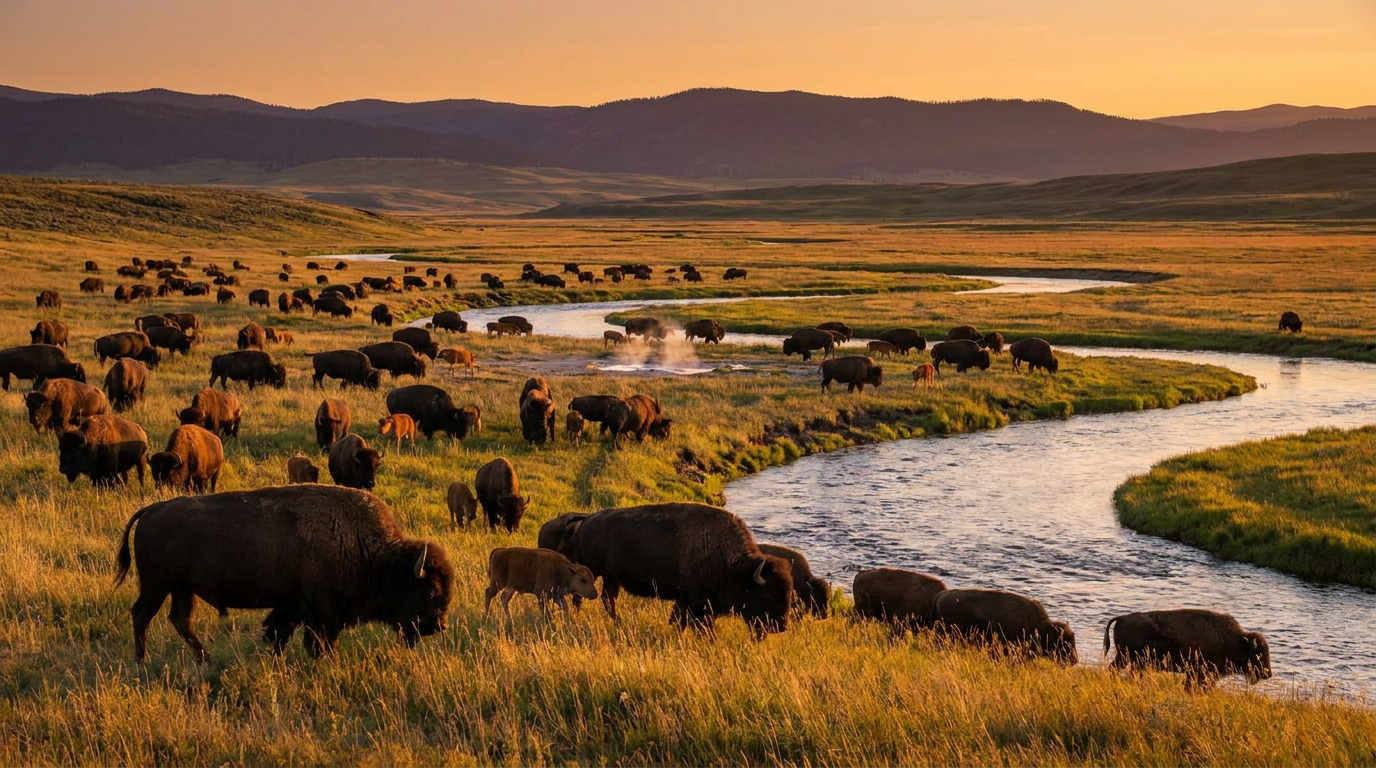
Private land ownership is also driving massive rewilding efforts. Media mogul Ted Turner purchased the 113,000-acre Flying D Ranch in Montana in 1989 with the explicit goal of restoring the native ecosystem. He replaced domestic cattle with bison, funding the massive conservation project through the commercial sale of bison meat. Today, Turner manages tens of thousands of bison across the American West, demonstrating how profit motives can successfully restore native species at a landscape scale.[4]
Even when government involvement is necessary, market mechanisms have proven vastly superior to rigid mandates. The classic example is the fight against acid rain in the 1990s. Rather than dictating exactly which technologies power plants had to install to reduce sulfur dioxide emissions, the 1990 Clean Air Act amendments created a cap-and-trade system.[3][5]
The government set a firm cap on total emissions and issued tradable permits to power companies. Facilities that could reduce their pollution cheaply did so, and then sold their excess permits to older plants that faced higher upgrade costs. This market-based approach achieved a 50 percent reduction in sulfur dioxide emissions faster than anyone predicted, and at an estimated savings of $1 billion per year compared to traditional command-and-control regulations.[5]

Despite these successes, free-market environmentalism is not a universal panacea, and mainstream ecologists often point out its limitations. The primary criticism is that markets require clearly defined property rights to function, and some natural resources simply cannot be fenced or owned. It is relatively easy to assign property rights to a herd of bison or a specific tract of timber, but nearly impossible to do so for the open atmosphere or a river that crosses multiple international borders.[5]
Global climate change represents the ultimate challenge for the free-market model. Because greenhouse gases mix globally, the costs of carbon emissions are externalized onto the entire planet, making it incredibly difficult for private contracts or local property rights to solve the problem without some form of overarching government intervention to set a price on carbon.[5][7]
Ultimately, the most effective environmental strategies of the 21st century are likely to be hybrids. While pure libertarian models may struggle with global atmospheric issues, the core insight of free-market environmentalism remains undeniable: conservation is vastly more successful when it works with human nature rather than against it. By turning ecological health into an economic asset, society can recruit the immense power of the free market to protect the natural world.[3][7]
How we got here
1980
The Property and Environment Research Center (PERC) is founded in Montana to explore market-based solutions to ecological problems.
1989
Ted Turner purchases the Flying D Ranch, beginning a massive private rewilding project funded by commercial bison sales.
1990
The Clean Air Act amendments introduce a highly successful cap-and-trade market to reduce the sulfur dioxide emissions causing acid rain.
1990s
Namibia and other Southern African nations begin devolving wildlife property rights to local communities, sparking a recovery in endangered species.
Viewpoints in depth
The Free-Market View
Conservation works best when it aligns with human economic incentives.
Proponents of free-market environmentalism argue that the root cause of ecological destruction is not capitalism, but a lack of defined property rights. When resources like the open ocean or the atmosphere are unowned, individuals have an incentive to exploit them before someone else does—a dynamic known as the tragedy of the commons. By assigning property rights, whether through catch shares in fisheries or private ownership of wildlife conservancies, individuals gain a direct financial stake in the long-term health of the resource. This approach replaces the adversarial relationship between landowners and regulators with voluntary cooperation and innovation.
The Regulatory View
Strict government oversight is required to prevent the exploitation of vulnerable ecosystems.
Mainstream environmental organizations and traditional ecologists often express skepticism that the profit motive can be entirely trusted to protect nature. They point out that many critical environmental assets—such as the global climate, migratory bird routes, and complex river systems—cannot be easily divided into private property. From this perspective, landmark laws like the Endangered Species Act and the Clean Water Act, while imperfect, provide a necessary baseline of protection. Without the threat of government penalties, critics argue, industries would simply externalize the costs of pollution onto the public, prioritizing short-term profits over long-term ecological stability.
What we don't know
- How effectively free-market mechanisms can be scaled to address global, borderless issues like atmospheric carbon emissions.
- Whether the financialization of nature might inadvertently price out local communities from accessing traditional lands or resources.
Key terms
- Free-Market Environmentalism
- An approach to conservation that uses property rights, market incentives, and voluntary contracts rather than government regulation.
- Enviropreneur
- An entrepreneur who uses market mechanisms and private property rights to solve environmental problems.
- Cap-and-Trade
- A system where a government sets a limit on pollution but allows companies to buy and sell permits, using the market to find the cheapest way to reduce emissions.
- Tragedy of the Commons
- An economic principle where individuals have an incentive to over-consume an unowned resource before others do, leading to its rapid depletion.
- Catch Shares
- A fishery management system that allocates a secure privilege to harvest a specific percentage of a fishery's total catch to individuals or communities.
Frequently asked
What is free-market environmentalism?
An approach to conservation that relies on property rights, voluntary contracts, and market incentives rather than government regulation to protect natural resources.
How does the Endangered Species Act sometimes harm animals?
By imposing heavy fines and land-use restrictions, it inadvertently encourages some landowners to destroy habitats before the government notices, a phenomenon known as 'shoot, shovel, and shut up.'
What are catch shares in fishing?
A system that gives fishers a tradable property right to a percentage of the total allowable catch, incentivizing them to protect the long-term health of the fishery.
What is a conservation easement?
A voluntary legal agreement where a landowner is paid or receives tax benefits in exchange for permanently limiting development on their property to protect its ecological value.
Sources
Source coverage
7 outlets
3 viewpoints surfaced







[1]Property and Environment Research Center (PERC)Free-Market Environmentalists
What is Free Market Environmentalism?
Read on Property and Environment Research Center (PERC) →[2]Reason FoundationFree-Market Environmentalists
The Importance of Property Rights for Successful Endangered Species Conservation
Read on Reason Foundation →[3]Philanthropy RoundtablePragmatic Integrationists
Soaring High: The Rise of Free Market Environmentalism
Read on Philanthropy Roundtable →[4]Patrolling MagazinePragmatic Integrationists
Free Market Environmentalism and African Wildlife Conservation
Read on Patrolling Magazine →[5]EBSCO SustainabilityTraditional Conservationists
Free Market Environmentalism: Principles and Criticisms
Read on EBSCO Sustainability →[6]Conscious ConnectionFree-Market Environmentalists
Free Market Environmentalism Explained
Read on Conscious Connection →[7]Factlen Editorial TeamPragmatic Integrationists
Synthesis by Factlen editorial team
Read on Factlen Editorial Team →
Every angle. Every day.
Get perspectives stories with full source coverage and perspective breakdowns delivered to your inbox.