
How Nuclear Thermal Propulsion Could Halve Travel Time to Mars
By replacing chemical combustion with a fission reactor, nuclear thermal rockets offer double the efficiency of traditional engines, paving the way for faster, safer deep-space exploration.
By Factlen Editorial Team
- Aerospace Engineers & Researchers
- This camp views nuclear thermal propulsion as the only viable physics solution for deep-space logistics.
- Deep Space Astronauts & Flight Surgeons
- Medical experts prioritize NTP for its ability to drastically reduce human exposure to deep-space hazards.
- Planetary Protection & Safety Advocates
- Safety watchdogs focus on the strict protocols required to launch nuclear material without risking terrestrial contamination.
What's not represented
- · Environmental Watchdogs
- · Commercial Launch Providers
Why this matters
Chemical rockets have reached their physical limits, making human missions to Mars dangerously long. Nuclear thermal propulsion breaks this bottleneck, promising to drastically reduce astronaut exposure to deep-space radiation while opening up the entire inner solar system to rapid transit.
Key points
- Nuclear thermal propulsion (NTP) uses a fission reactor to heat liquid hydrogen, replacing traditional chemical combustion.
- By operating at extreme temperatures, NTP engines can achieve double the fuel efficiency (specific impulse) of the best chemical rockets.
- This increased efficiency could cut the travel time to Mars from seven to nine months down to just three or four months.
- To ensure safety, the nuclear reactor remains completely inert during launch and is only activated once in a safe, high orbit.
- NASA and DARPA are collaborating on the DRACO program to demonstrate this technology in space by the late 2020s.
The fundamental problem of space travel is the tyranny of the rocket equation. To go faster, you need more fuel, but more fuel adds mass, which requires even more fuel to move. For decades, space agencies have relied on chemical propulsion—mixing a fuel and an oxidizer and igniting them to create thrust. While chemical rockets have successfully taken humanity to the Moon and sent probes beyond the solar system, they are fundamentally limited by the chemical energy stored in their propellants.[1][5]
This limitation becomes a severe bottleneck when planning human missions to Mars. Using traditional chemical propulsion, a journey to the Red Planet takes roughly seven to nine months one-way. During this extended transit, astronauts are exposed to high levels of cosmic radiation and the debilitating physiological effects of microgravity. To make deep-space human exploration viable and safe, engineers need a propulsion system that can drastically cut travel time.[1][4]
Enter Nuclear Thermal Propulsion (NTP). Unlike chemical rockets that rely on combustion, an NTP system uses a nuclear fission reactor to generate immense heat. This technology is not entirely new; the United States first researched it extensively during the NERVA program in the 1960s. However, modern advancements in materials science, reactor design, and fuel safety have brought NTP out of the archives and into active development, promising a paradigm shift in space logistics.[1][5]
The mechanism behind NTP is elegantly simple in concept, even if it is highly complex in execution. In a chemical rocket, two heavy liquids (like liquid oxygen and kerosene or hydrogen) are pumped into a combustion chamber and ignited. In a nuclear thermal rocket, there is no combustion and no oxidizer. Instead, the system relies on a single propellant—typically liquid hydrogen, which is the lightest element in the universe.[1][3]

The liquid hydrogen is stored at cryogenic temperatures, around minus 253 degrees Celsius. When the engine fires, powerful turbopumps force this super-chilled hydrogen into the nuclear reactor core. Inside the core, uranium atoms are undergoing controlled fission, splitting apart and releasing tremendous amounts of thermal energy. As the hydrogen flows through the reactor's intricate channels, it absorbs this heat, rapidly expanding.[3][5]
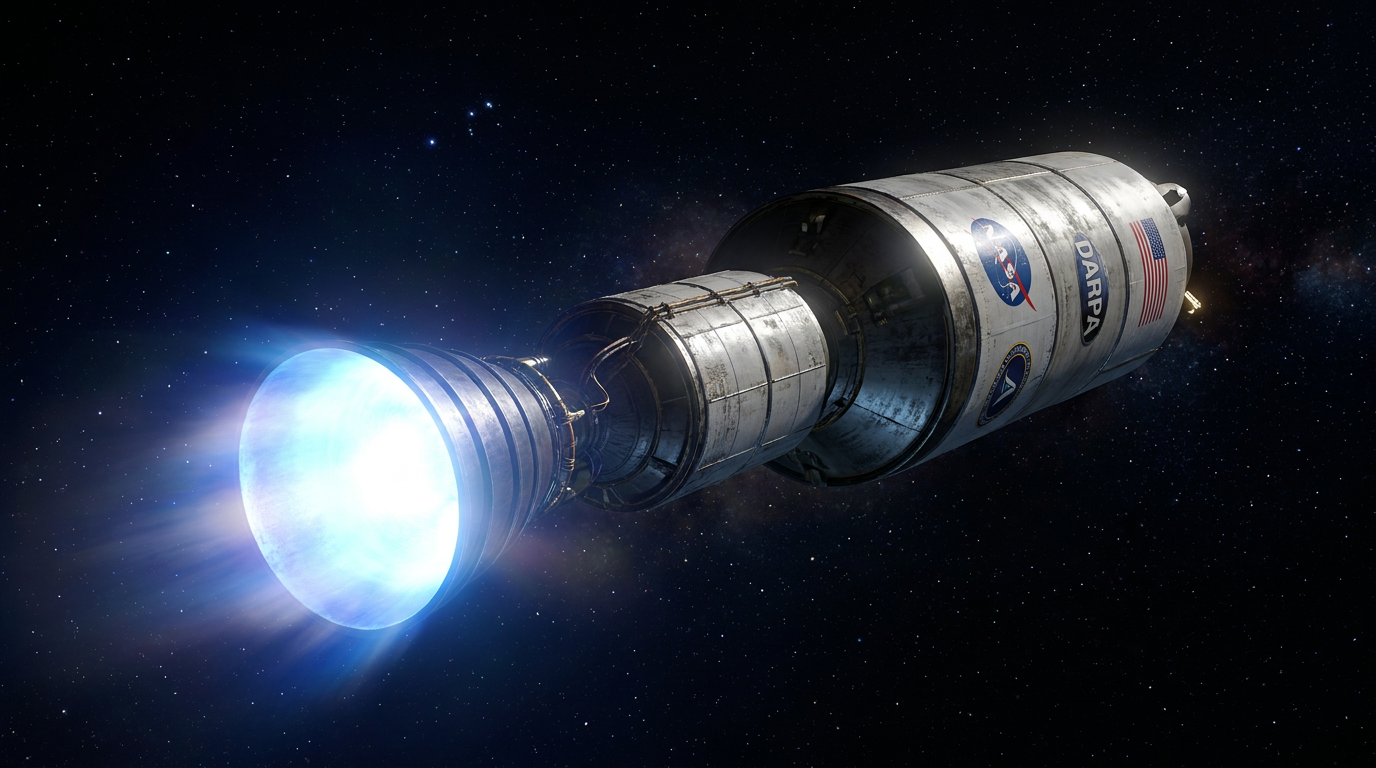
Within a fraction of a second, the hydrogen is heated to temperatures exceeding 2,700 degrees Celsius. This superheated, high-pressure gas is then funneled out through a converging-diverging nozzle at the back of the spacecraft. As the gas expands out of the nozzle, it accelerates to extraordinary velocities, producing thrust that pushes the spacecraft forward.[1][3]
Within a fraction of a second, the hydrogen is heated to temperatures exceeding 2,700 degrees Celsius.
The true advantage of NTP lies in a metric called specific impulse (Isp), which measures how efficiently a rocket uses its propellant. Think of it as the miles-per-gallon rating for a spacecraft. The best chemical rockets, like those using liquid hydrogen and liquid oxygen, max out at a specific impulse of about 450 seconds. Because an NTP engine uses pure, lightweight hydrogen and heats it to extreme temperatures, it can achieve a specific impulse of 900 seconds or more—double the efficiency of chemical combustion.[1][3][4]
This doubling of efficiency fundamentally changes the math of deep-space travel. With an Isp of 900 seconds, a spacecraft can accelerate to much higher speeds using the same amount of propellant mass. For a Mars mission, this means the transit time could be slashed from seven to nine months down to just three or four months.[1][4]

Halving the travel time solves several of the most daunting challenges of human spaceflight. It dramatically reduces the crew's exposure to galactic cosmic rays and solar radiation, which cannot be fully shielded against without adding prohibitive amounts of mass. It also lessens the physiological toll of zero gravity on bone density and muscle mass, and reduces the amount of food, water, and life-support consumables the ship must carry.[4][5]
To turn this physics theory into flight-ready hardware, NASA and the Defense Advanced Research Projects Agency (DARPA) have partnered on the Demonstration Rocket for Agile Cislunar Operations (DRACO) program. DRACO aims to build and fly an experimental NTP spacecraft in Earth orbit by the late 2020s. This mission will serve as a critical pathfinder, proving that a modern fission reactor can survive the intense vibrations of launch and operate reliably in the vacuum of space.[2][5]
A major focus of the DRACO program is safety, particularly regarding the launch phase. To prevent any risk of radioactive contamination on Earth, the nuclear reactor is designed to remain completely inert during liftoff. The spacecraft will be launched atop a conventional chemical rocket. Only after it has reached a safe, high orbit—where any atmospheric reentry would take thousands of years—will the reactor be activated for the first time.[2][4]

Modern NTP designs also utilize High-Assay Low-Enriched Uranium (HALEU) rather than the highly enriched weapons-grade uranium considered in the 1960s. HALEU provides the necessary energy density to heat the hydrogen propellant while remaining much safer to handle, transport, and process on the ground. This shift in fuel chemistry has been crucial in making the current generation of nuclear rockets politically and environmentally viable.[1][2]
Despite its immense promise, NTP does come with engineering trade-offs. The reactor generates intense radiation while operating, meaning the crew module must be heavily shielded. Engineers typically solve this by placing the reactor at the very rear of a long spacecraft, using the liquid hydrogen propellant tanks themselves as a radiation shadow-shield to protect the astronauts at the front.[3][5]

Beyond Mars, the high efficiency of nuclear thermal propulsion opens up the entire inner solar system. It enables rapid cislunar operations—moving heavy cargo swiftly between Earth and the Moon—and could eventually power robotic missions to the outer planets, cutting years off transit times to Jupiter and Saturn. By breaking the chemical bottleneck, NTP stands poised to be the workhorse of the next era of space exploration.[2][4][5]
How we got here
1960s
NASA and the Atomic Energy Commission successfully ground-test nuclear thermal rockets under the NERVA program.
1973
The NERVA program is canceled as post-Apollo budgets shrink and Mars plans are delayed.
2021
DARPA announces the DRACO program to develop a modern nuclear thermal propulsion system.
2023
NASA joins DARPA on the DRACO project, aiming to accelerate the technology for crewed Mars missions.
Late 2020s
The targeted launch window for the DRACO spacecraft's first in-orbit demonstration.
Viewpoints in depth
Aerospace Engineers & Researchers
This camp views nuclear thermal propulsion as the only viable physics solution for deep-space logistics.
For propulsion engineers, the appeal of NTP comes down to pure mathematics and the tyranny of the rocket equation. Chemical rockets have been optimized to their absolute physical limits over the last sixty years; there is simply no more efficiency to squeeze out of combusting hydrogen and oxygen. By decoupling the energy source (the reactor) from the propellant (the hydrogen), engineers can achieve exhaust velocities that are impossible with chemical bonds. Their primary focus now is materials science—specifically, developing reactor core components that can withstand highly corrosive, 2,700-degree hydrogen gas for hours at a time without degrading.
Deep Space Astronauts & Flight Surgeons
Medical experts prioritize NTP for its ability to drastically reduce human exposure to deep-space hazards.
Flight surgeons view transit time as the single greatest risk factor in a Mars mission. Beyond the protective bubble of Earth's magnetosphere, astronauts are bombarded by galactic cosmic rays and solar particle events, which increase cancer risks and can cause acute radiation sickness. Furthermore, prolonged microgravity degrades bone density, muscle mass, and cardiovascular health, meaning astronauts arriving after a nine-month chemical transit would require weeks of recovery before they could safely work on the Martian surface. By cutting the journey to three or four months, NTP significantly mitigates these biological risks, ensuring crews arrive healthy and ready to operate.
Planetary Protection & Safety Advocates
Safety watchdogs focus on the strict protocols required to launch nuclear material without risking terrestrial contamination.
While supportive of the technology's potential, safety advocates emphasize the catastrophic risks of launching nuclear reactors on top of controlled explosives (rockets). Their primary requirement is that the reactor must be launched 'cold'—meaning no fission reactions occur on the launch pad or during ascent. They advocate for stringent orbital activation protocols, ensuring the engine is only powered on once the spacecraft has achieved a sufficiently high orbit. In this safe zone, even if the spacecraft were to fail, orbital decay would take thousands of years, allowing any radioactive isotopes to safely decay long before the hardware could re-enter Earth's atmosphere.
What we don't know
- How well the reactor materials will hold up to superheated hydrogen over multiple engine restarts in the vacuum of space.
- The exact cost of scaling up HALEU fuel production to support a fleet of nuclear thermal spacecraft.
- Whether international regulatory frameworks will need to be updated to handle routine launches of inert nuclear reactors.
Key terms
- Specific Impulse (Isp)
- A measure of how efficiently a rocket engine uses its propellant, roughly equivalent to miles-per-gallon for a car.
- Nuclear Fission
- A reaction in which the nucleus of an atom splits into two or more smaller nuclei, releasing a massive amount of energy.
- Propellant
- The chemical mixture or gas that is expelled from a rocket to create thrust.
- Cislunar Space
- The volume of space between the Earth and the Moon.
- HALEU
- High-Assay Low-Enriched Uranium, a type of nuclear fuel that is safer to handle than highly enriched uranium but powerful enough for advanced reactors.
Frequently asked
Is the exhaust from a nuclear thermal rocket radioactive?
No. The liquid hydrogen propellant passes through the reactor to absorb heat, but it does not become radioactive itself. The exhaust is simply superheated hydrogen gas.
What happens if the rocket explodes on the launch pad?
The nuclear reactor is launched 'cold' and remains completely inert until the spacecraft reaches a safe orbit. An explosion on the pad would not trigger a nuclear reaction or release significant radiation.
Why didn't we use this technology for the Apollo missions?
While the US tested nuclear rockets in the 1960s under the NERVA program, chemical rockets were sufficient for the short three-day trip to the Moon. The technology was shelved when plans for a 1970s Mars mission were canceled.
Sources
Source coverage
5 outlets
3 viewpoints surfaced





[1]NASAAerospace Engineers & Researchers
Nuclear Thermal Propulsion: Game Changing Technology
Read on NASA →[2]DARPAPlanetary Protection & Safety Advocates
Demonstration Rocket for Agile Cislunar Operations (DRACO)
Read on DARPA →[3]American Institute of Aeronautics and AstronauticsAerospace Engineers & Researchers
Performance Analysis of Nuclear Thermal Propulsion Systems
Read on American Institute of Aeronautics and Astronautics →[4]Space.comDeep Space Astronauts & Flight Surgeons
Why nuclear rockets are the future of deep space travel
Read on Space.com →[5]Factlen Editorial TeamAerospace Engineers & Researchers
Synthesis by Factlen editorial team
Read on Factlen Editorial Team →
Every angle. Every day.
Get transportation stories with full source coverage and perspective breakdowns delivered to your inbox.