
How an Ancient Japanese Mold is Rewriting the Rules of Global Cuisine
Aspergillus oryzae, the fungus behind soy sauce and miso, has broken out of traditional boundaries to become the culinary world's most powerful tool for flavor innovation and sustainable protein.
By Factlen Editorial Team
- Fine Dining Innovators
- Chefs utilizing koji to accelerate aging and localize global terroir.
- Plant-Based Advocates
- Chefs using microbial fermentation to solve the umami deficit in vegan cuisine.
- Food Tech Scientists
- Researchers scaling fungal biomass as a sustainable global protein source.
What's not represented
- · Traditional Japanese Brewmasters (Toji)
- · Home Fermentation Hobbyists
Why this matters
Understanding koji demystifies the secret behind the world's best restaurant dishes and highlights a crucial pathway for the future of sustainable, resource-efficient food production.
Key points
- Aspergillus oryzae (koji) is an ancient mold traditionally used for Japanese sake, miso, and soy sauce.
- The mold produces powerful enzymes, including amylase and protease, which naturally tenderize food and unlock deep umami flavors.
- Global chefs are now using koji to rapidly dry-age meats in a fraction of the traditional time.
- Plant-based restaurants leverage koji to build complex, savory depth without relying on animal products or artificial additives.
- Food technology companies are scaling koji biomass as a highly sustainable, resource-efficient alternative to animal and soy proteins.
There is a living engine operating in the dark corners of the world’s most acclaimed kitchens. It does not require heat, a blade, or a flame. It requires only time, warmth, and a patient willingness to let biology accomplish what no amount of traditional cooking skill can replicate. For over a thousand years, this invisible workforce has been the quiet foundation of East Asian cuisine, buried inside the condiments that define regional flavor profiles. Today, it has broken out of the pantry and into the spotlight, becoming the most powerful natural tool in modern gastronomy.[5][7]
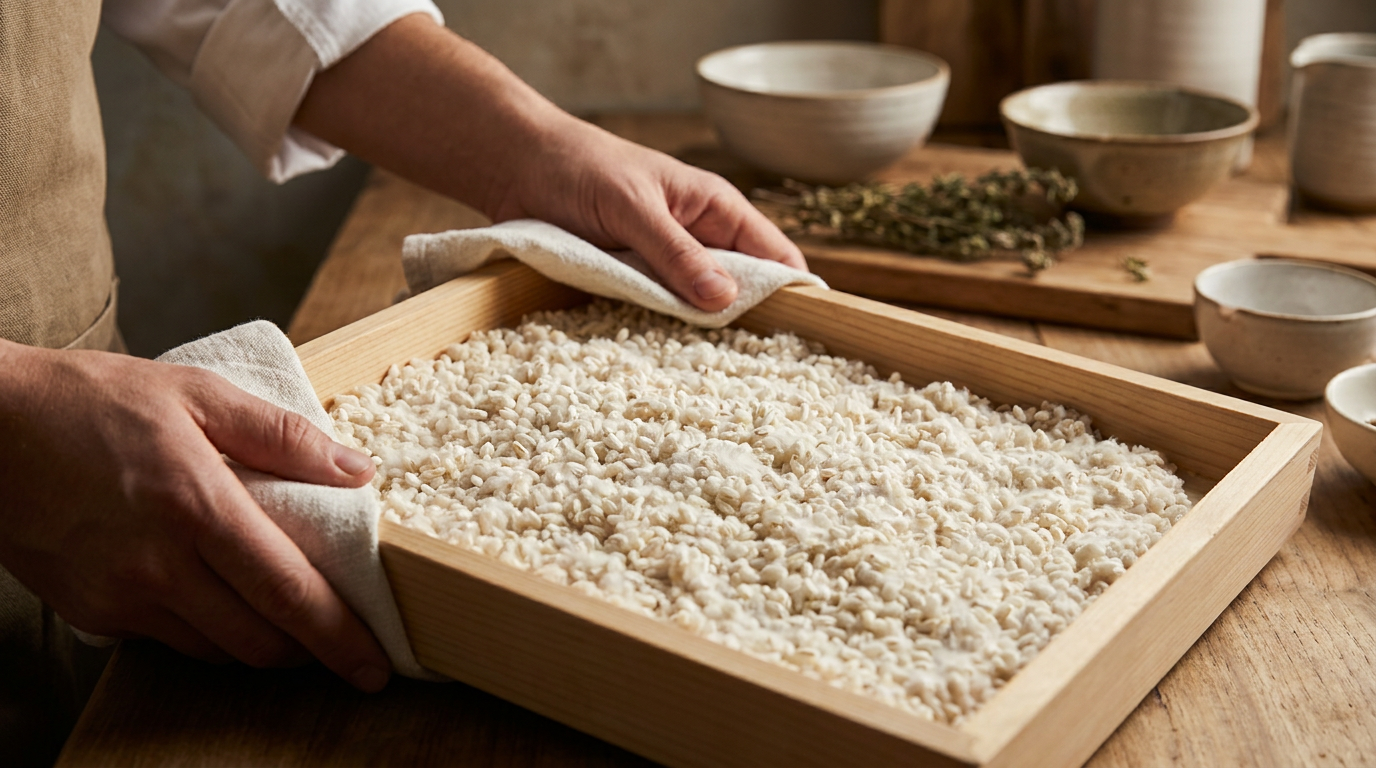
The organism is Aspergillus oryzae, a filamentous mold known colloquially as koji. In Japan, where it was named the "national fungus" by the Brewing Society, koji is the biological cornerstone of sake, miso, soy sauce, and mirin. The process begins simply: spores of the mold, appearing as a yellow-green dust, are inoculated onto steamed grains like rice or barley. Over two to three days in a warm, humid environment, the mold blooms into a snowy white mycelium, fundamentally altering the chemical structure of its host.[1][2][5][7]
Over the past decade, koji has migrated from traditional Japanese fermentation houses into the research labs of the global fine-dining elite. Pioneered in the West by institutions like Copenhagen’s Noma, the mold is no longer just a means to make soy sauce. It is being applied directly to ingredients as a curing agent, a tenderizer, a sweetener, and a flavor amplifier with no equivalent in any other culinary tradition.[2][4][5]
The transformative power of koji lies in its enzymatic output. As the mold grows, its hyphae penetrate the host grains, releasing a cascade of roughly 100 different powerful enzymes. These biological catalysts act as molecular scissors, dismantling complex macromolecules into their simplest, most flavorful building blocks. It is a process of controlled pre-digestion that unlocks hidden depths in ordinary ingredients.[3][5][7]

The two most critical enzymes produced by koji are amylase and protease. Amylase targets complex carbohydrates, breaking starches down into simple sugars. This mechanism is responsible for the gentle, natural sweetness found in products like amazake, a traditional Japanese rice drink, achieved entirely without added sugar.[3][7]
Protease, meanwhile, targets proteins, severing long chains into individual amino acids. The most flavor-significant of these is glutamic acid—the compound responsible for umami, the deeply savory "fifth taste." By naturally generating high concentrations of glutamates, koji provides a profound savory depth that makes food feel complete and satisfying on the palate, entirely without artificial flavor enhancers.[3][5]
This enzymatic mechanism has revolutionized how chefs approach the aging of meat. Traditionally, dry-aging a cut of beef to concentrate its flavor and tenderize its muscle fibers takes 21 days or more. But by rubbing koji spores directly onto the surface of the meat, culinary innovators have drastically compressed this timeline.[2]
This enzymatic mechanism has revolutionized how chefs approach the aging of meat.
Chef Jeremy Umansky, operating out of a delicatessen in Ohio, demonstrated that a koji-inoculated cut of meat aged at 90 degrees Fahrenheit for just 36 hours achieves the exact same flavor profile and tenderness as a traditionally aged steak. The proteases work rapidly on the surface proteins, seasoning the meat from within while the mold's hyphae physically tenderize the tissue.[2][5]

Beyond the realm of carnivores, koji is solving one of the most persistent challenges in plant-based cooking: the absence of deep, resonant savoriness. Most vegan kitchens rely heavily on nutritional yeast, commercial mock meats, or heavy salting to simulate the umami naturally present in animal fats and aged cheeses. Koji offers a biological alternative, allowing chefs to build flavor from the microbe up.[6]
At Wakamama, a vegan omakase restaurant in Singapore, koji is the foundational craft that elevates vegetables, grains, and legumes. By utilizing house-fermented shio koji (a mixture of koji, salt, and water) and custom misos, the kitchen coaxes out the kind of structural complexity and richness usually reserved for aged meats and seafood. The mold transforms simple plant proteins into umami-dense centerpieces.[5][6]
As the technique spreads globally, chefs are adapting the Japanese mold to their own regional terroirs, creating ferments with a distinct sense of place. Rather than relying strictly on traditional white rice or soybeans, kitchens are applying koji to local starch mediums. The results are shoyus and misos that encapsulate the agricultural identity of far-flung ecosystems.[1][7]
In Mexico City, high-end restaurants are growing koji on native arroz Morelos and blending it with huitlacoche (corn smut) to create intensely localized garums. In Philadelphia, chefs are cultivating the mold on farro, while kitchens in the American Southwest are fermenting indigenous tepary beans. In these spaces, ancient Japanese biology meets hyper-local agriculture in the fermentation tank.[1]
The implications of Aspergillus oryzae extend far beyond Michelin-starred tasting menus. Food technology startups are now leveraging the mold to address the global demand for sustainable protein. Unlike precision fermentation, which engineers specific microbes to excrete isolated molecules, companies like Nosh.bio are utilizing "biomass fermentation"—growing the entire koji organism to serve as a food source itself.[4]
Because koji is highly efficient at converting agricultural side-streams into nutrient-dense mass, this "Koji Protein" dramatically outperforms animal agriculture, as well as soy and pea crops, in resource efficiency. It requires a fraction of the land and water, boasts a lower carbon footprint, and can be produced in decentralized, climate-resilient facilities. Furthermore, because the mold has a long-standing "Generally Recognized as Safe" (GRAS) status, it faces fewer regulatory hurdles than novel engineered proteins.[4][7]

Despite its vast potential, working with koji requires meticulous precision. The mold is highly sensitive to its environment; adjusting the temperature during key phases dictates which enzymes flourish. Higher temperatures encourage amylase production for sweeter profiles, while lower ranges support the proteases needed for savory applications. Maintaining this delicate balance demands exact climate control and careful monitoring.[3][5]
There are also strict biological boundaries. While the domesticated Aspergillus oryzae is entirely safe for human consumption, wild strains of the Aspergillus genus can produce dangerous toxins. For this reason, experts warn against attempting to capture wild mold cultures for food production; chefs and home fermenters must source verified spores from established producers to ensure safety.[7]
From a microscopic spore to a global culinary movement, koji represents a rare intersection of ancient tradition and modern innovation. Whether it is rapidly dry-aging a steak in Ohio, providing the umami backbone for a vegan tasting menu in Singapore, or scaling up as a sustainable protein source for the future, Aspergillus oryzae proves that sometimes the most revolutionary technologies in food are not invented—they are grown.[1][4][6]
How we got here
300 BC
Koji mold is introduced to Japan from China, becoming the foundation of traditional fermentation.
2006
The Brewing Society of Japan officially names Aspergillus oryzae the "national fungus."
2018
Noma publishes "The Noma Guide to Fermentation," popularizing koji applications in Western fine dining.
2024
Sustainable food tech companies begin scaling koji biomass fermentation as a planet-friendly alternative to animal protein.
Viewpoints in depth
Fine Dining Innovators
Chefs utilizing koji to accelerate aging and localize global terroir.
For culinary innovators, koji is primarily a tool for rapid flavor extraction and regional expression. By applying the mold to non-traditional ingredients—from native Mexican rice to Nordic fava beans—chefs are creating novel misos and garums that reflect their local ecosystems. Furthermore, the mold's ability to dry-age meat in 36 hours rather than 21 days has revolutionized kitchen efficiency, allowing restaurants to serve intensely flavorful, tenderized proteins without the massive spatial and temporal overhead of traditional aging rooms.
Plant-Based Advocates
Chefs using microbial fermentation to solve the umami deficit in vegan cuisine.
A persistent hurdle in plant-based cooking is replicating the deep, resonant savoriness naturally found in animal fats and aged dairy. Plant-based advocates view koji as the ultimate biological solution. By leveraging the mold's protease enzymes to break down plant proteins into glutamic acid, vegan kitchens can build complex umami profiles from the microbe up. This allows them to move away from ultra-processed mock meats and artificial flavorings, instead elevating simple vegetables and legumes to the structural complexity of fine dining.
Food Tech Scientists
Researchers scaling fungal biomass as a sustainable global protein source.
Beyond flavor, the scientific community views Aspergillus oryzae as a highly efficient biological factory. Food tech startups are utilizing biomass fermentation to grow the entire organism into a nutrient-dense protein source. Because koji can thrive on agricultural side-streams and requires significantly less water and land than both animal agriculture and traditional plant proteins (like soy or pea), scientists see it as a critical pillar for future food security. Its long-established safety record also allows it to bypass the steep regulatory hurdles facing lab-grown meats.
What we don't know
- How consumer acceptance of fungi-based 'Koji Protein' will scale in mainstream grocery markets compared to familiar plant proteins like soy and pea.
- Whether the rapid global adoption of koji will lead to the discovery and commercialization of new, localized Aspergillus strains.
Key terms
- Aspergillus oryzae
- The scientific name for koji, a filamentous mold used to ferment foods.
- Amylase
- An enzyme produced by koji that breaks down complex starches into simple, sweet sugars.
- Protease
- An enzyme that breaks down proteins into amino acids, creating deep savory flavors.
- Shio Koji
- A versatile marinade made of koji, salt, and water that tenderizes proteins and amplifies umami.
- Biomass Fermentation
- A sustainable food production method that grows the entire fungal organism to create protein-rich ingredients.
Frequently asked
Is eating mold safe?
Yes, Aspergillus oryzae has been domesticated over millennia and is designated as Generally Recognized as Safe (GRAS). However, wild strains of Aspergillus can be toxic, so culinary koji is always grown from verified spores.
What does koji taste like on its own?
Raw koji has a mildly sweet, slightly floral flavor with a soft, rounded umami profile and a hint of fermented funkiness.
Can I use koji at home?
Yes, home cooks frequently use 'shio koji' (salt koji) as a simple, ready-to-use marinade to tenderize meats and enhance the savory depth of vegetables.
Sources
Source coverage
7 outlets
3 viewpoints surfaced







[1]Fine Dining LoversFine Dining Innovators
How Chefs Across North America Are Localizing Koji
Read on Fine Dining Lovers →[2]ForbesFine Dining Innovators
How Japanese Koji Is Revolutionizing American Cuisine
Read on Forbes →[3]The House of UmamiFood Tech Scientists
The Science of Koji: Enzymes and Umami
Read on The House of Umami →[4]Nosh.bioFood Tech Scientists
Koji Protein: The Future of Sustainable Biomass
Read on Nosh.bio →[5]Soil DiningPlant-Based Advocates
Why Koji Has Become the Most Important Fermentation Culture in Modern Kitchens
Read on Soil Dining →[6]WakamamaPlant-Based Advocates
What Is Koji, and Why Do the Best Plant Based Restaurants Use It?
Read on Wakamama →[7]Factlen Editorial TeamFood Tech Scientists
Synthesis by Factlen editorial team
Read on Factlen Editorial Team →
Every angle. Every day.
Get food drink stories with full source coverage and perspective breakdowns delivered to your inbox.