
Explainer: How the 7.5 Earthquake Doublet Threatens Venezuela's Fragile Post-Maduro Oil Recovery
A massive earthquake near Venezuela's coastal refineries threatens to derail the country's recent surge in oil exports and its broader economic stabilization.
By Factlen Editorial Team
- Energy Markets & Investors
- Focused on the physical damage to Venezuela's coastal refineries and the threat to the country's goal of reaching 2 million barrels per day in exports.
- Humanitarian & Emergency Responders
- Prioritizing the immediate rescue efforts in Caracas and Carabobo state, warning that the country's degraded infrastructure cannot handle a mass-casualty event.
- Geopolitical Observers
- Analyzing how the earthquake will test the newly established post-Maduro government and its reliance on U.S. sanctions relief.
What's not represented
- · Local Venezuelan oil workers facing unsafe conditions at damaged facilities
- · Neighboring Caribbean nations bracing for potential economic and migratory spillover
Why this matters
Venezuela's fragile transition away from a decade of economic collapse relies entirely on reviving its oil exports. If this earthquake has crippled the coastal refineries and pipelines, the resulting financial shock could derail the country's political stabilization and trigger a new wave of regional migration.
Key points
- A 7.5 magnitude earthquake doublet struck northern Venezuela, collapsing buildings in Caracas and triggering regional tsunami advisories.
- The epicenter was located just 17 miles from Morón, a critical hub for Venezuela's coastal oil refineries and export pipelines.
- The disaster threatens to derail Venezuela's recent economic stabilization following the January 2026 political transition and easing of U.S. sanctions.
- Prior to the quake, oil exports had surged to 1.25 million barrels per day, driven by new foreign investment and regulatory reforms.
- Analysts warn that damage to specialized heavy-crude upgraders or the fragile national power grid could halt the export recovery entirely.
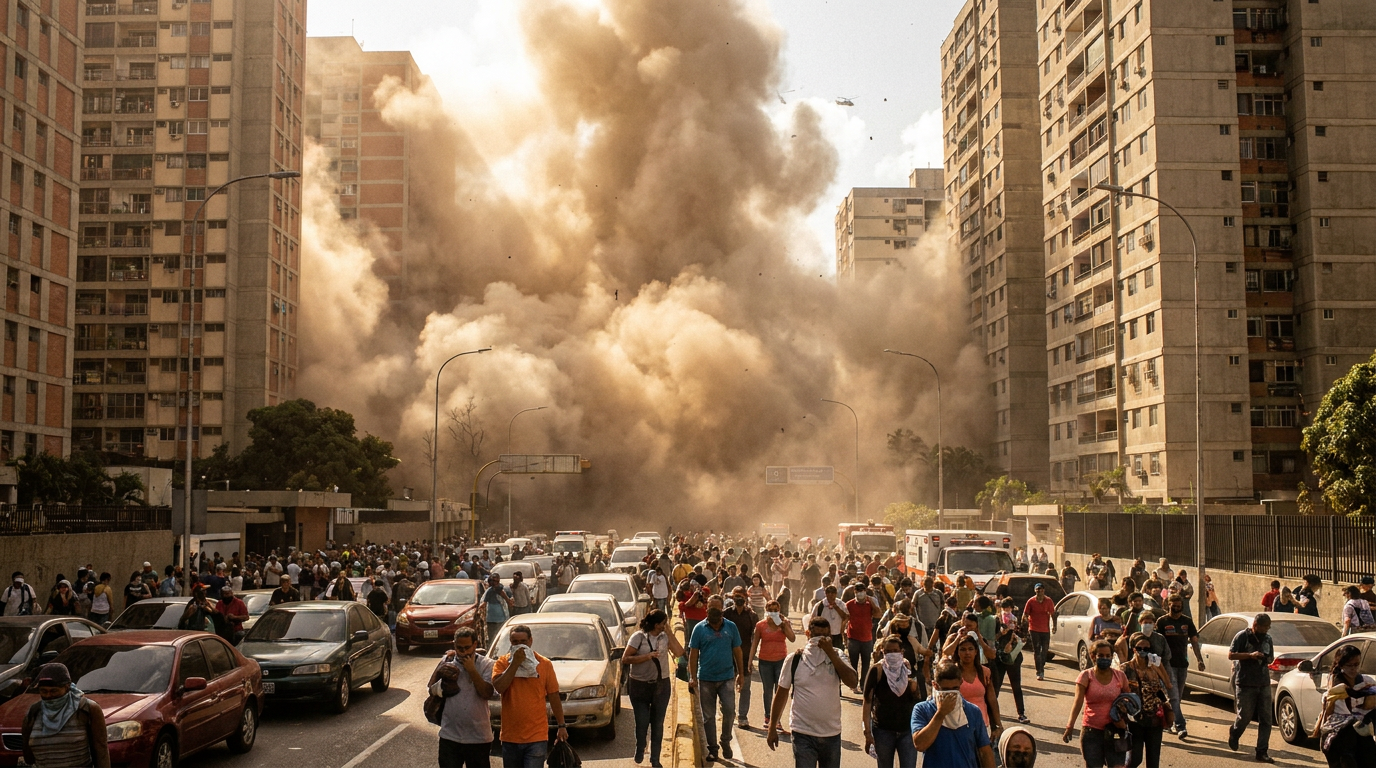
The devastating magnitude 7.5 earthquake doublet that violently shook northern Venezuela on June 24 is rapidly evolving from a localized humanitarian emergency into a direct threat to the country's fragile economic lifeline. Striking just 17 miles west of the coastal community of Morón, the seismic event hit the geographic nerve center of Venezuela's petroleum export infrastructure. For a nation that had just begun to claw its way out of a decade-long economic abyss following a historic political transition, the timing of the disaster could not be more precarious. The immediate focus remains on pulling survivors from collapsed facades in Caracas, but behind the scenes, energy markets are scrambling to assess whether the physical bottlenecks of the state's oil sector have been irreparably compromised.[1][2][8]
The geological reality of the earthquake—a 7.1 foreshock followed just 39 seconds later by a massive 7.5 mainshock—sent shockwaves far beyond the epicenter in Carabobo state. In the capital city of Caracas, located roughly 100 miles to the east, terrified residents and office workers rushed out of swaying high-rises as entire walls gave way. Thick columns of dust blanketed commercial neighborhoods that were otherwise quiet for a national independence holiday, transforming a day of celebration into a chaotic scramble for survival.[1][2][3]
The tremors were powerful enough to trigger temporary tsunami advisories across the Caribbean islands of Puerto Rico, Aruba, and Curaçao, while residents in neighboring Colombia reported significant shaking. Emergency responders are currently navigating roads blocked by concrete debris and shattered glass, hampered by widespread power outages and internet failures that plunged much of the region into an information blackout. Municipal police and fire units have been deployed to dig through the rubble of collapsed facades, though the full extent of the casualties remains unclear.[2][3][8]
While the human toll mounts in the urban centers, geopolitical observers and energy analysts are intensely focused on the epicenter's proximity to the El Palito refinery and the critical coastal pipelines that transport crude to global markets. Following the ouster of Nicolás Maduro in January 2026 and the subsequent easing of U.S. sanctions, Venezuela had just begun to stabilize its collapsing economy. The new government had staked its legitimacy on reviving the oil sector, which historically provided the vast majority of the state's revenue.[4][5]

Driven by a newly amended Organic Hydrocarbons Law that allowed private foreign companies to independently produce and export oil, the country's exports had recently surged to an estimated 1.25 million barrels per day. U.S. Energy Secretary Chris Wright had even projected a potential return to 2 million barrels per day under the new administration, signaling a staggering turnaround for the petro-state. Western majors like Chevron had already begun scaling up operations, injecting millions into the Orinoco Belt to capitalize on the newly favorable diplomatic framework.[4][5][6]
Western majors like Chevron had already begun scaling up operations, injecting millions into the Orinoco Belt to capitalize on the newly favorable diplomatic framework.
However, that optimistic recovery trajectory was predicated on the assumption that Venezuela's decaying infrastructure could withstand the strain of increased capacity. Energy analysts have long warned that the country's extraction and upgrading facilities—severely degraded by decades of underinvestment, corruption, and deferred maintenance—were operating on borrowed time. The physical state of the grid represents a dimension of the investment challenge that statistical production figures do not fully capture.[4][7]
Venezuelan crude is structurally complex and unforgiving to handle. The heavy, sour oil extracted from the vast Orinoco Belt is composed of long carbon chains, making it highly viscous. It cannot flow through standard pipelines or be processed by conventional refineries without extensive prior treatment. Before it can be loaded onto export tankers, the crude must be processed in specialized upgraders and blended with expensive imported diluents to reduce its density.[5][7]
If the violent seismic activity has damaged these specialized upgraders, the coastal blending facilities, or the deep-water export terminals near Morón, the physical bottleneck could halt exports entirely. Even a temporary shutdown of the coastal pipelines would force upstream producers to choke back extraction in the Orinoco Belt, reversing the hard-won production gains of the last six months. The geology of the region simply does not allow for quick logistical workarounds when heavy infrastructure fails.[7][8]

The financial implications of a major infrastructure failure would be catastrophic for the newly established government. While regulatory reforms successfully attracted initial foreign capital, bridging the gap from 1.25 million barrels per day back to the country's historical peak of 3 million was already estimated to require over $100 billion in investment over the next decade. That staggering figure was calculated before the earth split open beneath Carabobo state.[4][7]
Now, international investors must also price in the immediate cost of emergency grid reconstruction and seismic repairs. Reports from Caracas indicating widespread power grid failures highlight the extreme fragility of the national utility system. Oil extraction and upgrading are highly energy-intensive processes; without a reliable supply of electricity, even undamaged refineries cannot operate at the capacity required to meet the government's ambitious export targets.[3][4]

For the post-Maduro administration, the earthquake presents an existential test of state capacity and international diplomacy. The government must simultaneously manage a complex mass-casualty rescue operation, restore basic utilities to millions of citizens, and reassure international energy markets that its export terminals remain viable. The administration is expected to issue emergency appeals for international humanitarian aid, testing the responsiveness of Western allies who championed the recent political transition.[3][5]

If the physical infrastructure proves too damaged to sustain the recent export surge, the economic momentum generated by the political transition could stall abruptly. Without the vital influx of petrodollars, the state will lack the revenue needed to rebuild its shattered cities. This dynamic threatens to trigger a new wave of outward migration and will severely test the patience of a population that had just begun to hope for a stable, prosperous future.[4][7]
How we got here
1990s
Venezuela's oil production peaks at over 3 million barrels per day before decades of underinvestment and mismanagement trigger a steep decline.
2019
The U.S. imposes heavy sanctions on Venezuela's state oil company, PDVSA, accelerating the collapse of the country's export economy.
January 2026
Nicolás Maduro is removed from power; the new government amends the Organic Hydrocarbons Law and the U.S. eases sanctions, sparking an oil recovery.
June 24, 2026
A massive 7.5 magnitude earthquake doublet strikes near the coastal oil hub of Morón, collapsing buildings in Caracas and threatening the economic recovery.
Viewpoints in depth
Energy Markets & Investors
Focused on the physical damage to Venezuela's coastal refineries and the threat to the country's export targets.
For international oil majors and commodity analysts, the earthquake represents the realization of their worst fears regarding Venezuela's above-ground risk. While the January 2026 legal reforms made the country investable on paper, analysts have consistently warned that the physical infrastructure—from power grids to heavy-crude upgraders—was too degraded to handle stress. Investors argue that until the extent of the damage to the Morón-area export terminals is fully quantified, capital deployment into the Orinoco Belt will likely freeze. They emphasize that the $100 billion already required to modernize the sector must now be revised upward to account for seismic retrofitting.
Humanitarian & Emergency Responders
Prioritizing immediate rescue efforts and warning that the country's degraded infrastructure cannot handle a mass-casualty event.
Relief organizations and municipal emergency units are focused entirely on the human toll in Caracas and Carabobo state. They point out that Venezuela's healthcare system and emergency services were already hollowed out by years of economic crisis and mass emigration of medical professionals. Responders argue that the international community must decouple humanitarian aid from energy politics, urging immediate dispatch of heavy lifting equipment, medical supplies, and temporary power generators. For this camp, the narrative of 'oil recovery' is secondary to the immediate survival of citizens trapped in collapsed residential blocks.
Geopolitical Observers
Analyzing how the disaster will test the newly established post-Maduro government and its relations with Washington.
Diplomats and regional analysts view the earthquake as the first existential stress test for Venezuela's new political leadership. The government's legitimacy hinges on its ability to deliver economic stabilization and competent governance—both of which are now threatened by the disaster. Observers note that the administration will be heavily reliant on U.S. and international assistance to manage the fallout. They argue that if the state fails to mount an effective rescue and recovery operation, it could fracture the fragile political coalition that took power in January, potentially leading to renewed instability and a surge in regional migration.
What we don't know
- The full extent of the structural damage to the El Palito refinery and the Orinoco Belt upgraders.
- The final casualty count in Caracas and Carabobo state as rescue operations continue through the rubble.
- Whether the international community will provide emergency financing to rebuild the damaged power grid.
Key terms
- Orinoco Belt
- A vast territory in central Venezuela that holds some of the world's largest deposits of heavy and extra-heavy crude oil.
- Diluent
- A lighter hydrocarbon liquid mixed with heavy crude oil to reduce its viscosity, allowing it to flow through pipelines and be loaded onto tankers.
- Organic Hydrocarbons Law
- A Venezuelan legal framework, amended in January 2026, that allows private and foreign companies to independently produce and export oil without rigid state joint-venture constraints.
- Upgrader
- A specialized industrial facility that processes heavy, viscous crude oil into a lighter, more valuable synthetic crude that conventional refineries can handle.
Frequently asked
Where exactly did the earthquake strike?
The earthquake was a 'doublet' event, with a 7.1 foreshock followed 39 seconds later by a 7.5 mainshock. The epicenter was located about 17 miles west of Morón, a coastal community in Carabobo state, roughly 100 miles west of the capital, Caracas.
Why is the earthquake's location significant for the economy?
The epicenter near Morón is dangerously close to critical petroleum infrastructure, including the El Palito refinery and coastal pipelines. Damage to these facilities could bottleneck Venezuela's ability to process and export oil.
How much oil was Venezuela exporting before the quake?
Following the political transition in January 2026 and the easing of U.S. sanctions, exports had surged to an estimated 1.25 million barrels per day, with projections aiming for 2 million barrels per day.
Why is Venezuelan oil so difficult to process?
Venezuela's reserves, primarily located in the Orinoco Belt, consist of heavy, sour crude. This highly viscous oil requires specialized upgraders and expensive imported diluents to flow through pipelines and be processed for export.
Sources
Source coverage
8 outlets
3 viewpoints surfaced








[1]The GuardianHumanitarian & Emergency Responders
Venezuela rocked by powerful back-to-back earthquakes
Read on The Guardian →[2]CBS NewsHumanitarian & Emergency Responders
Pair of powerful earthquakes, up to 7.5 magnitude, strike Venezuela
Read on CBS News →[3]ReutersHumanitarian & Emergency Responders
Strong earthquake rocks north-central Venezuela, capital Caracas
Read on Reuters →[4]StratforEnergy Markets & Investors
Venezuela's Oil Recovery Faces Structural Constraints
Read on Stratfor →[5]Offshore TechnologyEnergy Markets & Investors
Venezuela post-Maduro: will oil majors invest again?
Read on Offshore Technology →[6]CryptoBriefingEnergy Markets & Investors
US Energy Secretary Chris Wright announces Venezuela's oil exports could reach 2 million barrels per day
Read on CryptoBriefing →[7]Discovery AlertEnergy Markets & Investors
The Geology That Humbles Economics: Why Venezuela's Oil Story Is More Complex Than Any Political Transition
Read on Discovery Alert →[8]NBC Palm SpringsHumanitarian & Emergency Responders
Powerful Magnitude 7.5 Earthquake Strikes Near Northern Coast of Venezuela
Read on NBC Palm Springs →


Every angle. Every day.
Get news politics stories with full source coverage and perspective breakdowns delivered to your inbox.