
Retrofit vs. Full Replacement Smart Locks: The 2026 Trade-Off Analysis
Choosing between a retrofit smart lock and a full deadbolt replacement comes down to whether you prioritize renter-friendly installation or commercial-grade security with built-in keypads.
By Factlen Editorial Team
- Homeowners & Security Maximizers
- Focuses on commercial-grade physical strength, integrated access methods, and maximum durability.
- Renters & Minimalists
- Prioritizes non-destructive installation, landlord compliance, and preserving the home's original aesthetic.
- Smart Home Integrators
- Values seamless ecosystem connectivity, Apple Home Key support, and advanced automation routines.
What's not represented
- · Professional Locksmiths
- · Apartment Property Managers
Why this matters
Upgrading to a smart lock is one of the most impactful convenience upgrades you can make to a home, but choosing the wrong type can lead to lease violations, security vulnerabilities, or frustrating battery drains. Understanding the structural differences ensures you get the right balance of security and convenience for your specific living situation.
Key points
- Retrofit locks install in under 10 minutes and leave the exterior door hardware untouched, making them ideal for renters.
- Full deadbolt replacements offer superior physical security, often featuring ANSI Grade 1 or 2 commercial ratings.
- Built-in keypads and fingerprint scanners are standard on full replacements, while retrofits usually require purchasing a separate keypad.
- Retrofit models rely on the physical strength of your existing deadbolt, which may be a vulnerability if the current hardware is builder-grade.
- Battery life heavily favors full replacements, which typically hold larger AA batteries compared to the smaller cells used in compact retrofits.
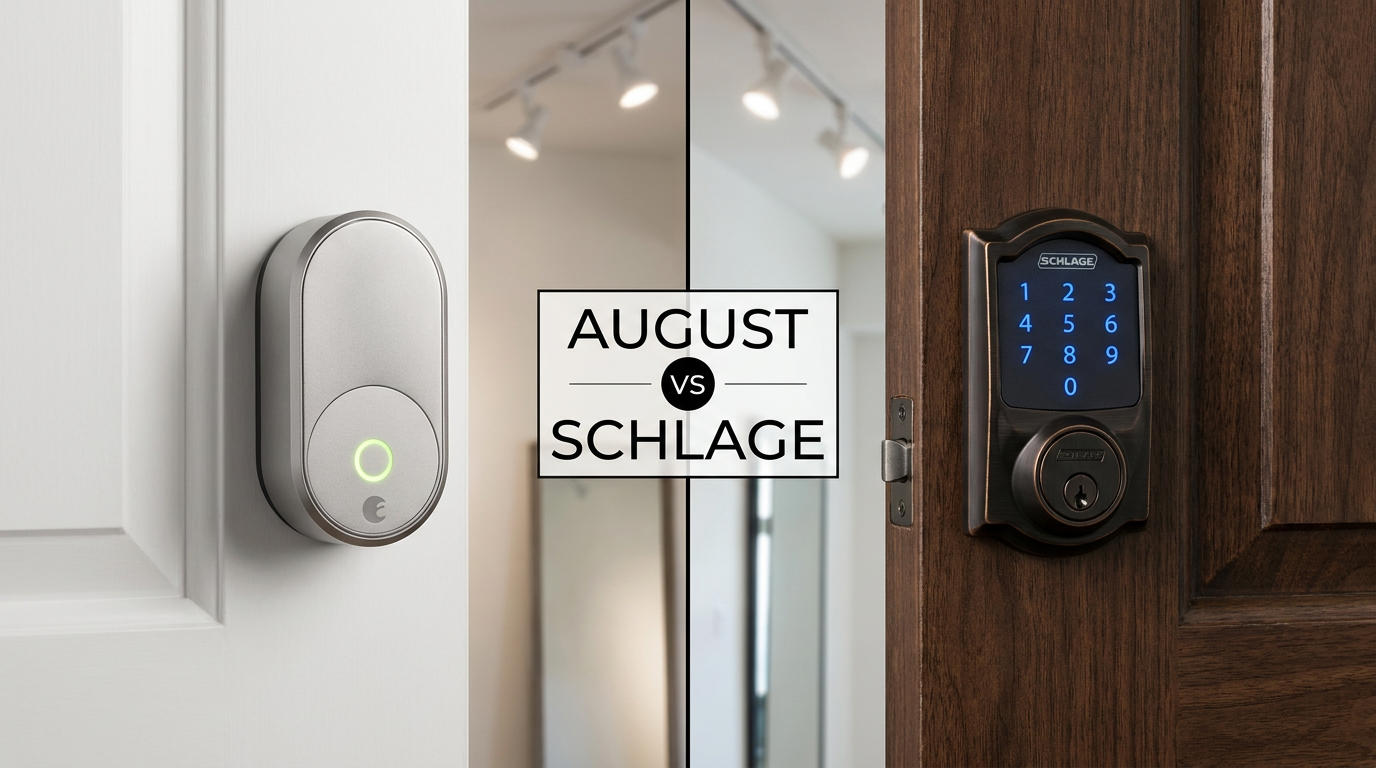
The smart lock has matured from a glitchy, hub-dependent novelty into a reliable, everyday cornerstone of the modern connected home. But as buyers look to upgrade their entryways in 2026, they face a fundamental architectural fork in the road before they even look at software features. The market has cleanly bifurcated into two distinct hardware philosophies: retrofit models that clamp over your existing interior thumb-turn, and full deadbolt replacements that require ripping out the old lock entirely to install new mechanisms on both sides of the door. This initial choice dictates everything from installation time to physical security.[1][2]
Choosing between the two is rarely a matter of which lock is objectively superior in a vacuum. Instead, it is a lifestyle calculation that pits the convenience of a ten-minute, non-destructive installation against the robust, commercial-grade security of heavy-duty hardware. Brands like August and SwitchBot champion the retrofit approach, catering to those who want a quick software upgrade for their analog doors. Meanwhile, traditional lock stalwarts like Schlage and Yale dominate the full-replacement category, appealing to users who want a complete security overhaul. Understanding the structural differences ensures buyers get the right balance of security and convenience for their specific living situation.[5][6]
The retrofit design is an engineering sleight of hand. These devices, such as the widely popular August Wi-Fi Smart Lock, replace only the interior thumb-turn of the door. From the outside, the door looks exactly as it did before, and the original metal key continues to work perfectly. The installation process is famously straightforward, typically requiring nothing more than a standard Phillips-head screwdriver, a few strips of painter's tape to hold the exterior plate in place, and about ten minutes of time. There is no need to measure door thickness, align strike plates, or chisel out wooden frames.[3][5]

For renters, this non-destructive approach is an absolute game-changer in the smart home space. Most apartment lease agreements strictly forbid tenants from altering exterior hardware or changing the locks, as landlords and property managers require master-key access for emergencies and routine maintenance. A retrofit lock allows apartment dwellers to enjoy auto-unlocking, remote access, and digital guest passes without violating their lease or risking their security deposit. Furthermore, because the modification is entirely reversible, the device can be easily unscrewed, packed up, and taken to the next apartment when moving out, leaving no trace behind on the landlord's property.[3][5]
Beyond renters, retrofit locks appeal heavily to homeowners with custom, historic, or highly stylized front doors. If a home features ornate, oil-rubbed bronze hardware or a classic wooden aesthetic, slapping a glowing black plastic touchscreen on the exterior can severely disrupt the curb appeal. Retrofits keep the smart technology completely hidden on the inside of the house. This preserves the home's traditional exterior look while still delivering modern conveniences, such as Bluetooth geofencing, which senses the user's smartphone and unlocks the door automatically as they walk up the driveway with arms full of groceries.[5]
However, the retrofit approach comes with inherent compromises, primarily regarding physical security. A retrofit lock is only a motor; it is entirely dependent on the physical strength of the deadbolt it attaches to. If the existing hardware is a cheap, builder-grade lock from a big-box store, adding a $200 smart motor to the inside does absolutely nothing to prevent a physical forced-entry attack or a lock-picking attempt. The smart features may alert you that the door has been opened, but the physical barrier remains exactly as vulnerable as it was before the upgrade.[7]

However, the retrofit approach comes with inherent compromises, primarily regarding physical security.
This is where full deadbolt replacements make their strongest case. Models like the Schlage Encode Plus or the Ultraloq U-Bolt completely replace the existing lock, from the interior motor to the exterior keyhole and the internal latch mechanism. While the installation takes closer to 45 minutes and requires careful alignment to ensure the motorized bolt slides smoothly into the door frame without friction, the payoff is a massive, tangible upgrade in physical durability and overall home defense. By replacing the entire assembly, homeowners guarantee that the mechanical components are just as advanced and robust as the digital software running them.[2][4]
Security maximizers look closely at ANSI and BHMA certification grades when evaluating these full-replacement locks. The Builders Hardware Manufacturers Association (BHMA) rigorously tests locks for durability, weather resistance, and strength against sledgehammers and crowbars. Full replacements from reputable brands frequently achieve ANSI Grade 1 or Grade 2 ratings, meaning they have been tested to withstand hundreds of thousands of cycles and significant blunt-force impacts. For homeowners looking to fortify their primary entry point, this commercial-grade hardware offers a level of peace of mind that a plastic retrofit motor simply cannot match.[6][7]
Full replacements also fundamentally change how users interact with the door on a daily basis. Because they include new exterior hardware, they almost always feature built-in touchscreens, physical keypads, or biometric fingerprint scanners. This allows anyone in the family to enter without needing a smartphone, which is particularly valuable for children coming home from school, elderly relatives, or housekeepers who do not want to download a proprietary app. The keypad becomes the primary interface, offering a foolproof backup if a phone is lost or its battery dies.[1][2]
In contrast, retrofit users who want keypad access usually have to purchase a separate, battery-powered keypad accessory. These add-on keypads must be mounted to the door frame or surrounding brick with adhesive or screws, adding extra cost to the initial purchase. Furthermore, this creates a disjointed, two-piece system that relies on a localized Bluetooth connection between the exterior keypad and the interior lock. Some users find this introduces slight latency or reliability issues compared to a fully integrated, hardwired unit where the keypad and the locking mechanism are physically connected through the door itself.[5]
The technological arms race has also given full replacements a distinct edge in the Apple ecosystem. Apple's Home Key feature, which allows users to unlock the door by simply tapping their iPhone or Apple Watch against the lock—even if the device's battery is dead—requires specialized NFC hardware on the exterior of the door. Consequently, Home Key is exclusively available on full replacement models that feature exterior touchpads. For users deeply embedded in Apple's smart home architecture, this frictionless, tap-to-unlock capability is often the deciding factor.[1][5]

Battery life presents another significant, often overlooked trade-off in the smart lock debate. Retrofit locks, particularly those with built-in Wi-Fi radios that constantly ping the home router, are notoriously power-hungry. Their compact, interior-only designs often force them to rely on smaller CR123 batteries, which may need replacing every three to six months depending on household traffic. Full replacements, with their larger interior housings, typically accommodate four standard AA batteries. Combined with low-power wireless protocols like Thread or Zigbee, these larger battery banks extend the lock's lifespan to anywhere from six to twelve months, significantly reducing the frequency of annoying low-battery alerts.[5][6]
Ultimately, the decision hinges on ownership status, aesthetic priorities, and daily access preferences. The retrofit lock is the ultimate frictionless upgrade—perfect for renters, design purists, and those who want their door to magically unlock via geofencing as they walk up with groceries. It is a brilliant software upgrade for analog hardware, prioritizing ease of installation and lease compliance above all else. If you cannot permanently modify your door, or if you simply dread the idea of wielding a power drill, the retrofit path is the only logical choice.[3][5]

The full deadbolt replacement, meanwhile, is a comprehensive security and convenience overhaul. It fits perfectly for homeowners who want to ditch their physical keys entirely, rely on biometric fingerprint scanners or PIN-code entry, and fortify their door against physical attacks with certified, heavy-duty hardware. While it demands more effort, time, and DIY confidence upfront, the integrated experience, longer battery life, and robust durability pay dividends over time. For those who own their doors and want the absolute best in smart home security, ripping out the old deadbolt is an investment well worth making.[4][6]
How we got here
2014
August launches its first retrofit smart lock, popularizing the concept of keeping the existing deadbolt.
2019
Schlage introduces the Encode, bringing built-in Wi-Fi to full deadbolt replacements without needing a hub.
2022
Apple announces Home Key, pushing manufacturers to integrate NFC tap-to-unlock into full replacement models.
2026
Matter-over-Thread becomes the standard, allowing both retrofit and full replacement locks to communicate across all major smart home ecosystems.
Viewpoints in depth
Renters and Minimalists
Prioritizes non-destructive installation, landlord compliance, and preserving the home's original aesthetic.
For this camp, the smart lock should be invisible from the street. Renters face strict lease agreements that forbid altering exterior hardware, making retrofit models the only viable path to keyless entry. Minimalists also favor this approach because it prevents the front door from looking like a server room. By keeping the original deadbolt, users maintain the traditional physical key as a foolproof backup, while relying on Bluetooth geofencing to magically unlock the door as they approach.
Homeowners and Security Maximizers
Focuses on commercial-grade physical strength, integrated access methods, and maximum durability.
This perspective views the front door as the home's primary defensive perimeter, where builder-grade deadbolts are unacceptable. Security maximizers prefer full replacements because they upgrade the entire locking mechanism to ANSI Grade 1 or 2 standards, capable of withstanding heavy physical attacks. They also value the reliability of built-in keypads and biometric scanners, arguing that relying solely on a smartphone for entry is a vulnerability if the phone dies or is lost.
Smart Home Integrators
Values seamless ecosystem connectivity, Apple Home Key support, and advanced automation routines.
For integrators, a smart lock is just one node in a broader automated symphony. They gravitate toward full replacements that support Apple Home Key for frictionless NFC tap-to-unlock, or Matter-over-Thread for instant communication with lights, thermostats, and security cameras. This camp is less concerned with the installation effort and more focused on latency, battery efficiency, and ensuring the lock responds instantly to voice commands or complex conditional routines.
What we don't know
- How long older retrofit models will continue to receive software support as Matter-over-Thread becomes the dominant standard.
- Whether landlords will eventually begin installing full-replacement smart locks universally, rendering the renter-specific retrofit market obsolete.
Key terms
- ANSI/BHMA Grade
- The industry standard for lock durability and security, with Grade 1 being the highest commercial rating.
- Retrofit Smart Lock
- A device that attaches to the interior of an existing deadbolt, automating the thumb-turn without changing the exterior hardware.
- Apple Home Key
- A feature that allows users to unlock their door by simply tapping their iPhone or Apple Watch against the lock, using NFC technology.
- Geofencing
- A location-based feature that automatically locks or unlocks the door when the user's smartphone enters or leaves a designated perimeter.
Frequently asked
Can my landlord tell if I install a retrofit smart lock?
No, retrofit locks only replace the interior thumb-turn, leaving the exterior keyhole completely unchanged and fully compatible with the landlord's master key.
What happens if the battery dies while I am outside?
Full replacements often have external battery jump-start points or hidden physical keyholes, while retrofits still allow you to use your original physical key.
Do I need a smart home hub for these locks?
Many 2026 models feature built-in Wi-Fi or Matter-over-Thread, allowing them to connect directly to your home network without a proprietary bridge.
Sources
Source coverage
7 outlets
3 viewpoints surfaced







[1]CNETSmart Home Integrators
Best smart locks 2026
Read on CNET →[2]PCMagHomeowners & Security Maximizers
The Best Smart Locks for 2026
Read on PCMag →[3]TechRadarRenters & Minimalists
The best smart locks 2026: tested by experts
Read on TechRadar →[4]Bob VilaHomeowners & Security Maximizers
The Best Smart Locks Tested
Read on Bob Vila →[5]Android CentralRenters & Minimalists
August Wi-Fi Smart Lock vs. Schlage Encode
Read on Android Central →[6]House DigestHomeowners & Security Maximizers
What to look for in a smart lock
Read on House Digest →[7]PCWorldSmart Home Integrators
Understanding ANSI and BHMA lock ratings
Read on PCWorld →
Every angle. Every day.
Get shopping stories with full source coverage and perspective breakdowns delivered to your inbox.