
The Science of the Scare: How Biometrics and AI Are Replacing the Hollywood Test Screening
Movie studios are increasingly abandoning traditional comment cards in favor of infrared cameras, heart-rate monitors, and micro-expression tracking to measure exactly how audiences feel frame by frame.
By Factlen Editorial Team
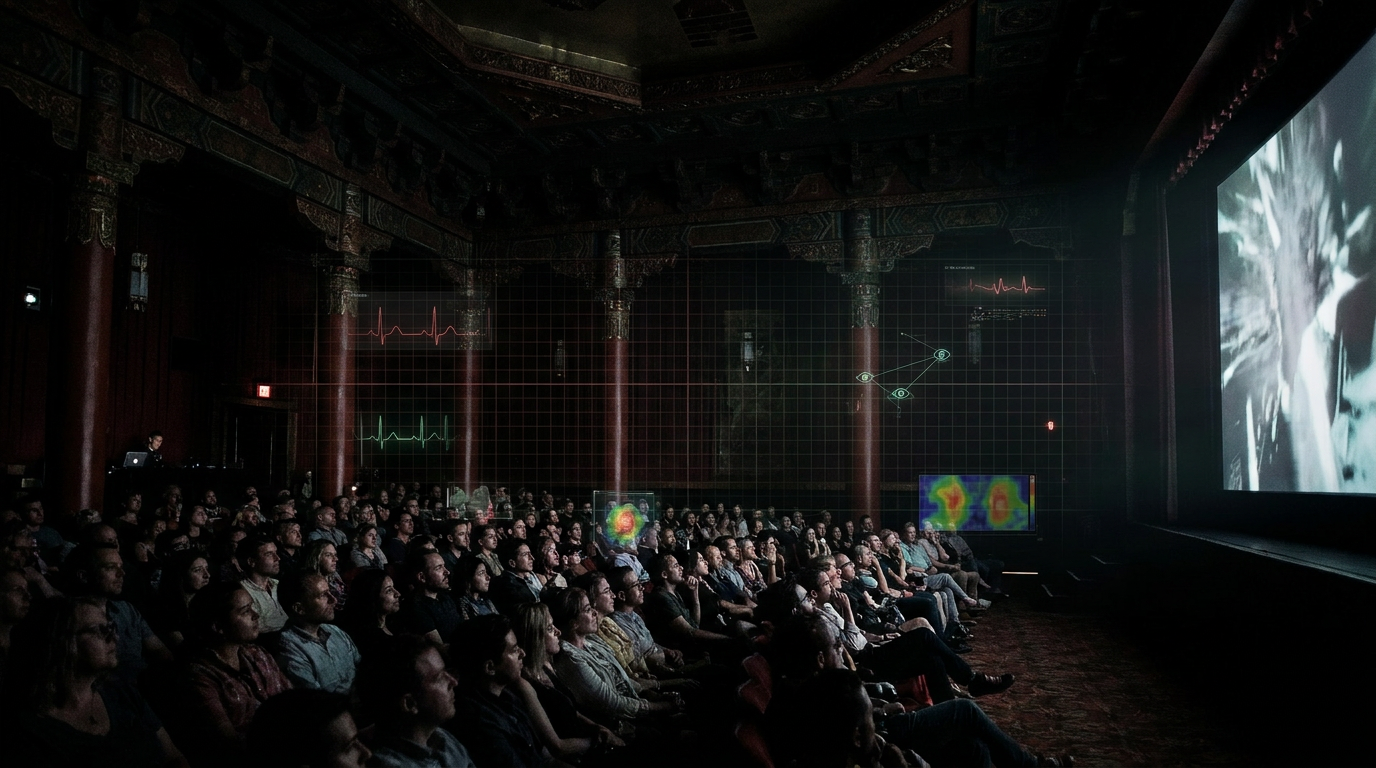
- Audience Researchers
- Argue that traditional comment cards are flawed because viewers cannot accurately articulate their subconscious emotional reactions.
- Studio Executives
- View biometric data as a necessary fiduciary tool to mitigate the massive financial risks of modern blockbuster production.
- Traditional Filmmakers
- Fear that optimizing films for constant physiological arousal will destroy artistic intuition and lead to homogenized storytelling.
What's not represented
- · Independent cinema distributors
- · Screenwriters Guild representatives
Why this matters
As studios rely more on physiological data to edit films, the pacing and emotional rhythm of the movies we watch are increasingly being shaped by algorithms rather than pure artistic intuition. Understanding this invisible feedback loop reveals why modern blockbusters feel the way they do.
Key points
- Hollywood is replacing traditional test screening comment cards with biometric sensors and infrared cameras.
- Technology tracks heart rates, micro-expressions, and skin responses to build an 'emotional heat map' of a film.
- Editors use this data to fine-tune the timing of jump scares, jokes, and overall pacing.
- AI models can now predict with 85% accuracy when an audience will disengage from a scene.
- Traditional filmmakers worry the technology prioritizes constant stimulation over artistic nuance and thematic depth.
The tradition of the Hollywood test screening is as old as the studio system itself. For nearly a century, directors have paced nervously in the back of suburban multiplexes, waiting for audiences to fill out paper comment cards to determine if a movie's ending worked.[1][7]
But self-reported data has a fatal flaw: audiences are notoriously bad at articulating exactly why a movie lost their attention. A viewer might write that the second act felt "boring," leaving the editor to guess which specific scenes caused the pacing to drag.[3]
Today, the comment card is being replaced by the biometric sensor. Major studios are quietly rolling out advanced test screenings that rely on infrared cameras, galvanic skin response monitors, and wearable heart-rate trackers to measure subconscious physical reactions.[2][7]
This shift from subjective opinion to objective biological data represents one of the most significant changes in post-production history. By tracking micro-expressions and pulse rates, filmmakers can pinpoint the exact second an audience's attention wanders.[5]

The mechanism behind this technology relies on a combination of computer vision and affective computing. During a biometric screening, specialized infrared cameras scan the theater, mapping up to 68 distinct facial landmarks on each viewer in the dark.[6]
These cameras feed real-time data into neural networks trained to recognize the physical markers of human emotion: the subtle furrow of a brow indicating confusion, the widening of eyes signaling fear, or the micro-smiles that precede a laugh.[3][5]
Simultaneously, a subset of the audience may wear biometric wristbands that track heart rate variability and electrodermal activity—the tiny fluctuations in sweat gland activity that correlate with physiological arousal and stress.[2]
All of this data is aggregated and synced directly to the film's timecode. The result is an "emotional heat map" that overlays the movie's timeline, providing the director and editor with a second-by-second graph of the audience's collective nervous system.[7]

All of this data is aggregated and synced directly to the film's timecode.
The practical applications of this data are profound, particularly in genre filmmaking. Horror directors, for instance, use heart-rate data to fine-tune the timing of jump scares. If the data shows the audience's pulse spiking too early, the editor might add three extra frames of silence to maximize the tension before the scare hits.[1][4]
Comedy editors use audio-visual tracking to measure the exact duration and decay of collective laughter. This allows them to adjust the pacing of the next scene, ensuring that crucial dialogue isn't drowned out by the audience's reaction to the previous joke.[2]
Disney Research has been at the forefront of this field, developing factorized variational autoencoders—complex AI models capable of predicting audience reactions based on massive datasets of historical theater observations.[6]
According to researchers, these models can predict with up to 85% accuracy when an audience will disengage from a scene, allowing studios to identify structural pacing issues weeks before a film's final cut is locked.[5][6]

However, the rise of biometric filmmaking has sparked a quiet civil war within Hollywood. While studio executives view the technology as a crucial risk-mitigation tool for $200 million blockbusters, many traditional filmmakers see it as an existential threat to artistic intuition.[1][4]
Auteurs argue that great cinema is often born from making audiences intentionally uncomfortable or challenging their expectations. If a biometric heat map flags a long, quiet scene as "low engagement," a data-driven studio might demand it be cut, sacrificing thematic resonance for constant stimulation.[4]
"Data can tell you that an audience's heart rate dropped, but it can't tell you if that drop was a necessary breath before an emotional climax, or if they were just checking their watches," notes one prominent independent producer.[4][7]

There is also the uncertainty of the "novelty effect." As audiences become subconsciously accustomed to films paced perfectly by algorithms, there is a risk that blockbuster pacing could become homogenized, resulting in movies that feel mathematically perfect but artistically hollow.[3][5]
Despite these concerns, the economics of modern Hollywood make the widespread adoption of biometric testing almost inevitable. When a single tentpole film can determine a studio's quarterly profitability, executives are eager for any metric that reduces financial risk.[1][2]
Ultimately, the most successful filmmakers of the next decade will likely be those who learn to treat biometric data not as a mandate, but as a diagnostic tool—using the audience's literal pulse to inform their edits while trusting their own creative instincts to guide the story.[7]
How we got here
1928
Harold Lloyd conducts one of the first recorded Hollywood test screenings, using audience laughter to re-edit his silent comedies.
1975
The massive success of 'Jaws' validates the modern test screening process, proving the financial value of re-editing based on audience feedback.
2011
Affectiva spins out of MIT, pioneering commercial emotion-recognition software using standard cameras.
2017
Disney Research publishes breakthrough papers on using deep learning and infrared cameras to track audience engagement in dark theaters.
2024
Major studios begin standardizing wearable biometric trackers for high-budget tentpole test screenings.
Viewpoints in depth
Audience Researchers
Argue that traditional comment cards are flawed because viewers cannot accurately articulate their subconscious emotional reactions.
Researchers in the field of affective computing argue that human beings are inherently unreliable narrators of their own experiences. When handed a comment card, viewers often try to sound like amateur film critics, intellectualizing their reactions rather than reporting how the movie actually made them feel. Biometric tracking bypasses this cognitive filter entirely. By measuring the autonomic nervous system, researchers can capture the unvarnished truth of the body's reaction, providing editors with data that reflects genuine emotional resonance rather than performative opinion.
Traditional Filmmakers
Fear that optimizing films for constant physiological arousal will destroy artistic intuition and lead to homogenized storytelling.
Many directors and editors view the biometric heat map as a dangerous tool that fundamentally misunderstands the purpose of art. They argue that a drop in heart rate or a lack of micro-expressions isn't always a sign of boredom; it can be a necessary moment of reflection, a thematic breather, or the setup for a delayed emotional payoff. There is a growing fear among auteurs that if studios mandate edits based purely on keeping physiological arousal high, the result will be a homogenization of cinema—movies that are exhausting, mathematically perfect rollercoasters devoid of nuance or challenging quiet moments.
Studio Executives
View biometric data as a necessary fiduciary tool to mitigate the massive financial risks of modern blockbuster production.
For the executives greenlighting $200 million tentpole films, the romanticism of the director's gut instinct is often outweighed by the reality of corporate finance. When a single movie's failure can impact a parent company's stock price, studios argue they have a fiduciary responsibility to use every available metric to ensure audience satisfaction. From this perspective, biometric testing isn't about stifling creativity; it's about providing filmmakers with the most accurate diagnostic tools possible to ensure their creative vision actually translates to the paying audience.
What we don't know
- Whether audiences will eventually develop a subconscious tolerance to algorithmically paced films.
- How heavily biometric data will influence the greenlighting process for original scripts before they are even shot.
Key terms
- Affective Computing
- The study and development of systems and devices that can recognize, interpret, and process human emotions.
- Galvanic Skin Response (GSR)
- A change in the electrical resistance of the skin caused by emotional stress, measurable by sensors to gauge audience arousal.
- Factorized Variational Autoencoders
- Complex AI models used to analyze massive datasets of audience reactions to predict future engagement.
- Timecode Syncing
- The process of aligning biometric data graphs perfectly with the exact frame of the movie being watched.
Frequently asked
Do audiences know they are being tracked?
Yes. Participants in biometric test screenings must sign extensive non-disclosure and consent agreements before wearing sensors or being recorded by infrared cameras.
Can this technology write or direct the movie?
No. Biometrics are strictly a diagnostic tool used during the editing process to identify pacing issues, not a generative tool for creating the content itself.
Is this only used for action blockbusters?
While blockbusters use it for general pacing, comedy and horror films are actually the most frequent users, as those genres rely heavily on precise timing for laughs and scares.
Sources
Source coverage
7 outlets
3 viewpoints surfaced







[1]VarietyStudio Executives
Inside the Evolution of the Hollywood Test Screening
Read on Variety →[2]The Hollywood ReporterStudio Executives
How Studios Are Using Wearable Tech to Edit Blockbusters
Read on The Hollywood Reporter →[3]WiredAudience Researchers
The AI That Reads Your Face While You Watch Movies
Read on Wired →[4]IndieWireTraditional Filmmakers
The Algorithmification of Art: Why Directors Fear the Biometric Edit
Read on IndieWire →[5]MIT Technology ReviewAudience Researchers
Affective Computing is Changing How We Measure Entertainment
Read on MIT Technology Review →[6]Disney ResearchStudio Executives
Factorized Variational Autoencoders for Modeling Audience Reactions
Read on Disney Research →[7]Factlen Editorial Team
Synthesis by Factlen editorial team
Read on Factlen Editorial Team →

More in entertainment
See all 5 stories →School Safety
How Matthew McConaughey's Initiative is Unlocking Billions for School Safety Before the 2026 Deadline
6 sources
Classical Revival
Classical Music Attendance Hits 50-Year High as Gen Z Embraces 'Neo-Classical' and Immersive Concerts
6 sources

Sustainable Hollywood
Hollywood's Green Tipping Point: How Clean Mobile Power is Replacing Diesel on Film Sets in 2026
7 sources
Every angle. Every day.
Get entertainment stories with full source coverage and perspective breakdowns delivered to your inbox.