
The Evidence on 'Productive Failure': Why Struggling Before Instruction Outperforms Traditional Teaching
A comprehensive meta-analysis of over 12,000 students reveals that attempting to solve complex problems before being taught the concepts leads to significantly deeper learning and knowledge transfer.
By Factlen Editorial Team
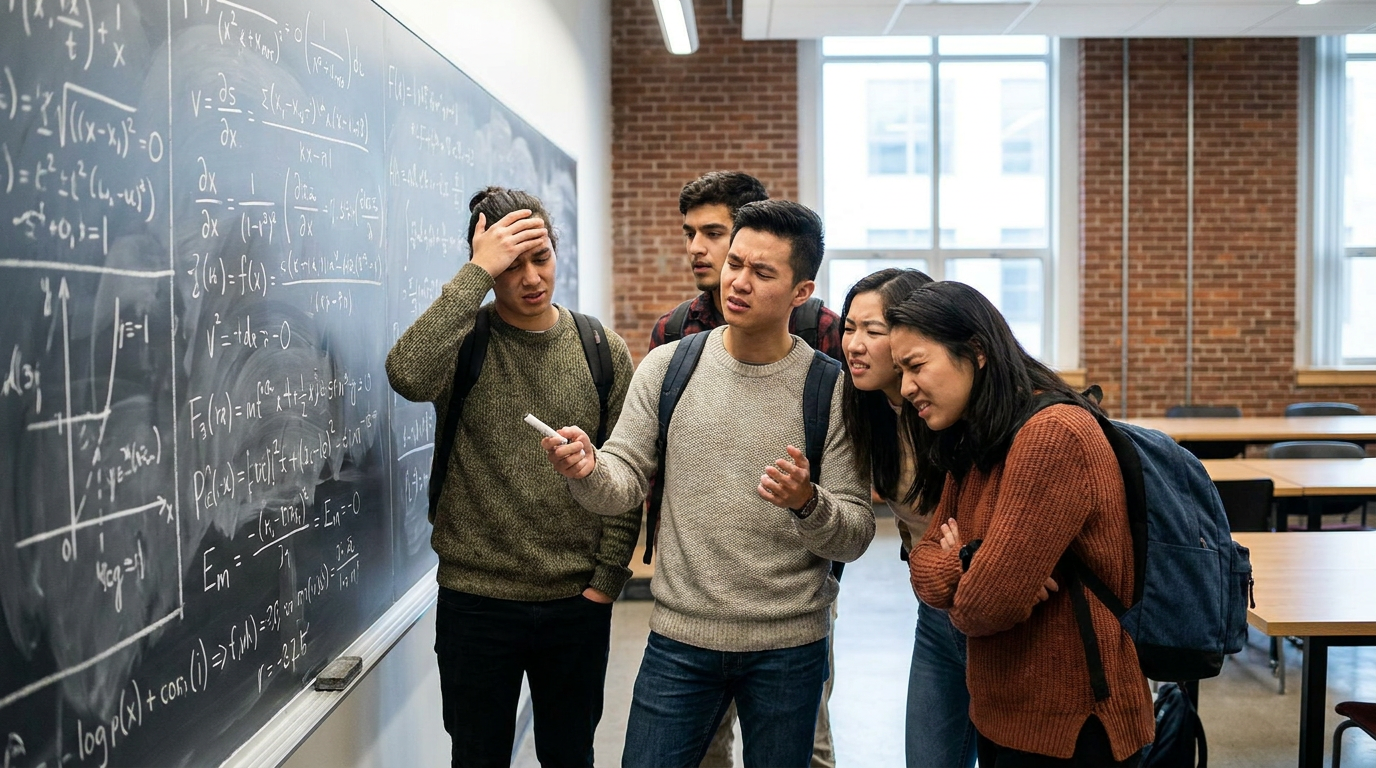
- Cognitive Scientists
- Argue that prior knowledge activation and cognitive dissonance are biological prerequisites for deep encoding.
- Direct Instruction Advocates
- Warn that unguided problem-solving can overwhelm working memory and lead to the encoding of misconceptions.
- Classroom Educators
- Highlight the practical difficulty of designing 'sweet spot' problems and managing student anxiety in test-heavy systems.
What's not represented
- · Students with learning disabilities who may require more immediate scaffolding
- · Parents concerned about non-traditional teaching methods
Why this matters
For decades, educational systems have prioritized minimizing student errors through direct instruction. Understanding that controlled struggle actually builds stronger neural pathways allows educators, parents, and self-directed learners to reframe frustration as a necessary biological step toward mastery, rather than a sign of inadequacy.
Key points
- Productive failure asks students to solve complex problems before receiving formal instruction.
- A meta-analysis of 12,000 students shows it outperforms traditional direct instruction in conceptual learning.
- The initial struggle activates prior knowledge and makes students aware of their knowledge gaps.
- The method relies heavily on a teacher-led 'assembly' phase to correct misconceptions.
- It is most effective in STEM subjects and for older students, rather than young children.
For decades, the dominant pedagogical model in classrooms worldwide has followed a predictable, linear sequence: "I do, we do, you do." A teacher introduces a new concept, demonstrates the correct procedure, guides the class through a few examples, and finally assigns independent practice.[6]
This "instruction-first" approach is logical, efficient, and designed to minimize student errors. But a growing body of cognitive science suggests it may be optimizing for the wrong variable, inadvertently short-circuiting the very mechanisms that lead to durable understanding.[1][6]
Enter "Productive Failure" (PF), a learning design that deliberately flips the traditional script. Pioneered by Dr. Manu Kapur, an educational psychologist at ETH Zurich, the method asks students to grapple with complex, novel problems before they have been taught the concepts or formulas required to solve them.[2][4]
The expectation is that students will struggle, generate sub-optimal solutions, and ultimately fail to discover the canonical answer on their own. Yet, according to a massive synthesis of educational data, this carefully orchestrated struggle actually primes the brain for significantly deeper learning.[1][3]

The most comprehensive evidence for the method comes from a landmark meta-analysis published in the Review of Educational Research. Researchers analyzed 53 independent studies encompassing 166 experimental comparisons and more than 12,000 participants across various educational levels.[1]
The results were striking. Students who engaged in problem-solving followed by instruction significantly outperformed their peers in traditional instruction-first classrooms on measures of conceptual understanding and knowledge transfer.[1][2]
The effect sizes were substantial. On average, the productive failure model yielded a moderate effect size (Cohen's d = 0.36). However, when the method was implemented with high fidelity to its core design principles, the effect size jumped to 0.58—roughly double the benchmark for what a typical year of good teaching achieves.[1][3]

To understand why failing first works, it helps to look at a classic productive failure exercise. Imagine teaching middle schoolers the statistical concept of standard deviation.[4]
In a traditional classroom, the teacher writes the formula on the board and explains the steps. In a productive failure classroom, the teacher might present two sets of data—say, the varying performance of two athletes—and ask the students to invent a mathematical way to determine which athlete is more consistent.[4][6]
In a traditional classroom, the teacher writes the formula on the board and explains the steps.
The students might try subtracting the lowest score from the highest, or plotting the numbers on a graph. Their invented methods will be flawed, but the process of trying to build a solution forces them to deeply analyze the structure of the problem.[3][4]
Kapur identifies four distinct cognitive mechanisms at work during this process, which he calls the "Four A's": Activation, Awareness, Affect, and Assembly.[4]
First, the struggle activates the students' prior knowledge, bringing their existing mental models to the surface. Second, it builds awareness of their own knowledge gaps—they realize exactly what they do not know.[4][5]
Third, this awareness triggers a shift in affect, or psychological state. Having invested effort into a problem and hit a wall, students become highly motivated and receptive to learning the actual solution.[4]
Finally, the critical assembly phase occurs. The teacher steps in, not just to deliver a lecture, but to explicitly compare the students' failed attempts with the expert solution. Because the students have already wrestled with the problem's constraints, the formal instruction lands on fertile cognitive ground.[3][4]

However, researchers are quick to emphasize that productive failure is not simply "discovery learning," nor is it about throwing students into the deep end and leaving them to drown.[1][6]
Unproductive failure occurs when tasks are too difficult, when students are left to flounder without support, or when the crucial consolidation phase is skipped. The meta-analysis clearly showed that the benefits vanish if the teacher does not expertly weave the students' initial ideas into the formal instruction.[1][3]
There are also boundaries to the method's efficacy. The data shows productive failure works exceptionally well in STEM subjects—such as math, physics, chemistry, and biology—and for older students in secondary school and university.[1][4]
Conversely, the evidence is much weaker for younger learners, specifically second to fifth graders, and for the acquisition of domain-general skills or purely procedural, rote memorization. For those contexts, direct instruction often remains the superior choice.[1]

Implementing productive failure at scale also requires a cultural shift. In many educational systems, failure is heavily stigmatized and associated with shame. Teachers must actively reframe the classroom environment so that initial struggle is viewed as a safe, expected, and necessary part of the learning process.[3][5]
Ultimately, the evidence suggests that by shielding students from confusion, traditional education may be inadvertently short-circuiting the very mechanisms that lead to durable understanding. As Kapur notes, if failure isn't built into our educational systems, we are under-optimizing learning.[5][6]
How we got here
1998
Researchers publish foundational work on 'Preparation for Future Learning,' showing the value of exploring data before a lecture.
2008
Dr. Manu Kapur formally coins the term 'Productive Failure' and begins publishing controlled studies on the method in mathematics education.
2016
Kapur demonstrates that productive failure works across different ability levels in Singaporean schools, leading to broader curriculum integration.
2021
A massive meta-analysis of 53 studies confirms that problem-solving before instruction significantly outperforms traditional direct instruction for conceptual learning.
Viewpoints in depth
Cognitive Scientists
Argue that prior knowledge activation and cognitive dissonance are biological prerequisites for deep encoding.
Researchers in this camp view the brain not as a blank hard drive waiting for data, but as a predictive engine that learns best when its predictions are proven wrong. They argue that the initial struggle in productive failure is a biological necessity for complex learning. By forcing students to generate sub-optimal solutions, the brain activates existing neural networks. When those networks fail to solve the problem, the resulting cognitive dissonance creates an optimal state of receptivity for the correct expert model.
Direct Instruction Advocates
Warn that unguided problem-solving can overwhelm working memory and lead to the encoding of misconceptions.
Rooted heavily in Cognitive Load Theory, this perspective cautions against moving away from explicit instruction. Proponents argue that novice learners have highly limited working memory capacities. Asking them to solve novel problems without guidance can easily overwhelm their cognitive resources, leading to frustration rather than productive struggle. Furthermore, they warn that if the teacher's consolidation phase is not executed perfectly, students may accidentally encode their own flawed, invented methods into long-term memory.
Classroom Educators
Highlight the practical difficulty of designing 'sweet spot' problems and managing student anxiety in test-heavy systems.
While many teachers acknowledge the theoretical benefits of productive failure, they point to significant hurdles in real-world implementation. Designing a task that is just hard enough to cause failure, but accessible enough to prevent students from giving up, requires immense skill and preparation time. Additionally, educators note that in school systems heavily focused on high-stakes standardized testing, students are often deeply conditioned to fear mistakes, making it difficult to foster the psychological safety required for the method to work.
What we don't know
- Whether productive failure can be effectively adapted for early elementary education.
- How well the method translates to domain-general skills like critical reading or historical analysis.
- The long-term impact of productive failure on students with severe math anxiety.
Key terms
- Productive Failure (PF)
- A learning design where students attempt to solve complex, novel problems before receiving formal instruction on the underlying concepts.
- Direct Instruction
- A traditional teaching model where the teacher explicitly explains a concept and demonstrates the procedure before students practice it.
- Cognitive Load Theory
- The psychological theory that working memory has limited capacity, suggesting that instructional design should minimize unnecessary mental strain on learners.
- Knowledge Transfer
- The ability of a student to take a concept learned in one context and successfully apply it to a novel, unfamiliar problem.
- Effect Size (Cohen's d)
- A statistical metric used in research to quantify the magnitude of a difference between two groups; in education, it measures how much an intervention improved learning.
Frequently asked
What is the difference between productive failure and discovery learning?
Discovery learning often expects students to find the correct answer on their own with minimal guidance. Productive failure expects students to fail, using that struggle purely as preparation for a highly structured, teacher-led instruction phase.
Does productive failure work for all subjects?
The strongest evidence is in STEM fields (math, science, engineering) where conceptual understanding is key. There is currently less evidence for its effectiveness in domain-general skills or subjects requiring pure factual recall.
Does this method harm students' confidence?
Research shows that when the failure is framed correctly as a low-stakes, expected part of the process, it actually increases motivation and receptivity. However, if the classroom culture penalizes mistakes, it can lead to anxiety.
Sources
Source coverage
6 outlets
3 viewpoints surfaced






[1]Review of Educational ResearchDirect Instruction Advocates
When Problem Solving Followed by Instruction Works: Evidence for Productive Failure
Read on Review of Educational Research →[2]ETH ZurichCognitive Scientists
Evidence for productive failure as a teaching tool
Read on ETH Zurich →[3]EdutopiaClassroom Educators
The Science of Productive Failure
Read on Edutopia →[4]Times Higher EducationClassroom Educators
Evidence for productive failure as a teaching tool
Read on Times Higher Education →[5]Imperial College LondonCognitive Scientists
The science of failing well: Professor Manu Kapur on Productive Failure
Read on Imperial College London →[6]Factlen Editorial Team
Synthesis by Factlen editorial team
Read on Factlen Editorial Team →

Every angle. Every day.
Get education stories with full source coverage and perspective breakdowns delivered to your inbox.