
How AI and Bioacoustics Are Revolutionizing Ecosystem Conservation
By combining solar-powered microphones with advanced machine learning, conservationists are now monitoring the health of remote ecosystems and detecting illegal logging in real time.
By Factlen Editorial Team
- Conservation Biologists
- Prioritizing non-invasive, large-scale ecological baselines.
- Enforcement & Rangers
- Focusing on real-time threat detection and intervention.
- Corporate Compliance
- Seeking standardized metrics for nature-related financial risks.
- AI Researchers
- Focusing on improving algorithmic accuracy and adapting models to new environments.
What's not represented
- · Indigenous forest communities
- · Hardware manufacturers
Why this matters
The ability to continuously monitor ecosystems at scale allows humanity to measure biodiversity accurately and stop illegal deforestation before it happens, fundamentally shifting conservation from reactive to proactive.
Key points
- Conservationists are increasingly using passive acoustic sensors to monitor ecosystems without disturbing wildlife.
- AI models convert audio into visual spectrograms to identify species calls and human-made noises from millions of hours of data.
- Systems like Rainforest Connection's Guardian devices send real-time alerts to rangers when chainsaws or gunshots are detected.
- The integration of bioacoustics with eDNA is providing corporations with standardized metrics to measure biodiversity risk.
For decades, measuring the health of an ecosystem meant sending humans into the wild. Ecologists would hike through dense underbrush, set up camera traps, or conduct catch-and-release surveys to count species. It was a slow, expensive, and inherently flawed process—human presence alters animal behavior, and visual tools frequently fail in the dark or under thick forest canopies.[7]
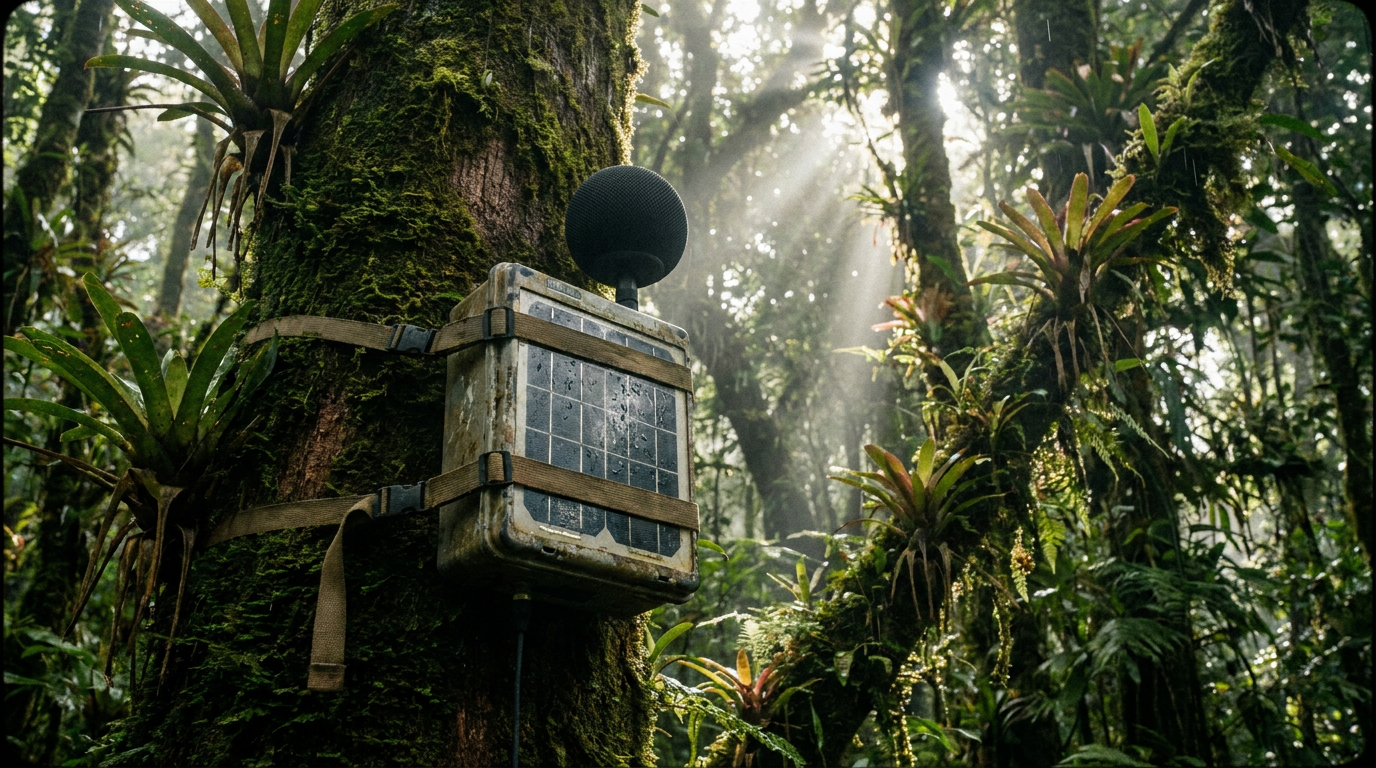
Today, conservationists are adopting a radically different approach: they are simply listening. The natural world is a cacophony of data, broadcasting its health twenty-four hours a day. By deploying rugged, solar-powered microphones into remote habitats, researchers can capture the continuous hum of life without ever disturbing it.[2]
This emerging field is known as soundscape ecology. It operates on the premise that every ecosystem has a unique acoustic signature, composed of three distinct layers. There is the "biophony" (the calls of birds, frogs, and insects), the "geophony" (wind, rain, and flowing water), and the "anthropophony" (human-made noise like chainsaws or engines).[2][3]

However, this acoustic revolution quickly ran into a massive data bottleneck. A network of sensors can easily record millions of hours of audio in a single season. It would take human researchers lifetimes to listen to and manually identify the species hidden within those recordings. The data was simply too vast to be useful.[1][3]
That bottleneck is now being shattered by artificial intelligence. Machine learning algorithms, specifically Convolutional Neural Networks (CNNs), have been trained to "listen" at superhuman scales, processing years of audio in a matter of hours.[2]
The mechanism is surprisingly visual. The AI does not process raw audio; instead, the sound files are converted into spectrograms—visual heat maps of sound frequencies over time. The AI then scans these images, recognizing the specific visual pattern of a rare bird's chirp or a chainsaw's roar just as facial recognition software identifies a human face.[2][7]

The scale of this capability is transforming field research. Google DeepMind recently released an updated version of its "Perch" AI model, which is trained on massive public datasets like Xeno-Canto to identify thousands of species across diverse environments.[1]
In Hawaii, biologists from the LOHE Bioacoustics Lab used the Perch model to monitor endangered honeycreepers, which face extinction from avian malaria. The AI helped researchers find the rare bird calls nearly 50 times faster than traditional manual methods, allowing them to map the surviving populations across much larger territories.[1]
In Hawaii, biologists from the LOHE Bioacoustics Lab used the Perch model to monitor endangered honeycreepers, which face extinction from avian malaria.
Beyond tracking biodiversity, bioacoustics is being deployed as a real-time security system for the world's most vulnerable forests. The nonprofit Rainforest Connection has pioneered the use of "Guardian" devices—often built from upcycled smartphones—strapped high in the forest canopy.[2][6]
These solar-powered nodes continuously stream audio to the cloud. If the AI detects the acoustic signature of a chainsaw, a logging truck, or a gunshot, it instantly transmits a geographic alert to local rangers' mobile phones, allowing them to intercept the threat.[2][6]

This shifts enforcement from reactive to proactive. In Sumatra, Rainforest Connection has even partnered with Hitachi to develop predictive models. By analyzing subtle acoustic anomalies and disturbances in the forest's baseline soundscape, the system attempts to predict illegal logging events before the chainsaws even start running.[6]
The technology is also proving critical for regulatory compliance and corporate sustainability. As global regulations tighten around biodiversity risk, businesses are turning to "naturetech" to measure their environmental impact accurately.[4]
Companies like NatureMetrics now offer integrated platforms where passive acoustic monitoring is combined with environmental DNA (eDNA) sampling. While eDNA is excellent for detecting aquatic life, bioacoustics fills the gap by providing continuous, species-level precision for birds and bats—data that is notoriously difficult to capture through snapshot surveys.[5]
This influx of corporate and institutional interest has triggered a boom in the naturetech sector. Investment in biodiversity monitoring and ecosystem restoration technologies surged to roughly $2 billion in 2022, growing at an average annual rate of 52% since 2018.[4]

Researchers are now pushing the boundaries of what AI can interpret. At the Argonne National Laboratory, scientists are deploying bioacoustic audio recorders to establish long-term baselines for animal biodiversity, allowing them to quantify exactly how land-use changes or climate shifts alter an ecosystem over years.[3]
Advanced models are even beginning to adapt to entirely new environments, such as underwater ecosystems. AI is being trained to disentangle the complex acoustic scenes of coral reefs, tracking the clicks and grunts of marine life to assess the health of the reef without requiring divers in the water.[1]
Despite the rapid progress, the technology faces hurdles. Hyperdiverse environments, like the Amazon basin, present incredibly complex "cocktail party" problems where thousands of overlapping calls can confuse algorithms. Furthermore, maintaining hardware in extreme humidity, dense canopies, and corrosive salt air remains a logistical challenge.[7]
Yet, the trajectory is clear. By combining cheap sensors, cloud computing, and advanced machine learning, conservationists are building a real-time planetary dashboard for biodiversity. For the first time, humanity has the tools to listen to the Earth—and the intelligence to understand what it is saying.[7]
How we got here
Pre-2010s
Conservation relies heavily on manual field surveys, camera traps, and human-led acoustic monitoring.
2014
Rainforest Connection deploys its first upcycled smartphone "Guardian" devices to detect illegal logging.
2020
Hitachi and Rainforest Connection partner to test predictive AI models in Sumatra to forecast logging before it happens.
2022
Global investment in "naturetech" and biodiversity monitoring surges to approximately $2 billion.
August 2025
Google DeepMind releases a major update to its Perch AI model, expanding detection to underwater environments and thousands of new species.
Viewpoints in depth
Conservation Biologists
Prioritizing non-invasive, large-scale ecological baselines.
For field ecologists, the primary value of AI bioacoustics is scale and invisibility. Traditional methods like catch-and-release or human observation inherently alter the behavior of the animals being studied and are limited by the physical endurance of the researchers. By deploying passive acoustic sensors, biologists can establish objective, long-term baselines of ecosystem health across vast territories. They argue that understanding the subtle shifts in a soundscape over years is the most accurate way to measure the impact of climate change and habitat loss.
Enforcement & Rangers
Focusing on real-time threat detection and intervention.
For those on the front lines of forest protection, biodiversity metrics take a backseat to immediate security. Rangers and local enforcement agencies value bioacoustics as a real-time alarm system. Because illegal loggers and poachers rely on chainsaws, trucks, and firearms, their activities broadcast a distinct acoustic signature. Enforcement advocates emphasize that transmitting instant, geolocated alerts allows small, underfunded ranger teams to intercept threats proactively, rather than discovering deforested clearings weeks after the fact.
Corporate Compliance
Seeking standardized metrics for nature-related financial risks.
As global regulatory frameworks increasingly require businesses to report their impact on nature, corporate stakeholders view bioacoustics as a vital compliance tool. Traditional environmental impact assessments are often slow, expensive, and based on snapshot surveys. The corporate sector argues that integrating AI-driven acoustics with other technologies like eDNA provides a continuous, auditable, and standardized metric of biodiversity. This allows companies to accurately measure the success of their nature-based investments and prove regulatory compliance to shareholders.
What we don't know
- How well AI models can untangle the 'cocktail party' problem of thousands of overlapping calls in hyperdiverse environments like the Amazon.
- The long-term durability of sensitive acoustic hardware in highly corrosive environments like salt-sprayed coastlines or extreme humidity.
- Whether predictive AI models can accurately forecast illegal logging events in new regions outside of their initial training data.
Key terms
- Bioacoustics
- The scientific study of sounds produced by or affecting living organisms in their environment.
- Soundscape Ecology
- The study of the acoustic relationships between living organisms, human activities, and the natural environment.
- Spectrogram
- A visual representation of the spectrum of frequencies of a signal as it varies with time, used by AI to "see" sound.
- Environmental DNA (eDNA)
- Genetic material obtained directly from environmental samples (soil, water) used to detect the presence of species.
- Biophony
- The collective sounds produced by all living organisms in a given habitat.
Frequently asked
How is bioacoustics different from using camera traps?
Camera traps rely on line-of-sight and can miss animals in dense foliage or darkness. Bioacoustic sensors capture a continuous 360-degree radius of sound regardless of visibility.
Can AI identify individual animals or just the species?
While most models currently identify species, recent advancements are beginning to allow AI to recognize individual animal signatures and track population abundance without catch-and-release methods.
How do the remote recording devices get power?
Most modern bioacoustic sensors, such as the Guardian devices, are equipped with specialized solar panels designed to harvest energy even through the dappled light of a forest canopy.
Does this technology replace human conservationists?
No. AI processes the massive data bottleneck, but human ecologists and rangers are still required to interpret the broader ecological trends and physically intervene to stop illegal activities.
Sources
Source coverage
7 outlets
4 viewpoints surfaced







[1]Google DeepMindAI Researchers
How AI is helping advance the science of bioacoustics to save endangered species
Read on Google DeepMind →[2]Rainforest ConnectionEnforcement & Rangers
The Technology of Sound: Understanding Rainforest Bioacoustics
Read on Rainforest Connection →[3]Argonne National LaboratoryConservation Biologists
Long-term analysis of soundscapes using machine learning and AI
Read on Argonne National Laboratory →[4]IMDCorporate Compliance
Data interpretation: Turning complexity into actionable insights for nature conservation
Read on IMD →[5]NatureMetricsCorporate Compliance
Detect birds and bats at scale with bioacoustics monitoring
Read on NatureMetrics →[6]Hitachi Digital ServicesEnforcement & Rangers
Rainforest Connection Helps Prevent Illegal Deforestation with Hitachi Partnership
Read on Hitachi Digital Services →[7]Factlen Editorial TeamAI Researchers
Synthesis by Factlen editorial team
Read on Factlen Editorial Team →
Every angle. Every day.
Get environment stories with full source coverage and perspective breakdowns delivered to your inbox.