
How AI Agents Actually Work: The Architecture Behind Autonomous Systems
The AI industry is shifting from passive chatbots to autonomous agents capable of planning, using tools, and collaborating in multi-agent systems to solve complex tasks.
By Factlen Editorial Team
- AI Researchers & Developers
- Focus on the architectural breakthroughs that enable autonomous tool use and multi-agent orchestration.
- Enterprise Strategists
- Value the shift from rigid automation to adaptable workflows that reduce IT maintenance.
- AI Governance Advocates
- Emphasize the need for robust oversight and human-in-the-loop systems as agents gain execution capabilities.
What's not represented
- · Traditional software engineers skeptical of non-deterministic code execution
Why this matters
Understanding agentic AI is crucial because it represents the transition from software that simply answers questions to software that actively executes work on your behalf, fundamentally changing how businesses and individuals manage digital tasks.
Key points
- The AI industry is moving from zero-shot chatbots to autonomous agents that can plan and execute multi-step workflows.
- The ReAct (Reasoning and Acting) framework allows models to interleave internal thought processes with external tool use.
- Agentic workflows utilize reflection and self-correction, enabling AI to spot and fix its own errors before delivering a final result.
- Multi-agent systems divide complex tasks among specialized subagents, managed by a central routing agent, to improve reliability.
For the past few years, the world’s interaction with artificial intelligence has largely been a game of ping-pong. A user types a prompt, and a large language model (LLM) generates a response. If the answer is wrong, the human must refine the prompt and try again. This "zero-shot" paradigm treats AI as a static oracle. But a fundamental shift is underway in software engineering, moving the industry away from passive chatbots and toward autonomous "AI agents."[6]
Unlike standard chatbots, AI agents do not just generate text; they execute tasks. They are designed to perceive a goal, plan a sequence of actions, use external tools, and adapt if they encounter errors. This transition from conversational AI to "agentic AI" is transforming large language models from mere conversationalists into digital workers capable of navigating complex, multi-step workflows.[1][3]
The implications for productivity and software design are profound. Instead of a human manually orchestrating every step of a digital task—such as researching a topic, formatting the data, and emailing a report—an agentic system can handle the entire loop autonomously. To understand how this works, one must look under the hood at the architectural breakthroughs that make AI agency possible.[6]
The foundational engine of modern AI agents is a concept known as ReAct, short for "Reasoning and Acting." Introduced by researchers in 2022, the ReAct framework forces the language model to interleave internal thought processes with external actions. Instead of immediately guessing an answer, the model is prompted to think out loud.[4]
A ReAct loop typically follows a strict cycle: Thought, Action, and Observation. First, the agent analyzes the user's request and formulates a "Thought" about what to do next. Second, it takes an "Action," such as querying a database or searching the web. Finally, it ingests the "Observation"—the result of that action—and uses it to inform its next thought.[4]

This iterative loop dramatically reduces hallucinations. By grounding its reasoning in real-world observations rather than relying solely on its pre-trained weights, the AI can verify facts on the fly. In early benchmark testing, ReAct-based models achieved up to a 30% increase in accuracy on complex question-answering tasks compared to models relying on pure reasoning.[4]
Of course, reasoning is only half the equation; an agent must also be able to act. This is achieved through "tool use" or "function calling." Developers equip the LLM with a specific set of digital tools—APIs, web browsers, calculators, or code interpreters.[1]
When the agent's reasoning engine determines that it needs external information, it outputs a structured command to trigger one of these tools. For example, if asked about current stock prices, the agent recognizes it cannot rely on its training data. It autonomously writes a command to call a financial API, waits for the live data to return, and then synthesizes that data into its final answer.[3]
This capability effectively gives the AI "hands." It allows agents to book flights, update customer relationship management (CRM) software, or execute Python code to analyze a spreadsheet. The language model serves as the brain, while the tools serve as the sensory organs and limbs interacting with the outside digital world.[6]
The language model serves as the brain, while the tools serve as the sensory organs and limbs interacting with the outside digital world.
As developers began experimenting with these capabilities, pioneers like Andrew Ng formalized the concept of "agentic workflows." Ng argues that the future of AI lies not just in building more massive foundational models, but in wrapping existing models in iterative, self-correcting workflows.[5]
Ng identifies four core design patterns for agentic workflows: Reflection, Tool Use, Planning, and Multi-agent collaboration. Reflection is particularly powerful. It involves prompting the AI to review its own output, spot errors, and rewrite its work before ever showing it to the user.[5]

Planning allows the agent to break a massive, ambiguous goal into a step-by-step checklist. If a step fails—for instance, if a specific web search API goes down—a robust agentic workflow allows the AI to recognize the failure and pivot to an alternative tool, such as a Wikipedia scraper, without requiring human intervention.[5]
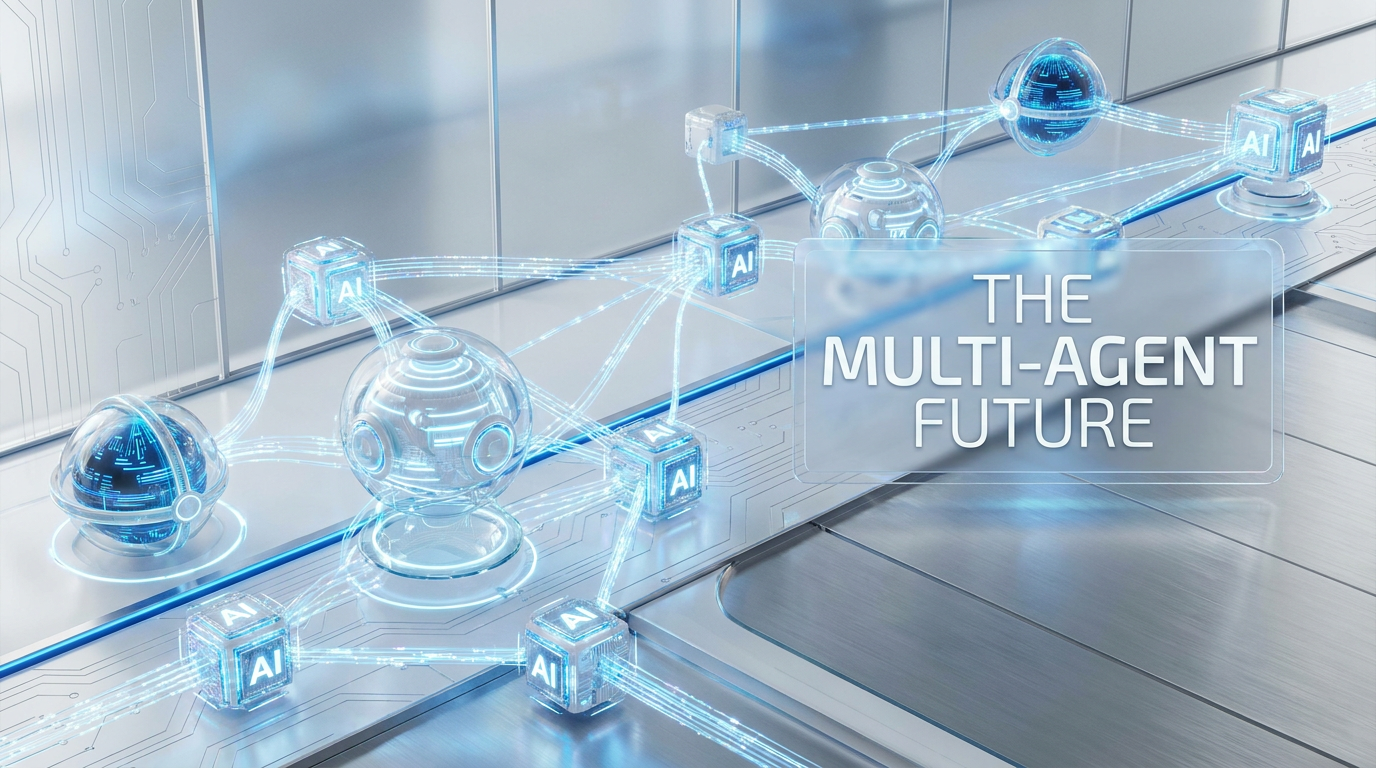
As tasks become more complex, a single AI agent can become overwhelmed. Giving one model access to 50 different tools and a massive set of instructions often leads to confusion and poor decision-making. The solution is the "Multi-Agent System."[2]
In a multi-agent architecture, developers create a team of specialized, narrow agents rather than one omnipotent bot. Frameworks like LangChain have popularized this approach, utilizing "Router" agents that act as managers. When a user submits a complex request, the Router analyzes the intent and delegates the work to the appropriate subagents.[2]

For example, a software development multi-agent system might feature a "Coder Agent" that writes the initial script, a "Reviewer Agent" that tests the code for security vulnerabilities, and a "Documentation Agent" that writes the readme file. These agents converse with one another, passing data back and forth until the overarching goal is met, mirroring the structure of a human corporate team.[2][5]
The enterprise world is taking notice. Consulting firms like McKinsey & Company project that IT architectures will fundamentally shift to accommodate these multi-agent models. Traditional automation, such as Robotic Process Automation (RPA), relies on rigid, predefined rules that break when a website's layout changes or an unexpected error occurs.[3]
Agentic AI, by contrast, is dynamic. Because the agents possess semantic understanding and reasoning capabilities, they can navigate ambiguity. If a button moves on a webpage, a visual AI agent can still find it. If a data format changes, the agent can write a quick script to reformat it on the fly.[1]

This adaptability significantly reduces the maintenance burden on IT departments and opens the door to automating highly complex, knowledge-based workflows that were previously out of reach for traditional software.[3]
While the technology is still maturing—agents can sometimes get stuck in infinite loops or rack up high API costs if left entirely unchecked—the trajectory is clear. The industry is moving from software as a tool we wield, to software as a collaborator we manage.[6]
By combining the vast knowledge of large language models with the structured execution of ReAct loops, tool use, and multi-agent collaboration, agentic workflows represent the next major leap in artificial intelligence. They are transforming AI from a system that simply talks, into a system that does.[6]
How we got here
2022
Researchers introduce the ReAct framework, proving that interleaving reasoning and acting improves LLM reliability.
2023
Major AI labs introduce native Function Calling, giving foundational models reliable ways to interact with external APIs.
2024
Multi-agent frameworks like LangChain gain massive popularity among developers for orchestrating complex workflows.
2025
Enterprise adoption accelerates as organizations begin replacing rigid RPA systems with adaptable agentic architectures.
Viewpoints in depth
AI Researchers & Developers
Focus on the architectural breakthroughs that enable autonomous tool use.
For the research community, the excitement around agentic AI stems from breaking the limitations of static, zero-shot generation. By implementing frameworks like ReAct and multi-agent routing, developers are finding that they can extract significantly higher performance and reliability from smaller, cheaper models. The focus is on building robust orchestration layers—like LangChain—that allow these models to self-correct, manage memory, and seamlessly hand off tasks to specialized subagents without human intervention.
Enterprise Strategists
Value the shift from rigid automation to adaptable workflows.
Business leaders view AI agents as the long-awaited evolution of Robotic Process Automation (RPA). Traditional RPA is notoriously brittle, requiring constant maintenance whenever a user interface or data format changes. Enterprise strategists argue that agentic workflows solve this by introducing semantic understanding into the automation pipeline. Because agents can reason about their goals, they can dynamically adapt to unexpected errors, pivot to alternative tools, and maintain operational continuity, drastically reducing IT overhead.
AI Governance Advocates
Emphasize the need for robust oversight as agents gain execution capabilities.
As AI moves from generating text to executing real-world actions—such as modifying databases, sending emails, or executing code—governance advocates stress the critical need for safety guardrails. They argue that autonomous systems can easily spiral into infinite loops, rack up massive API costs, or execute destructive commands if they hallucinate a tool call. This camp advocates for strict 'human-in-the-loop' architectures, where agents can plan and draft actions, but require explicit human authorization before executing high-stakes operations.
What we don't know
- How reliably multi-agent systems can scale to handle highly ambiguous, months-long enterprise projects without human intervention.
- The long-term security implications of granting autonomous AI agents direct access to execute code and modify production databases.
Key terms
- Agentic Workflow
- An iterative process where an AI model plans, executes, reflects, and self-corrects to achieve a goal, rather than generating a single zero-shot response.
- ReAct Prompting
- A technique that prompts an AI to cycle through "Thought, Action, and Observation," grounding its reasoning in real-world tool use.
- Tool Use (Function Calling)
- The ability of an AI model to interact with external software, such as searching the web, querying a database, or running code.
- Multi-Agent System
- An architecture where multiple specialized AI agents communicate and collaborate to complete a complex overarching task.
- Zero-Shot Prompting
- Asking an AI model to generate a final answer in a single attempt without prior examples or iterative refinement.
Frequently asked
What is the difference between an AI agent and a chatbot?
A chatbot is designed primarily to generate text in response to a prompt. An AI agent is designed to achieve a goal by planning steps, using external tools, and executing actions autonomously.
What does ReAct stand for in AI?
ReAct stands for "Reasoning and Acting." It is a prompting framework that forces the AI to interleave internal thought processes with external actions, allowing it to verify facts and adapt.
What is a multi-agent system?
Instead of relying on one massive AI model to do everything, a multi-agent system uses a team of specialized AI agents (like a coder, a researcher, and a reviewer) that collaborate to solve complex problems.
Why are agentic workflows better than traditional automation?
Traditional automation relies on rigid rules that break when environments change. Agentic workflows use language models to understand context, allowing them to dynamically adapt to errors or changes in data formats.
Sources
Source coverage
6 outlets
3 viewpoints surfaced






[1]IBMEnterprise Strategists
What is agentic architecture?
Read on IBM →[2]LangChainAI Researchers & Developers
Multi-agent architectures
Read on LangChain →[3]McKinsey & CompanyEnterprise Strategists
What is an AI agent?
Read on McKinsey & Company →[4]arXivAI Researchers & Developers
ReAct: Synergizing Reasoning and Acting in Language Models
Read on arXiv →[5]DeepLearning.AIAI Researchers & Developers
Agentic Workflows
Read on DeepLearning.AI →[6]Factlen Editorial TeamAI Governance Advocates
Synthesis by Factlen editorial team
Read on Factlen Editorial Team →

More in ai
See all 6 stories →Drug Discovery
New AI Model Accelerates Molecular Simulations 10,000-Fold, Promising Faster Drug Discovery
6 sources
AI Regulation
EU Delays High-Risk AI Rules to 2027, But August 2026 Transparency Cliff Remains
7 sources

Edge AI
The Local AI Revolution: How Small Foundation Models Are Putting Private, Offline Intelligence on Your Phone
8 sources

On-Device AI
How Small Language Models Are Moving AI From the Cloud to Your Pocket
6 sources

Every angle. Every day.
Get ai stories with full source coverage and perspective breakdowns delivered to your inbox.