
Global Fencing Injury Report: Unprecedented Safety Data, Overuse Battles, and the Race for Hong Kong
A massive new dataset confirms fencing as one of the world's safest combat sports, even as elite athletes like Hong Kong's Ryan Choi battle the sport's true nemesis: asymmetric overuse injuries.
By Factlen Editorial Team
- Sports Medical Professionals
- Focus on the biomechanical realities of the sport, emphasizing that while acute injuries are rare, asymmetric overuse requires strict load management.
- National Federations & Coaches
- Balance the drive for international medals and Olympic qualification with the urgent need to rehabilitate star athletes safely.
- Amateur & Veteran Fencers
- Value the statistical reassurance of the sport's safety and draw inspiration from successful injury comebacks that prove longevity is possible.
What's not represented
- · Equipment Manufacturers
- · Strength and Conditioning Coaches
Why this matters
For parents, amateur athletes, and elite competitors, the latest sports medicine data provides immense reassurance about fencing's fundamental safety. It also shifts the training focus away from acute trauma prevention and toward smarter load management to extend athletes' careers.
Key points
- A six-season analysis of 637,000 bouts confirms fencing has a medical withdrawal rate of just 0.338%.
- Academic studies reveal that elite fencers primarily suffer from overuse injuries rather than acute trauma.
- Over 57% of training injuries affect the lower extremities due to the asymmetric demands of the lunge.
- Hong Kong's Ryan Choi is racing to recover from a hamstring injury ahead of the World Championships.
- The FIE is hosting a dedicated Sports Medicine Conference in Hong Kong to address training loads and safety.
- Veteran fencer Paul Epply-Schmidt recently won gold following a two-year injury rehabilitation.
As the global fencing community turns its eyes toward the 2026 World Fencing Championships in Hong Kong this July, the sport is undergoing a quiet revolution in how it understands, tracks, and treats injuries. For decades, fencing has carried the reputation of being a remarkably safe combat sport. This year, the data has finally caught up to the anecdotes, providing a comprehensive look at what actually keeps fencers off the piste.[2][6]
In a landmark safety report released earlier this year, USA Fencing analyzed more than 637,000 direct elimination bouts spanning six full seasons. The findings were striking: the medical withdrawal rate across all age groups and skill levels was a microscopic 0.338%, or roughly one withdrawal for every 296 bouts. Even among the youngest competitors (age 10 and under), the withdrawal rate hovered near 0.102%.[2][6]
The data also revealed fascinating variations between the three weapons. Épée proved to be the safest discipline with a medical withdrawal rate of just 0.261%. Saber followed at 0.369%, while foil recorded the highest rate at 0.393%. Crucially, a "medical withdrawal" encompasses everything from dehydration and muscle cramps to pre-existing conditions, meaning the rate of actual acute injuries sustained during a bout is even lower.[2][6]

However, while acute tournament injuries are vanishingly rare, elite fencers face a different, chronic battle: overuse. A pair of comprehensive academic studies published in early 2026 mapped the cumulative toll that thousands of hours of asymmetric training take on the body. Researchers found that elite fencers experience 3.22 injuries per 1,000 training hours, with overuse injuries outnumbering acute trauma by a margin of four to one.[3]
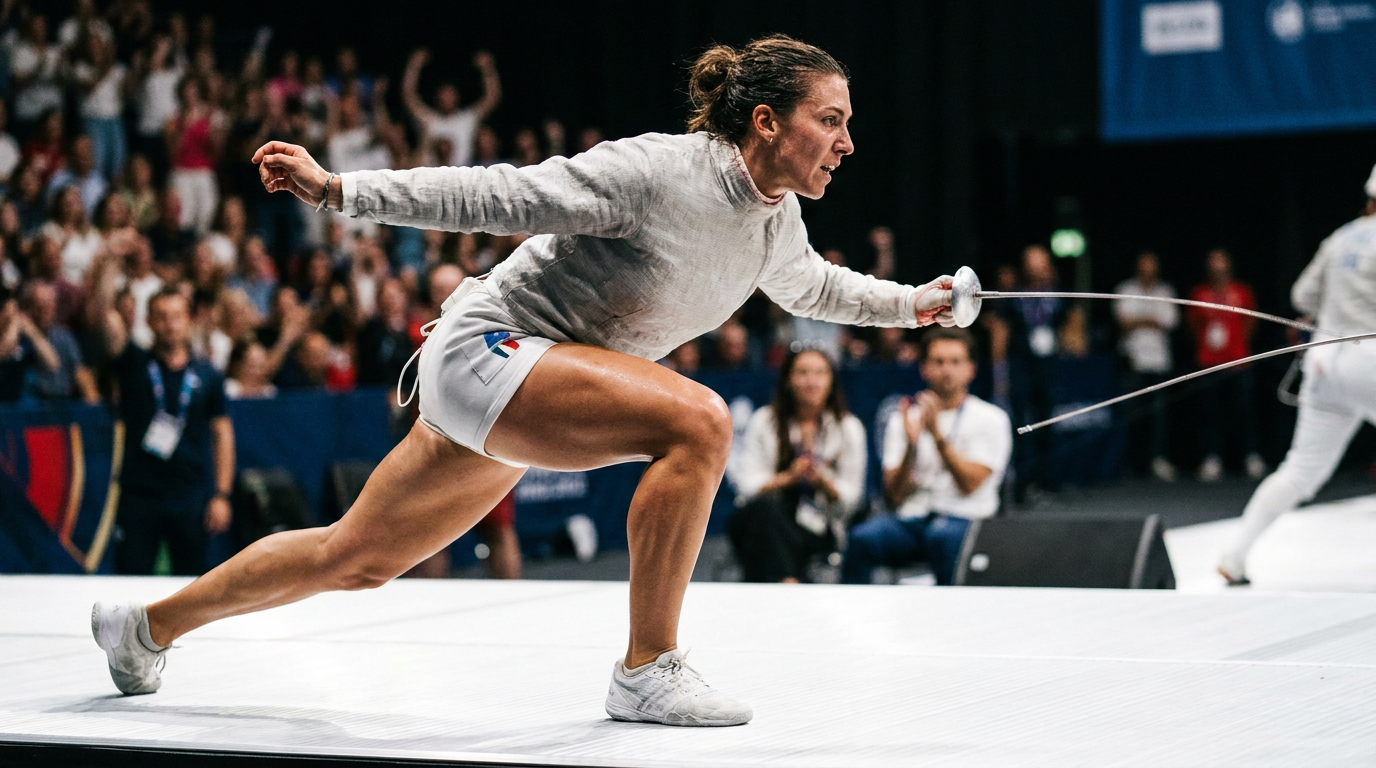
The biomechanics of the sport make the anatomical distribution of these injuries highly predictable. Over 57% of all fencing injuries affect the lower extremities—specifically the knees, ankles, and hamstrings. The fencing lunge requires explosive acceleration followed by massive eccentric deceleration on the lead leg. When tissue capacity fails to match the training volume, patellar tendinopathy and hamstring strains inevitably follow.[3]

The biomechanics of the sport make the anatomical distribution of these injuries highly predictable.
That exact biomechanical reality is currently dominating the headlines in Hong Kong. World No. 2 foilist Ryan Choi Chun-yin suffered a left hamstring injury during the Asian Fencing Championship in New Delhi in mid-June. Despite the injury, the Hong Kong men's team fought their way to a silver medal, falling to Japan in the final.[1]
Hong Kong head coach Greg Koenig has openly described Choi's recovery as a "race against time" ahead of the World Championships, which begin on July 22 at the AsiaWorld-Expo. Koenig emphasized that the team's medical staff is working around the clock to ensure the 28-year-old left-hander is fully fit to compete on home soil, noting that the ultimate goal remains securing a top world ranking for the Los Angeles Olympics.[1]
The global governing body is taking these overuse trends seriously. In an unprecedented move, the Fédération Internationale d'Escrime (FIE) will host a dedicated Sports Medicine Conference in Hong Kong on July 23, running concurrently with the World Championships. The conference is designed to align with the International Olympic Committee's health mandates, focusing heavily on injury prevention, biomechanical demands, and the Fencing Injury Surveillance System (FISS).[4]
By bringing together sports physicians, physiotherapists, and national coaches, the FIE aims to shift the sport's culture toward proactive load management. The scientific program will address the exact issues plaguing fencers like Choi: tracking training loads, implementing recovery interventions, and managing the asymmetric stress that leads to chronic joint and tendon degradation.[4]

When properly managed, athletes can return from severe setbacks to achieve remarkable longevity in the sport. At the February North American Cup in Cincinnati, veteran fencer Paul Epply-Schmidt provided a masterclass in resilience. After a grueling two-year absence due to a severe injury, Epply-Schmidt returned to the piste to capture gold in the Vet-60 men's foil event.[5]
Reflecting on his triumphant return, Epply-Schmidt noted that the key to his comeback was mental discipline and managing the physical load. "After two years due to injury of not participating, to come back and have a very close bout like that was a huge thrill," he remarked, adding that his strategy was simply to block out the pressure and fence "one touch at a time."[5]
As the fencing world converges on Hong Kong, the narrative surrounding athlete health has never been more optimistic. The sport has definitively proven its baseline safety, and with advanced biomechanical tracking and dedicated medical conferences now taking center stage, the focus has shifted entirely to helping athletes train smarter, recover faster, and stay on the piste longer.[2][4][6]
How we got here
Aug 2019 – Jul 2025
USA Fencing collects safety data across 637,000 direct elimination bouts.
Feb 2026
USA Fencing publishes its landmark safety report; Paul Epply-Schmidt returns from a two-year injury to win gold.
Mar/Apr 2026
New academic studies highlight the prevalence of overuse injuries in elite fencers.
Jun 2026
Hong Kong foilist Ryan Choi suffers a hamstring injury at the Asian Championships in New Delhi.
Jul 2026
The FIE will host a dedicated Sports Medicine Conference alongside the World Championships in Hong Kong.
Viewpoints in depth
Sports Medical Professionals
Medical experts emphasize that while fencing is safe from acute trauma, chronic overuse requires strict management.
For sports physicians and biomechanics researchers, the narrative around fencing safety is shifting from the piste to the training room. While the low rate of tournament withdrawals is celebrated, medical professionals point out that the repetitive, asymmetric nature of the sport places immense eccentric loads on the lead leg. This results in a high prevalence of patellar tendinopathy and hamstring strains. The upcoming FIE Sports Medicine Conference represents a major push by these experts to integrate load monitoring, the Fencing Injury Surveillance System (FISS), and targeted strength conditioning into daily elite training regimens.
National Federations & Coaches
Coaches must balance the intense physical demands of Olympic qualification with the long-term health of their athletes.
For head coaches like Hong Kong's Greg Koenig, injury management is a high-stakes logistical puzzle. When a star athlete like Ryan Choi suffers a hamstring injury just weeks before a home World Championship, the pressure to accelerate rehabilitation is immense. Federations are increasingly relying on data-driven recovery protocols to ensure their athletes can peak at the right moments without risking career-ending structural damage. The challenge lies in maintaining the high training volumes required to compete at the world level while respecting the biological limits of the athletes' tendons and ligaments.
What we don't know
- Whether Ryan Choi will be fully recovered in time to compete at peak capacity in the World Championships.
- How the FIE's new sports medicine guidelines will alter daily training volumes for elite national teams.
Key terms
- Medical Withdrawal
- When a fencer cannot complete a bout due to an issue such as an injury, illness, or severe cramping.
- Overuse Injury
- Tissue damage resulting from repetitive mechanical demand over time, rather than a single acute traumatic event.
- Lunge
- The primary attacking footwork in fencing, which places immense asymmetric eccentric load on the lead knee and hamstring.
- FISS
- The Fencing Injury Surveillance System, an international tracking tool used by the FIE to monitor and analyze athlete safety data.
Frequently asked
Is fencing a dangerous sport?
No. A massive 2026 study of over 637,000 bouts found a medical withdrawal rate of just 0.338%, making it one of the safest combat sports in the world.
What is the most common fencing injury?
Overuse injuries to the lower extremities (knees, ankles, and hamstrings) are the most common, driven by the repetitive asymmetric stress of the fencing lunge.
Will Ryan Choi compete in the World Championships?
Hong Kong's World No. 2 foilist is currently in a "race against time" to rehabilitate a left hamstring injury ahead of the July 2026 tournament on home soil.
Sources
Source coverage
6 outlets
3 viewpoints surfaced





[1]South China Morning PostNational Federations & Coaches
Hong Kong star Ryan Choi faces race to be fit in time for World Fencing Championships
Read on South China Morning Post →[2]USA FencingAmateur & Veteran Fencers
The Numbers Are In: Fencing Remains One of the Safest Combat Sports
Read on USA Fencing →[3]PLOS ONESports Medical Professionals
Training-related injury patterns and return-to-sports in elite fencing athletes
Read on PLOS ONE →[4]Fédération Internationale d'EscrimeSports Medical Professionals
FIE Hong Kong Sports Medicine Conference 2026
Read on Fédération Internationale d'Escrime →February NAC 2026 Day 1 Recap: Staying Focused, One Touch at a Time
Read on USA Fencing →[6]Academy of Fencing MastersAmateur & Veteran Fencers
Fencing Safety in Numbers
Read on Academy of Fencing Masters →

More in sports
See all 30 stories →Standings
Gold Coast and North Melbourne Cling to Inaugural Wildcard Spots as AFL Finals Race Intensifies
6 sources

Injury
Pro Lacrosse Injury Report: Charlotte North's Achilles Tear Shakes Up WLL and Team USA
6 sources
Standings
PLL Playoff Race: Elite Goaltending Keeps Archers and Waterdogs in the Hunt as Midseason Approaches
7 sources

Injury
World Snooker Tour Injury Report: Tom Ford and Mark Williams Headline Summer Recoveries
8 sources
Every angle. Every day.
Get sports stories with full source coverage and perspective breakdowns delivered to your inbox.