
The Ancient Focus Switch: How a Newly Discovered Brainstem Circuit Filters Distractions
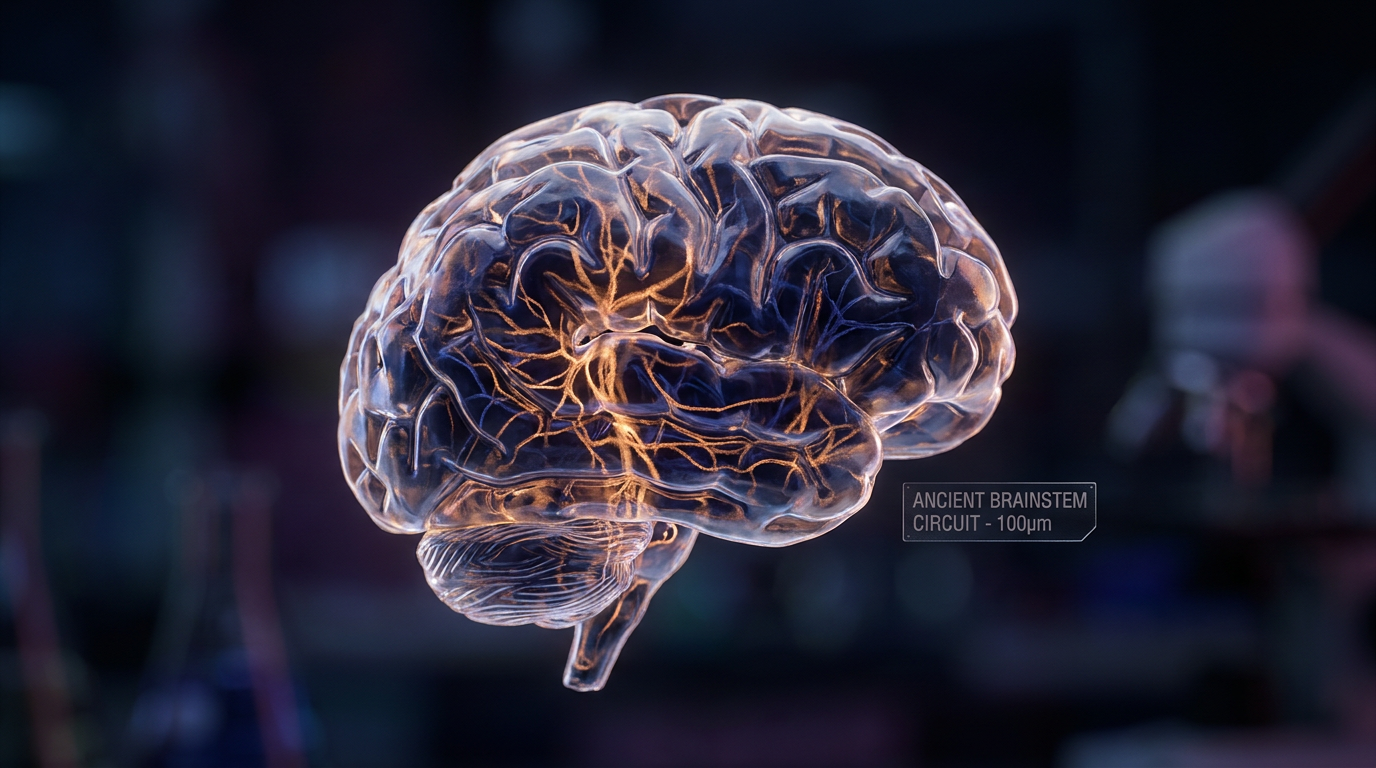
Scientists have discovered an evolutionarily ancient network of neurons in the brainstem that acts as the brain's primary filter for distractions. The finding overturns decades of assumptions about how attention works and opens new pathways for treating ADHD and autism.
By Factlen Editorial Team
- Clinical Researchers
- Focus on the breakthrough's potential to replace broad stimulants with targeted therapies for ADHD.
- Evolutionary Biologists
- Argue that the discovery resolves a major evolutionary gap regarding how lower vertebrates focus.
- Cognitive Psychologists
- Emphasize the behavioral mechanics of spatial attention and how the brain prioritizes competing stimuli.
What's not represented
- · Patients living with ADHD and Autism
- · Pharmacological drug developers
Why this matters
For decades, treatments for attention disorders have relied on broad stimulants that affect the entire brain. By pinpointing the exact neural circuit responsible for filtering distractions, this discovery paves the way for highly targeted therapies for ADHD and autism with far fewer side effects.
Key points
- Researchers discovered an ancient brainstem circuit that filters out distractions.
- The finding overturns the belief that focus is controlled solely by the prefrontal cortex.
- Silencing these neurons in mice caused immediate, severe distractibility mirroring ADHD.
- The discovery paves the way for highly targeted treatments for attention disorders.
The everyday miracle of selective attention is something most people take for granted. It is the cognitive superpower that allows a person to find a friend in a crowded room, follow a single conversation in a noisy restaurant, or ignore a buzzing phone to finish reading a sentence. For decades, neuroscience credited this ability entirely to the prefrontal cortex—the highly evolved, uniquely complex outer layer of the primate brain.[1][3]
But that classical model harbored a massive evolutionary plot hole. If the prefrontal cortex is strictly required to filter out distractions, how do birds, fish, and reptiles—creatures lacking a highly developed cortex—manage to hunt, navigate, and focus with such lethal precision? The assumption that focus was a uniquely advanced mammalian trait simply did not align with the reality of the animal kingdom.[2][5]
A groundbreaking discovery by researchers at Johns Hopkins University has finally solved that puzzle. Published this week in Nature Communications, the study reveals that our ability to filter out the noise of the world actually relies on a tiny, evolutionarily ancient cluster of neurons tucked deep within the brainstem. This foundational system is shared by all vertebrates, proving that the architecture of attention is far older than previously believed.[1][4]
The researchers identified a specific network called the parabigemino-lateral tegmental inhibitory complex, or PLTi. This deep-brain circuit acts as the mind's fundamental "attentional selection engine." It continuously evaluates competing environmental inputs to decide which stimulus commands immediate focus and which should be relegated to background noise.[3][4]

To understand exactly how this engine works, the Johns Hopkins team, led by postdoctoral fellow Ninad Kothari and neuroscientist Shreesh Mysore, designed a human-like visual attention test for mice. The animals were trained to focus on a central screen and respond to specific cues to receive a reward, all while ignoring bright, flashing lights appearing on the periphery of their vision.[2][6]
Under normal conditions, the mice performed flawlessly, easily tuning out the peripheral noise to complete their task. But the researchers wanted to isolate the exact role of the PLTi circuit. Using an advanced technique called chemogenetics, they administered a custom drug that temporarily and selectively silenced these specific brainstem neurons while leaving the rest of the brain untouched.[4][5]
The results were immediate and dramatic. The moment the PLTi neurons were deactivated, the mice became acutely hyper-distractible. They completely lost their ability to prioritize information, abandoning their central task the second even a faint, irrelevant light flashed on the edge of the screen. Without the brainstem filter, every stimulus was treated as an emergency.[3][7]
The moment the PLTi neurons were deactivated, the mice became acutely hyper-distractible.
Crucially, the researchers ran rigorous control tests to ensure they hadn't simply impaired the animals' vision or motor skills. The mice could still see perfectly and move normally. The deficit was purely attentional—a catastrophic failure of the brain's ability to filter out competing signals, proving the PLTi's specific role in maintaining focus.[1][3]

The mechanism behind this filter relies on a chemical messenger called GABA. The PLTi neurons send GABA—an inhibitory neurotransmitter—directly to the superior colliculus, a region that processes sensory inputs. By dampening the electrical activity of competing distractions, the PLTi circuit essentially turns down the volume on everything except the primary target.[4]
The most remarkable aspect of the experiment was its reversibility. The very next day, when the chemogenetic drug wore off and the PLTi neurons were reactivated, the exact same mice regained their flawless focus. They could once again ignore even incredibly bright and intense peripheral distractions as if nothing had happened.[3][5]
This reversible hyper-distractibility closely mirrors the sensory struggles faced by humans with Attention-Deficit/Hyperactivity Disorder (ADHD). A hallmark of ADHD is that even faint background distractors can violently pull attention away from a primary task—exactly the behavior exhibited by the mice when their brainstem filter was switched off.[5][7]
Currently, the most common pharmacological treatments for ADHD involve broad-spectrum stimulants that bathe the entire brain in dopamine and norepinephrine. While effective for many, these medications can cause significant side effects because they alter brain chemistry globally rather than targeting the specific root of the distraction.[3][7]

The discovery of the PLTi circuit opens the door to a radically new approach to psychiatric medicine. If researchers can develop therapies that specifically target this ancient brainstem switch, they could potentially restore the brain's filtering capacity without the systemic side effects of current stimulants, offering a much cleaner intervention.[2][6]
The implications extend well beyond ADHD. Sensory overload—the overwhelming inability to filter out background noise, lights, and movement—is a core experience for many individuals on the autism spectrum. Understanding how the brainstem regulates this sensory flood could lead to targeted behavioral and medical interventions for autism as well.[3][5]
From an evolutionary perspective, the findings rewrite the textbooks. The PLTi circuit predates the prefrontal cortex by hundreds of millions of years. It proves that the fundamental architecture of focus was laid down long before mammals ever walked the earth, conserved across eons because it is absolutely essential for survival.[1][4]

What remains unknown is exactly how this ancient brainstem engine interacts with the modern prefrontal cortex in humans. Does the cortex act as a manager, sending high-level goals down to the brainstem to execute the filtering? Or do the two systems operate in parallel, handling different flavors of attention simultaneously?[4][6]
As neuroscience continues to map these deep-brain circuits, the narrative of human cognition is shifting. Our most sophisticated mental abilities—like holding a deep state of focus—are not solely the product of our advanced outer brain, but rely heavily on ancient, hidden machinery that we share with the humblest of fish and birds.[2][7]
How we got here
Hundreds of millions of years ago
The PLTi brainstem circuit evolves in early vertebrates, establishing the foundational ability to filter sensory distractions.
Late 20th Century
Neuroscientific consensus incorrectly establishes the prefrontal cortex as the sole driver of selective spatial attention.
April 2026
Johns Hopkins researchers publish findings in Nature Communications identifying the brainstem's role as an attentional selection engine.
June 2026
The study gains widespread recognition as an editorial highlight, sparking new avenues for ADHD and autism research.
Viewpoints in depth
Evolutionary Biologists
Resolving the mystery of how non-primates focus.
For decades, evolutionary biologists struggled to explain how birds, fish, and reptiles could exhibit laser-like focus without a highly developed prefrontal cortex. This discovery provides the missing link, demonstrating that the fundamental architecture of attention was laid down hundreds of millions of years ago in the brainstem. It suggests that the cortex is a relatively recent evolutionary add-on that refines, rather than creates, the ability to concentrate.
Clinical Psychiatrists
Moving beyond broad-spectrum stimulants for ADHD.
Current pharmacological treatments for attention disorders rely heavily on stimulants that flood the entire brain with dopamine and norepinephrine. Clinical researchers view the PLTi circuit discovery as a roadmap for next-generation psychiatric medicine. By targeting the specific brainstem switch responsible for filtering distractions, future drugs or behavioral therapies could treat ADHD and sensory overload in autism with surgical precision, eliminating the widespread side effects of current medications.
Cognitive Neuroscientists
Mapping the interaction between ancient and modern brain regions.
While the brainstem's role as an 'attention engine' is now clear, cognitive neuroscientists are focused on how it communicates with the prefrontal cortex in humans. They hypothesize a top-down and bottom-up relationship: the brainstem handles the raw, immediate filtering of sensory input, while the cortex sets the high-level goals (e.g., 'I need to read this book'). Understanding this dual-processing system is the next major frontier in attention research.
What we don't know
- Exactly how the ancient brainstem circuit interacts with the highly evolved prefrontal cortex in humans.
- Whether targeted pharmacological drugs can be developed to safely stimulate only the PLTi circuit in human patients.
- How variations in this brainstem circuit might naturally differ across neurodivergent populations.
Key terms
- PLTi Circuit
- The parabigemino-lateral tegmental inhibitory complex; an ancient network of neurons in the brainstem that filters out distractions.
- Chemogenetics
- A research technique that allows scientists to temporarily turn specific neurons on or off using custom-designed drugs.
- Superior Colliculus
- A brain structure that processes visual and sensory inputs, which the PLTi circuit inhibits to block out irrelevant noise.
- GABA
- An inhibitory neurotransmitter that reduces the electrical activity of neurons, effectively turning down the 'volume' of distractions.
- Selective Spatial Attention
- The cognitive ability to focus on a specific location or object while ignoring competing background information.
Frequently asked
What did the Johns Hopkins researchers discover?
They discovered a tiny cluster of neurons in the brainstem, called the PLTi circuit, that acts as a filter to block out distractions and allow the brain to focus.
Why does this change our understanding of the brain?
For decades, scientists believed focus was controlled entirely by the prefrontal cortex. This discovery proves that the ability to pay attention relies on an ancient system shared by all vertebrates, including fish and birds.
How does this relate to ADHD?
When researchers temporarily turned off this brainstem circuit in mice, the animals exhibited extreme distractibility—a hallmark symptom of ADHD. Reactivating the circuit completely restored their focus.
Will this lead to new treatments?
Yes. By identifying the exact neural circuit responsible for filtering distractions, researchers hope to develop highly targeted therapies for ADHD and autism that avoid the side effects of current whole-brain stimulants.
Sources
Source coverage
7 outlets
3 viewpoints surfaced







[1]Nature CommunicationsEvolutionary Biologists
Evolutionarily old brainstem neurons are required for the control of selective spatial attention
Read on Nature Communications →[2]Johns Hopkins UniversityClinical Researchers
Ancient brain cells control focus
Read on Johns Hopkins University →[3]Neuroscience NewsClinical Researchers
Ancient Brainstem Neurons Discovered to Control Attention
Read on Neuroscience News →[4]PsyPostCognitive Psychologists
Deep within the brainstem, an ancient group of neurons acts as an attentional selection engine
Read on PsyPost →[5]ScienceDailyEvolutionary Biologists
Scientists discover ancient brain cells that help block distractions
Read on ScienceDaily →[6]Technology NetworksCognitive Psychologists
Researchers identified brainstem neurons that help animals focus by suppressing distractions
Read on Technology Networks →[7]IGIHEClinical Researchers
Inside the brain's hidden filtering system that keeps us focused
Read on IGIHE →
Every angle. Every day.
Get meta stories with full source coverage and perspective breakdowns delivered to your inbox.