
FIBA OQT Concludes: Greece, Brazil, Spain, and Puerto Rico Claim Final Olympic Basketball Spots
The grueling FIBA Olympic Qualifying Tournaments have concluded, with four nations surviving the winner-take-all format to secure the final berths in the 12-team Olympic field.
By Factlen Editorial Team
- Global Governing Bodies
- Value the OQT system for promoting global universality and creating high-stakes international fixtures.
- National Federations
- View the tournaments as a grueling but essential gauntlet for national pride and program funding.
- Professional Franchises
- Express concern over the physical toll and injury risk for star players competing in summer qualifiers.
What's not represented
- · The players themselves, who must balance the immense pride of representing their country with the physical exhaustion of year-round basketball.
- · Fans of eliminated nations, who face a four-year wait for another chance at Olympic representation.
Why this matters
The Olympic men's basketball tournament is one of the most exclusive and highly anticipated events in global sports. Understanding the grueling qualification mechanism highlights the immense stakes and physical toll required just to reach the starting line.
Key points
- Greece, Spain, Brazil, and Puerto Rico won their respective Olympic Qualifying Tournaments.
- The OQT is a brutal winner-take-all format where 24 teams compete for just four Olympic berths.
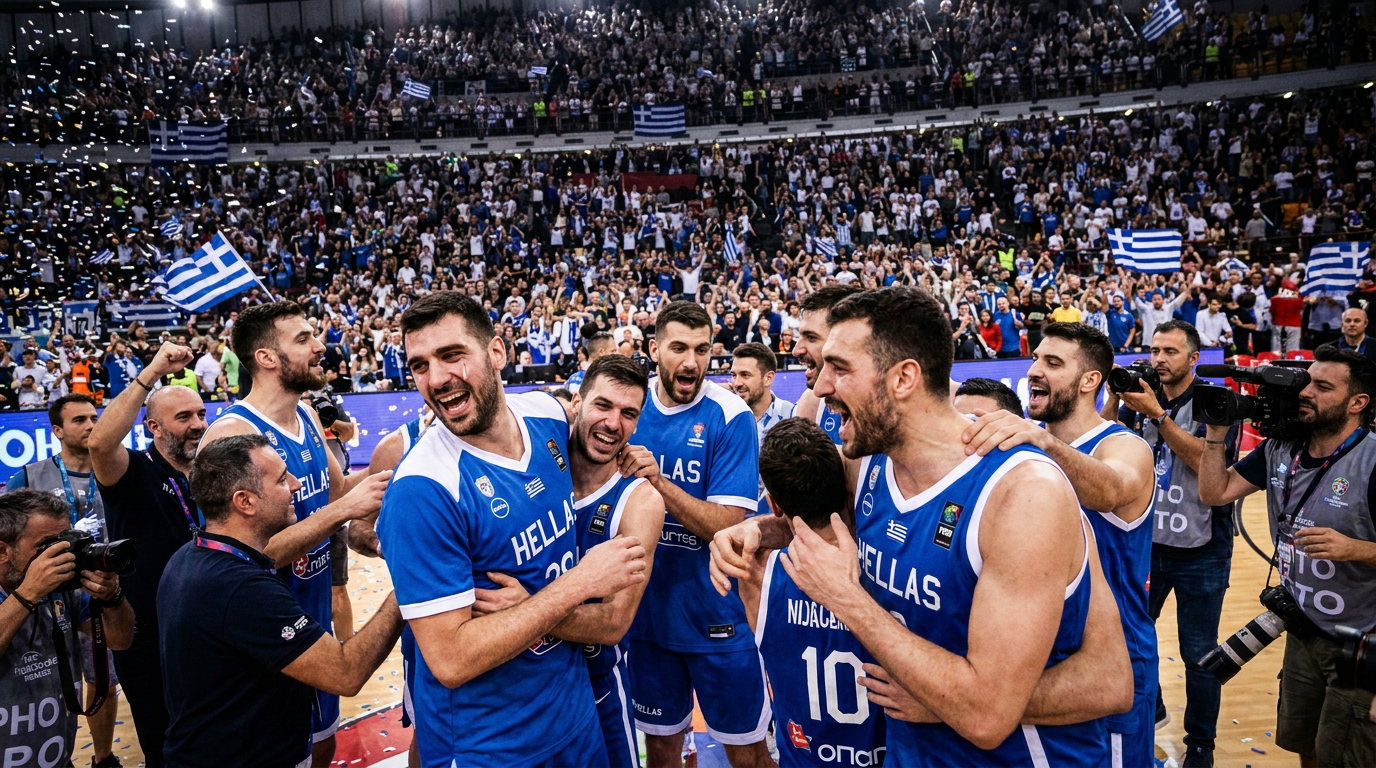
- Greece ended a 16-year Olympic drought by winning their home tournament in Piraeus.
- Brazil was the only nation to win an OQT on foreign soil, defeating Latvia in Riga.
- The 12-team Olympic field is now set, with Group A widely considered the Group of Death.
The most unforgiving gauntlet in international basketball has concluded. Across four host cities—Piraeus, Valencia, Riga, and San Juan—twenty-four national teams spent the past week battling for the final four tickets to the Olympic men's basketball tournament. When the final buzzers sounded, Greece, Spain, Brazil, and Puerto Rico emerged victorious, securing their places in the highly anticipated 12-team Olympic field.[1][2]
To understand the sheer difficulty of the FIBA Olympic Qualifying Tournaments (OQT), one must look at the math. The Olympic basketball tournament is strictly capped at 12 nations, making it one of the most exclusive brackets in global sports. Seven of those spots are awarded during the preceding FIBA World Cup, and one is reserved for the host nation. That leaves the rest of the globe fighting for just four remaining berths through the OQT system.[1][5]
The mechanism is designed to be a brutal, winner-take-all sprint. The 24 participating teams are divided into four separate mini-tournaments of six teams each. After a brief round-robin group stage, the top teams advance to a single-elimination semifinal and final. There is no prize for second place; only the outright winner of each tournament punches a ticket to the Games. One cold shooting night, a single bad quarter, or an ill-timed injury means a four-year Olympic dream evaporates instantly.[2][5]

In Piraeus, the Greek national team capitalized on their home-court advantage to end a 16-year Olympic drought. Greece had not appeared in the Summer Games since 2008, a glaring absence for a nation with a rich basketball heritage. Anchored by elite NBA talent, they navigated a treacherous bracket that included Luka Dončić's Slovenia and a deeply resilient Croatian squad.[1][4]
The Greek squad defeated Croatia 80-69 in the final in front of nearly 12,000 raucous fans. The emotional weight of the victory was palpable, with veteran players visibly moved after the final buzzer. Their superstar forward was named the tournament's MVP, cementing his legacy in international play by finally leading his country back to the Olympic stage.[1][2]
Meanwhile, in Valencia, the reigning European powerhouse faced a unique challenge. Spain, seeking its seventh consecutive Olympic appearance, hosted a Bahamas squad that was attempting to become the smallest nation in history to qualify for the tournament. The Bahamian team, bolstered by a sudden influx of top-tier NBA talent, had cruised through their side of the bracket and posed a legitimate, athletic threat to the Spanish hosts.[4]
Ultimately, Spain's depth, tactical discipline, and vast international experience prevailed. They defeated the Bahamas 86-78 in a tightly contested final, relying on a balanced attack where four different players scored in double figures. The victory underscored Spain's enduring status as a global basketball titan, proving they can still execute under immense pressure even as they transition between generations of talent.[2]
Ultimately, Spain's depth, tactical discipline, and vast international experience prevailed.
Across the Atlantic, the atmosphere in San Juan was electric as Puerto Rico sought its first Olympic bid since 2004. Playing in front of a passionate, deafening home crowd, the Puerto Rican squad embraced an aggressive, high-energy style of play. They faced a formidable opponent in the final: Lithuania, a traditional European giant with a rich Olympic pedigree and a massive frontcourt advantage.[1][4]
Puerto Rico executed a stunning upset, running the Lithuanians off the floor to claim the tournament crown. Their dynamic point guard, who averaged 16 points, 3.8 rebounds, and 2.3 steals across the event, was named the TISSOT MVP. The victory sparked massive celebrations across the island, marking a historic resurgence for the national program and validating their fast-paced tactical approach.[1]

The only nation to successfully navigate the OQT on foreign soil was Brazil. Traveling to Riga, the Brazilians faced a hostile environment and a Latvian team riding a wave of momentum from a historically strong World Cup showing. Latvia was heavily favored to win their home tournament and secure their first-ever Olympic basketball appearance, backed by a fiercely loyal fan base.[2][4]
Brazil, however, executed a flawless game plan to spoil the party in Riga. They dismantled the Latvian hosts in the final, securing a coveted place at the Olympics for the 16th time in their history. The Brazilian victory highlighted the unpredictability of the OQT format, proving that historical pedigree and precise tactical execution can overcome the distinct advantage of a home crowd.[1][3]

The underlying philosophy of this grueling qualification system is FIBA's commitment to universality. The governing body structures the pathways to ensure that the Olympic tournament represents a true global cross-section, rather than just a concentration of European and North American powers. The OQT provides a vital lifeline for teams from the Americas, Africa, and Asia to challenge the established hierarchy on a neutral—or hostile—floor.[1][5]
However, the system is not without its critics. The OQT requires elite players to extend their competitive seasons deep into the summer, often just weeks after concluding grueling 82-game NBA campaigns or intense EuroLeague playoffs. This physical load is a constant point of tension between national federations, who rely on their stars to qualify, and professional franchises, who fear catastrophic injuries to their highest-paid assets.[5]
With the final four tickets claimed, the landscape of the Olympic tournament is now firmly set. The 12 teams have been sorted into three groups of four. Group A is already being universally dubbed the Group of Death, featuring a staggering concentration of talent: Australia, Canada, Greece, and Spain. At least one of these powerhouse nations will fail to advance past the preliminary round, underscoring the brutal density of the tournament.[3]
Group B features the host nation France, reigning World Cup champion Germany, Japan, and the newly qualified Brazil. Group C rounds out the field with the heavily favored United States, a Nikola Jokić-led Serbia, rising African power South Sudan, and Puerto Rico. Every single group features legitimate medal contenders, leaving no easy matchups on the schedule.[3]

The stakes in the Olympic tournament remain incredibly high. During the preliminary round, the top two teams from each group, along with the two best third-place teams, will advance to the knockout stage. The margin for error is razor-thin, and the intensity of the qualifying tournaments serves as a perfect primer for the pressure-cooker environment of the Games.[3][5]
As the basketball world turns its attention to the Olympic stage, the teams that survived the OQT carry a distinct competitive advantage. Greece, Spain, Brazil, and Puerto Rico enter the tournament not just as qualifiers, but as battle-tested units that have already played high-stakes, elimination basketball. They have survived the sport's most unforgiving gauntlet, and they arrive at the Games ready to disrupt the established order.[2][5]
How we got here
August 2023
The FIBA World Cup concludes, awarding the first seven direct Olympic qualification spots.
November 2023
FIBA conducts the draw for the Olympic Qualifying Tournaments, setting the 24-team field.
Early July
The four OQTs tip off in Greece, Spain, Latvia, and Puerto Rico.
Final Day
Greece, Spain, Brazil, and Puerto Rico win their respective finals to claim the last Olympic berths.
Viewpoints in depth
Global Governing Bodies
FIBA and the IOC prioritize global representation and high-stakes competition.
Organizations like FIBA view the OQT system as a massive success for the global growth of the game. By spreading the tournaments across four different host cities, they create localized basketball fervor and ensure that the Olympic field isn't solely determined by a single World Cup event. They argue the universality principle keeps the sport growing in emerging markets and provides a vital lifeline for teams outside of Europe and North America.
National Federations
The organizations tasked with fielding teams view the OQT as a necessary but brutal gauntlet.
For national basketball federations, the OQT is a high-stress, all-or-nothing proposition. Program funding, national prestige, and the growth of domestic basketball often hinge on Olympic qualification. While they embrace the challenge, federation directors acknowledge that the single-elimination format leaves zero margin for error, where a single bad quarter can erase four years of preparation and investment.
Professional Franchises
NBA and EuroLeague clubs express concern over the physical toll on their star players.
Professional clubs watch the OQTs with bated breath. Their highest-paid assets are extending their seasons into the summer to play intense, high-stakes minutes immediately following grueling club campaigns. Franchises argue that the lack of a proper offseason increases the risk of catastrophic injuries, creating a persistent underlying tension between a player's national pride and their professional obligations.
What we don't know
- How the physical toll of the grueling OQT schedule will affect the qualifying teams' performance in the actual Olympic tournament.
- Which powerhouse nation will be eliminated early from the highly competitive Group A, dubbed the Group of Death.
Key terms
- FIBA
- The International Basketball Federation, the global governing body for the sport.
- OQT
- Olympic Qualifying Tournament, the final, winner-take-all qualification pathway for the Olympic Games.
- Universality Principle
- FIBA's structural mandate to ensure that multiple continents and regions are represented in global tournaments.
Frequently asked
How many teams play in the Olympic men's basketball tournament?
The tournament is strictly capped at 12 teams, making it one of the most exclusive fields in international sports.
Why didn't these teams qualify directly?
Seven spots were awarded based on placements at the previous FIBA World Cup, leaving the remaining nations to fight for the final four spots in the OQT.
How does the OQT format work?
Twenty-four teams are split across four host cities. Each six-team tournament features a group stage followed by a single-elimination semifinal and final. Only the winner advances.
Sources
Source coverage
5 outlets
3 viewpoints surfaced





[1]FIBA BasketballGlobal Governing Bodies
Greece, Brazil, Puerto Rico and Spain qualify for last spots at Men's Olympic Basketball Tournament
Read on FIBA Basketball →[2]Olympics.comGlobal Governing Bodies
2024 FIBA Olympic Qualifying Tournament Finals: Greece, Brazil, Spain and Puerto Rico qualify
Read on Olympics.com →[3]EurohoopsNational Federations
Olympic Games groups set after FIBA OQT conclusion
Read on Eurohoops →[4]BasketNewsNational Federations
FIBA Olympic Qualifiers final matchups set
Read on BasketNews →[5]Factlen Editorial TeamProfessional Franchises
Synthesis by Factlen editorial team
Read on Factlen Editorial Team →
More in sports
See all 29 stories →Standings
Champions Chess Tour Standings: Duda and Lazavik Chase Carlsen as Esports World Cup Roster Takes Shape
7 sources
Injury
The Comeback Trail: Teague-Neeld and Sinclair Headline Crucial Injury Returns Across Global Netball
7 sources
Standings
Championship Picture: Manchester Thunder Claim NSL Crown as SSN and ANZ Premiership Reach Do-or-Die Stages
6 sources

Injury
AFL Injury Update: Brisbane's Cavalry Nears Return as Hawthorn Manages Mid-Season Setbacks
7 sources

Every angle. Every day.
Get sports stories with full source coverage and perspective breakdowns delivered to your inbox.