
NASA's Lucy Mission Finds Peanut-Shaped Asteroid With Evidence of Ancient Water Ice
Data from a 2025 flyby reveals that the main-belt asteroid Donaldjohanson is a tumbling contact binary containing clay minerals formed by liquid water.
By Factlen Editorial Team
- Planetary Geologists
- Focused on the physical structure, crater erasure, and contact binary formation.
- Cosmochemists
- Focused on the phyllosilicates, water history, and implications for Earth's water delivery.
- Mission Strategists
- Focused on the engineering and calibration value of this flyby before the main Trojan mission.
What's not represented
- · Independent planetary dynamicists modeling the exact collision that formed the Erigone family.
- · Astrobiologists focused specifically on the organic delivery mechanisms to early Earth.
Why this matters
Understanding how and where water existed in the early solar system helps scientists piece together how Earth acquired the ingredients necessary for life.
Key points
- NASA's Lucy spacecraft flew by the main-belt asteroid Donaldjohanson in April 2025, revealing a peanut-shaped contact binary.
- Instruments detected iron-bearing phyllosilicates, proving the asteroid or its parent body once harbored liquid water.
- The asteroid is estimated to be 155 million years old, born from a catastrophic collision that created the Erigone family.
- A lack of small craters suggests shifting surface material is actively erasing features as the asteroid tumbles.
In April 2025, NASA's Lucy spacecraft zipped past a small main-belt asteroid named Donaldjohanson at 30,000 miles per hour. Now, a comprehensive analysis published in the journal Science has revealed that this brief encounter captured a world far stranger than astronomers anticipated. The flyby, originally intended as a mere calibration exercise, has provided unprecedented insights into the violent history and chemical makeup of the early solar system.[1][2]
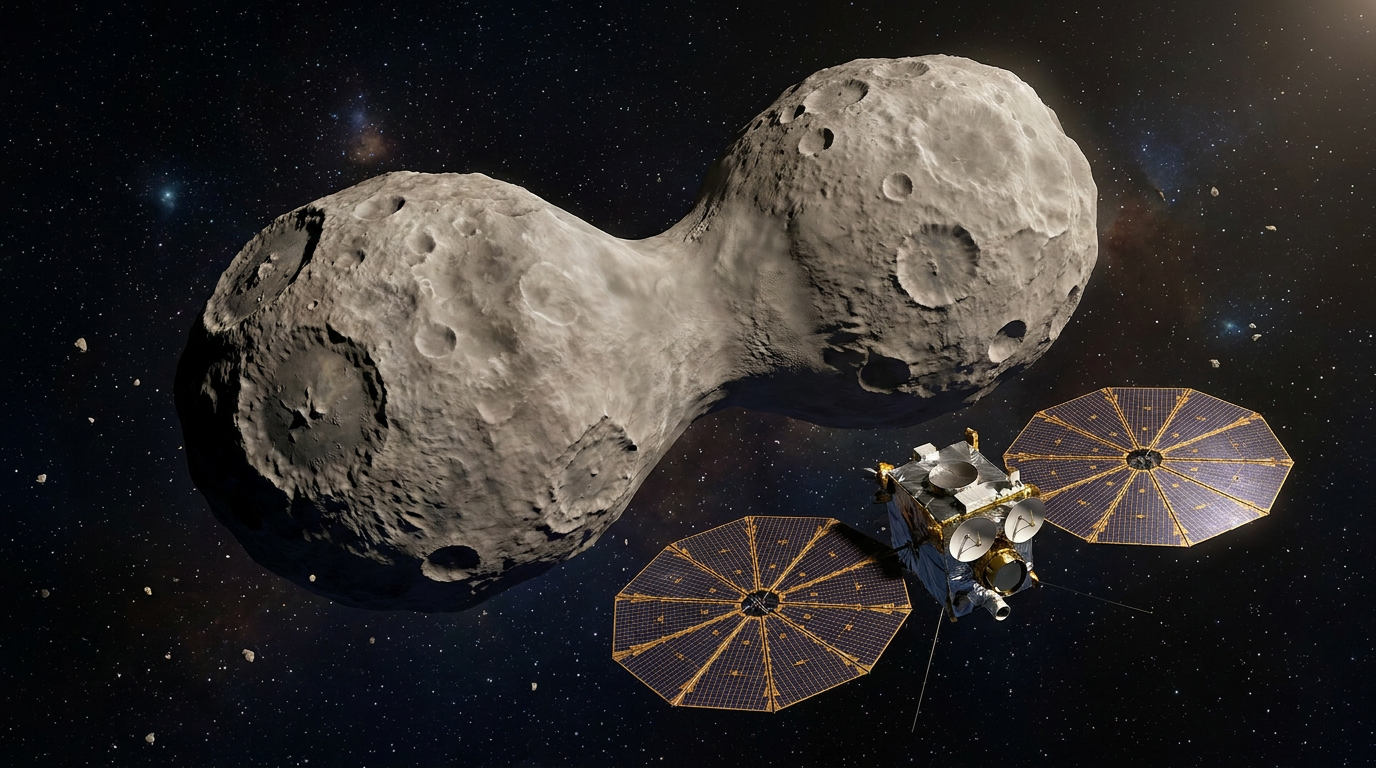
Instead of a simple rocky sphere, Donaldjohanson is a 'contact binary'—a peanut-shaped object consisting of two distinct, cratered lobes connected by a remarkably smooth neck. Measuring roughly eight kilometers long, the asteroid tumbles through space in a complex rotation. This bilobed structure suggests that two separate fragments from an ancient collision gently drifted together and fused under their own weak gravity.[1][3]
The most significant finding from the flyby is chemical. Lucy's onboard spectrometers detected iron-bearing phyllosilicates across the asteroid's surface. These clay minerals only form in the presence of liquid water, providing direct evidence that this ancient rock—or the larger parent body it broke off from—once harbored water. It is a striking discovery for an object residing in the inner main asteroid belt.[1][4]

Finding evidence of aqueous alteration in this region of the solar system is highly intriguing to cosmochemists. While water-rich asteroids are expected further out past the 'frost line,' Donaldjohanson's composition suggests that water was present shortly after the formation of its parent body at the dawn of the solar system. This adds a crucial data point to the ongoing debate about how water was distributed across the primordial disk.[4][5]
However, the chemical alteration on Donaldjohanson is limited compared to other primitive asteroids like Bennu and Ryugu, which were recently visited by sample-return missions. Those bodies feature magnesium-rich clays indicating prolonged water exposure, whereas Donaldjohanson points to a much briefer encounter with liquid water. This contrast highlights the immense diversity of environments that existed within the early asteroid belt.[1][5]
Those bodies feature magnesium-rich clays indicating prolonged water exposure, whereas Donaldjohanson points to a much briefer encounter with liquid water.
Planetary geologists believe Donaldjohanson was born from violence. Approximately 155 million years ago, a massive collision shattered a much larger parent body, creating a swarm of some 2,000 rocky fragments known as the Erigone collisional family. Donaldjohanson is a relatively young piece of this ancient wreckage, offering a pristine window into the interior of its destroyed parent.[1][3]
The asteroid's youth is confirmed by its cratering record, but that record contains a glaring anomaly. Scientists noticed a complete absence of craters smaller than 400 meters across. On a typical airless body, micrometeorites constantly pit the surface with tiny scars over millions of years. The missing craters suggest that Donaldjohanson's surface is highly dynamic rather than static.[1][5]

Researchers hypothesize that the lack of small craters is due to the continuous movement of loose surface material. As the peanut-shaped asteroid tumbles, gravity and centrifugal forces cause regolith to shift, effectively filling in smaller features. This shifting dust naturally pools in the central gravity well between the two lobes, giving the neck region its surprisingly smooth appearance.[1][5]
For the Lucy mission team, Donaldjohanson was technically a rehearsal. The spacecraft's primary objective is to explore the Jupiter Trojans—two massive swarms of asteroids that share Jupiter's orbit and are thought to be pristine leftovers from the outer solar system's formation. The successful data collection at Donaldjohanson proves that Lucy's autonomous tracking systems can handle complex, fast-moving targets.[2][6]

By testing its cameras and spectrometers on this main-belt rock, Lucy has validated its capabilities ahead of its first Trojan encounter with the asteroid Eurybates in August 2027. But in doing so, it has already rewritten our understanding of the main asteroid belt, proving that even the mission's 'practice targets' hold profound secrets about the origins of our solar neighborhood.[2][6]
How we got here
Oct 2021
NASA launches the Lucy spacecraft.
Nov 2023
Lucy flies by its first target, the main-belt asteroid Dinkinesh.
Apr 2025
Lucy completes a close flyby of the asteroid Donaldjohanson.
Jun 2026
Scientists publish the comprehensive analysis of the Donaldjohanson flyby in Science.
Aug 2027
Lucy is scheduled to encounter its first Jupiter Trojan, Eurybates.
Viewpoints in depth
Planetary Geologists
Focus on the physical structure, crater erasure, and contact binary formation.
For geologists, Donaldjohanson is a masterclass in dynamic surface processes on small bodies. The complete absence of craters smaller than 400 meters challenges previous assumptions about how long small scars persist on main-belt asteroids. The prevailing theory is that the asteroid's tumbling rotation generates enough centrifugal force to shift loose regolith, effectively 'sandblasting' or filling in smaller craters over millions of years. This process also explains the remarkably smooth neck connecting the two lobes, where shifting dust naturally pools.
Cosmochemists
Focus on the phyllosilicates, water history, and implications for Earth's water delivery.
The chemical signature of Donaldjohanson is the most profound takeaway for researchers studying the early solar system. The presence of iron-bearing phyllosilicates definitively proves that the Erigone parent body experienced aqueous alteration—meaning liquid water flowed through its rock matrix. However, because this alteration is less extensive than what was found on asteroids like Bennu, it suggests a spectrum of water exposure in the early solar system. Understanding this spectrum is critical for tracing how water and organic compounds were eventually delivered to a young Earth.
Mission Strategists
Focus on the engineering and calibration value of this flyby before the main Trojan mission.
From an operational standpoint, the Donaldjohanson flyby was a high-stakes dress rehearsal. The Lucy spacecraft is ultimately bound for the Jupiter Trojans, a population of asteroids that have never been visited by humanity. By successfully tracking a tumbling, irregularly shaped object at 30,000 miles per hour and capturing high-resolution spectral data, the engineering team has validated the spacecraft's autonomous targeting systems. This ensures that when Lucy reaches its primary targets in 2027, its instruments will be perfectly calibrated to capture pristine data.
What we don't know
- Exactly how long liquid water persisted on the Erigone parent body before it was shattered by a collision.
- Whether the smooth neck region contains different subsurface materials than the two heavily cratered lobes.
- How Donaldjohanson's composition will ultimately compare to the pristine Jupiter Trojans Lucy will visit in 2027.
Key terms
- Contact binary
- A celestial object composed of two distinct lobes that gently collided and fused together.
- Phyllosilicates
- Clay minerals that form in the presence of liquid water.
- Jupiter Trojans
- A large group of asteroids that share Jupiter's orbit around the Sun, trapped in its Lagrange points.
- Main asteroid belt
- The region of the solar system between Mars and Jupiter where most asteroids orbit.
- Regolith
- The layer of loose, dusty, and rocky material covering the solid bedrock of an asteroid or planet.
Frequently asked
Why is the asteroid named Donaldjohanson?
It is named after the paleoanthropologist Donald Johanson, who discovered the famous 3.2-million-year-old hominin fossil 'Lucy' in 1974. The spacecraft is also named after this fossil.
Does the asteroid currently have liquid water?
No. The detection of clay minerals indicates that liquid water was present in its ancient past, likely shortly after the formation of its parent body.
Why are there no small craters on its surface?
Scientists believe that loose surface material, or regolith, shifts as the asteroid tumbles through space, filling in and erasing craters smaller than 400 meters.
Sources
Source coverage
6 outlets
3 viewpoints surfaced






[1]SciencePlanetary Geologists
The Lucy flyby of (52246) Donaldjohanson: A bilobed asteroid with tumbling rotation
Read on Science →[2]NASAMission Strategists
Lucy Observations of Asteroid Donaldjohanson
Read on NASA →[3]Space.comCosmochemists
NASA's Lucy mission finds evidence of ancient water on asteroid Donaldjohanson
Read on Space.com →[4]IFLScienceCosmochemists
NASA's Lucy Mission Finds Evidence Of Ancient Water On Asteroid Donaldjohanson
Read on IFLScience →[5]Southwest Research InstitutePlanetary Geologists
SwRI scientists lead analysis of Lucy flyby of asteroid Donaldjohanson
Read on Southwest Research Institute →[6]Factlen Editorial TeamMission Strategists
Synthesis by Factlen editorial team
Read on Factlen Editorial Team →
Every angle. Every day.
Get science stories with full source coverage and perspective breakdowns delivered to your inbox.