
Global Equestrian Injury Report: Driscoll's Miraculous Return and Jacobs' Grand Prix Victory Highlight June Comebacks
American show jumper Cathleen Driscoll has made an emotional return to the ring following a severe traumatic brain injury, while Charlotte Jacobs and Rincoola Milsean secured a triumphant Grand Prix win after a season-long absence.
By Factlen Editorial Team
- Rehabilitating Athletes
- Focuses on the grueling, non-linear path of physical and mental recovery, emphasizing patience and small milestones over immediate results.
- Veterinary & Medical Experts
- Advocates for giving injuries—both equine and human—adequate time to heal, pushing back against the rushed timelines of the competitive calendar.
- High-Performance Management
- Balances the welfare of top horses and riders with the intense pressure of championship qualifications and Olympic shortlists.
What's not represented
- · Equestrian sports psychologists
- · Insurance providers for high-value sport horses
Why this matters
In a sport where the pressure to compete often rushes recovery, these high-profile comebacks demonstrate that patience and comprehensive rehabilitation yield the most sustainable results for both horse and rider.
Key points
- Cathleen Driscoll has returned to the show jumping ring one year after a traumatic brain injury left her with a 30% chance of walking.
- Charlotte Jacobs and Rincoola Milsean won a $116,500 CSI3* Grand Prix following a season-long equine rehabilitation.
- Top U.S. dressage horse Jane will miss the National Championships to prioritize healing from a paddock injury.
- German Olympian Hubertus Schmidt is recovering from multiple pelvic and rib fractures sustained in a March fall.
- A new study highlights how the equestrian culture of 'manning up' prolongs concussion recovery by ignoring cognitive symptoms.
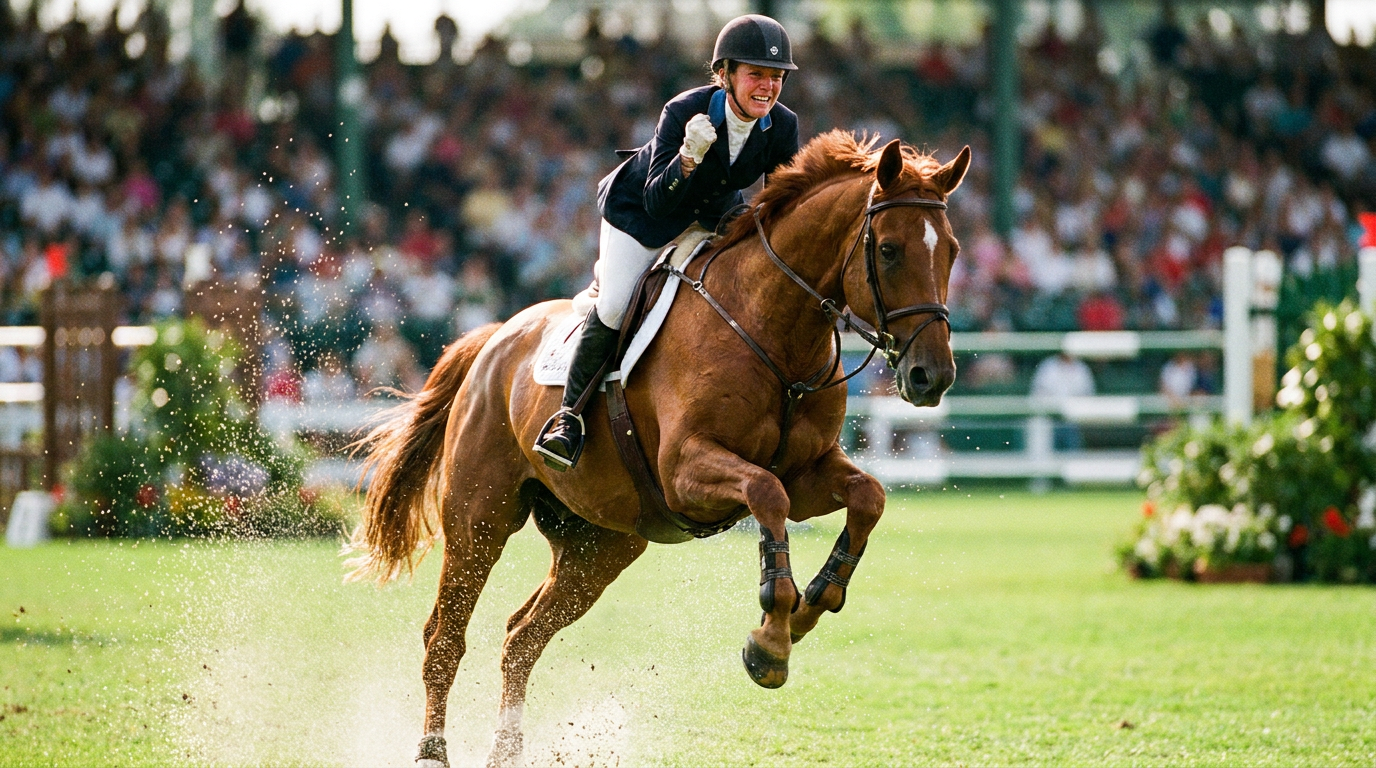
The month of June has delivered a powerful reminder of resilience across the global equestrian landscape. While the sport's grueling calendar often penalizes time away from the arena, a wave of triumphant mid-season comebacks is proving that patience remains the ultimate performance enhancer. Leading the charge are American show jumpers Cathleen Driscoll and Charlotte Jacobs, both of whom have returned to the ring this month following devastating, career-halting injuries.[1][2]
Driscoll’s return is nothing short of miraculous. In June of last year, the 33-year-old was enjoying a career-best season and was ranked among the top ten female riders in the world when a freak accident at a Grand Prix in Deauville, France, brought everything to an abrupt halt. Her horse fell at the first fence of the jump-off, and Driscoll sustained a severe traumatic brain injury. She was placed in a medically induced coma and spent two weeks in a Normandy intensive care unit.[1]
The initial prognosis was grim. Due to paralysis in her leg, medical professionals gave Driscoll only a 30 percent chance of ever walking again. Yet, through grueling physical therapy, vision therapy, and extensive outpatient rehab, she defied the odds. Just a month and a half after the accident, she was back in the saddle at a therapeutic riding center in Atlanta, slowly rebuilding her balance, strength, and confidence.[1]

By early June 2026, Driscoll made her official return to the show ring, starting softly in the 1.00m classes. Because she has no memory of the accident, she reports carrying no emotional trauma into the arena, allowing her to ride freely and without fear. She aims to step back up to the 1.40m level over the summer and hopes to return to FEI international classes by next year, crediting the overwhelming support of the equestrian community for fueling her recovery.[1]
On the equine side of the sport, Charlotte Jacobs celebrated a similarly emotional milestone at the Flintfields Horse Park in Traverse City, Michigan. Jacobs and her 13-year-old Irish Sport Horse gelding, Rincoola Milsean—affectionately known as "Roy"—had been a dominant force in international competition before an injury sidelined the horse for an entire season.[2]
On the equine side of the sport, Charlotte Jacobs celebrated a similarly emotional milestone at the Flintfields Horse Park in Traverse City, Michigan.
Their return to the top level culminated in a spectacular victory in the $116,500 Molon Grand Prix CSI3*. Clearing the massive tracks with the same scope and enthusiasm that defined their earlier career, the pair proved that a long, careful rehabilitation process can fully restore a top-tier equine athlete to their peak capabilities without compromising their long-term soundness.[2]
The success of horses like Rincoola Milsean highlights a growing consensus in equine sports medicine. Dr. Julie Vargas, founder of Limestone Equine Performance Medicine, notes that while modern veterinary science offers unprecedented diagnostic tools, the most critical element of rehabilitation cannot be manufactured: time. Horses rarely heal on a linear, predefined schedule, and rushing a return to work often leads to chronic setbacks.[5]

This reality is currently playing out in the dressage arena, where Marcus Orlob’s top mount, Jane, has been sidelined. The 12-year-old mare, owned by Alice Tarjan, sustained a paddock injury earlier this year. Despite the looming pressure of Olympic shortlisting and the U.S. National Grand Prix Championships, veterinary advisors mandated that the horse not resume work until she was fully healed, forcing the pair to miss crucial selection events to prioritize the mare's long-term welfare.[3]
Meanwhile, human athletes in dressage are also navigating the slow road to recovery. German dressage master Hubertus Schmidt continues his rehabilitation following a severe fall at his Fleyenhof barn in March. The decorated Olympian sustained multiple fractures to his collarbone, ribs, pubic bone, and pelvis. Despite requiring multiple stabilizing surgeries, Schmidt has maintained a fiercely positive outlook, driven by the desire to return to coaching his talented string of students and horses.[4]
These high-profile recoveries are coinciding with a broader cultural shift regarding how the equestrian community handles trauma, particularly concussions. A new interview study supported by Rider Minds and British Equestrian has shed light on the prolonged, often misunderstood nature of brain injuries in the sport. The research revealed that many riders unknowingly prolong their recovery by trying to "man up" and ride through the pain.[6]

The study found that cognitive and emotional symptoms—such as extreme mental fatigue, poor concentration, and low mood—are frequently misdiagnosed as general stress or anxiety rather than direct results of a concussion. This lack of awareness has historically led to delayed care, with some riders reporting recovery times stretching over two years because they did not immediately step back from the saddle to allow their brains to heal.[6]
Ultimately, the stories defining June 2026 reflect a maturing sport. Whether it is a show jumper returning from a traumatic brain injury, a Grand Prix horse given a full year to heal, or a dressage master patiently rebuilding his shattered pelvis, the overarching message is clear. The equestrian world is learning that true resilience is not about rushing back to the ring, but having the courage to heal properly so that when the return happens, it is triumphant.[1][2][4][5][6]
How we got here
June 2025
Cathleen Driscoll suffers a severe fall in Deauville, resulting in a TBI and a medically induced coma.
August 2025
Driscoll returns to the saddle at a therapeutic riding center in Atlanta.
March 2026
German dressage rider Hubertus Schmidt sustains multiple fractures in a barn accident.
April 2026
Top U.S. dressage prospect Jane is sidelined with a paddock injury, missing key qualifiers.
June 2026
Driscoll makes her official return to the show ring; Charlotte Jacobs wins the $116,500 CSI3* Grand Prix in her comeback.
Viewpoints in depth
The Athlete's Reality
Riders face immense mental hurdles when losing peak seasons, but stepping away often provides a renewed perspective.
For high-performance athletes like Cathleen Driscoll and Hubertus Schmidt, an injury does more than break bones; it shatters carefully laid championship plans and rankings. However, the forced hiatus often strips away the intense pressure of the competitive circuit. Driscoll noted that having no memory of her accident allowed her to return to the ring without emotional baggage, viewing her survival as a 'blessing in disguise' that recalibrated her relationship with the sport.
The Veterinary Consensus
Equine veterinarians stress that soft tissue and neurological injuries require dynamic timelines that cannot be rushed.
In an era of advanced regenerative therapies and precise diagnostics, owners and trainers frequently pressure veterinarians for a 'quick fix' to get a horse back in the ring. Experts like Dr. Julie Vargas argue that while science can support healing, it cannot replace the sheer volume of time required for tissue to remodel. Rushing a horse back—as is often tempted during Olympic selection years—frequently results in chronic, career-ending setbacks, making patience the ultimate veterinary prescription.
The Concussion Awakening
The equestrian culture of 'getting right back on the horse' is actively harmful to riders suffering from traumatic brain injuries.
The Rider Minds study exposed a dangerous gap in equestrian safety culture: the misinterpretation of cognitive concussion symptoms. Because riders are conditioned to ignore pain, they often dismiss extreme mental fatigue, mood swings, and poor concentration as mere stress or anxiety. This cultural blind spot leads to delayed medical intervention, turning what should be a standard recovery protocol into a multi-year ordeal that jeopardizes both their health and their careers.
What we don't know
- Whether Cathleen Driscoll will be able to fully return to the 1.40m and FEI levels by next year as planned.
- If the dressage mare Jane will recover in time to be considered for future international championship cycles.
- How quickly global equestrian federations will adopt standardized, mandatory concussion protocols based on recent studies.
Key terms
- Traumatic Brain Injury (TBI)
- A disruption in the normal function of the brain caused by a severe bump, blow, or jolt to the head, often requiring extensive cognitive and physical therapy.
- CSI3*
- A three-star Concours de Saut International, a high-level international show jumping competition regulated by the FEI.
- Paddock Injury
- An injury sustained by a horse while turned out in a field or enclosure, rather than during active riding or training.
- FEI
- The Fédération Équestre Internationale, the international governing body of equestrian sports.
Frequently asked
What happened to Cathleen Driscoll?
Driscoll suffered a severe traumatic brain injury during a freak fall at a Grand Prix in France last year. After being given a 30% chance of walking again, she has made a miraculous recovery and returned to the show ring in June 2026.
Why did Charlotte Jacobs and Rincoola Milsean miss a season?
Rincoola Milsean sustained an injury that required a full season of rehabilitation. The pair returned to competition in June 2026, winning the $116,500 Molon Grand Prix in Traverse City.
Why is the dressage horse Jane missing the National Championships?
Jane, ridden by Marcus Orlob, sustained a paddock injury earlier in the year. Veterinary advisors recommended she not resume work until fully healed, forcing her to miss the U.S. National Grand Prix Championships.
What did the Rider Minds study reveal about equestrian concussions?
The study found that riders often try to "tough out" concussions, mistaking cognitive symptoms like mental fatigue and low mood for general stress, which severely delays their recovery.
Sources
Source coverage
6 outlets
3 viewpoints surfaced






[1]World of ShowjumpingRehabilitating Athletes
Cathleen Driscoll: “I do believe I can look back on it all as a blessing in disguise”
Read on World of Showjumping →[2]Jumper NewsRehabilitating Athletes
The Return of Roy! Rincoola Milsean Propels Charlotte Jacobs to Wedding Anniversary Win in the $116,500 Molon Grand Prix CSI 3*
Read on Jumper News →[3]Dressage-NewsHigh-Performance Management
Jane Sidelined With Injury, Likely Out of Grand Prix Championships
Read on Dressage-News →[4]EurodressageRehabilitating Athletes
Hubertus Schmidt Hospitalized after Riding Accident
Read on Eurodressage →[5]The Plaid HorseVeterinary & Medical Experts
The Only Shortcut Is Showing Up Long Enough
Read on The Plaid Horse →[6]British EquestrianVeterinary & Medical Experts
Rider Minds study highlights the lived recovery experiences of female riders
Read on British Equestrian →
More in sports
See all 30 stories →Standings
Gold Coast and North Melbourne Cling to Inaugural Wildcard Spots as AFL Finals Race Intensifies
6 sources
Injury
Pro Lacrosse Injury Report: Charlotte North's Achilles Tear Shakes Up WLL and Team USA
6 sources
Standings
PLL Playoff Race: Elite Goaltending Keeps Archers and Waterdogs in the Hunt as Midseason Approaches
7 sources
Injury
World Snooker Tour Injury Report: Tom Ford and Mark Williams Headline Summer Recoveries
8 sources
Every angle. Every day.
Get sports stories with full source coverage and perspective breakdowns delivered to your inbox.