
Fact-Checking the AI Detectives: Do Content Credentials and Watermarks Actually Work?
As the 2026 global elections test the limits of digital trust, tech giants and regulators have deployed Content Credentials and invisible watermarks to label AI-generated media. While these tools successfully track provenance for compliant platforms, significant vulnerabilities remain in detecting malicious deepfakes.
By Factlen Editorial Team
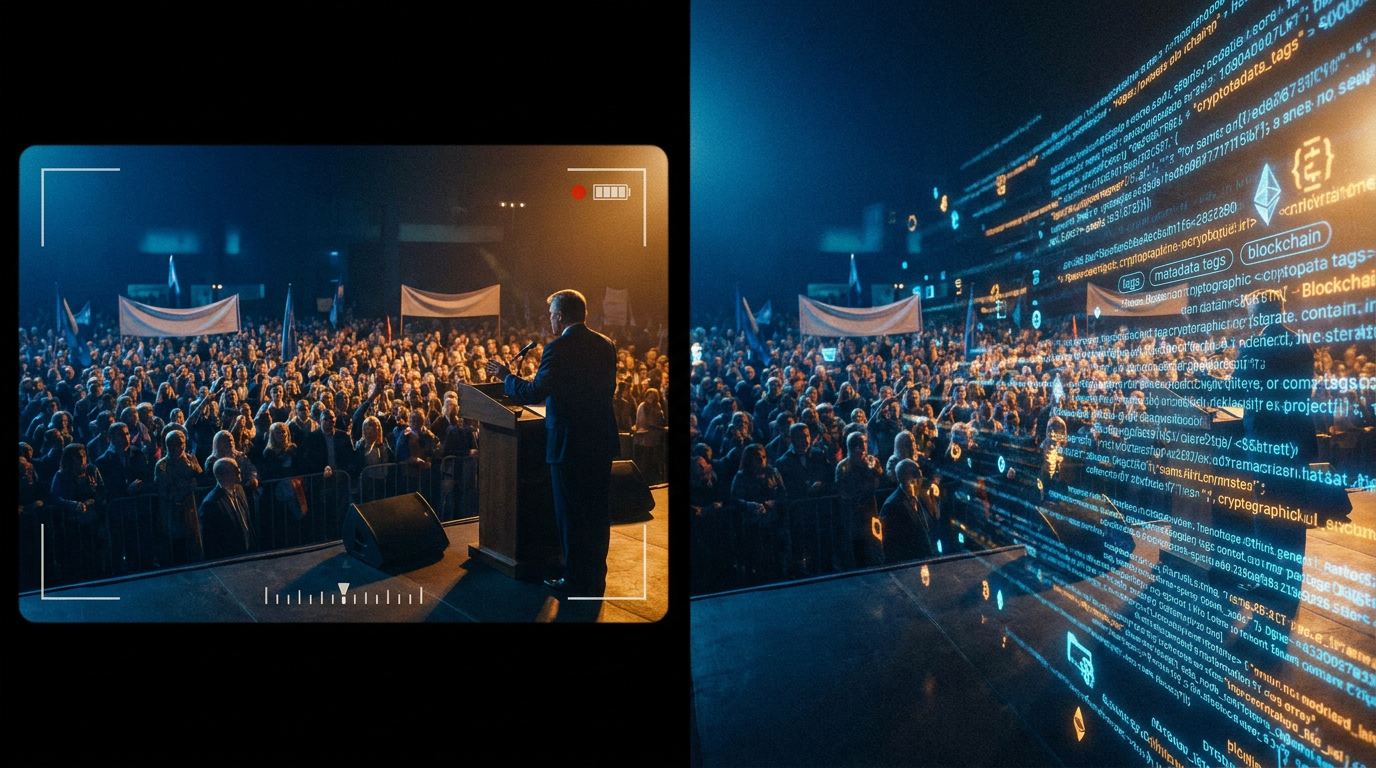
- Provenance Advocates
- Tech giants and publishers pushing for universal adoption of metadata standards.
- Forensic Analysts
- Investigators who warn that metadata is too fragile to stop malicious actors.
- Digital Rights Groups
- Advocates raising alarms about the bias and privacy implications of AI detection.
- Market Analysts
- Industry observers tracking the commercial growth of verification services.
What's not represented
- · Open-source AI developers whose models are often blamed for deepfakes
- · Independent creators who cannot afford enterprise compliance tools
Why this matters
As generative AI makes it effortless to create hyper-realistic deepfakes, the ability to verify what is real has become a critical infrastructure issue for the 2026 elections. The success or failure of these new digital 'nutrition labels' will determine whether voters can trust the photos, videos, and news they consume.
Key points
- Fact-checking organizations report that AI-related investigations now consume up to 20% of their resources.
- The C2PA standard attaches tamper-evident 'Content Credentials' to digital media to prove its origin.
- While cryptographic metadata is secure, it can be easily stripped by malicious actors or non-compliant platforms.
- Invisible watermarking tools like SynthID embed statistical patterns into pixels to survive image manipulation.
- AI text detectors remain unreliable and exhibit significant bias against non-native English speakers.
As the 2026 global elections test the limits of digital trust, the sheer volume of synthetic media has forced a reckoning in how society verifies reality. Fact-checking organizations report that artificial intelligence-related investigations now consume a record share of their resources. The European Digital Media Observatory recently noted that one-fifth of all verified claims in the region involve AI-generated or manipulated content. The threat is no longer just the creation of highly convincing deepfakes, but the sheer hyperproduction of "AI slop" that pollutes public discourse and exploits human empathy for algorithmic engagement. This deluge of synthetic media threatens to overwhelm traditional journalistic verification, necessitating automated, systemic solutions.[7]
Beyond the fakes themselves, the proliferation of generative AI has armed politicians and bad actors with a potent new weapon: the "liar's dividend." This phenomenon occurs when public figures exploit the widespread public awareness of deepfakes to falsely claim that genuine, damaging evidence against them is synthetically generated. Because the public knows that audio and video can be easily faked, bad actors can cast a shadow of doubt over authentic journalism and legitimate whistleblowers. In response to this existential threat to shared reality, a coalition of technology giants, news publishers, and regulators has deployed a suite of tools designed to hardwire truth into the internet's underlying infrastructure.[4]
The primary defense against synthetic media is the Coalition for Content Provenance and Authenticity (C2PA), an open technical standard that functions as a digital nutrition label. When an image is captured by a compliant camera or generated by an artificial intelligence tool, the software embeds a secure cryptographic manifest detailing its origin, authorship, and editing history. This metadata travels with the file, allowing anyone to inspect its lineage and verify its authenticity.[1]
By 2026, this standard has seen massive enterprise adoption across the digital ecosystem. When users see an "AI Generated" label on platforms like Instagram or Google Search, it is frequently derived from these underlying Content Credentials. Major generative AI providers, including OpenAI's DALL-E 3, Adobe Firefly, and Google Gemini, now automatically sign their outputs with C2PA manifests. Similarly, legacy news outlets like the BBC and The New York Times attach these credentials to their published photography, allowing readers to click a small "CR" badge to inspect the image's complete history from the photographer's camera to the publishing desk.[1]

While proponents champion C2PA as a definitive solution, forensic analysts caution that its effectiveness is strong within compliant ecosystems but weak in adversarial environments. The cryptographic signatures themselves are highly secure, tamper-evident, and mathematically sound. However, the metadata container that holds these signatures is inherently fragile. If a user takes a simple screenshot of a credentialed image, or if the file is passed through an older social media platform that automatically strips metadata to save server space, the cryptographic chain is instantly broken.[1][9]
Furthermore, C2PA is fundamentally a system of opt-in transparency. It relies entirely on the goodwill of the software provider and the user. Malicious actors generating deepfakes for political disinformation or financial fraud can simply use modified open-source AI models that do not attach Content Credentials, or they can intentionally strip the metadata using basic software tools before distribution. Therefore, while C2PA excels at proving that a legitimate image is real, the absence of credentials does not definitively prove that an image is fake.[1][9]
Recognizing the fragility of metadata, the technology industry has heavily invested in digital watermarking to reliably detect AI generation even if metadata is stripped. Unlike traditional visible watermarks, which can be easily cropped out or painted over, these modern signals are woven directly into the statistical distribution of an image's pixels or an audio file's acoustic frequencies. This embeds the proof of origin into the content itself, rather than relying on an external metadata container.[6][8]
Recognizing the fragility of metadata, the technology industry has heavily invested in digital watermarking to reliably detect AI generation even if metadata is stripped.
Google DeepMind's SynthID is the most prominent example of this pixel-level approach. By 2025, SynthID had been used to watermark over ten billion images and video frames across Google's various consumer and enterprise services. Because the watermark is integrated into the content's core structural data, it is specifically designed to survive common adversarial manipulations like cropping, heavy JPEG compression, color adjustments, and format changes.[6]

The robustness of this watermarking is highly effective for proprietary, closed-source models, but remains a vulnerability for the broader open-source ecosystem. Commercial solutions deployed by enterprise platforms have achieved verification success rates exceeding 97 percent, even after an image has been heavily altered. However, watermarking must be embedded during the initial generation process. If a bad actor downloads an open-source AI model and manually disables the watermarking module in the code, the resulting deepfakes will evade algorithmic detection entirely.[6][8]
While image and audio verification have made significant technical strides, the text domain remains highly contested. Numerous startups and academic institutions have developed tools that claim to accurately catch AI-generated writing by analyzing token probability, sentence complexity, and structural predictability. These tools are widely marketed to educators and publishers as a silver bullet for academic integrity and plagiarism detection.[6]
Despite these claims, the evidence supporting AI text detection is weak, and the tools present significant equity risks. As large language models have advanced, their outputs have become statistically indistinguishable from human writing, causing text detectors to frequently produce false positives. Crucially, academic research has demonstrated that these tools exhibit severe bias against non-native English speakers. Because non-native speakers often rely on more predictable sentence structures, their legitimate, human-authored writing is routinely misclassified as AI-generated, creating a discriminatory penalty in academic and professional settings.[6]
Because post-hoc detection is increasingly viewed as a losing battle against rapidly improving generative models, the regulatory landscape has shifted toward mandating upfront provenance. The European Union's AI Act, which began enforcing strict compliance measures in 2024 and 2025, requires that AI-generated content be labeled in a machine-readable format. This intense regulatory pressure has catalyzed a booming global market for media verification services, which industry analysts project will grow from $0.9 billion in 2026 to $24.0 billion by 2036.[1][2][5]

Institutions across various sectors are rapidly adapting their workflows to this new reality. Scientific publishers, facing a crisis of manipulated images and AI-generated text in research papers, are increasingly mandating C2PA-compliant workflows and utilizing advanced forensic suites to verify data integrity before publication. In the political arena, electoral integrity institutions are combining automated detection tools with human expert analysis to triage and assess synthetic content, aiming to debunk false narratives before they achieve viral velocity.[8]
Ultimately, the combination of Content Credentials and invisible watermarking does not eliminate the existence of deepfakes, nor does it prevent bad actors from lying. Instead, it aims to create a bifurcated internet: a trusted ecosystem where professional media, corporate communications, and official government releases carry verifiable cryptographic proof of origin, and an untrusted wilderness where uncredentialed media is viewed with inherent skepticism.[1][10]
Just as the universal adoption of HTTPS did not stop email phishing but made secure browsing the baseline expectation, the push for digital provenance is about changing the defaults of digital consumption. As these standards stabilize and browser extensions begin passively verifying content in real-time, the burden of proof is slowly shifting. In the near future, it will no longer be the consumer's job to spot the fake; it will be the publisher's job to mathematically prove the truth.[1][10]
How we got here
2019
The Content Authenticity Initiative (CAI) is announced by Adobe to develop industry standards for digital provenance.
2021
The Coalition for Content Provenance and Authenticity (C2PA) is formally launched by major tech and media companies.
August 2023
Google DeepMind launches SynthID in beta to watermark AI-generated images.
August 2024
The European Union's AI Act takes effect, mandating transparency and labeling for high-risk AI systems and synthetic content.
2026
C2PA adoption accelerates across major platforms, driven by global elections and regulatory compliance deadlines.
Viewpoints in depth
Provenance Advocates
Tech giants and publishers pushing for universal adoption of metadata standards.
Organizations like Adobe, Microsoft, and the BBC argue that the internet must shift from a model of 'detecting fakes' to 'proving authenticity.' They believe that if every legitimate camera, editing software, and publishing platform adopts the C2PA standard, synthetic or manipulated media will naturally stand out because it lacks a verified cryptographic history. This camp views opt-in transparency as the ultimate solution to the scale of generative AI.
Forensic Analysts & Fact-Checkers
Investigators who warn that metadata is too fragile to stop malicious actors.
Fact-checking networks and forensic researchers point out that while C2PA is useful for compliant actors, it does little to stop deliberate disinformation. Malicious actors can simply strip the metadata or use open-source AI models that do not attach Content Credentials. This camp argues that robust, invisible watermarking at the pixel or audio-frequency level—combined with human investigation—is required to catch the most harmful deepfakes.
Digital Rights & Equity Groups
Advocates raising alarms about the bias and privacy implications of AI detection.
Civil society groups and academic researchers highlight the unintended consequences of the rush to detect AI. They point to studies showing that AI text detectors disproportionately flag the writing of non-native English speakers, creating a discriminatory 'AI penalty' in academic and professional settings. Furthermore, they caution that tying digital identity to every piece of media could undermine the right to anonymous speech online.
What we don't know
- Whether decentralized, open-source AI models can ever be effectively regulated or forced to adopt watermarking.
- How quickly social media platforms will stop stripping C2PA metadata from user uploads.
- If the general public will actually click and read Content Credentials, or simply ignore them.
Key terms
- Content Credentials
- A standardized, tamper-evident metadata label attached to digital files that displays their origin, authorship, and editing history.
- SynthID
- A technology developed by Google DeepMind that embeds imperceptible digital watermarks directly into AI-generated images, audio, and video.
- Liar's dividend
- A phenomenon where public figures exploit the existence of deepfakes to falsely claim that genuine, damaging evidence against them is AI-generated.
- Manifest
- In the context of C2PA, a small database attached to a digital asset containing cryptographic assertions about its provenance.
- Post-hoc detection
- The attempt to determine if a piece of media is AI-generated after it has been created, usually by analyzing its pixels or text patterns.
Frequently asked
What are Content Credentials?
Content Credentials are an open standard that attaches a tamper-evident 'nutrition label' to digital media, detailing its origin, authorship, and editing history.
Can Content Credentials be faked?
The cryptographic signatures themselves are highly secure, but the metadata can be intentionally stripped by malicious actors or lost when passing through non-compliant platforms.
How is AI watermarking different from a regular watermark?
Unlike a visible logo, AI watermarks like Google's SynthID alter the statistical distribution of pixels or audio frequencies in a way that is invisible to humans but detectable by algorithms.
Do AI text detectors actually work?
Currently, text detectors are unreliable and prone to false positives. Research shows they frequently misclassify legitimate writing by non-native English speakers as AI-generated.
Sources
Source coverage
10 outlets
4 viewpoints surfaced










[1]C2PAProvenance Advocates
Content Credentials: What They Are, How They Work, and Why They Matter
Read on C2PA →[2]Fact.MRMarket Analysts
Content Provenance & Synthetic Media Verification Services Market Analysis Report - 2036
Read on Fact.MR →[3]techUKMarket Analysts
Deepfakes and Disinformation: What impact could this have on elections?
Read on techUK →[4]Brookings InstitutionDigital Rights Groups
Watch out for false claims of deepfakes, and actual deepfakes, this election year
Read on Brookings Institution →[5]European ParliamentMarket Analysts
Artificial intelligence, democracy and elections
Read on European Parliament →[6]WikipediaDigital Rights Groups
AI content watermarking
Read on Wikipedia →[7]European Fact-Checking Standards NetworkForensic Analysts
EFCSN Contributes Comment to Meta's Oversight Board on AI-Generated Video
Read on European Fact-Checking Standards Network →[8]DatainteloMarket Analysts
AI Model Watermarking Tool Market Research Report 2034
Read on Dataintelo →[9]UMBC PASA Working GroupForensic Analysts
Provenance and Authenticity Standards Assessment
Read on UMBC PASA Working Group →[10]Factlen Editorial TeamProvenance Advocates
Synthesis by Factlen editorial team
Read on Factlen Editorial Team →

More in news politics
See all 5 stories →Water Security
EU Plans to Rewrite Water Protection Laws to Fast-Track Critical Mineral Mines in Drought Regions
7 sources
US-Iran Peace Deal
US and Iran Sign Historic Ceasefire to End 110-Day War, Opening Path to Final Deal
6 sources
US-Iran Deal
Israel and Hezbollah Renew Ceasefire as Lebanon Flare-Up Threatens US-Iran Peace Deal
7 sources

Every angle. Every day.
Get news politics stories with full source coverage and perspective breakdowns delivered to your inbox.