
Why Metrolinx Wrote Off $504 Million in Rail Signalling Upgrades
Ontario's transit agency has scrapped half a billion dollars in upgrades to Toronto's Union Station rail corridor, abandoning a decade-long modernization effort to make way for a fully electrified, high-frequency network.
By Factlen Editorial Team
- Transit Agency Management
- Argues the write-off is a necessary pivot to enable the high-frequency GO Expansion.
- Fiscal Accountability Advocates
- Views the half-billion-dollar loss as a symptom of poor long-term planning and project mismanagement.
- Rail Technology Experts
- Emphasizes the massive technological gulf between 1920s analog systems and modern moving-block signalling.
- General News Observers
- Reports the financial loss within the broader context of regional transit delays.
What's not represented
- · Frontline train movement directors
- · Commuters facing construction delays
Why this matters
The write-off highlights the brutal math of infrastructure tech debt. To achieve world-class, 15-minute rail frequencies, transit agencies sometimes have to abandon hundreds of millions in sunk costs on legacy band-aid solutions.
Key points
- Metrolinx has written off $504 million spent on upgrading the Union Station Rail Corridor's 1920s-era signalling system.
- The project, launched in 2013, was paused in 2023 after being deemed incompatible with the new GO Expansion vision.
- The GO Expansion requires the European Train Control System (ETCS) to achieve 15-minute, high-frequency electric train service.
- While a massive sunk cost, experts argue abandoning the legacy upgrades is necessary to avoid permanently capping the transit network's capacity.
In a stark admission of the financial costs associated with pivoting a century-old transit network toward the future, Ontario's provincial transit agency, Metrolinx, has officially written off $504 million spent on redundant rail signalling upgrades. The massive write-down, detailed deep within the agency's June 2026 annual report, effectively closes the book on a decade-long effort to modernize the intricate web of tracks surrounding downtown Toronto's Union Station. While the half-billion-dollar figure has drawn immediate scrutiny from taxpayers and political watchdogs, the cancellation represents a fundamental clash between two eras of transit philosophy: the desire to patch an aging analog system versus the mandate to build a fully electrified, high-frequency regional network from scratch.[1][2]
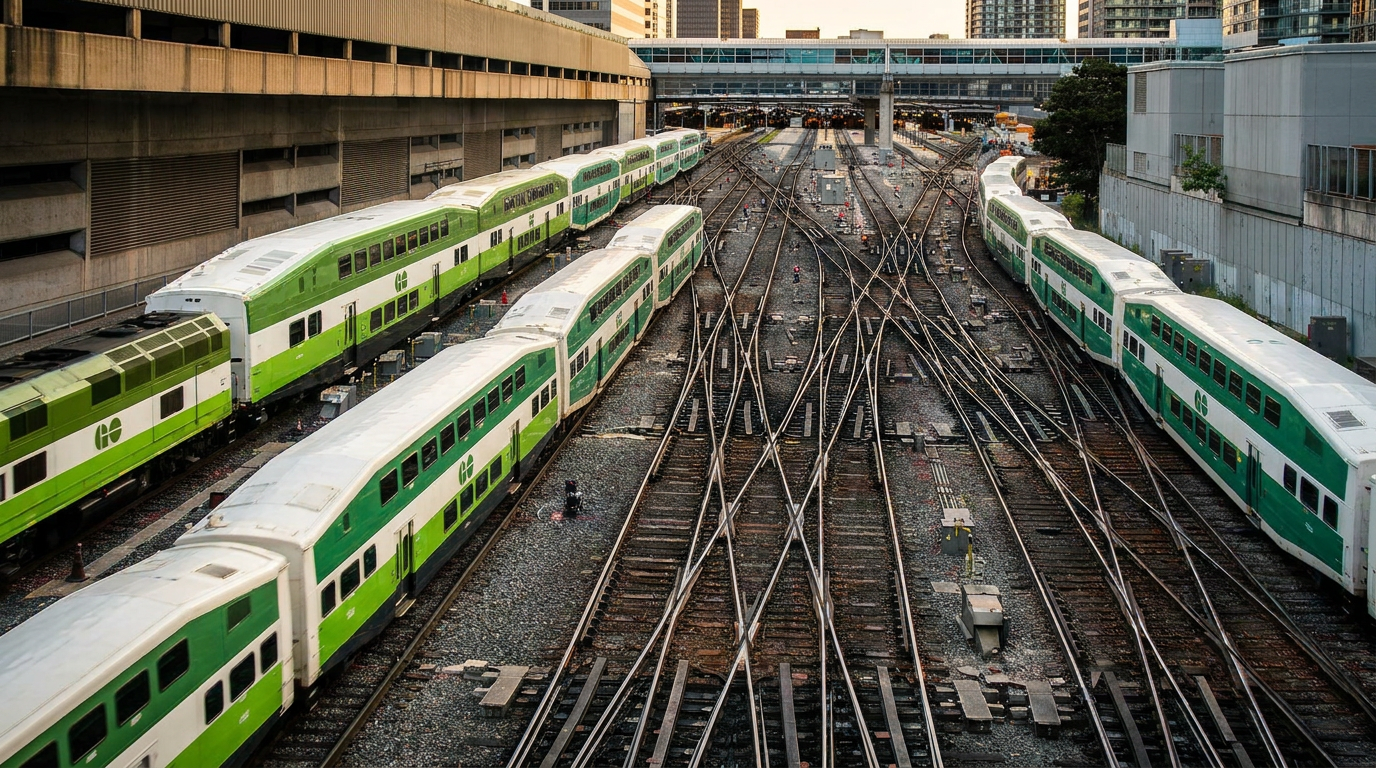
The origins of the abandoned project trace back to 2013, an era when the region's transit ambitions were significantly more modest. At the time, Metrolinx launched a comprehensive overhaul of the Union Station Rail Corridor (USRC), a 6.4-kilometre chokepoint that serves as the beating heart of Canada's busiest passenger facility. The primary goal was to replace an antiquated, electro-mechanical interlocking system that had been directing trains safely but inefficiently since the late 1920s. Engineers were tasked with installing modern, solid-state interlockings and laying dozens of kilometres of new circuited track, a massive physical undertaking designed to keep the existing diesel commuter trains running smoothly for another three decades.[1][3]
For nearly a century, the USRC relied on a complex 'rat's nest' of analog wiring and heavy manual levers housed in heritage brick watchtowers. Train movement directors physically pulled red and black levers to switch tracks and change signals, listening for mechanical double-clicks to confirm a route was safely locked. The 2013 project aimed to replace this mechanical marvel with a digitized equivalent. It was a necessary upgrade for the time, but it was fundamentally a modernization of the status quo—a system still reliant on traditional fixed-block signalling, where trains are kept safely apart by static physical sections of track and trackside traffic lights.[1][4]

But as the physical upgrades plodded along through the 2010s, the overarching vision for the Greater Toronto Area's transit future underwent a radical transformation. Metrolinx introduced the 'GO Expansion' program, a multi-billion-dollar mandate to convert the existing peak-hour diesel commuter rail network into a fully electrified, high-frequency regional transit system. This new vision promised a 'turn-up-and-go' service model, with electric trains arriving every 15 minutes or better across the core corridors, fundamentally changing how millions of residents would navigate the region. Achieving this level of rapid, subway-like frequency on a sprawling regional rail network requires a complete reimagining of how trains are tracked, spaced, and controlled, rendering traditional infrastructure upgrades entirely insufficient.[2][4]
Achieving that ambitious 15-minute frequency target requires trains to run much closer together than traditional fixed-block signalling allows. Under the legacy fixed-block system—which the 2013 project was explicitly designed to upgrade—the rail corridor is divided into static physical sections. Only one train is permitted in a block at any given time, and drivers must rely on trackside traffic lights to know when it is safe to proceed. While incredibly safe, this method leaves massive spatial gaps between trains, severely capping the corridor's maximum capacity and making high-frequency electric service mathematically impossible.[4][5]
To break through this capacity ceiling, Metrolinx realized it needed to adopt the European Train Control System (ETCS) Level 2. This advanced, moving-block technology abandons static track sections entirely, instead continuously tracking the exact location, speed, and direction of every train via bidirectional radio communication. Rather than relying on trackside lights that can be obscured by weather or curves, movement authorities and speed limits are beamed directly to a digital display inside the driver's cab, creating a dynamic, virtual safety bubble around each train. This allows trains to safely tailgate one another at higher speeds, maximizing the throughput of the existing physical tracks. It is the global gold standard for high-capacity rail, used extensively across Europe, Asia, and Australia to manage the world's busiest transit corridors.[4][5]

To break through this capacity ceiling, Metrolinx realized it needed to adopt the European Train Control System (ETCS) Level 2.
This technological leap forward created a fatal incompatibility with the ongoing construction. By 2023, Metrolinx engineers recognized that the solid-state interlockings and trackside infrastructure being installed under the 2013 contract simply could not support the complex data requirements of ETCS Level 2. Furthermore, the GO Expansion demanded a complete redesign of Union Station's track layouts and platforms to accommodate the new electric trains, meaning the physical cables and switches laid down over the previous decade were suddenly in the wrong places. The agency found itself at a crossroads: continue pouring money into a system that would bottleneck the network's future, or halt the project and absorb a massive financial loss.[1][2]
Faced with the reality that the new signalling infrastructure would be obsolete before it was even fully operational, Metrolinx quietly paused the USRC signalling project in 2023. The agency spent the next three years finalizing the advanced track layouts for the GO Expansion, hoping to salvage as much of the physical infrastructure as possible. However, the final accounting arrived in the 2026 annual report, confirming the inevitable: the vast majority of the half-billion-dollar investment had no permanent service potential in the electrified era. The decision to formally write off the asset marks a definitive, if costly, break from the agency's past operational models.[1][2]
'As planning advanced for the broader GO Expansion plans, it became clear that the approach to modernizing the legacy signalling system would not support the signalling requirements for the higher-frequency, two-way, all-day service,' a Metrolinx spokesperson stated in response to the write-down. The agency noted that while a 'usable portion' of the completed physical work—such as certain concrete foundations and cable containments—will be retained and incorporated into the new expansion plans, the core technological investment has been entirely scrapped. This pivot underscores the sheer difficulty of executing a mid-stream technological upgrade on an active railway that handles hundreds of thousands of passengers daily.[1][2]
The $504 million write-off represents roughly one percent of Metrolinx's total capital asset balance, but it arrives amid a period of broader financial friction for the transit authority. The agency's latest annual report revealed it came in eight percent over budget for the 2025–2026 fiscal year. This shortfall was driven largely by nearly $1 billion in overspending on other major, long-delayed transit projects across the region, including the Eglinton Crosstown and Finch West light rail lines, amplifying public frustration over transit spending. When viewed alongside these other overruns, the signalling write-off has become a lightning rod for critics who question the agency's ability to manage mega-projects efficiently.[2]

The write-down also highlights the broader uncertainty currently surrounding the GO Expansion itself. Metrolinx cut capital spending on the expansion program by over half a billion dollars last year, scaling the initial rollout back to a 'minimum viable product.' Following an acrimonious split with its original European operating partners, Deutsche Bahn, the agency is now focusing its immediate electrification efforts primarily on the Lakeshore East and West lines. There is currently no firm public timeline for when the entire network will be fully electrified, though internal projections point toward the mid-2030s. This shifting timeline makes the loss of the interim signalling system even more acute for daily commuters who must continue to rely on the legacy infrastructure.[2][3]
For transit advocates, fiscal watchdogs, and taxpayers, the $504 million sunk cost is a bitter pill to swallow. It underscores the severe financial risks of upgrading legacy infrastructure in piecemeal phases without a locked-in, long-term technological roadmap. Critics argue the loss reflects a distinct lack of foresight during the early 2010s planning stages, suggesting that the incompatibility between the 2013 upgrades and the broader electrification goals should have been identified years before half a billion dollars was spent. The frustration is compounded by the fact that the 1920s-era mechanical relays will now have to remain in service even longer while the new ETCS architecture is designed and deployed.[2][3]
However, rail technology experts and engineers view the pivot through a different lens, seeing it as a painful but entirely necessary course correction. Attempting to force a 21st-century electrified rail network onto a signalling architecture designed for 20th-century diesel operations would have permanently bottlenecked the region's transit capacity. In the world of global infrastructure, transitioning from electro-mechanical systems to digital moving-block cab signalling is rarely a seamless software patch; it requires a complete paradigm shift that often renders intermediate upgrades obsolete. Experts note that similar write-offs have occurred in transit networks from London to New York when agencies finally make the leap to fully digital train control.[4][5]

Ultimately, the $504 million write-off exposes the hidden, often brutal cost of escaping infrastructure tech debt. By abandoning the redundant upgrades now, Metrolinx is clearing the technological slate. While the financial loss is undeniable, it ensures that when the GO Expansion finally arrives, it will run on a signalling system genuinely built for the future, rather than a compromised, digitized version of the past. For a region desperate for world-class transit, paying for the mistakes of the past may be the only way to unlock the capacity of the future. The true test will be whether the agency can now deliver the ETCS Level 2 system without repeating the costly missteps of the last decade.[1][4]
How we got here
2013
Metrolinx launches a project to upgrade the 1920s-era signalling system in the Union Station Rail Corridor.
2019
The GO Expansion program is formalized, aiming to electrify the network and provide 15-minute service.
2023
The signalling upgrade is paused after engineers identify severe compatibility risks with the new ETCS Level 2 requirements.
June 2026
Metrolinx officially writes off $504 million of the legacy signalling work in its annual report.
Viewpoints in depth
Transit Agency Management
Argues the write-off is a necessary pivot to enable the high-frequency GO Expansion.
Metrolinx maintains that the rapid evolution of the GO Expansion program fundamentally changed the operational requirements of the rail network. From their perspective, clinging to the 2013 signalling upgrades would have permanently capped the system's capacity, preventing the realization of 15-minute, two-way, all-day service. They view the $504 million as a sunk cost that, while unfortunate, is vastly outweighed by the long-term economic and transit benefits of adopting the European Train Control System (ETCS).
Fiscal Accountability Advocates
Views the half-billion-dollar loss as a symptom of poor long-term planning and project mismanagement.
Critics and financial watchdogs point to the write-off as a glaring example of public sector inefficiency. They argue that the incompatibility between the 2013 upgrades and the broader electrification goals should have been identified years before $504 million was spent. Coupled with an eight percent overall budget overrun for the fiscal year and scaled-back spending on the GO Expansion itself, this camp sees the signalling pivot not as a strategic masterstroke, but as a costly consequence of disjointed infrastructure planning.
Rail Technology Experts
Emphasizes the massive technological gulf between 1920s analog systems and modern moving-block signalling.
Engineers and rail modernization specialists focus on the technical reality of the transition. Moving from an electro-mechanical interlocking system to ETCS Level 2 is not a simple software patch; it requires a complete paradigm shift in how trains are tracked and spaced. Experts note that intermediate 'band-aid' upgrades frequently become obsolete when a transit network makes the leap to digital, moving-block cab signalling, making such write-offs a common, albeit painful, feature of global rail modernization efforts.
What we don't know
- Exactly what percentage of the physical infrastructure from the 2013 project will be salvaged for the new network.
- The final timeline and revised budget for the full implementation of the electrified GO Expansion.
Key terms
- Union Station Rail Corridor (USRC)
- The 6.4-kilometre network of approach tracks and platforms surrounding downtown Toronto's main transit hub.
- Interlocking
- A failsafe arrangement of signals and track switches that prevents trains from conflicting with one another.
- Fixed-Block Signalling
- A traditional safety system that divides tracks into static sections, allowing only one train per section at a time.
- European Train Control System (ETCS) Level 2
- A modern, moving-block signalling standard that continuously tracks trains via radio and beams speed limits directly into the driver's cab.
Frequently asked
Why was the $504 million signalling project cancelled?
The project was designed for traditional diesel trains and fixed-block signalling. It became obsolete when Metrolinx pivoted to the GO Expansion, which requires advanced moving-block technology (ETCS) for high-frequency electric trains.
Will any of the previous work be saved?
Yes. Metrolinx stated that a 'usable portion' of the physical infrastructure completed before the 2023 pause will be retained and incorporated into the new network.
How does this affect the GO Expansion timeline?
The write-off clears the way for the new signalling system, but the overall GO Expansion program is facing budget cuts and uncertainty, with full electrification likely pushed into the mid-2030s.
Sources
Source coverage
5 outlets
4 viewpoints surfaced





[1]Global NewsGeneral News Observers
Metrolinx writes off $500M in signalling upgrades that are no longer useful
Read on Global News →[2]The TrilliumFiscal Accountability Advocates
Metrolinx writes off more than $500M in upgrades, cuts GO expansion spending
Read on The Trillium →[3]Toronto StarFiscal Accountability Advocates
Metrolinx spent $500M on a Union Station signalling project. Now, it's scrapping the plan
Read on Toronto Star →[4]MetrolinxTransit Agency Management
GO Expansion Advanced Signalling System
Read on Metrolinx →[5]UrbanTorontoRail Technology Experts
Advanced signalling technology for rail: ETCS
Read on UrbanToronto →
Every angle. Every day.
Get transportation stories with full source coverage and perspective breakdowns delivered to your inbox.