
Virginia Enacts Landmark Right to Contraception and Equity Laws
Governor Abigail Spanberger signed legislation guaranteeing access to birth control and mandating insurance coverage for contraceptives, cementing Virginia's status as a regional outlier on reproductive rights.
By Factlen Editorial Team
- State Administration & Sponsors
- Argue that reproductive care is deeply personal and should be shielded from political shifts, framing the laws as a victory for personal freedom.
- Reproductive Health Advocates
- Emphasize the medical necessity of contraceptives for treating conditions like PCOS and endometriosis, and celebrate the removal of financial barriers.
- Policy & Procurement Analysts
- Focus on the compliance shift for healthcare providers, the impact on state procurement, and the partisan legislative history of the bills.
What's not represented
- · Health Insurance Providers
- · Pharmacists implementing the new OTC coverage forms
Why this matters
The legislation ensures that Virginians cannot be legally barred from obtaining birth control and eliminates out-of-pocket costs for both prescription and over-the-counter contraceptives. It also establishes Virginia as the sole Southern state actively expanding reproductive healthcare access in the post-Roe landscape.
Key points
- Governor Abigail Spanberger signed the Right to Contraception Act, barring local and state governments from restricting access to birth control.
- The Contraception Equity Act eliminates out-of-pocket costs for FDA-approved contraceptives, including over-the-counter options.
- Virginia remains the only Southern state that has not imposed additional reproductive healthcare restrictions since Roe v. Wade was overturned.
- The legislation takes effect on July 1, 2026, following two previous vetoes by former Governor Glenn Youngkin.
- Spanberger also announced Virginia's entry into the Reproductive Freedom Alliance, a multi-state coalition protecting healthcare access.
Governor Abigail Spanberger signed two landmark reproductive healthcare bills into law on Wednesday, guaranteeing access to contraception and mandating comprehensive insurance coverage across Virginia. The legislative package, which includes the Right to Contraception Act and the Contraception Equity Act, marks a significant policy shift for the commonwealth and cements its status as a regional outlier on reproductive rights. By codifying these protections, the state government has effectively built a firewall against future attempts to restrict family planning resources, ensuring that residents maintain uninterrupted access to essential medical care regardless of shifting political dynamics in Richmond or Washington.[1][4]
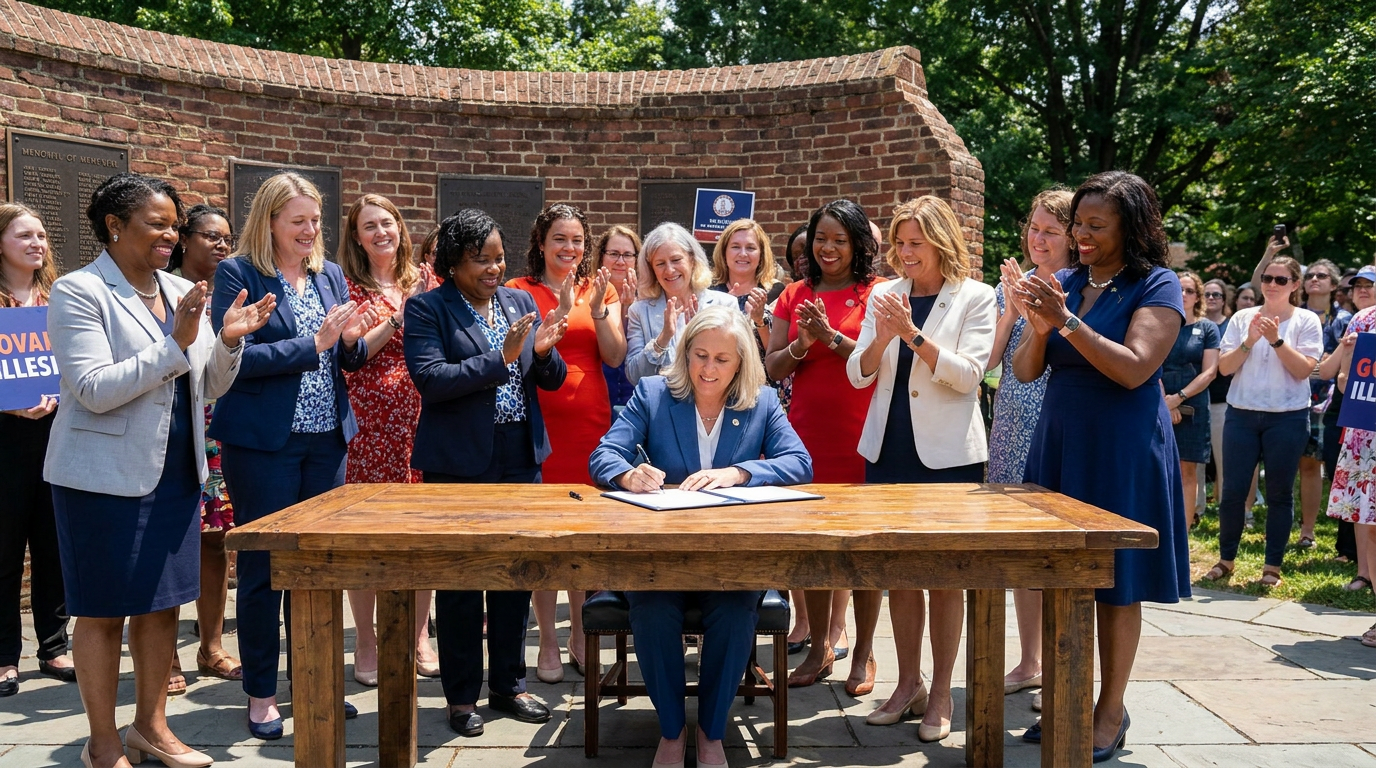
The signing ceremony took place at the Turning Point Suffragist Memorial in Lorton, a site deliberately chosen to honor the women imprisoned during the 1917 Silent Sentinels protests outside the White House. Surrounded by reproductive rights advocates, healthcare providers, and Democratic lawmakers, Spanberger framed the legislation as a fundamental protection of personal freedom. She emphasized that reproductive decisions belong exclusively to individuals and their doctors, rather than politicians or government officials. The historical backdrop of the memorial served to underscore the administration's message that access to contraception is deeply intertwined with women's broader economic and social equality.[1][3][5]
The first measure, the Right to Contraception Act (officially designated as Senate Bill 596 and House Bill 6), strictly prohibits state and local governments from enacting any laws, regulations, or policies that restrict access to FDA-approved contraceptives. This explicit legal protection covers a wide spectrum of family planning methods, specifically safeguarding the right to obtain and use intrauterine devices (IUDs) and emergency contraception. By preemptively banning municipal or state-level restrictions, the law ensures that healthcare providers can continue offering comprehensive reproductive services without fear of sudden legal liabilities or localized bans that have emerged in other jurisdictions.[1][4][6]
The companion legislation, the Contraception Equity Act, directly targets the financial barriers associated with reproductive care. It requires all health insurance plans operating within the state to cover a broad range of contraceptives without any out-of-pocket costs for the patient. This means the elimination of co-pays, deductibles, and cost-sharing requirements that often put preferred or highly effective birth control methods out of reach for lower-income residents. The mandate is designed to ensure that financial constraints do not dictate a patient's medical choices, allowing individuals to select the contraceptive method that best aligns with their specific health needs.[1][2]

Crucially, the Equity Act extends these strict coverage mandates to over-the-counter options, such as condoms and non-prescription birth control pills, which have historically been excluded from standard insurance benefits. Furthermore, the law introduces a mechanism for patients to request specific, non-preferred contraceptives through a streamlined pharmacy form rather than navigating a lengthy and often opaque insurance approval process. This provision ensures that if a doctor determines a specific brand or formulation is medically necessary, the patient can access it without facing prohibitive out-of-pocket expenses or administrative delays imposed by their insurance carrier.[2][4]
The enactment of these laws marks the culmination of a protracted, multi-year legislative battle in the Virginia General Assembly. Identical measures were successfully passed by lawmakers in both 2024 and 2025, only to be vetoed both times by former Republican Governor Glenn Youngkin. During his tenure, Youngkin cited concerns over the breadth of the insurance mandates and the potential infringement on religious exemptions for certain employers. The repeated vetoes turned contraception access into a central campaign issue, mobilizing advocates and ultimately setting the stage for rapid legislative action once the executive branch changed hands earlier this year.[1][4][6]
The enactment of these laws marks the culmination of a protracted, multi-year legislative battle in the Virginia General Assembly.
With the recent change in the governor's mansion, the bills' primary sponsors finally saw their persistent efforts codified into state law. State Senator Jennifer Carroll Foy and Delegate Marcia Price, who championed the legislation through multiple contentious sessions, emphasized that the new laws permanently remove political interference from deeply personal medical decisions. During the ceremony, they celebrated the victory as a testament to the tenacity of medical providers and advocates, noting that the legislation provides immediate peace of mind to patients who had grown increasingly anxious about the security of their healthcare access in a volatile political climate.[1][3]
Throughout the legislative process and the signing ceremony, advocates consistently highlighted the broader medical applications of contraceptives beyond traditional family planning. Panelists and lawmakers noted that birth control is frequently prescribed as a primary treatment for debilitating conditions like polycystic ovary syndrome (PCOS), endometriosis, and severe menstrual pain. For thousands of Virginians suffering from these conditions, guaranteed access to hormonal contraceptives is not merely a matter of reproductive choice, but a fundamental healthcare necessity required to manage chronic pain, regulate hormonal imbalances, and maintain their overall quality of life and ability to work.[2][3]
The legislation firmly cements Virginia's unique and increasingly isolated position in the post-Roe v. Wade landscape of the American South. It remains the only Southern state that has not imposed additional restrictions or outright bans on reproductive healthcare since the Supreme Court overturned federal abortion protections. This stark regional contrast has transformed Virginia into a critical access point for reproductive services, drawing an increasing number of out-of-state patients seeking care that is no longer legally available or practically accessible in neighboring states across the region.[1][4][5]

Recognizing this regional isolation and the broader national landscape, Governor Spanberger also used the occasion to announce that Virginia has officially joined the Reproductive Freedom Alliance. This multi-state coalition, comprising over 20 governors, works collaboratively to protect and expand access to reproductive healthcare across state lines. The alliance coordinates efforts to stockpile essential medications like mifepristone, share legal strategies, and shield both patients and healthcare providers from out-of-state legal actions or investigations initiated by jurisdictions with strict reproductive bans.[2]
The new laws will officially take effect on July 1, 2026, triggering a rapid implementation phase across the commonwealth's medical and insurance sectors. Healthcare providers, pharmacies, and insurance administrators are already preparing for the compliance shift, which requires updating billing algorithms to eliminate cost-sharing for a wide array of products. Industry analysts anticipate that the mandates will increase overall demand for contraceptive services and alter state healthcare procurement contracts, as agencies adjust their benefit structures to fully align with the comprehensive coverage requirements mandated by the Contraception Equity Act.[6][7]

While the signing of these bills represents a major legislative milestone, the political fight over reproductive rights in Virginia is far from over. Lawmakers and advocacy groups are now turning their full attention and resources toward a high-stakes ballot referendum scheduled for November 2026. The referendum will ask voters whether to enshrine reproductive rights directly into the state constitution—a permanent measure that has faced unified, party-line opposition from Republican legislators. The upcoming vote promises to keep reproductive healthcare at the forefront of Virginia's political discourse through the end of the year.[2][3]
How we got here
June 2022
The U.S. Supreme Court overturns Roe v. Wade, prompting states to establish their own reproductive healthcare laws.
2024–2025
Former Virginia Governor Glenn Youngkin vetoes earlier versions of the Right to Contraception Act.
January 2026
Abigail Spanberger is inaugurated as Governor of Virginia, shifting the executive branch's stance on reproductive legislation.
June 17, 2026
Governor Spanberger signs the Right to Contraception Act and Contraception Equity Act into law.
July 1, 2026
The new contraception access and insurance coverage mandates officially take effect.
November 2026
Virginia voters will decide on a ballot referendum to enshrine reproductive rights into the state constitution.
Viewpoints in depth
State Administration & Sponsors
Argue that reproductive care is deeply personal and should be shielded from political shifts, framing the laws as a victory for personal freedom.
Governor Spanberger and the bills' legislative sponsors view the Right to Contraception Act as a necessary firewall against shifting political winds. By codifying these rights, they argue that Virginia is protecting fundamental personal freedoms from government overreach. They frequently highlight Virginia's status as a 'safe haven' in the South, arguing that ensuring access to reproductive healthcare is not only a moral imperative but an economic one, allowing women to remain in the workforce and plan their families without state interference.
Reproductive Health Advocates
Emphasize the medical necessity of contraceptives for treating conditions like PCOS and endometriosis, and celebrate the removal of financial barriers.
For patient advocates and healthcare providers, the legislation is a crucial public health victory. They stress that contraception is often prescribed for reasons entirely unrelated to preventing pregnancy, such as managing severe menstrual pain, ovarian cysts, and endometriosis. By eliminating co-pays and expanding coverage to over-the-counter options, advocates argue the Contraception Equity Act removes prohibitive financial barriers that previously forced patients to choose cheaper, less effective treatments over what their doctors actually recommended.
Policy & Procurement Analysts
Focus on the compliance shift for healthcare providers, the impact on state procurement, and the partisan legislative history of the bills.
Industry analysts and legislative trackers note that the new laws will force a rapid compliance shift across Virginia's healthcare sector. Insurers must update their coverage algorithms by July 1 to eliminate cost-sharing for a wide array of products, while state procurement offices will likely see increased demand for reproductive health services. Observers also point to the stark partisan divide underlying the policy: the bills passed along party lines and were vetoed twice by the previous Republican administration, signaling that reproductive healthcare remains a deeply polarized issue heading into the November constitutional amendment vote.
What we don't know
- How health insurance providers will adjust their broader premium pricing to absorb the costs of the new zero-co-pay mandates.
- Whether the upcoming November ballot referendum to enshrine reproductive rights into the state constitution will pass, given the unified opposition from Republican lawmakers.
Key terms
- Intrauterine Device (IUD)
- A small, highly effective contraceptive device inserted into the uterus to prevent pregnancy for several years.
- Over-the-counter (OTC)
- Medications and health products that can be purchased directly by consumers without requiring a doctor's prescription.
- Reproductive Freedom Alliance
- A coalition of over 20 U.S. governors working together to protect and expand access to reproductive healthcare across state lines.
- Polycystic Ovary Syndrome (PCOS)
- A hormonal disorder causing enlarged ovaries with small cysts, often treated using prescription hormonal contraceptives.
Frequently asked
Will I still have to pay a co-pay for my birth control?
Under the Contraception Equity Act, health insurance plans must cover at least one option in each FDA-approved contraceptive category without any out-of-pocket costs, including co-pays or deductibles.
Does the new law cover over-the-counter contraceptives?
Yes. The legislation requires insurers to cover over-the-counter options, such as condoms and non-prescription birth control pills, without cost-sharing.
Are emergency contraceptives protected under this legislation?
Yes. The Right to Contraception Act explicitly prohibits state and local governments from restricting access to FDA-approved emergency contraception and intrauterine devices (IUDs).
When do these new rules go into effect?
The legal protections and insurance coverage mandates officially take effect on July 1, 2026.
Sources
Source coverage
7 outlets
3 viewpoints surfaced







[1]Virginia Governor's OfficeState Administration & Sponsors
Governor Spanberger Signs Historic Legislation to Guarantee & Expand Contraception Access
Read on Virginia Governor's Office →[2]WHRO Public MediaReproductive Health Advocates
Spanberger joins governors in Reproductive Freedom Alliance, signs related Virginia bills into law
Read on WHRO Public Media →[3]FFXnowReproductive Health Advocates
Gov. Spanberger signs contraception access bills near suffragist memorial
Read on FFXnow →[4]Rocktown NowState Administration & Sponsors
Virginia Governor signs reproductive healthcare legislation
Read on Rocktown Now →[5]WBOCPolicy & Procurement Analysts
Legislation signed in Virginia that guarantees access to contraception
Read on WBOC →[6]LegiScanPolicy & Procurement Analysts
Virginia Senate Bill 596
Read on LegiScan →[7]GovlyPolicy & Procurement Analysts
Virginia Enacts Contraception Access Laws
Read on Govly →

More in news politics
See all 5 stories →US-Iran Relations
US-Iran Peace Talks Postponed as Israel-Hezbollah Clashes Shatter Ceasefire
8 sources

Iran Nuclear Deal
The U.S.-Iran Peace Framework and the 60-Day Race to Secure a Nuclear 'Blind Spot'
8 sources

Guaranteed Income
Fact-Checking the Guaranteed Income Pilots: What the Data Actually Shows
7 sources

Every angle. Every day.
Get news politics stories with full source coverage and perspective breakdowns delivered to your inbox.