
The U.S. and Iran Signed a Ceasefire to End the 110-Day War. Here is Why It Is Already Unraveling.
A fragile memorandum of understanding has paused the devastating U.S.-Iran conflict and reopened the Strait of Hormuz, but ongoing Israeli military operations in Lebanon threaten to collapse the 60-day negotiation window.
By Factlen Editorial Team

- U.S. Administration
- Views the memorandum as a necessary pragmatic step to end a costly war, reopen global shipping, and force Iran into nuclear negotiations.
- Iranian Leadership
- Frames the survival of the 110-day war and the lifting of the blockade as a strategic victory, though remains deeply distrustful of U.S. commitments.
- Israeli Government
- Views the deal as a disastrous betrayal that leaves Iran's nuclear infrastructure intact and prematurely halts military momentum in Lebanon.
- Global Economic Stakeholders
- Relieved by the reopening of the Strait of Hormuz and the stabilization of energy markets after months of severe disruption.
What's not represented
- · Lebanese civilians caught in the crossfire
- · U.S. domestic political opposition
Why this matters
The 110-day war choked off 20% of global energy shipping, driving up inflation and threatening a worldwide recession. Whether this fragile truce holds will determine if global markets stabilize or if the Middle East plunges back into a devastating regional conflict.
Key points
- The U.S. and Iran signed an interim agreement to pause their 110-day war.
- The deal reopens the Strait of Hormuz, easing a severe global energy crisis.
- A 60-day window has been established to negotiate a final nuclear and sanctions agreement.
- The deal mandates a ceasefire in Lebanon, but Israel has refused to halt its operations.
- Iran canceled the first round of talks in Switzerland over Israel's continued strikes.
- Israeli officials have fiercely criticized the deal, calling it a strategic disaster.
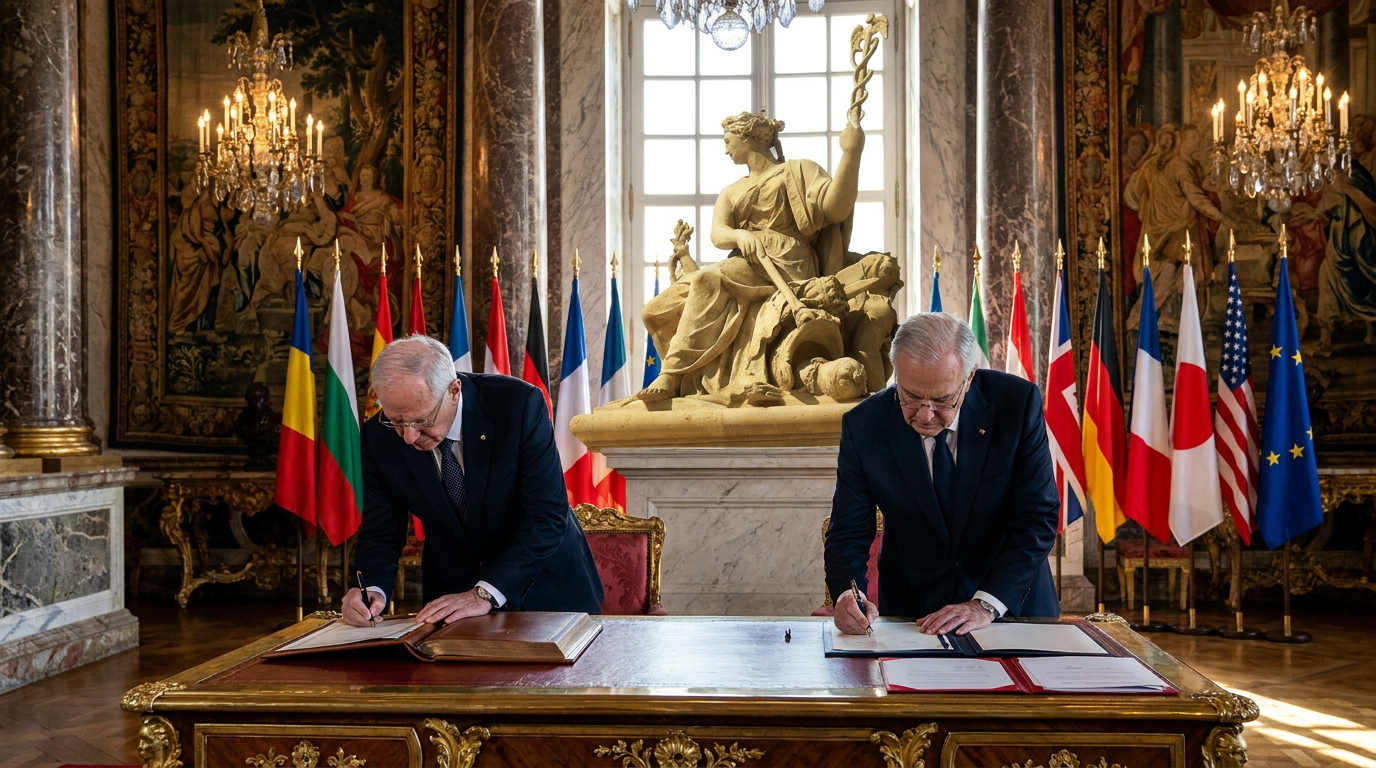
The 110-day war that paralyzed global energy markets and reshaped Middle Eastern alliances has officially paused, but the peace is already fraying at the edges. On Wednesday, U.S. President Donald Trump and Iranian President Masoud Pezeshkian signed the "Islamabad Memorandum of Understanding," an interim agreement designed to halt hostilities and reopen the heavily blockaded Strait of Hormuz.[1][2]
The breakthrough, finalized at the Palace of Versailles following mediation by Pakistan and Qatar, represents a dramatic pivot from military confrontation to high-stakes diplomacy. The conflict, which began in late February 2026 with coordinated U.S. and Israeli strikes on Iranian nuclear and military facilities, had rapidly escalated into a devastating regional war with profound economic consequences.[1][7]
The immediate global relief was palpable. For months, Iran’s retaliatory blockade of the Strait of Hormuz choked off roughly a fifth of the world’s oil and gas shipping, sending energy prices skyrocketing and threatening a global economic meltdown. Within hours of the signing, commercial vessels began transiting the waterway at the highest volume seen since April.[2][7]
However, the memorandum is not a comprehensive peace treaty. It is a sequencing mechanism that establishes a fragile 60-day window for direct bilateral negotiations. During this period, Washington and Tehran are expected to hammer out a final agreement addressing Iran’s nuclear program, the permanent lifting of U.S. sanctions, and a proposed $300 billion regional reconstruction fund.[1][7]

The core mechanism of the deal relies on intertwined concessions. The U.S. has agreed to lift its own blockade and grant necessary waivers for financial transactions, while Iran has committed to restoring maritime traffic and halting military operations. Crucially, the text mandates the immediate and permanent termination of military operations on all fronts, explicitly including Lebanon.[1][7]
That single clause regarding Lebanon has become the agreement’s most explosive vulnerability. While the U.S. and Iran agreed to the terms, Israel was not a party to the memorandum and does not consider itself bound by its stipulations regarding its northern border.[1][3]
Israeli Prime Minister Benjamin Netanyahu and his hardline coalition partners have reacted with fury to the U.S.-Iran detente. Israeli officials view the agreement as a strategic disaster that prematurely ends the military campaign while leaving Iran’s nuclear infrastructure largely intact.[4][6]
Israeli Prime Minister Benjamin Netanyahu and his hardline coalition partners have reacted with fury to the U.S.-Iran detente.
Across the Israeli political spectrum, the reaction has been described as a meltdown. National Security Minister Itamar Ben-Gvir and Defense Minister Israel Katz have explicitly stated that Israel will not withdraw its forces from southern Lebanon. Opposition figures have similarly castigated the deal, accusing the U.S. administration of throwing a lifeline to the regime in Tehran just as it was weakening.[4][6]

The disconnect between the memorandum's text and the reality on the ground became violently apparent by the weekend. Despite the announced ceasefire, Israeli military operations continued in southern Lebanon, aimed at neutralizing Hezbollah positions and establishing a buffer zone. Hezbollah forces retaliated, resulting in deadly cross-border flare-ups that killed several people.[2][5]
The continued fighting in Lebanon immediately derailed the diplomatic schedule. The first round of technical talks between the U.S. and Iran, slated to begin Friday in Switzerland, was abruptly canceled by Tehran.[2][3]
Iranian officials informed mediators that they would not sit at the negotiating table until the U.S. guaranteed that Israel would cease its operations against Hezbollah, as outlined in the memorandum. In response to the collapse of the Friday meetings, the White House announced that U.S. Vice President JD Vance had postponed his planned trip to Geneva.[2][3]
The diplomatic crisis has placed the U.S. administration in a precarious position between its closest Middle Eastern ally and its desire to exit a costly war. President Trump publicly urged all parties to maintain their commitment to the peace process, reportedly telling Israeli leadership to calm down and accept the ceasefire on all fronts.[1][2]

In Tehran, the regime is framing the survival of the 110-day war as a historic victory. President Pezeshkian told provincial leaders that the country withstood an onslaught designed to collapse its government and economy. The fact that Iran forced the U.S. back to the negotiating table without conceding military defeat is being broadcast domestically as a triumph of endurance.[1]
Yet, internal Iranian politics remain complex. Supreme Leader Mojtaba Khamenei, who assumed the role following the death of his father in the war's opening hours, issued a statement offering cautious, conditional support for the memorandum. He authorized the negotiations but warned that engaging with the U.S. does not mean accepting the enemy's worldview, reflecting deep-seated institutional distrust.[1][2]
The next 60 days will test the durability of this fragile architecture. Mediators from Pakistan, Qatar, and Switzerland are working frantically behind the scenes to salvage the Geneva talks and find a formula that satisfies Iran’s demands for a Lebanese ceasefire without entirely alienating Israel.[3][7]

If the talks collapse, U.S. officials have indicated they are prepared to aggressively tighten economic and military pressure once again. For now, the world watches the Strait of Hormuz and the hills of southern Lebanon, knowing that a single miscalculation could instantly reignite a conflict that the global economy can ill afford.[1][7]
How we got here
Feb 28, 2026
U.S. and Israel launch coordinated strikes on Iranian military and nuclear facilities, beginning the 110-day war.
March 2026
Iran blockades the Strait of Hormuz, choking off 20% of global oil shipping and spiking energy prices.
June 17, 2026
The U.S. and Iran finalize the Islamabad Memorandum of Understanding to pause hostilities.
June 19, 2026
Iran pulls out of scheduled technical talks in Switzerland due to ongoing Israeli strikes in Lebanon.
Viewpoints in depth
U.S. Administration's View
The deal is a pragmatic necessity to stabilize the global economy and force nuclear negotiations.
For the U.S. administration, the 110-day war had reached a point of diminishing returns. The blockade of the Strait of Hormuz was inflicting unacceptable damage on the global economy and domestic gas prices. By signing the memorandum, the administration argues it has successfully reopened vital shipping lanes while establishing a strict 60-day clock to force Tehran into binding concessions regarding its nuclear program. Officials maintain that the threat of resuming military action remains a viable stick if talks fail.
Iranian Leadership's View
The regime survived a war designed to destroy it and forced the U.S. to the negotiating table.
Tehran is framing the ceasefire as a victory of endurance. Despite the assassination of its former Supreme Leader and severe military strikes, the government did not collapse. Iranian officials argue that their blockade strategy successfully pressured the U.S. into lifting sanctions and offering a $300 billion reconstruction plan without Iran having to concede military defeat. However, deep institutional distrust remains, with leadership demanding strict adherence to the Lebanon ceasefire clause before proceeding with technical talks.
Israeli Government's View
The agreement is a disastrous betrayal that leaves Iran's nuclear threat intact.
Across the Israeli political spectrum, the U.S.-Iran deal is viewed with intense hostility. Hardline ministers and opposition leaders alike argue that the U.S. prematurely abandoned the military campaign just as Iran was weakening. They contend the deal throws a financial lifeline to Tehran while failing to dismantle its nuclear infrastructure. Furthermore, Israel vehemently rejects the clause mandating a ceasefire in Lebanon, asserting its sovereign right to continue military operations to secure its northern border against Hezbollah.
Global Economic Stakeholders' View
The reopening of the Strait of Hormuz averts a catastrophic global recession.
For international markets and European allies, the primary concern was the strangulation of the global energy supply. The 110-day blockade of the Strait of Hormuz had choked off a fifth of the world's oil and gas, driving up inflation and threatening a severe recession. Economic stakeholders view the memorandum with profound relief, prioritizing the immediate resumption of commercial shipping over the geopolitical nuances of the Lebanon border dispute or the specifics of Iran's nuclear enrichment.
What we don't know
- Whether Israel will eventually agree to halt its military operations in southern Lebanon.
- If the U.S. and Iran can successfully negotiate a permanent nuclear agreement within the 60-day window.
- How the proposed $300 billion regional reconstruction fund for Iran will be financed and structured.
Key terms
- Islamabad Memorandum of Understanding
- The interim ceasefire agreement signed by the U.S. and Iran in June 2026, mediated largely by Pakistan, which pauses the 110-day war.
- Strait of Hormuz
- A vital maritime chokepoint between the Persian Gulf and the Gulf of Oman, through which a fifth of global oil consumption passes.
- Buffer Zone
- A designated neutral area between hostile forces; in this context, the area in southern Lebanon that Israel seeks to clear of Hezbollah fighters.
Frequently asked
What is the Islamabad Memorandum of Understanding?
It is an interim ceasefire agreement signed by the U.S. and Iran in June 2026 to pause the 110-day war and start a 60-day negotiation period.
Why did the 110-day war start?
The conflict began in late February 2026 following coordinated U.S. and Israeli military strikes on Iranian military and nuclear facilities.
Why are the peace talks currently delayed?
Iran suspended technical talks in Switzerland, demanding a guarantee that Israel will halt its military operations against Hezbollah in Lebanon.
How does the deal affect the global economy?
It lifts the Iranian blockade on the Strait of Hormuz, allowing roughly 20% of the world's oil and gas shipping to resume, which eases global energy prices.
Sources
Source coverage
7 outlets
4 viewpoints surfaced







[1]The GuardianIranian Leadership
What lessons will Iran's new leadership draw from the 110-day war?
Read on The Guardian →[2]CBS NewsU.S. Administration
Iran pulls out of talks with U.S. over Israel's conflict with Hezbollah in Lebanon
Read on CBS News →[3]The Times of IsraelIsraeli Government
First round of US-Iran talks delayed as Tehran demands guarantee of Israel-Hezbollah truce
Read on The Times of Israel →[4]AxiosU.S. Administration
Netanyahu fumes, allies rage over Trump's Iran deal
Read on Axios →[5]NPRGlobal Economic Stakeholders
Fighting persists in Lebanon despite a ceasefire as U.S.-Iran deal is under threat
Read on NPR →[6]Al JazeeraIsraeli Government
Trump’s Iran deal, Israel’s meltdown
Read on Al Jazeera →[7]The Soufan CenterGlobal Economic Stakeholders
The Global Role in Implementing the U.S.-Iran Agreement
Read on The Soufan Center →
More in news politics
See all 5 stories →US-Iran Relations
US-Iran Peace Talks Postponed as Israel-Hezbollah Clashes Shatter Ceasefire
8 sources
Iran Nuclear Deal
The U.S.-Iran Peace Framework and the 60-Day Race to Secure a Nuclear 'Blind Spot'
8 sources
Guaranteed Income
Fact-Checking the Guaranteed Income Pilots: What the Data Actually Shows
7 sources

Every angle. Every day.
Get news politics stories with full source coverage and perspective breakdowns delivered to your inbox.