
The Evidence Pack: How 'Citizens' Assemblies' Are Breaking Political Gridlock
As electoral polarization stalls policy worldwide, governments are increasingly turning to 'sortition'—randomly selecting everyday citizens to deliberate and draft legislation.
By Factlen Editorial Team
- Deliberative Democracy Advocates
- Argue that sortition bypasses partisan gridlock and special interests, producing policies that reflect the true informed will of the public.
- Institutional Reformers
- Support assemblies but caution that they must be formally integrated into the legislative process with binding authority to avoid being ignored.
- Electoral Traditionalists
- Maintain that while assemblies are useful advisory tools, final decision-making power must remain with elected representatives who can be held accountable.
What's not represented
- · Career politicians who view citizens' assemblies as a threat to their electoral authority.
- · Lobbyists and special interest groups whose influence is diluted by random selection.
Why this matters
By bypassing career politicians and special interests, citizens' assemblies offer a proven method for navigating highly polarized issues—from climate change to reproductive rights—giving everyday people direct influence over the policies that shape their lives.
Key points
- Citizens' assemblies use 'sortition'—random selection by lottery—to draft everyday people into policy-making roles.
- Stratified sampling ensures the assembly accurately reflects the public's demographics, including age, gender, and income.
- Participants undergo an intensive learning phase, hearing from experts before engaging in facilitated deliberation.
- The model bypasses the short-term incentives of electoral politics, allowing for consensus on long-term issues like climate change.
- The OECD has tracked a 'deliberative wave' of over 700 such assemblies globally since 2010.
- A major challenge remains ensuring governments act on the assemblies' recommendations rather than treating them as advisory PR.
Across the globe, traditional electoral democracies are increasingly paralyzed by partisan gridlock, elite capture, and a profound erosion of public trust. As political campaigns become more expensive and media ecosystems more fractured, career politicians often find themselves incentivized to prioritize short-term electoral survival and base-pleasing soundbites over long-term problem-solving. This dynamic has left many of the most complex, existential challenges—from climate change to wealth inequality—languishing in legislative purgatory. In response to this systemic stagnation, a growing coalition of political scientists, civic organizations, and frustrated governments are turning to a radical yet ancient alternative to break the deadlock: bypassing elections entirely in favor of randomly selecting everyday citizens to draft policy.[7]
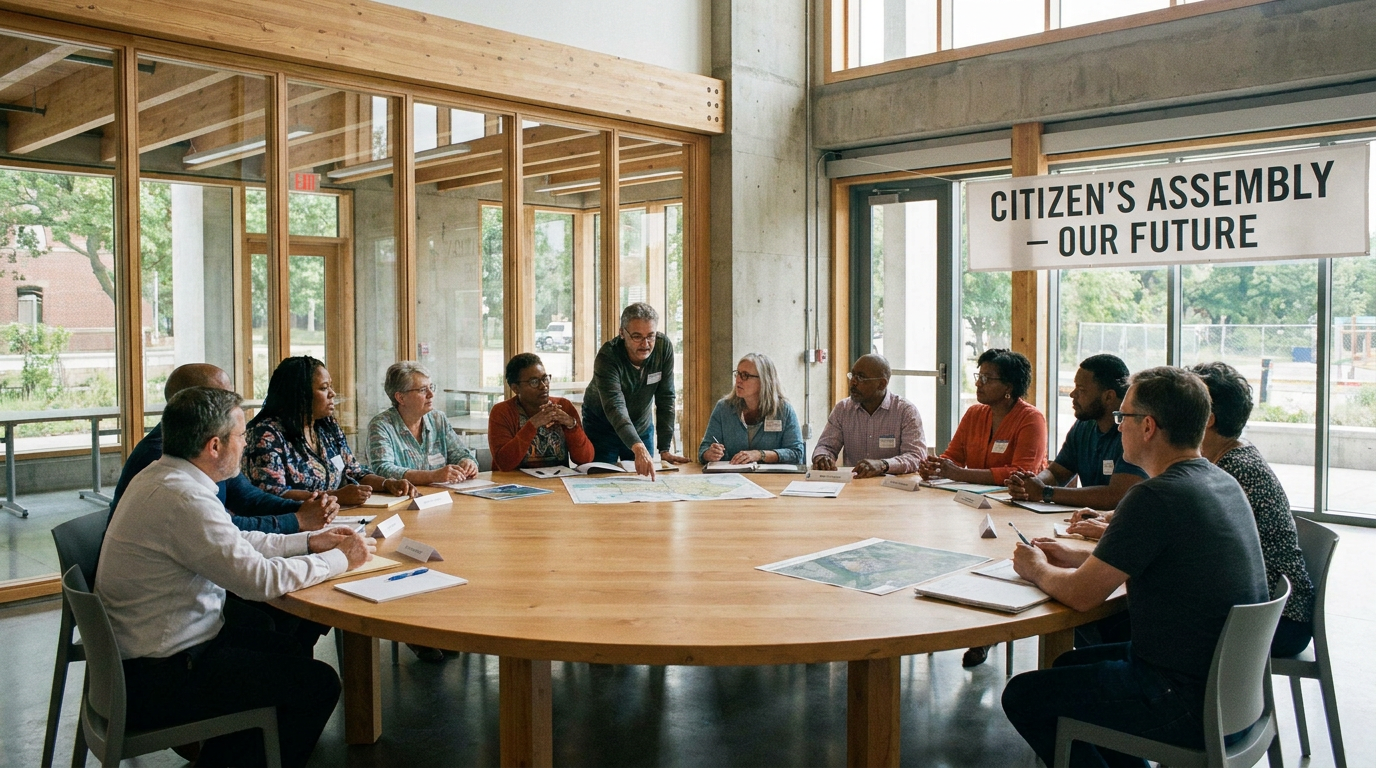
This concept is known as "sortition," a democratic mechanism that dates back to ancient Athens. Rather than electing representatives through competitive campaigns, Athenian democracy relied heavily on lotteries to select magistrates and legislative councils from the general citizenry. The underlying philosophy was that a randomly selected cross-section of the public, when given the time and resources to deliberate, would govern more fairly and effectively than a self-interested elite. Today, this ancient practice is experiencing a massive modern revival in the form of "citizens' assemblies"—structured forums where ordinary people are drafted, much like a jury, to tackle specific, highly contentious policy issues.[1][5]
The resurgence of sortition is not merely theoretical; it is a documented global phenomenon. The Organisation for Economic Co-operation and Development (OECD) has identified what it calls a "deliberative wave" sweeping across democratic nations. Since 2010, the OECD has tracked hundreds of representative deliberative practices—including citizens' assemblies, juries, and panels—commissioned by public authorities at the local, regional, and national levels. These assemblies are being deployed to navigate multifaceted public issues that traditional legislatures have found too politically toxic to touch, ranging from infrastructure investment decisions to the ethical boundaries of reproductive rights.[2]

The mechanics of a modern citizens' assembly begin with a process called a "democratic lottery." Organizers send out thousands of invitations to randomly selected households within a jurisdiction. From the pool of respondents who agree to participate, a second lottery is conducted using demographic stratification. This ensures that the final assembly—typically consisting of anywhere from 36 to 150 people—is a highly accurate microcosm of the broader society. The stratification process actively balances the room by age, gender, geographic location, educational attainment, and socio-economic status, intentionally bringing in marginalized voices that are routinely excluded from traditional political engagement.[3][5]
Once convened, the assembly does not immediately begin debating; it begins by learning. Participants are usually paid for their time and provided with accommodations, childcare, and travel expenses to remove barriers to entry. Over the course of several weekends or months, the assembly enters an intensive educational phase. They hear testimonies from a wide spectrum of subject-matter experts, stakeholders, and individuals with lived experience regarding the policy question at hand. Crucially, this process is guided by neutral, professional facilitators who ensure that the information presented is balanced and that every participant—not just the loudest or most confident—has an equal opportunity to speak and be heard.[1][5]

Proponents argue that this environment fundamentally alters the incentives of political decision-making. In an electoral system, politicians are structurally rewarded for fundraising, party loyalty, and highlighting divisions to mobilize their base. In a citizens' assembly, participants do not have to worry about reelection, campaign donors, or partisan whips. This freedom allows them to engage in genuine deliberation—weighing evidence, changing their minds when presented with new facts, and seeking consensus. Political theorists suggest that this "epistemic" advantage—the cognitive diversity of a room full of varied life experiences—often produces more robust and creative policy solutions than a homogenous chamber of career politicians.[6]
Proponents argue that this environment fundamentally alters the incentives of political decision-making.
The most famous and consequential modern application of sortition occurred in Ireland, a country that had been deadlocked for decades over the Eighth Amendment, which effectively banned abortion. Recognizing that the issue was too politically explosive for the standard legislative process, the Irish government convened a Citizens' Assembly in 2016. After five weekends of expert testimony, medical evidence, and deeply personal deliberation, the 99 randomly selected citizens produced a clear recommendation: the constitution should be amended to legalize the procedure. This consensus provided political cover for the government to call a national referendum in 2018, which voters ultimately approved by a staggering 66 percent margin, mirroring the assembly's findings.[1]
Following the Irish success, governments have increasingly deployed citizens' assemblies to tackle the defining crisis of our era: climate change. Because climate action requires unprecedented systemic changes and long-term planning that extends far beyond standard election cycles, it is uniquely suited to deliberative democracy. The UK commissioned the Climate Assembly UK (CAUK) to map out a path to net-zero emissions by 2050, while France convened the Convention Citoyenne pour le Climat. In both cases, the assemblies demonstrated that everyday citizens, when fully informed of the stakes and the trade-offs, are often willing to endorse far more ambitious and sweeping climate policies than their elected counterparts.[4]

However, the track record of these climate assemblies also highlights the primary vulnerability of the sortition model: the translation of recommendations into binding law. A comprehensive review by the World Resources Institute (WRI) found that while climate assemblies excel at generating equitable and ambitious policy roadmaps, they often generate frustration when their proposals are subsequently watered down or ignored by the sponsoring governments. The WRI concluded that citizens' assemblies contribute most effectively to actual climate action when they are designed with "teeth"—meaning the convening government commits in advance to either implement the recommendations directly or subject them to a binding public referendum.[4]
This tension has sparked a debate among democratic theorists about the future institutionalization of sortition. Currently, almost all citizens' assemblies operate as ad-hoc advisory bodies; they exist at the pleasure of elected officials who retain the ultimate authority to accept or reject their findings. Some political scientists argue that this subordinate status limits the true potential of deliberative democracy. They propose moving toward a "bicameral sortition democracy," where a traditional elected chamber sets the broad legislative agenda, but a permanent, randomly selected sortition chamber holds the exclusive authority to deliberate and pass binding legislation, effectively neutralizing elite capture.[6]
Skeptics of sortition often question whether "ordinary" people possess the technical expertise required to govern complex modern states. How can a retired software developer, a young retail worker, and a school teacher be expected to draft intricate tax policy or energy regulations? Advocates counter that elected politicians are rarely technical experts themselves; they rely on advisors, civil servants, and lobbyists. The citizens' assembly model simply democratizes access to that expertise. Much like a jury in a complex corporate fraud trial, citizens do not need to be subject-matter experts to weigh competing evidence, assess the credibility of witnesses, and apply their shared values to reach a sound judgment.[1][5]
Beyond policy formulation, citizens' assemblies are increasingly viewed as a vital tool for democratic resilience in regions facing rising authoritarianism. Research by DemocracyNext highlights a surge of deliberative processes in Central and Eastern Europe, where societies are grappling with disinformation, polarization, and a legacy of institutional distrust. By bringing together citizens from across deep political and cultural divides to work on shared local problems—such as urban planning or environmental protection—these assemblies are actively rebuilding social cohesion. Participants frequently report that the experience of respectful, face-to-face deliberation significantly reduces their animosity toward those with opposing political views.[3]

Despite these profound benefits, the rapid proliferation of sortition carries the risk of "assembly-washing." If governments routinely use citizens' assemblies merely as public relations exercises—convening them to create the illusion of public consultation while ignoring any recommendations that challenge the status quo—they risk deepening the very civic cynicism these processes are meant to cure. Ensuring the integrity of the deliberative wave requires robust standards, transparent methodologies, and, most importantly, a genuine willingness from those in power to share their authority with the public.[4][7]
Ultimately, the rise of citizens' assemblies represents a profound shift in how we conceptualize civic duty. It challenges the prevailing assumption that democracy is merely a competitive, spectator sport where citizens vote every few years and then retreat to their partisan corners. Instead, sortition offers a vision of deliberative democracy that is active, collaborative, and deeply demanding of its participants. By trusting everyday people with the complexity of governance, citizens' assemblies are proving that the antidote to a broken political system might simply be the people themselves.[7]
How we got here
508 BC
Cleisthenes introduces reforms in ancient Athens, establishing sortition as the primary method for selecting magistrates and citizen councils.
2004
The Canadian province of British Columbia convenes one of the first modern Citizens' Assemblies to deliberate on electoral reform.
2016
Ireland convenes a Citizens' Assembly to address the highly contentious Eighth Amendment regarding reproductive rights.
2018
Irish voters approve a national referendum to legalize abortion by 66%, directly mirroring the consensus reached by the Citizens' Assembly.
2020
The OECD publishes its landmark report identifying a global 'deliberative wave,' tracking over 700 representative deliberative processes worldwide.
2025
A permanent Global Citizens' Assembly for People and Planet is established to inform the UN COP30 climate negotiations.
Viewpoints in depth
Deliberative Democracy Advocates
Argue that sortition bypasses partisan gridlock and special interests, producing policies that reflect the true informed will of the public.
This camp, which includes organizations like the Sortition Foundation and DemocracyNext, views elections as inherently flawed mechanisms for solving long-term crises. They argue that electoral politics structurally rewards short-term thinking, fundraising, and polarization. By contrast, they point to the cognitive diversity and lack of reelection incentives in citizens' assemblies as the key to unlocking genuine consensus. For these advocates, sortition is not just a supplementary tool, but a superior epistemic process that should eventually replace or co-equal elected chambers in deciding complex, existential policies like climate change.
Institutional Reformers
Support assemblies but caution that they must be formally integrated into the legislative process with binding authority to avoid being ignored.
Researchers and policy analysts in this camp emphasize the structural vulnerabilities of the current 'deliberative wave.' While they celebrate the ability of citizens' assemblies to generate high-quality, equitable policy recommendations, they warn against the growing trend of 'assembly-washing'—where governments convene assemblies for public relations purposes but quietly shelve their findings. This perspective argues that for sortition to be truly effective, assemblies must be given 'teeth.' This means establishing legal frameworks where assembly recommendations automatically trigger parliamentary votes or binding public referendums, ensuring that the time and effort of the citizens translate into tangible legislative action.
Electoral Traditionalists
Maintain that while assemblies are useful advisory tools, final decision-making power must remain with elected representatives who can be held accountable.
This viewpoint, often held by incumbent politicians and traditional democratic theorists, acknowledges the value of citizens' assemblies as advanced focus groups or advisory panels. However, they strongly resist the idea of granting sortition bodies binding legislative power. Their primary argument centers on accountability: if a randomly selected citizen drafts a disastrous policy, they simply return to their private life without facing the voters. Elected representatives, despite their flaws, can be voted out of office. Therefore, traditionalists argue that while deliberation is valuable for informing policy, the ultimate authority—and the burden of accountability—must remain with those who have earned a democratic mandate at the ballot box.
What we don't know
- Whether governments will eventually cede binding legislative power to citizens' assemblies, or keep them strictly advisory.
- How the sortition model scales to address immediate, fast-moving crises that don't allow for months of deliberation.
- The long-term impact of AI and digital facilitation tools on the cost and speed of running large-scale democratic lotteries.
Key terms
- Sortition
- The practice of selecting political decision-makers or assembly members by random lottery rather than by election.
- Democratic Lottery
- The initial phase of sortition where invitations are sent to randomly selected households to recruit potential assembly participants.
- Stratified Sampling
- A statistical method used to ensure that the randomly selected assembly members accurately reflect the demographic makeup of the broader population.
- Deliberative Democracy
- A model of democracy where informed, respectful discussion and consensus-building are central to legitimate decision-making.
- Mini-public
- A group of citizens selected by sortition to represent a microcosm of the wider society for the purpose of deliberation.
Frequently asked
Do participants get paid for their time?
Yes, in almost all modern citizens' assemblies, participants receive a stipend for their time, and their travel, accommodation, and childcare expenses are covered to ensure everyone can participate.
Can anyone volunteer to join an assembly?
No. To ensure the group remains a statistically accurate microcosm of society and isn't dominated by activists, participants can only join if they are randomly selected through the democratic lottery.
Do citizens' assemblies actually change laws?
It depends on the government's mandate. Some, like the Irish assembly on reproductive rights, directly led to constitutional changes, while others serve only as advisory bodies whose recommendations can be ignored by politicians.
How do ordinary people understand complex policy?
Assemblies include an intensive 'learning phase' where participants hear from a balanced roster of subject-matter experts, stakeholders, and advocates, allowing them to ask questions and build technical understanding before deliberating.
Sources
Source coverage
7 outlets
3 viewpoints surfaced






[1]The GuardianElectoral Traditionalists
Citizens' assemblies: are they the future of democracy?
Read on The Guardian →[2]OECDDeliberative Democracy Advocates
Innovative Citizen Participation and New Democratic Institutions: Catching the Deliberative Wave
Read on OECD →[3]DemocracyNextDeliberative Democracy Advocates
Citizens' assemblies in Central and Eastern Europe
Read on DemocracyNext →[4]World Resources InstituteInstitutional Reformers
Citizens' Assemblies and the Climate Emergency: Lessons for Design to Enhance Climate Action
Read on World Resources Institute →[5]Sortition FoundationDeliberative Democracy Advocates
What is sortition?
Read on Sortition Foundation →[6]Taylor & FrancisInstitutional Reformers
A new model of bicameral sortition democracy
Read on Taylor & Francis →[7]Factlen Editorial Team
Synthesis by Factlen editorial team
Read on Factlen Editorial Team →
Every angle. Every day.
Get opinion stories with full source coverage and perspective breakdowns delivered to your inbox.