
Smart Ring vs. Smartwatch: The 2026 Trade-Off Analysis
As the wearable market expands in 2026, consumers face a definitive choice between the active, real-time coaching of a smartwatch and the passive, continuous health monitoring of a smart ring. While watches dominate workout tracking, rings have claimed the crown for sleep and recovery data.
By Factlen Editorial Team
- Passive Health Advocates
- Prioritize invisible technology, sleep optimization, and recovery metrics without the distraction of screens or notifications.
- Active Fitness Enthusiasts
- Value real-time pacing, GPS tracking, and actionable mid-workout data to actively manage their training sessions.
- Medical and Safety Monitors
- Focus on FDA-cleared diagnostics, irregular heart rhythm alerts, and emergency features that provide an active safety net.
What's not represented
- · Traditional watchmakers losing wrist real estate
- · Data privacy advocates concerned with continuous biometric tracking
Why this matters
Choosing the right wearable dictates whether you actually use the data it collects. Understanding the fundamental trade-offs between active and passive tracking ensures you invest in a device that seamlessly fits your daily habits, rather than one that ends up abandoned in a drawer.
Key points
- The wearable market has split into two distinct philosophies: active smartwatches and passive smart rings.
- Smart rings excel at sleep and recovery tracking, boasting a 98 percent overnight wear compliance rate due to their lightweight comfort.
- Smartwatches remain essential for active fitness, offering real-time pacing, built-in GPS, and automatic workout detection.
- A growing trend in 2026 sees users adopting a hybrid approach, wearing a watch during the day for workouts and a ring at night for sleep data.
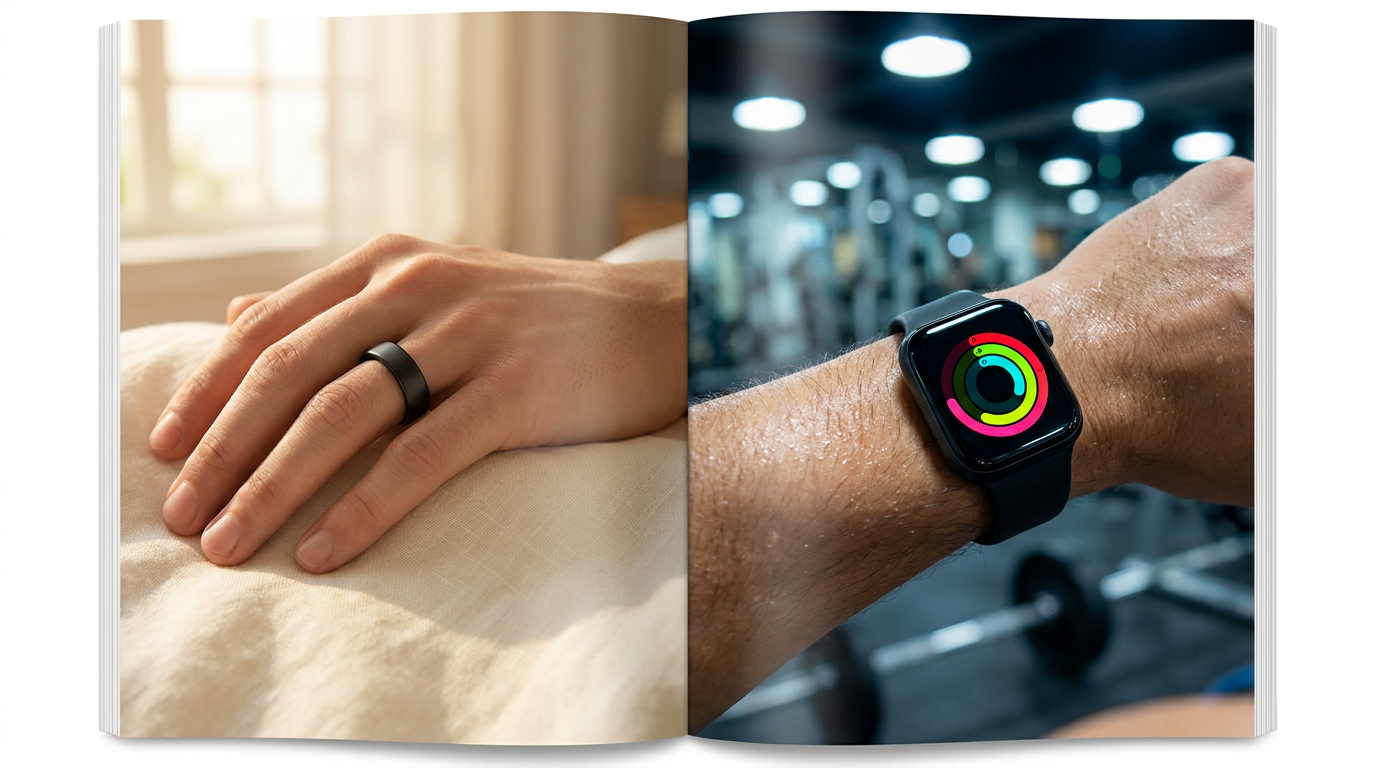
The wearable technology market in 2026 has fractured into two distinct philosophies: the active digital companion and the passive health observer. As the global wearable market surges past $109 billion, consumers are no longer just choosing between brands; they are choosing between form factors. The smartwatch, led by devices like the Apple Watch Series 11, dominates the wrist with vibrant screens and real-time feedback. Conversely, the smart ring, championed by the Oura Ring 4 and Samsung Galaxy Ring, has become the fastest-growing segment in the industry by stripping away the screen entirely.[5][6]
At the core of this comparison is how and where the devices collect biometric data. Both form factors utilize photoplethysmography (PPG) sensors—green and red LEDs that detect blood volume changes through the skin. However, the finger offers a distinct physiological advantage for passive monitoring. The arteries in the finger are closer to the surface and surrounded by thinner soft tissue compared to the wrist. Furthermore, the finger experiences significantly less ambient motion during rest, allowing a smart ring to capture a cleaner, more stable signal for baseline metrics like resting heart rate and skin temperature.[4][6]
The primary argument for the smart ring centers on sleep optimization and recovery tracking. Weighing just four to eight grams, a ring is virtually imperceptible, eliminating the physical friction of wearing a bulky device to bed. Industry data reveals a stark contrast in user behavior: 98 percent of smart ring owners wear their devices consistently overnight, compared to just 67 percent of smartwatch users. Because consistent wear is the foundation of accurate baseline data, the ring form factor inherently prevents the data gaps that plague wrist-worn wearables when they are left on the nightstand to charge.[4][6]

The evidence supporting the ring's superiority in sleep tracking is robust. A 2024 validation study published in the journal Sensors compared leading wearables against polysomnography, the clinical gold standard for sleep measurement. The study found that ring-based sensors achieved 79 percent accuracy in four-stage sleep classification, outperforming wrist-worn counterparts. By measuring continuous overnight skin temperature and heart rate variability (HRV) from a stable location, rings provide highly accurate readiness scores that help users gauge their daily recovery without ever looking at a screen.[3][5]
However, the argument against the smart ring is its complete lack of real-time utility. Because rings are screenless and lack built-in GPS, they are fundamentally passive devices. If a user goes for a run, the ring cannot display their current pace, alert them when they shift into a new heart rate zone, or track their route on a map without a tethered smartphone. Furthermore, panel testing indicates that rings often take several minutes to automatically register that a workout has begun, making them poorly suited for interval training or complex gym routines where immediate feedback is necessary.[1][3]
However, the argument against the smart ring is its complete lack of real-time utility.
This is where the case for the smartwatch becomes undeniable: it is an active fitness coach and a real-time navigator. Devices like the Apple Watch Series 11 and Garmin's premium lineup are engineered for action. They feature bright OLED displays that provide instant visual feedback, allowing athletes to adjust their effort mid-stride. Smartwatches also excel at automatic workout detection, seamlessly identifying whether a user is swimming laps, cycling, or walking, and logging the exact duration and intensity without requiring manual input.[1][2]
The evidence supporting the smartwatch extends beyond fitness into life-saving medical utility. While rings excel at passive wellness, premium smartwatches are increasingly functioning as FDA-cleared medical devices. The Apple Watch, for instance, includes a dedicated electrocardiogram (ECG) capable of detecting atrial fibrillation, alongside fall detection and emergency SOS features. For users with known cardiac conditions or those who prioritize active safety nets, the smartwatch offers a level of intervention that a passive ring simply cannot match.[5]
The primary argument against the smartwatch remains its battery life and the resulting data fragmentation. While smart rings routinely deliver four to seven days of continuous use on a single charge, feature-rich smartwatches typically require daily charging. An Apple Watch, for example, offers roughly 18 hours of battery life. This creates a logistical challenge: users must find time to charge the device, often choosing to do so overnight, which sacrifices the very sleep data that is crucial for calculating holistic health and recovery metrics.[1][4]

Financial considerations also reveal distinct trade-offs between the two form factors. While the upfront hardware costs are comparable—smartwatches range from $200 to $800, and premium rings sit between $250 and $400—the long-term costs diverge. The Oura Ring requires a $70 annual subscription to unlock its core sleep and health insights, a model that frustrates some consumers. Conversely, most smartwatches, alongside newer ring competitors like the Samsung Galaxy Ring and RingConn, offer their full suite of health analytics without ongoing monthly fees, making them more predictable long-term investments.[2][4]
Rather than choosing a definitive winner, the 2026 wearable market has seen a surge in users adopting a hybrid approach. Many fitness enthusiasts now wear both devices to cover each other's blind spots. In this dual-device ecosystem, the smartwatch is worn during the day to manage notifications, track outdoor runs via GPS, and monitor active calories. When evening arrives, the watch goes on the charger, and the smart ring takes over, providing unobtrusive, highly accurate sleep and recovery tracking through the night.[2][3]
Ultimately, the smartwatch fits well when the user requires real-time pacing, built-in GPS for phone-free workouts, and the security of medical-grade cardiac alerts. It is the ideal choice for runners, cyclists, and those who want their wearable to act as an extension of their smartphone. It does not fit well when the user suffers from screen fatigue, finds wristwear uncomfortable while typing or sleeping, or prefers the aesthetic of traditional mechanical watches.[3][6][7]

Conversely, the smart ring fits well when the user prioritizes sleep optimization, continuous passive data collection, and a discreet form factor that blends into everyday jewelry. It is perfect for individuals who want to understand their body's recovery trends without being bombarded by notifications or step-count guilt. It does not fit well when the user needs actionable mid-workout data, relies on wrist-based payments, or expects their wearable to actively coach them through a training session.[3][6][7]
How we got here
2015
The first Apple Watch launches, establishing the wrist as the primary location for consumer health and fitness tracking.
2018
The Oura Ring 2 is released, proving that miniaturized sensors can accurately track sleep from the finger.
2024
Clinical studies validate that smart rings can match or exceed wrist-worn devices in overnight sleep staging accuracy.
2026
Major tech companies like Samsung enter the ring market, solidifying the dual-device trend where users wear both a watch and a ring.
Viewpoints in depth
Passive Health Advocates
Prioritizing invisible technology and recovery over active coaching.
This camp argues that the best health technology is the kind you forget you are wearing. They point to the high compliance rates of smart rings as proof that comfort drives consistent data collection. For these users, the goal is not to gamify every step or receive constant wrist notifications, but to wake up, check a single readiness score on their phone, and adjust their day based on clinical-grade sleep and HRV data.
Active Fitness Enthusiasts
Demanding real-time data and active coaching to improve performance.
Athletes and active users argue that passive data is insufficient for improving performance. They rely on the smartwatch's ability to display heart rate zones mid-run, track exact GPS routes without a phone, and automatically log complex interval workouts. To this camp, a wearable must be an active participant in the training process, providing the immediate feedback necessary to push harder or pull back during a session.
Medical and Safety Monitors
Focusing on FDA-cleared diagnostics and emergency intervention capabilities.
This perspective views wearables primarily as life-safety devices. They emphasize the importance of the smartwatch's active sensors, such as FDA-cleared ECGs that can detect atrial fibrillation, and accelerometers calibrated for fall detection. For these users, the value of a wearable lies in its ability to actively alert the user—or emergency services—to a critical health event, a function that screenless rings currently cannot perform.
What we don't know
- Whether upcoming software updates will allow smart rings and smartwatches from different manufacturers to seamlessly merge their data into a single, unified recovery score.
- How quickly miniaturization technology will advance to allow smart rings to incorporate haptic feedback for mid-workout pacing without sacrificing battery life.
Key terms
- Photoplethysmography (PPG)
- The optical technology used by wearables to detect blood volume changes through the skin using green and red LEDs.
- Heart Rate Variability (HRV)
- The variation in time between consecutive heartbeats, used as a key metric to assess physical recovery and nervous system stress.
- Polysomnography
- The clinical gold standard for sleep measurement, typically conducted in a lab, used to validate the accuracy of consumer wearables.
- Atrial Fibrillation (AFib)
- An irregular and often very rapid heart rhythm that premium smartwatches can detect using built-in electrocardiogram (ECG) sensors.
Frequently asked
Can a smart ring completely replace a smartwatch?
No. While rings excel at passive sleep and recovery tracking, they lack screens and GPS, making them unsuitable for real-time workout pacing or phone-free navigation.
Do all smart rings require a monthly subscription?
No. While the popular Oura Ring requires a $5.99 monthly fee for full data access, competitors like the Samsung Galaxy Ring and RingConn offer their full health analytics without ongoing subscriptions.
Which device is more accurate for heart rate monitoring?
Rings are highly accurate for resting heart rate due to stable finger blood flow, but smartwatches perform better at tracking rapid heart rate changes during active, high-motion workouts.
Sources
Source coverage
7 outlets
3 viewpoints surfaced







[1]ForbesActive Fitness Enthusiasts
Oura Ring Vs. Apple Watch: Fitness Tracking
Read on Forbes →[2]EsquireActive Fitness Enthusiasts
Oura Ring 4 vs. Apple Watch: Which Is Better?
Read on Esquire →[3]AskVoraPassive Health Advocates
Smart Ring vs Smartwatch: The Honest 2026 Comparison
Read on AskVora →[4]JointCorpMedical and Safety Monitors
Smart Ring vs Fitness Tracker vs Smartwatch: Ultimate Comparison 2026
Read on JointCorp →[5]Span Global ServicesMedical and Safety Monitors
Oura Ring vs Apple Watch: The Market Split
Read on Span Global Services →[6]Smart Ring HQPassive Health Advocates
Smart Ring vs Smartwatch: The Honest 2026 Comparison
Read on Smart Ring HQ →[7]Factlen Editorial TeamMedical and Safety Monitors
Synthesis by Factlen editorial team
Read on Factlen Editorial Team →

Every angle. Every day.
Get shopping stories with full source coverage and perspective breakdowns delivered to your inbox.