
OLED vs. Mini-LED: Which Premium Display Technology Wins in 2026?
As flagship televisions cross the 10,000-nit brightness threshold, the choice between OLED and Mini-LED now depends entirely on room lighting, screen size, and static usage habits.
By Factlen Editorial Team
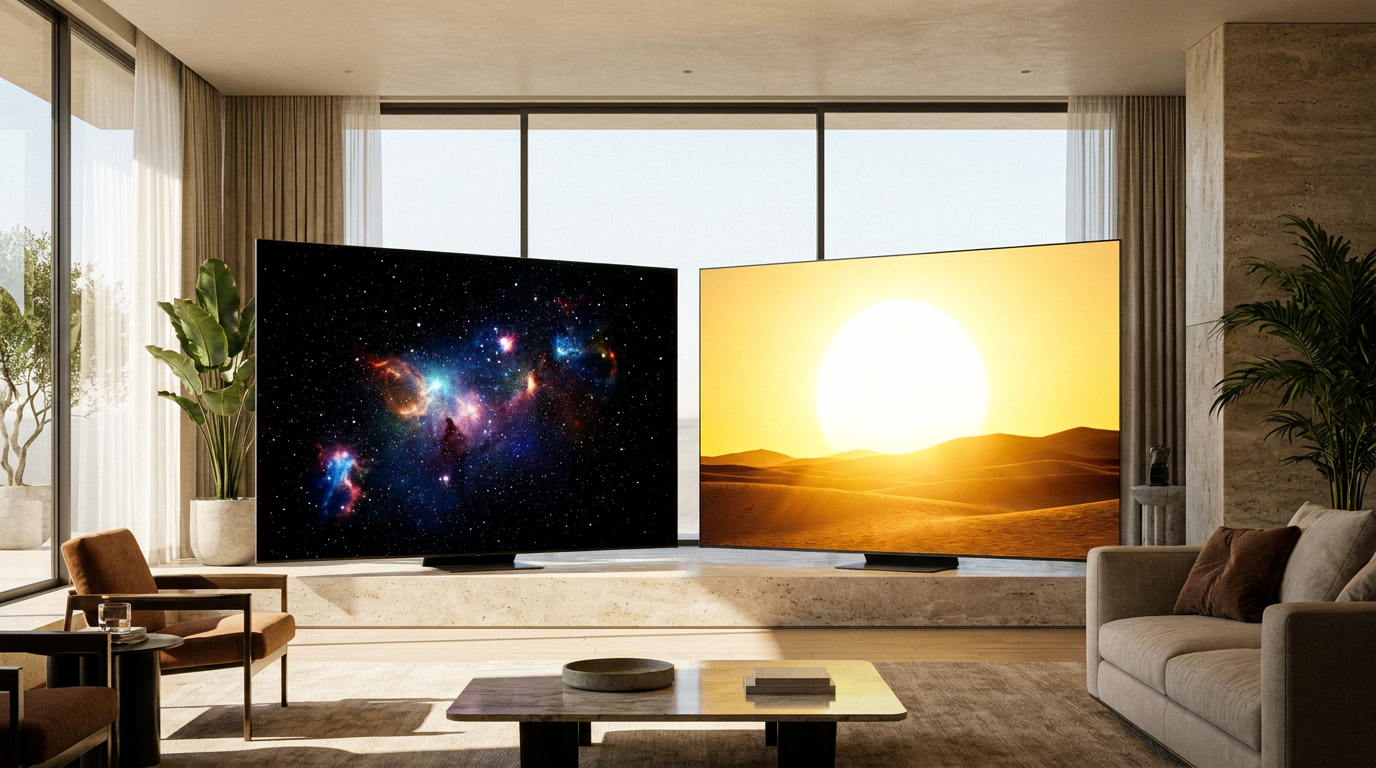
- Bright-Room Maximizers
- Argue that sheer brightness and zero burn-in risk make Mini-LED the most practical choice for real-world living rooms.
- Cinematic Purists
- Value absolute black levels, infinite contrast, and pixel-level precision above all else for dedicated home theaters.
- Productivity & PC Gamers
- Focus on long-term panel longevity, static UI wear, and response times for heavy desktop usage.
- Value & Size Optimizers
- Emphasize that the falling cost of massive 85-inch Mini-LED panels provides better overall immersion than smaller OLEDs.
What's not represented
- · Budget LCD Buyers
- · Micro-LED Early Adopters
- · Professional Colorists
Why this matters
Choosing the wrong display technology can result in thousands of dollars spent on a screen that either washes out in your sunlit living room or suffers permanent image retention from your daily workflow. Understanding the engineering trade-offs ensures your investment matches your actual viewing environment.
Key points
- The 2026 display market is defined by the engineering trade-offs between organic OLEDs and inorganic Mini-LEDs.
- OLED delivers perfect black levels and infinite contrast but risks cumulative wear from static images.
- Mini-LED offers massive peak brightness and zero burn-in risk, making it ideal for sunlit rooms.
- Flagship Mini-LEDs now feature over 20,000 dimming zones, drastically reducing blooming artifacts.
- OLED remains the superior choice for dark home theaters and competitive esports due to its 0.03ms response time.
- Falling manufacturing costs mean buyers can often purchase an 85-inch Mini-LED for the price of a 65-inch OLED.
Choosing a premium television or monitor in 2026 often begins with a misleading showroom demonstration, where perfectly calibrated jellyfish float across pitch-black screens. While these curated loops are designed to sell displays, the actual engineering reality of modern living rooms demands a more rigorous evaluation. The market has consolidated into a two-horse race between organic carbon-based OLEDs and inorganic Gallium Nitride Mini-LEDs. Both technologies have evolved dramatically, solving their historical weaknesses while introducing new capabilities. Making the right choice no longer depends on a simple budget calculation, but rather on a careful side-by-side trade-off analysis of room lighting, viewing habits, and long-term durability expectations.[1][2]
At the core of this comparison is a fundamental difference in display chemistry and architecture. OLED, or Organic Light-Emitting Diode, relies on carbon-based compounds that emit their own light when electrified, allowing each individual pixel to operate independently. Mini-LED, conversely, utilizes a traditional liquid crystal display illuminated by thousands of microscopic, inorganic diodes grouped into dimming zones. This structural divergence dictates how each panel handles heat, sustained brightness, and static images over thousands of hours of use. Understanding these physical constraints is essential for buyers who want to look past the marketing terminology and invest in the engineering that actually matches their daily environment.[3][5]
In the case for OLED, the primary advantage remains its infinite contrast ratio and absolute pixel-level precision. Because every single pixel generates its own illumination, the television can turn off specific microscopic areas completely, resulting in true, absolute black levels that no backlight system can replicate. This capability eliminates the hazy glow around bright objects on dark backgrounds, delivering a level of depth and three-dimensionality that cinematic purists consider the gold standard for home theaters. Furthermore, the self-emissive nature of the technology ensures that colors remain perfectly saturated and accurate even when viewed from extreme off-center angles.[3][5]

The evidence supporting OLED’s continued dominance in picture quality comes from the 2026 rollout of Micro Lens Array (MLA) 3.0 and fourth-generation QD-OLED panels. Independent testing confirms that these advanced displays can now push peak HDR highlights to 3,000 nits, effectively neutralizing the long-standing complaint that OLEDs are too dim for daytime viewing. Additionally, manufacturers have integrated deuterium-stabilized pixels and sophisticated thermal management systems that significantly slow the rate of organic material wear. For competitive gamers, the technology delivers a near-instantaneous 0.03-millisecond response time, providing motion clarity and input responsiveness that remains mathematically superior to any liquid crystal alternative.[2][4][6]
However, the arguments against OLED center entirely on the unavoidable limitations of its organic chemistry. To protect the sensitive panel from overheating and accelerated degradation, these televisions employ aggressive Auto Brightness Limiters. When displaying a sustained bright scene—such as a sunlit hockey rink or a full-screen web browser—the television will noticeably dim the entire image to preserve the pixels. Furthermore, 10,000-hour stress tests reveal that while modern software mitigations are excellent, displaying static interfaces like gaming heads-up displays or spreadsheet taskbars still carries a cumulative risk of differential wear, commonly known as burn-in, over the lifespan of the device.[4][7]
Conversely, the case for Mini-LED is built on brute-force brightness, inorganic durability, and absolute peace of mind. By utilizing thousands of microscopic Gallium Nitride diodes rather than organic compounds, these displays can sustain massive electrical current and light output without the chemical degradation inherent to OLED panels. This allows the television to hold a full-field white screen at maximum brightness indefinitely, completely bypassing the need for aggressive dimming algorithms. For users who leave their screens on for background viewing or utilize them as primary productivity monitors, the inorganic structure removes the anxiety associated with static logos and persistent user interfaces.[1][5]
Conversely, the case for Mini-LED is built on brute-force brightness, inorganic durability, and absolute peace of mind.
The evidence for Mini-LED is striking in the 2026 market, with flagship models routinely hitting 5,000 to 10,000 nits of peak brightness. This sheer output allows specular highlights—like on-screen explosions or sunlight reflecting off water—to punch through intense ambient glare in sun-drenched living rooms. Furthermore, the historical weakness of Mini-LED has been largely solved; premium 2026 models now utilize over 20,000 independent local dimming zones. When combined with advanced artificial intelligence processing, this massive array of zones virtually eliminates visible blooming, achieving a perceived contrast ratio that rivals OLED in all but the most demanding pitch-black environments.[2][5][6]

The arguments against Mini-LED primarily involve viewing angles, absolute precision, and physical bulk. Because the technology still relies on a liquid crystal layer to filter the backlight, colors and contrast will inevitably wash out when viewers sit at wider angles. Additionally, while a 1-millisecond response time is excellent for casual gaming, it cannot match the perfect motion clarity of an organic pixel for top-tier esports. Finally, the massive heat generated by pushing 10,000 nits requires substantial internal heat sinks and ventilation, resulting in a thicker, heavier chassis that lacks the razor-thin aesthetic appeal of a premium OLED installation.[3][5]
Beyond the technical specifications, the price-to-size ratio has become a defining factor in this comparison. As Mini-LED manufacturing has scaled, the technology has made massive screen sizes significantly more accessible. In 2026, buyers can frequently purchase an 85-inch Mini-LED television for the exact same price as a 65-inch flagship OLED. Because sheer screen size provides a dramatic boost to immersion and perceived picture quality at typical viewing distances, many home theater enthusiasts argue that the massive physical footprint of an 85-inch display easily outweighs the microscopic contrast advantages of a smaller organic panel.[2][6]
When synthesizing these trade-offs into practical buying advice, OLED fits well when the display is placed in a light-controlled environment or a dedicated dark room where its perfect black levels can be fully appreciated. It is the optimal choice when seating arrangements are spread out in a wide horseshoe shape, requiring perfect off-axis viewing angles. Furthermore, it fits well for users whose primary content consists of cinematic movies, prestige television, or varied gaming sessions where static on-screen elements are frequently rotated, allowing the organic pixels to wear evenly over time.[1][3][5]

Conversely, OLED does not fit well when the room features massive, unshaded windows that cast direct sunlight onto the screen, as the panel will struggle to overcome the glare and will aggressively dim to protect itself. It is also a poor fit when the user plays a single video game with a bright, static interface for thousands of hours, or when the screen serves as a daily productivity monitor displaying light-mode applications, spreadsheets, and fixed taskbars that accelerate localized pixel degradation.[4][5][7]
On the other side of the ledger, Mini-LED fits well when fighting intense daytime glare in a bright, open-concept living room, as its massive peak brightness easily cuts through ambient light. It is the superior choice when the user requires absolute peace of mind against burn-in, making it ideal for background news channels, static PC monitors, and marathon sessions of a single video game. Additionally, it fits well when maximizing screen size on a fixed budget is the top priority, allowing buyers to secure an immersive 85-inch panel without paying an exorbitant premium.[1][2][4]
Finally, Mini-LED does not fit well when the buyer demands perfect, pixel-level shadow detail in a pitch-black home theater, where even the most advanced 20,000-zone dimming systems will occasionally reveal slight halos around bright objects. It also falls short when viewers are forced to sit at extreme angles where the backlight structure becomes visible and colors degrade. Ultimately, the 2026 display market offers no single winner without conditions; the correct choice depends entirely on matching the specific engineering strengths of the panel to the exact lighting and usage realities of the room it will live in.[3][5][6]
How we got here
2013
The first large-format OLED televisions enter the consumer market, establishing a new benchmark for perfect black levels.
2019
Mini-LED technology is introduced as a premium alternative, utilizing thousands of tiny backlights to improve LCD contrast.
2023
OLED manufacturers introduce Micro Lens Array (MLA) technology, breaking the 2,000-nit brightness barrier for the first time.
2026
Flagship Mini-LEDs cross the 10,000-nit threshold with over 20,000 dimming zones, closing the perceived contrast gap with OLED.
Viewpoints in depth
Cinematic Purists
Home theater enthusiasts who prioritize absolute contrast and perfect black levels over peak brightness.
For this camp, the television is a dedicated instrument for watching movies in a light-controlled environment. They argue that the infinite contrast ratio of OLED—where a completely black pixel sits directly next to a bright highlight without any blooming—creates a three-dimensional depth that no backlight system can replicate. They view the lower peak brightness as a non-issue in dark rooms and consider the 0.03ms response time essential for pristine motion clarity.
Bright-Room Maximizers
Viewers in sunlit homes who require massive light output to cut through daytime glare.
This perspective treats the television as an appliance that must perform flawlessly in challenging, real-world lighting. They point out that perfect black levels are invisible in a room with open windows, making Mini-LED's 5,000+ nit peak brightness the far more valuable metric. Furthermore, they champion the inorganic nature of the panel, arguing that buyers should not have to worry about babysitting their screens to prevent burn-in from news tickers or sports scores.
Productivity & PC Gamers
Heavy desktop users who evaluate displays based on static interface longevity and text clarity.
For users who plug their displays into PCs, the evaluation metrics shift entirely toward durability. This camp relies on 10,000-hour stress tests showing that static taskbars and bright-mode applications still pose a cumulative wear risk to organic panels. They heavily favor Mini-LED for its unyielding brightness stability over years of 8-hour workdays, viewing it as the only responsible choice for spreadsheet analysts and software developers.
What we don't know
- Whether future iterations of Micro-LED will eventually become affordable enough to replace both OLED and Mini-LED.
- Exactly how long the new deuterium-stabilized OLED panels will last under extreme, multi-year static productivity workloads.
Key terms
- Auto Brightness Limiter (ABL)
- A protective software feature in OLED TVs that automatically dims the screen during sustained bright scenes to prevent overheating and pixel damage.
- Blooming
- A visual artifact where light bleeds into dark areas of the screen, creating a hazy halo around bright objects on backlit televisions.
- Local Dimming Zones
- Specific sections of a Mini-LED backlight that can independently dim or turn off to improve black levels and contrast.
- Micro Lens Array (MLA)
- A microscopic layer of lenses applied to modern OLED panels that focuses emitted light toward the viewer, significantly increasing peak brightness.
- Nits
- A standard unit of measurement for display brightness, equivalent to the light of one candle per square meter.
Frequently asked
Do OLED TVs still suffer from burn-in in 2026?
While risk is vastly reduced thanks to deuterium stabilization and software mitigations, cumulative wear can still occur if static elements like game HUDs are displayed for thousands of hours.
Is Mini-LED the same as Micro-LED?
No. Mini-LED uses tiny inorganic backlights behind a traditional LCD panel, whereas Micro-LED is a self-emissive technology where each pixel is its own microscopic light source.
Which technology is better for a bright living room?
Mini-LED is significantly better for bright rooms, as its massive peak brightness can cut through intense ambient glare without triggering the dimming algorithms that protect OLED panels.
Why do gamers prefer OLED if it has burn-in risk?
Competitive gamers often prefer OLED for its near-instantaneous 0.03-millisecond response time, which virtually eliminates motion blur and ghosting during fast-paced action.
Sources
Source coverage
7 outlets
4 viewpoints surfaced






[1]PCWorldBright-Room Maximizers
It's time to look beyond OLED to Mini-LED
Read on PCWorld →[2]Data Wire SolutionsValue & Size Optimizers
Best TVs for 2026: 10 OLED and Mini-LED Picks by Room, Brightness, and Install Reality
Read on Data Wire Solutions →[3]EasyCompareCinematic Purists
Mini-LED vs OLED: Key Specs Compared
Read on EasyCompare →[4]KTC PlayProductivity & PC Gamers
Panel Longevity After 10,000 Hours: Mini-LED vs OLED
Read on KTC Play →[5]EcoPicksGoCinematic Purists
LG G5 OLED vs LG QNED9M Mini LED Comparison (2026 Buyer's Guide)
Read on EcoPicksGo →[6]SenseCastBright-Room Maximizers
OLED vs Mini-LED — The Shocking Winner You Didn't Expect (2026)
Read on SenseCast →[7]Consumer ReportsProductivity & PC Gamers
TV Reliability and Brightness Stability in 2026
Read on Consumer Reports →


Every angle. Every day.
Get shopping stories with full source coverage and perspective breakdowns delivered to your inbox.