
How Virtual Reality is Rewiring the Skilled Trades Apprenticeship
Facing a massive labor shortage, vocational programs are turning to virtual and augmented reality to train the next generation of electricians, welders, and HVAC technicians safely and efficiently.
By Factlen Editorial Team
- Vocational Educators
- Focus on how immersive tech removes the physical and financial bottlenecks of traditional apprenticeships.
- Industry Employers
- Emphasize the urgent need to accelerate the pipeline of job-ready technicians to meet infrastructure demands.
- Skills Researchers
- Highlight the cognitive benefits of VR while cautioning that physical feedback remains necessary for true mastery.
What's not represented
- · Veteran Tradespeople
- · Union Apprenticeship Directors
Why this matters
As the demand for skilled tradespeople skyrockets to build data centers and green infrastructure, traditional training bottlenecks are slowing down the workforce. Immersive technology is accelerating how quickly and safely apprentices can enter high-paying, essential careers.
Key points
- A severe shortage of skilled tradespeople is threatening the expansion of green energy and AI data centers.
- Vocational schools are adopting VR to safely teach foundational skills without the cost of wasted physical materials.
- Tech giants like Google and Meta are investing millions to accelerate trades training pipelines.
- VR significantly reduces performance anxiety and builds confidence for beginners.
- Augmented Reality (AR) is preferred for advanced training because it allows students to feel the physical weight of real tools.
The American infrastructure boom has collided with a demographic cliff. As a generation of veteran electricians, pipefitters, and welders retires, the demand for their replacements is skyrocketing, driven by the rapid expansion of green energy projects and massive artificial intelligence data centers. In the HVAC sector alone, industry groups estimate a nationwide shortage of 110,000 workers.[1]
Traditional vocational training, while effective, is inherently bottlenecked by physical constraints. Apprenticeships require expensive raw materials, dedicated workshop space, and intensive one-on-one supervision to prevent catastrophic injuries. A novice welder, for instance, burns through significant amounts of scrap metal, shielding gas, and wire—known as consumables—just to learn the basic angles and travel speeds.[6]
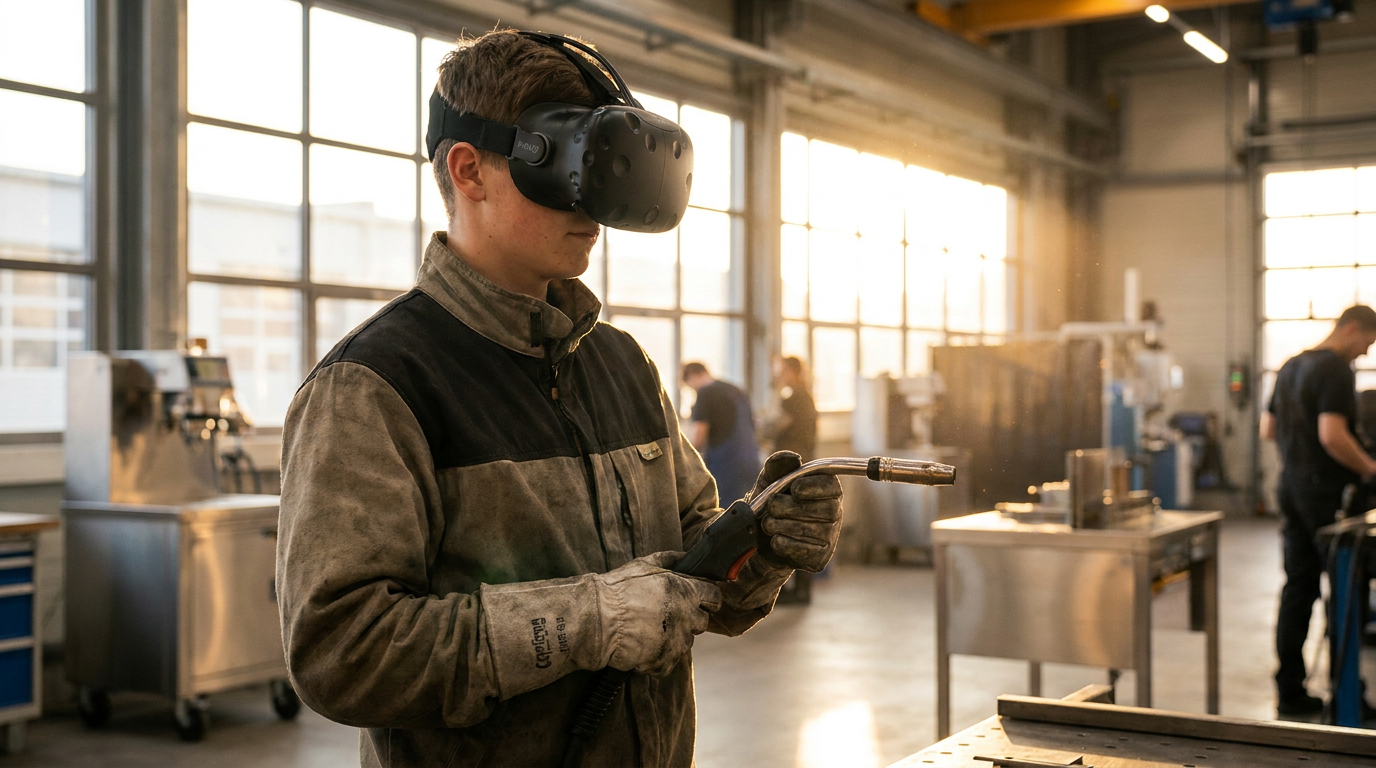
To break this bottleneck, trade schools and major employers are turning to an unexpected solution: virtual reality (VR) and augmented reality (AR). By strapping on headsets, apprentices are now learning to wire electrical panels, troubleshoot industrial air conditioners, and lay down weld beads in entirely digital environments.[1][6]
The shift is attracting massive capital from the very tech giants driving the infrastructure demand. In June 2026, Google committed $50 million to support labor unions and trade associations in modernizing their training programs with AI and digital tools. This followed a $115 million pledge from Meta aimed at guaranteeing jobs for graduates of its own workforce academy.[2]

"Building and maintaining the infrastructure for America's future requires a massive, coordinated workforce of skilled tradespeople," noted Maggie Johnson, Global Head of Google.org, highlighting that hundreds of thousands of roles remain unfilled. The tech industry has realized that AI cannot build its own data centers; it needs human hands, and those hands need faster training pipelines.[2]
The mechanism of VR training relies on immersive, risk-free repetition. In a typical VR HVAC module, a trainee visually enters a simulated customer basement. Looking down, they see digital hands mirroring their own movements via motion controllers. They must diagnose a failing furnace, select the correct digital multimeter, and test the components in the proper sequence.[1][6]
Crucially, the software provides immediate, consequence-free feedback. If an apprentice reaches for an electrified component without first throwing the digital breaker, the hand controller vibrates violently to simulate a shock, and the screen flashes red. The lesson is learned viscerally, but without the risk of a fatal electrocution or a blown physical circuit.[1]
This safe environment dramatically lowers the barrier to entry and reduces the psychological friction of learning a dangerous trade. A 2026 study published in MDPI tracked twenty participants with no prior welding experience who underwent a two-week VR training program. The researchers found that the virtual environment allowed learners to make mistakes without fear, significantly reducing their performance-related anxiety.[4]

Before the VR training, participants reported high anxiety and low self-confidence, scoring between 1.5 and 2.1 on standardized readiness scales. After two weeks of virtual repetition, confidence scores surged to between 3.9 and 4.6, and their theoretical knowledge of machine adjustment accuracy jumped from 28.7% to 92.3%.[4]
Before the VR training, participants reported high anxiety and low self-confidence, scoring between 1.5 and 2.1 on standardized readiness scales.
Beyond the psychological benefits, the economic advantages for training centers are profound. The Ontario government recently invested $300,000 into the Provincial Sheet Metal Workers Training Centre specifically to introduce VR. The technology allows the center to expose students to complex, large-scale sheet metal scenarios that would be prohibitively expensive to build in a physical lab, while simultaneously slashing the budget for wasted materials.[5]
For distributed companies, VR solves the tyranny of geography. When Southern Home Services, an HVAC and plumbing company with 27 locations, realized it had a severe training deficit, its training director was spending 240 nights a year in hotels traveling to instruct technicians. By adopting VR software, the company was able to standardize and distribute its curriculum instantly across all branches.[1]
However, researchers caution that fully virtual reality has distinct limitations, primarily regarding haptic feedback—the physical sensation of resistance and weight. A VR controller weighs only a few ounces and moves freely through the air. It cannot replicate the heavy drag of a physical welding torch, the intense heat radiating from a real arc, or the tactile snap of a physical pipe fitting slotting into place.[3][6]
This is where Augmented Reality (AR) is emerging as a superior tool for advanced skill transfer. Unlike VR, which replaces the real world entirely, AR overlays digital guides onto physical objects. An AR welding helmet allows the student to hold a real, weighted torch and drag it across a real piece of metal, while digital arrows in their visor guide their angle and speed in real-time.[3][6]
A 2026 comparative study conducted at the Silesian University of Technology in Poland tested 40 certified welders using both VR and AR systems. The experienced tradespeople rated the AR training as significantly more realistic, giving it a 4.13 out of 5, compared to just 2.55 for the VR system.[3]

The Polish researchers concluded that while VR is excellent for foundational learning, safety protocols, and cognitive sequencing, the physical interaction provided by AR is necessary for true psychomotor skill transfer. The lack of physical context in VR reduced its perceived authenticity among veterans of the trade.[3]
Consequently, the most effective vocational programs are adopting a blended "sub-sequencing" model. Apprentices begin in VR, where they learn the safety protocols, the order of operations, and the basic theory without burning a single piece of real metal or risking a shock.[6]
Once they have mastered the cognitive steps and built their confidence in the digital realm, they graduate to AR-assisted physical labs. Here, they apply their virtual knowledge to real materials, developing the crucial muscle memory and physical stamina required for the job.[6]

Finally, the apprentices move to traditional, unassisted physical workshops for their final certifications. By the time they strike their first real arc or wire their first live panel, they have already practiced the procedure dozens of times.[6]
This technological integration is also helping rebrand the skilled trades for a new generation. By introducing VR simulations in middle and high schools, educators are bypassing outdated stigmas and presenting the trades as the highly technical, digitally integrated professions they have become.[1][6]
Ultimately, virtual and augmented reality will not replace the need for calloused hands and physical craftsmanship. But by making the initial learning curve safer, cheaper, and more accessible, immersive technology is ensuring that the pipeline of skilled workers can expand fast enough to build the physical infrastructure of the future.[6]
How we got here
2023
HVAC companies like Southern Home Services begin adopting VR to scale training across disparate locations.
2024-2025
School districts begin introducing VR trades simulations to students as early as fifth grade to spark interest.
June 2026
Google and Meta announce a combined $165 million in funding to accelerate skilled trades training for infrastructure projects.
Viewpoints in depth
Vocational Educators
Focus on how immersive tech removes the physical and financial bottlenecks of traditional apprenticeships.
For trade school administrators and instructors, the primary value of virtual reality is scale and safety. Traditional physical labs require massive budgets for consumable materials like scrap metal and shielding gas, and instructors must closely monitor novices to prevent severe injuries. By moving the foundational stages of learning into a digital environment, educators argue they can process more students, allow for unlimited risk-free repetition, and expose trainees to complex scenarios—like commercial HVAC failures or high-rise structural welding—that are impossible to replicate in a standard classroom.
Industry Employers
Emphasize the urgent need to accelerate the pipeline of job-ready technicians to meet infrastructure demands.
Major contractors and tech companies view the skilled trades shortage as an existential threat to their growth. With hundreds of thousands of unfilled positions threatening to delay the construction of data centers and green energy grids, employers are investing heavily in VR to standardize and accelerate training. For distributed companies, digital modules ensure that a technician in Texas receives the exact same rigorous instruction as one in New York, without the logistical nightmare of flying instructors across the country.
Skills Researchers
Highlight the cognitive benefits of VR while cautioning that physical feedback remains necessary for true mastery.
Academic researchers studying psychomotor skill acquisition acknowledge that VR is highly effective at reducing beginner anxiety and teaching the cognitive 'order of operations.' However, they caution against viewing fully virtual systems as a complete replacement for physical training. Studies show that experienced tradespeople often find VR lacking in realism because it cannot replicate the weight, heat, and physical resistance of real tools. Consequently, researchers advocate for Augmented Reality (AR)—which overlays digital guides onto physical tools—as the superior medium for advanced muscle-memory development.
What we don't know
- How quickly state licensing boards will adapt to allow virtual simulation hours to count toward official journeyman certifications.
- Whether the initial cost of purchasing and maintaining VR/AR hardware will remain a barrier for smaller, underfunded vocational schools.
Key terms
- Virtual Reality (VR)
- A fully immersive digital environment where trainees practice skills using headsets and motion controllers without real-world risks.
- Augmented Reality (AR)
- Technology that overlays digital information, such as weld paths or positioning guides, onto real-world physical objects.
- Consumables
- Materials used up during traditional physical training, such as scrap metal, shielding gas, and welding wire, which represent a major cost for trade schools.
- Haptic Feedback
- The use of touch sensations, such as vibrations in a hand controller, to simulate physical interactions like an electrical shock or tool resistance.
Frequently asked
Does virtual reality replace hands-on physical training?
No. VR and AR are used as foundational stepping stones to build muscle memory and safety awareness before apprentices move on to real-world physical labs.
How does VR save money for vocational schools?
By simulating tasks virtually, schools drastically reduce the amount of physical 'consumables' like metal, gas, and wire that beginners typically waste while learning.
Why are tech companies like Google and Meta investing in trades?
The massive boom in AI and data center construction requires hundreds of thousands of electricians, pipefitters, and welders, prompting tech giants to fund workforce development.
Sources
Source coverage
6 outlets
3 viewpoints surfaced






[1]Facilities DiveVocational Educators
Virtual reality training helps bridge the skilled trades gap
Read on Facilities Dive →[2]Construction DigitalIndustry Employers
Google Commits US$50M to Tackle Construction Skills Gap
Read on Construction Digital →[3]ResearchGateSkills Researchers
Comparative effectiveness of Virtual Reality (VR) and Augmented Reality (AR) technologies in welding operator training
Read on ResearchGate →[4]MDPISkills Researchers
Effectiveness of a Virtual Reality-Based Welding Training System
Read on MDPI →[5]Ontario GovernmentVocational Educators
Ontario Investing in Virtual Reality Training for Skilled Trades
Read on Ontario Government →[6]Factlen Editorial TeamSkills Researchers
Synthesis by Factlen editorial team
Read on Factlen Editorial Team →
Every angle. Every day.
Get education stories with full source coverage and perspective breakdowns delivered to your inbox.