
How Plug-and-Play Balcony Solar is Finally Letting Renters Generate Their Own Power
Compact, DIY solar kits that plug directly into a standard wall outlet are bypassing traditional rooftop requirements and democratizing clean energy for apartment dwellers.
By Factlen Editorial Team
- DIY Solar Advocates
- Argue that plug-and-play solar is a necessary tool for democratizing clean energy and empowering renters.
- Utility Operators
- Emphasize the need for strict safety standards and grid management to prevent electrical hazards.
- Property Managers & HOAs
- Focus on structural liability and maintaining the aesthetic uniformity of building exteriors.
What's not represented
- · Hardware Manufacturers
- · Electricians' Unions
Why this matters
For decades, solar power was restricted to homeowners who could afford expensive rooftop installations. Plug-and-play balcony solar finally allows renters and apartment dwellers to generate their own clean energy, lower their monthly utility bills, and bypass complex installation requirements.
Key points
- Balcony solar kits allow renters to generate electricity by plugging panels directly into a standard wall outlet.
- The systems act as 'load reducers,' offsetting the power drawn by always-on appliances like refrigerators and routers.
- Germany leads the world with over 1.5 million installed systems, while the US market is just beginning to emerge.
- A new safety standard, UL 3700, ensures the plugs automatically cut power if disconnected, addressing utility safety concerns.
- Lawmakers in over two dozen US states are advancing legislation to exempt small plug-in systems from complex utility interconnection rules.
For decades, the residential solar revolution has operated like an exclusive club with a strict dress code: you needed to own a house, possess a structurally sound roof, and have thousands of dollars ready for professional installation. Renters, condo owners, and apartment dwellers—who make up nearly a third of the US population—were effectively locked out of generating their own clean energy.[4]
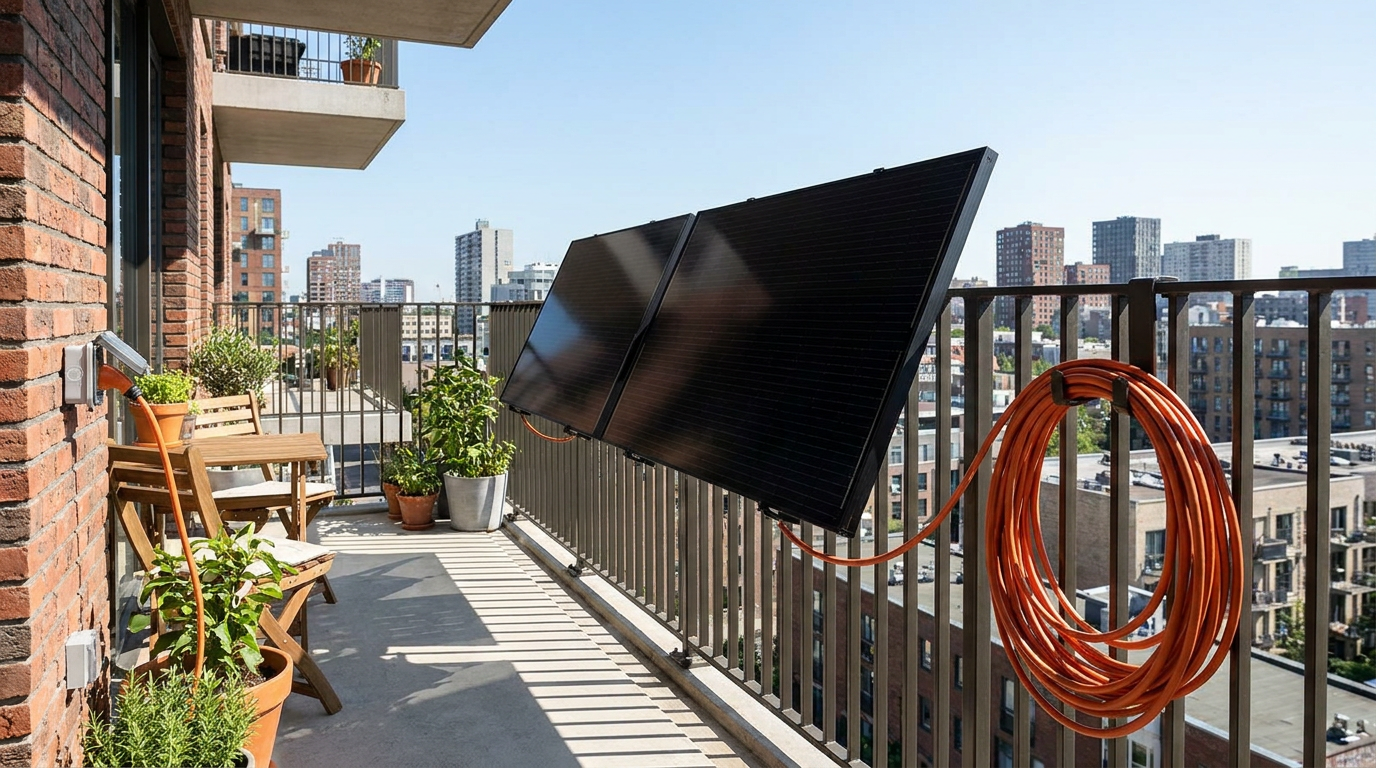
But a quiet hardware revolution is bypassing the roof entirely. "Balcony solar"—also known as plug-and-play or plug-in photovoltaics—is democratizing renewable energy. These compact, modular kits allow anyone with a sunny railing, patio, or fence to generate their own electricity and plug it directly into a standard wall outlet, requiring zero construction and no electrician.[2][4]
The concept is already a massive mainstream success in Europe. Germany's "Balkonkraftwerk" (balcony power plant) phenomenon has resulted in over 1.5 million registered systems by early 2026. Walk through any major German city, and you will see sleek black panels hanging from apartment railings on nearly every block, representing roughly 18 balcony solar units for every 1,000 people.[1][2]
By contrast, the United States has historically hovered near zero, with fewer than 50,000 units installed nationwide. But a convergence of new safety standards, falling hardware costs, and a wave of state-level legislation in 2025 and 2026 is finally clearing the regulatory hurdles that kept American renters in the dark.[2][3]

To understand the appeal, you have to understand the mechanism. A standard balcony solar kit consists of one to four lightweight solar panels, typically generating between 300 and 1,200 watts in total. Instead of requiring heavy roof racks that penetrate shingles, they mount to balcony railings or ground stands using heavy-duty zip ties, straps, or simple clamp brackets.[1][5]
The technological magic happens in the microinverter. Traditional solar panels generate direct current (DC) electricity, which must be routed through complex wiring to a central inverter bolted to the side of a house. In a plug-and-play setup, a small microinverter attaches directly to the back of the panel, instantly converting the DC power into the alternating current (AC) used by household appliances.[6]
From the microinverter, a standard three-prong power cord runs to any outdoor 120-volt wall outlet. Once plugged in, the system synchronizes with the home's grid power. Because electricity follows the path of least resistance, the power generated by the panels flows into the apartment's wiring and is immediately consumed by whatever is running inside.[1][4]
From the microinverter, a standard three-prong power cord runs to any outdoor 120-volt wall outlet.
Crucially, balcony solar is not designed to take a home off the grid. Instead, it acts as a "load reducer." Every home has a baseline of "always-on" energy consumption—the refrigerator humming, the Wi-Fi router blinking, the standby power of televisions. A typical 800-watt balcony kit offsets this constant baseline during daylight hours, effectively slowing down the utility meter.[1][4]

The economics are highly localized but generally favorable. A typical two-panel kit costs between $400 and $800. In a sunbelt state or a region with high electricity rates like California or New York, an 800-watt system can save a household roughly $250 to $300 annually. At that rate, the system pays for itself in under three years, providing free electricity for the remainder of its 20-year lifespan.[2][3]
Despite the simplicity, the US market has historically been paralyzed by "interconnection" rules. Utilities have long argued that plugging a power source into a wall outlet poses a severe safety risk, specifically the danger of "islanding" or "backfeeding" electricity into the grid during a blackout, which could electrocute line workers repairing the wires.[4]
That argument largely collapsed in January 2026 with the introduction of UL 3700, the first dedicated American safety standard for plug-in solar. Systems certified under UL 3700 feature automatic power cut-offs. If the cord is unplugged from the wall, or if the grid goes down, the microinverter detects the loss of voltage and kills the power output in milliseconds, rendering the plug's metal prongs completely dead and safe to touch.[1][4]
Armed with this technological safeguard, state legislatures are moving aggressively to bypass utility red tape. Utah led the nation in 2025 by passing a law that explicitly legalizes plug-and-play systems under 1.2 kilowatts, exempting them from costly interconnection agreements. Maine followed suit with a law taking effect in mid-2026.[1][4]
As of early 2026, lawmakers in 27 other states have introduced similar legislation. The prevailing legal strategy is to reclassify these small systems as standard household appliances rather than electrical power plants. As proponents argue: if a resident can safely plug in a 1,500-watt space heater that draws power, they should be able to plug in an 800-watt solar panel that provides it.[3][4]

The DIY installation process is remarkably straightforward, though experts urge a few basic precautions. Renters must first assess their sunlight exposure; a south-facing balcony is ideal, while heavy shading from adjacent buildings or trees can render the investment useless.[5][6]
Safety guidelines also mandate that the system be plugged into a GFCI-protected outlet on a dedicated circuit to prevent overloads. And while state laws are overriding utility bans, renters still occasionally face friction from Homeowners Associations (HOAs) or landlords concerned about the aesthetic impact of panels hanging from railings.[5]
How we got here
Early 2020s
Balcony solar systems surge in popularity across Europe, particularly in Germany, driven by high energy prices and simplified regulations.
March 2025
Utah becomes the first US state to pass dedicated legislation legalizing plug-and-play solar systems and exempting them from utility interconnection fees.
December 2025
UL Solutions releases the UL 3700 safety standard, establishing the first dedicated safety framework for plug-in solar in the US.
January 2026
The first UL 3700-certified microinverters begin hitting the market, alleviating utility concerns about electrical shocks and grid backfeeding.
Spring 2026
Lawmakers in 27 US states introduce bills to classify sub-1.2kW plug-in solar kits as standard household appliances.
Viewpoints in depth
DIY Solar Advocates
Argue that plug-and-play solar is a necessary tool for democratizing clean energy.
Advocates view the traditional rooftop solar model as inherently inequitable, locking out the millions of Americans who rent or live in multi-family buildings. They argue that by treating small-scale solar kits as household appliances rather than power plants, regulators can instantly empower lower-income households to reduce their utility bills. For this camp, the fight over balcony solar is fundamentally about energy justice and breaking the utility monopoly on power generation.
Utility Operators
Emphasize the need for strict safety standards and grid management.
Utility companies have historically opposed plug-in solar due to safety and grid stability concerns. Their primary fear is 'islanding'—a scenario where a home solar system continues pumping electricity into the grid during a blackout, potentially electrocuting line workers repairing the wires. While the new UL 3700 standard addresses this with automatic shutoffs, utilities argue that widespread, unregulated adoption of plug-in panels could still create localized voltage fluctuations and complicate grid management if they lack visibility into where these systems are installed.
Property Managers & HOAs
Focus on structural liability and aesthetic uniformity.
Landlords and Homeowners Associations often find themselves caught between residents who want to lower their energy bills and their own mandates to maintain building standards. Property managers raise concerns about the structural integrity of balcony railings supporting 40-pound panels in high winds. Additionally, many HOAs enforce strict aesthetic guidelines that prohibit visible modifications to building exteriors, setting up local legal battles even in states that have cleared the utility hurdles.
What we don't know
- How aggressively Homeowners Associations (HOAs) and landlords will fight the installation of visible solar panels on building exteriors, even as state laws clear utility hurdles.
- Whether the US market will develop the same massive, standardized ecosystem of mounting hardware and aesthetic options that currently exists in Europe.
- How quickly the backlog of new microinverters will achieve full UL 3700 certification, as the standard was only finalized in late 2025.
Key terms
- Microinverter
- A small device attached to a solar panel that converts the direct current (DC) electricity generated by the sun into alternating current (AC) that household appliances can use.
- Plug-and-Play Solar
- A modular solar energy system designed to be installed by consumers without an electrician, plugging directly into a standard wall outlet.
- UL 3700
- A safety certification standard introduced in 2026 specifically for plug-in solar systems, ensuring they automatically cut power if unplugged to prevent electric shocks.
- Interconnection
- The formal process and agreement required by utility companies to connect a power-generating system to the broader electrical grid.
- GFCI Outlet
- A Ground Fault Circuit Interrupter outlet, designed to protect against electrical shocks by instantly breaking the circuit if it detects an imbalance in the electrical current.
Frequently asked
Do I need my landlord's permission to install balcony solar?
It depends on your lease and local laws. While new state legislation is preventing utilities from blocking these systems, landlords or HOAs may still have rules regarding the exterior appearance of the building or hanging items from railings.
What happens to the power if the grid goes down?
For safety reasons, standard plug-in microinverters will automatically shut off if the grid loses power. This prevents the panels from sending electricity back into dead power lines, which could endanger utility workers.
Can I take the panels with me when I move?
Yes. Because they use non-permanent mounting hardware like heavy-duty zip ties or brackets, and plug into a standard outlet, the entire system can be uninstalled in minutes and transported to a new apartment.
Will this eliminate my electric bill?
No. Balcony solar systems are small and act as "load reducers." They typically generate enough power to offset "always-on" appliances like refrigerators and routers, reducing your bill by 15% to 25%, but they will not take you off the grid.
Sources
Source coverage
7 outlets
3 viewpoints surfaced







[1]WattBuildUtility Operators
Plug-in balcony solar experiences regulatory breakthrough in the US
Read on WattBuild →[2]SunHoursDIY Solar Advocates
Balcony Solar Panels in the USA: Best Deals, State-by-State Guide & Global Comparison
Read on SunHours →[3]RenewEconomyDIY Solar Advocates
The plug-and-play solar panels that could empower US renters
Read on RenewEconomy →[4]Solar.comDIY Solar Advocates
2026 Guide to Balcony Solar and Plug-in Panels
Read on Solar.com →[5]Plugin Solar USDIY Solar Advocates
The Ultimate Guide to Plug-In Solar for Apartments
Read on Plugin Solar US →[6]Thunder EnergyDIY Solar Advocates
A DIY Guide to Balcony Solar Panel Installation
Read on Thunder Energy →[7]Factlen Editorial TeamProperty Managers & HOAs
Synthesis by Factlen editorial team
Read on Factlen Editorial Team →
Every angle. Every day.
Get home stories with full source coverage and perspective breakdowns delivered to your inbox.