
How Photonic Chips Are Using Light to Break AI's Power Wall
As traditional electronic GPUs hit physical thermal limits, a new generation of silicon photonics accelerators is using light to perform AI computations at unprecedented speeds.
By Factlen Editorial Team
- Optical Computing Pioneers
- Startups and academic researchers arguing that light is the only scalable path forward for AI compute.
- Incumbent Hardware Giants
- Established chipmakers who view photonics as a crucial interconnect technology to supplement electronic GPUs.
- Hyperscale Cloud Providers
- Data center operators focused purely on the economics of power, cooling, and latency.
What's not represented
- · Semiconductor Foundry Workers
- · Environmental Policy Regulators
Why this matters
Artificial intelligence is currently constrained by the massive electricity demands of data centers. Transitioning from electrons to photons could drastically reduce the carbon footprint of AI while unlocking the compute power needed for next-generation models.
Key points
- AI data centers are hitting a 'power wall' due to the extreme heat and electricity required by traditional electronic GPUs.
- Silicon photonics replaces copper wires with microscopic waveguides, using light to compute and transmit data with zero resistance.
- A recent breakthrough at the University of Pennsylvania enables all-optical switching, removing the need to convert light back to electricity.
- Startups like Neurophos are raising hundreds of millions to commercialize exaflop-scale optical chips that drastically outperform GPUs in energy efficiency.
The artificial intelligence industry is currently colliding with a fundamental problem of physics. As large language models scale into the hundreds of billions or even trillions of parameters, the hyperscale data centers required to train and run them are consuming unprecedented gigawatts of electricity. This insatiable appetite for power is not merely an economic hurdle for tech companies; it is rapidly becoming a severe environmental and logistical crisis, forcing tech giants to seek out dedicated nuclear power plants and massive renewable energy grids just to keep their servers online and functioning.[7]
The root of this computational bottleneck lies not in the underlying logic of the algorithms, but in the physical movement of electrons. Traditional graphics processing units (GPUs) rely on microscopic copper interconnects and billions of electronic transistors to process and route data. Moving electrical signals through these dense metallic pathways generates inherent physical resistance, and that resistance inevitably manifests as extreme heat. As chips become denser and faster, the thermal output scales exponentially, creating a hostile environment within the server rack.[4][7]
To keep these massive server farms from physically melting down under the strain of continuous AI training, companies are forced to deploy elaborate, highly energy-intensive liquid cooling systems. The semiconductor industry refers to this threshold as the "power wall"—a hard physical limit where the energy required to move data electronically begins to outstrip the performance gains of adding more processors. This wall is actively threatening to cap the exponential growth of artificial intelligence, forcing engineers to look beyond traditional electronics.[2][7]

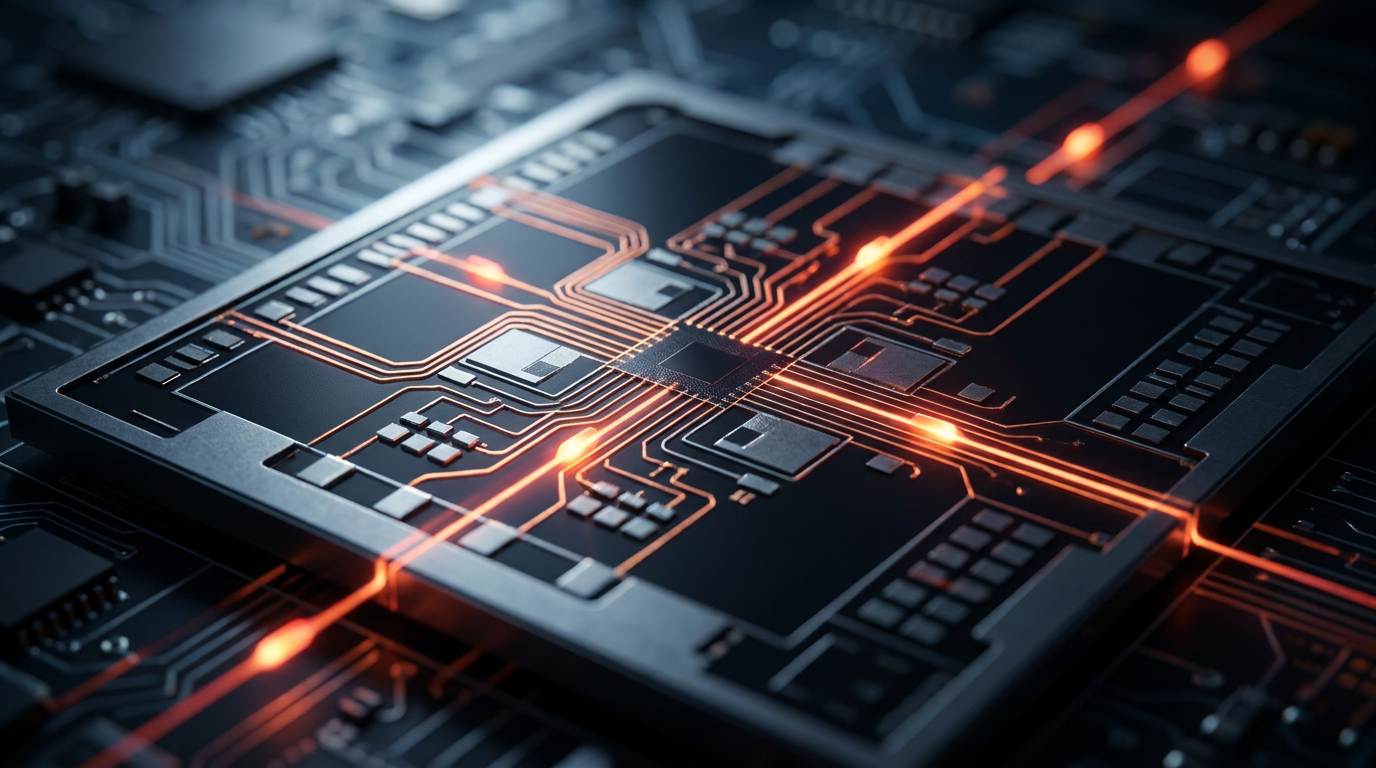
In response to this looming ceiling, a paradigm-shifting architecture known as silicon photonics is rapidly moving from the experimental laboratory to the commercial data center. Instead of pushing electrical currents through copper wires, photonic AI accelerators compute and transmit data using rapid pulses of light. By replacing electrons with photons, hardware engineers are attempting to rewrite the fundamental physical rules of computation, bypassing the thermal limitations that have defined the semiconductor industry for the last fifty years. This shift represents one of the most significant hardware evolutions since the invention of the integrated circuit.[3][4]
The mechanism behind this light-based technology relies on microscopic optical waveguides that are etched directly into a standard silicon substrate. A near-infrared laser generates a continuous, stable light source, which is then precisely encoded with data by optical modulators that rapidly alter the light's intensity or phase. These modulators act as the optical equivalent of electronic transistors, translating digital information into a stream of photons that can be routed through the chip's intricate network of microscopic glass-like channels.[3]
Because photons have zero rest mass and carry no electrical charge, they can travel across a silicon chip with virtually no physical resistance and generate absolutely zero heat. This unique quantum property allows data to move at the literal speed of light, vastly increasing the overall bandwidth of the computing system while simultaneously slashing the energy consumption required to push the signal from one end of the chip to the other. The result is a communication medium that is fundamentally immune to the thermal throttling that plagues modern GPUs.[1][3]
Crucially, these next-generation photonic chips are not just transmitting data from point A to point B; they are actively computing it in transit. At the heart of these optical accelerators are intricate, microscopic structures known as Mach-Zehnder interferometers (MZIs), which manipulate the phase of the light to perform complex mathematical operations directly within the optical domain. Modern neural networks rely fundamentally on matrix multiplication—a heavy, repetitive mathematical operation that requires immense processing power and time in traditional electronics. In a photonic chip, MZIs split and recombine light beams, using natural optical interference to perform these complex multiplications instantaneously and passively as the light flows through the silicon.[4]

Crucially, these next-generation photonic chips are not just transmitting data from point A to point B; they are actively computing it in transit.
Despite these massive advantages, optical computing has historically faced a major functional hurdle known as the "nonlinear" activation function. While light is perfectly suited for linear matrix multiplication, neural networks also require nonlinear decision-making steps that dictate whether a signal should pass to the next layer of the model. Because photons are charge-neutral, they do not naturally interact with one another. To solve this, earlier hybrid chips had to constantly convert the optical signal back into an electrical one to perform these nonlinear decisions, and then convert it back to light. This repeated translation severely eroded the speed and efficiency gains that made the photonic architecture attractive in the first place.[1][4]
A major breakthrough in overcoming this limitation arrived in the spring of 2026, when physicists at the University of Pennsylvania engineered a new nanoscale device designed to solve this exact translation bottleneck. The Penn researchers successfully created "exciton-polaritons"—hybrid quasiparticles that combine the blistering speed of light with the interactive properties of matter. By coupling photons with electrons in an atomically thin semiconductor, they enabled the light signals to interact strongly enough with their environment to perform complex signal-switching logic directly, without ever leaving the optical domain.[1]
This all-optical switching requires an extraordinarily small amount of energy—roughly four quadrillionths of a joule per operation, which is a fraction of the power required to briefly illuminate a tiny LED. If successfully scaled from the laboratory to commercial fabrication, this exciton-polariton technology could eliminate the need for electronic conversion entirely. Paving the way for pure-light AI processors, this breakthrough ensures that the entire computational pipeline—from matrix multiplication to nonlinear activation—can occur at the speed of light, operating with unprecedented energy efficiency.[1]
The commercial sector is already racing to capitalize on these optical architectures, moving the technology out of academic labs and into enterprise data centers. In early 2026, the Austin-based startup Neurophos secured $110 million in an oversubscribed Series A funding round. Backed by Microsoft's venture fund, M12, and Gates Frontier, the company is on a mission to bring exaflop-scale photonic chips to commercial data centers, specifically targeting the massive inference workloads generated by modern generative AI models.[2]

Neurophos claims to have achieved a 10,000-fold miniaturization of optical modulators using advanced metamaterials, solving one of the historical challenges of optical computing: physical size. By packing dense optical parallelism onto a single chip, the company projects its first-generation optical processing units (OPUs) will deliver massive computational throughput at a fraction of the power draw of current flagship GPUs. This physics-level shift means that both efficiency and raw speed improve as the system scales up, fundamentally breaking the power wall.[2]
Other prominent startups in the space, such as Lightmatter and Celestial AI, are pioneering what they call 'photonic fabrics' to disaggregate compute from memory. In traditional architectures, moving data between the memory banks and the processor consumes more time and energy than the actual computation. By using dedicated light paths to shatter this 'memory wall,' these companies are delivering data directly to the processing cores at optical speeds, eliminating the severe latency that plagues traditional electronic interconnects.[5]
The incumbent hardware giants are acutely aware of the optical threat and are actively integrating the technology into their own roadmaps. NVIDIA, the dominant force in the global AI hardware market, recently outlined a future accelerator architecture that places silicon photonics at center stage. Their proposed designs utilize optical connections for both intrachip and interchip communication, acknowledging that traditional copper wiring is rapidly reaching its physical limits for scaling out the massive GPU clusters required for next-generation AI training.[6]
However, the transition to light-based computing still faces steep manufacturing and engineering challenges before it can completely dethrone the GPU. Yield rates for optical components must improve drastically to match the highly refined reliability of traditional silicon foundries, which have spent decades perfecting the mass production of electronic transistors. Additionally, the physical process of coupling light from external optical fibers into microscopic chip surfaces without significant signal loss remains a delicate and complex physical hurdle that requires extreme precision during the packaging and manufacturing process.[3][4]

Furthermore, the software ecosystem powering modern artificial intelligence is deeply entrenched in electronic GPU frameworks, most notably NVIDIA's proprietary CUDA platform. Millions of developers and researchers have spent years optimizing their machine learning code specifically for electronic architectures. To make optical computing commercially viable at scale, the industry will need robust new compilers, libraries, and software toolchains. These tools must be able to seamlessly translate existing AI models into instructions that an optical processing unit can natively execute, abstracting away the complex physics of light without requiring developers to completely rewrite their underlying code.[7]
If these manufacturing and software hurdles can be successfully cleared, silicon photonics promises to decouple the advancement of artificial intelligence from the severe constraints of the global power grid. By harnessing the fundamental physics of light, the next generation of AI infrastructure could be exponentially faster, significantly cooler, and vastly more sustainable. As the demand for machine intelligence continues its relentless upward trajectory, the ability to compute with photons may prove to be the critical breakthrough that prevents the AI revolution from burning itself out.[7]
How we got here
1940s
The ENIAC establishes the paradigm of using electrons for general-purpose computing.
December 2024
NVIDIA outlines a future accelerator architecture that relies on silicon photonics for chip-to-chip connections.
January 2026
Startup Neurophos raises $110 million to commercialize exaflop-scale optical chips for data centers.
April 2026
University of Pennsylvania researchers demonstrate all-optical switching using exciton-polaritons, solving a major bottleneck.
Viewpoints in depth
Optical Computing Pioneers
Startups and academic researchers arguing that light is the only scalable path forward for AI compute.
This camp believes that Moore's Law for traditional electronics is effectively dead, constrained by the thermal realities of pushing electrons through copper. They argue that only a fundamental shift in physics—moving to zero-mass photons—can sustain the exponential growth of AI. By computing passively with light interference, they envision a future where data centers operate at a fraction of their current power draw, eliminating the need for massive liquid cooling infrastructure.
Incumbent Hardware Giants
Established chipmakers who view photonics as a crucial interconnect technology to supplement electronic GPUs.
Companies dominating the current AI hardware market acknowledge the physical limits of copper, but they are not abandoning the GPU. Instead, they view silicon photonics primarily as a high-bandwidth interconnect solution. By using light to move data between traditional electronic processors, they aim to solve the communication bottleneck while preserving the massive, established software ecosystem (like CUDA) that relies on electronic architectures.
Hyperscale Cloud Providers
Data center operators focused purely on the economics of power, cooling, and latency.
For the companies actually building and powering the infrastructure for AI, the underlying physics matter less than the utility bill. Hyperscalers are facing severe grid constraints and public pushback over their energy consumption. They are aggressively funding and testing optical computing startups because any architecture that can deliver exaflop-scale inference without requiring a dedicated nuclear reactor represents a massive competitive advantage.
What we don't know
- Whether optical chip manufacturers can achieve the high yield rates necessary to compete with traditional silicon foundries on price.
- How quickly the software ecosystem can adapt to compile existing AI models natively for Optical Processing Units (OPUs).
Key terms
- Silicon Photonics
- A technology that integrates optical components onto a silicon substrate, allowing data to be transmitted and processed using light instead of electricity.
- Mach-Zehnder Interferometer (MZI)
- An optical device that splits a beam of light in two and recombines it, using the resulting interference pattern to perform instantaneous calculations.
- Exciton-polariton
- A hybrid quasiparticle made of both light and matter, allowing photons to interact with each other to perform logical decision-making steps.
- Optical Processing Unit (OPU)
- A specialized AI accelerator chip that uses photons (light) rather than electrons to perform computations.
Frequently asked
Why can't we just keep using traditional GPUs?
Traditional GPUs rely on electrons moving through copper, which generates significant resistance and heat. As AI models grow, the electricity and cooling required to run these electronic chips are hitting physical and economic limits.
How does light actually perform math?
Photonic chips use components called Mach-Zehnder interferometers to split and recombine light beams. The natural physical interference of these light waves passively calculates matrix multiplications, the core mathematical operation of neural networks.
Will photonic chips replace my computer's CPU?
Not in the near term. Photonic chips are highly specialized accelerators designed specifically for the heavy, repetitive math of AI workloads. They will likely work alongside traditional electronic CPUs in data centers rather than replacing them entirely.
Sources
Source coverage
7 outlets
3 viewpoints surfaced







[1]University of PennsylvaniaOptical Computing Pioneers
Penn physicists create hybrid light-matter particles for optical AI
Read on University of Pennsylvania →[2]Pulse 2.0Optical Computing Pioneers
Neurophos: $110 Million Series A Raised To Bring Exaflop-Scale Photonic AI Chips To Data Centers
Read on Pulse 2.0 →[3]STMicroelectronicsIncumbent Hardware Giants
Silicon photonics: The magic of light on a chip
Read on STMicroelectronics →[4]FindLightOptical Computing Pioneers
Photonics for AI Hardware Acceleration
Read on FindLight →[5]TechRadarOptical Computing Pioneers
Light-based AI hardware startups
Read on TechRadar →[6]TechPowerUpIncumbent Hardware Giants
NVIDIA's Vision for Future AI Accelerators: Silicon Photonics
Read on TechPowerUp →[7]Factlen Editorial TeamHyperscale Cloud Providers
Synthesis by Factlen editorial team
Read on Factlen Editorial Team →

Every angle. Every day.
Get ai stories with full source coverage and perspective breakdowns delivered to your inbox.