
How Local AI Works: Why On-Device Models Are Replacing Cloud Subscriptions in 2026
Advances in consumer hardware and open-weight models now allow users to run frontier-grade artificial intelligence entirely offline, ensuring absolute privacy and zero recurring costs.
By Factlen Editorial Team
- Privacy & Security Advocates
- Value local AI because it guarantees data sovereignty, ensuring sensitive medical, legal, or corporate data never leaves the device.
- Open-Source Developers
- Champion local models for the freedom to build agentic workflows without API rate limits, censorship, or vendor lock-in.
- Hardware Manufacturers
- Push on-device AI to drive a massive hardware upgrade cycle, emphasizing the need for NPUs and unified memory.
- Cloud AI Providers
- Argue that while local AI is useful for daily tasks, the most complex scientific reasoning will always require massive centralized compute clusters.
What's not represented
- · Environmental Analysts
Why this matters
Running AI locally gives you permanent, free access to frontier-grade intelligence without sacrificing your privacy to tech giants. It transforms AI from a rented cloud service into a tool you actually own.
Key points
- Local AI allows users to run frontier-grade language models entirely offline on consumer hardware.
- The shift eliminates monthly subscription costs and guarantees absolute data privacy.
- Hardware advancements like Apple's unified memory and Windows NPUs made local processing viable.
- Techniques like quantization and Mixture of Experts (MoE) allow massive models to run efficiently on 16GB of RAM.
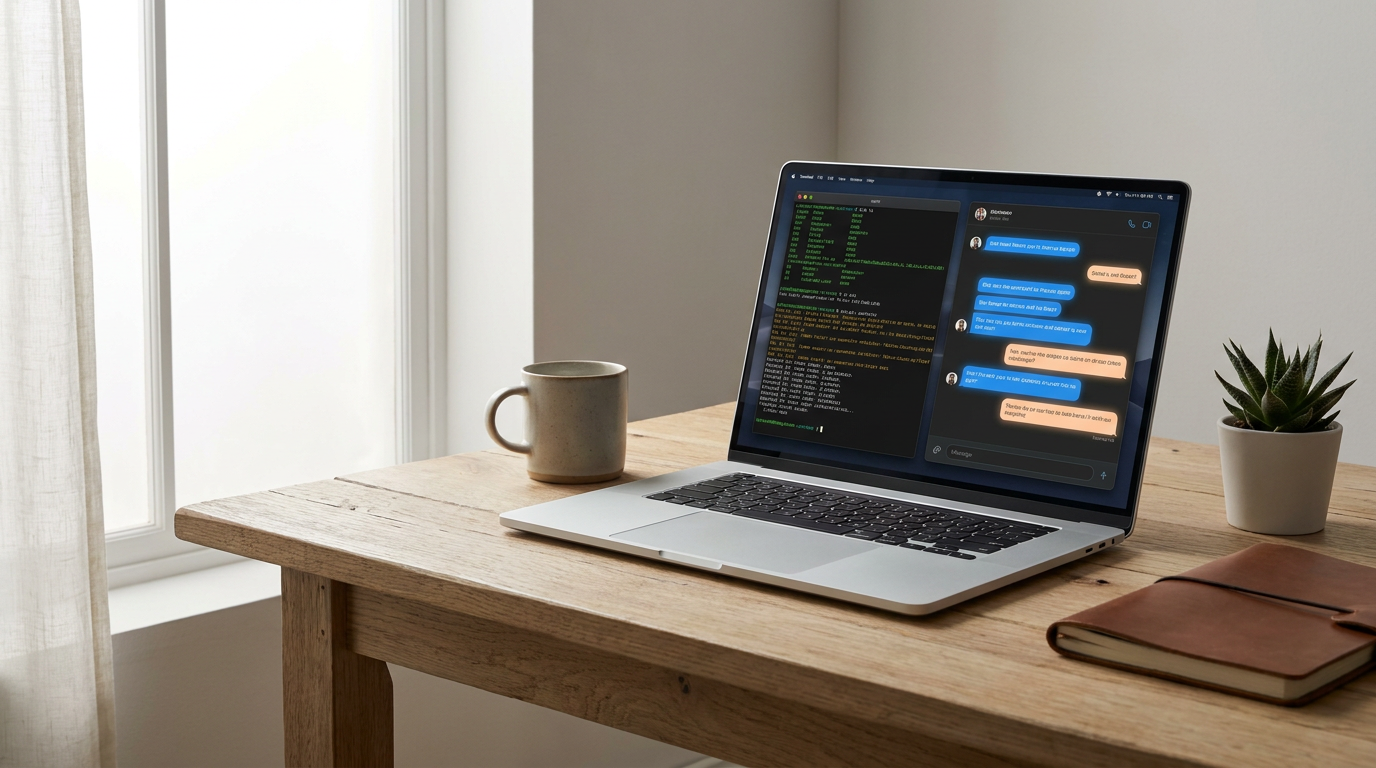
The era of renting artificial intelligence by the month is quietly ending. For the past few years, accessing frontier-grade AI meant paying a monthly subscription and sending every keystroke, private document, and proprietary codebase to a distant cloud server. But in 2026, a quiet revolution has flipped the architecture of the internet. The most capable language models in the world are now running entirely offline, directly on consumer laptops and desktop computers.[8]
This shift, known as "local AI" or "on-device AI," represents a fundamental democratization of computing power. Instead of relying on centralized data centers owned by a handful of tech giants, users are downloading models that rival or exceed the intelligence of early cloud models and running them locally. The appeal is immediate: zero recurring subscription costs, absolute data privacy, and the ability to generate unlimited text, code, and analysis without an internet connection.[4][6]
The tipping point arrived through a convergence of three distinct breakthroughs: specialized hardware, hyper-efficient software engines, and a new generation of open-weight models. On the hardware front, the primary bottleneck for running Large Language Models (LLMs) has always been memory. AI models require massive amounts of RAM to hold their neural weights during inference, which traditionally required expensive, specialized server equipment.[1][8]
Apple Silicon fundamentally changed this equation. By introducing "unified memory"—where the CPU and GPU share the same massive pool of RAM—laptops like the M3 and M4 Max can suddenly hold models that previously required multi-GPU server racks. Simultaneously, Windows PC manufacturers began embedding Neural Processing Units (NPUs) directly into consumer motherboards, specifically designed to accelerate AI math without draining the battery.[1][7]

But hardware alone wasn't enough; the software had to become accessible. A few years ago, running a local model required navigating complex Python environments and compiling code from GitHub. Today, tools like LM Studio and Ollama have reduced the process to a single click. LM Studio offers a polished, ChatGPT-style desktop interface where users can browse, download, and chat with models seamlessly.[3][8]
Ollama, meanwhile, has become the developer's standard. Operating as a lightweight background service, it allows users to pull models via a simple command-line interface and instantly exposes a local API. This means developers can point their coding assistants, automation scripts, and custom applications at their own machine rather than paying OpenAI or Anthropic for every API call.[3][8]
The models themselves have also undergone a radical transformation. In 2026, the open-source community is dominated by highly optimized models like Meta's Llama 4, Google's Gemma 4, and Alibaba's Qwen 3.5. These models achieve flagship performance not by being massive, but by being remarkably efficient.[2]
The models themselves have also undergone a radical transformation.
A key innovation driving this efficiency is the "Mixture of Experts" (MoE) architecture. Rather than activating the entire neural network for every single word it generates, an MoE model routes the prompt to a specific "expert" sub-network. A model might contain 80 billion parameters in total, but only use 3 billion active parameters to answer a specific question, drastically reducing the computational load on the user's computer.[7]
The second crucial innovation is "quantization." In simple terms, quantization compresses the AI model by reducing the mathematical precision of its internal weights—often shrinking a model from a 16-bit format down to 4-bit. This compression allows a massive, highly capable model to fit comfortably inside the 16GB to 24GB of RAM found in standard 2026 consumer laptops, with almost no noticeable drop in intelligence.[6][8]

The impact on privacy has been the primary driver of enterprise adoption. Industry data shows that by mid-2026, over 55% of enterprise AI inference has moved on-premises. Hospitals can analyze patient records, law firms can summarize confidential case files, and software engineers can debug proprietary codebases without a single byte of sensitive data ever traversing the public internet.[1][4]
Apple has aggressively validated this local-first approach with its rollout of Apple Intelligence. At WWDC 2026, Apple cemented its philosophy that AI should be deeply integrated and privacy-first. The vast majority of Apple Intelligence requests—from rewriting emails to executing complex cross-app Siri commands—are processed entirely on the iPhone or Mac's local NPU.[5]
When a request is too complex for the local hardware, Apple routes it to "Private Cloud Compute," a cryptographically secure server environment that actively deletes the user's data the millisecond the request is fulfilled. This hybrid approach underscores the tech industry's broader pivot: local processing is the default, and the cloud is merely a fallback for heavy lifting.[5][8]

For software developers, local AI has completely altered the economics of building applications. In the past, integrating AI meant absorbing unpredictable API costs that scaled with user growth. Today, developers can build "agentic" workflows—where AI systems autonomously write code, test it, and browse the web—running continuously in the background for the cost of electricity. On industry benchmarks like SWE-bench, local 2026 models now routinely outperform the cloud models of 2024.[7]
Despite the massive leaps, local AI is not without its trade-offs. Running a large language model locally requires significant computational energy, which can quickly drain a laptop's battery and generate noticeable heat. Furthermore, while local models are exceptionally capable at coding, writing, and daily reasoning, the absolute frontier of AI research—models with trillions of parameters designed for complex scientific discovery—still requires the immense power of centralized data centers.[8]
Yet, for the vast majority of daily tasks, the local AI ecosystem has crossed the threshold of "good enough" and entered the realm of "exceptional." The technology has transitioned from a niche hobby for hardware enthusiasts into a fundamental utility. By severing the tether to the cloud, local AI has given users permanent, private, and free ownership of the most powerful technology of the decade.[8]
How we got here
Early 2023
The weights for Meta's original LLaMA model leak online, sparking the open-source local AI movement.
Late 2024
Apple introduces the M4 chip with a vastly upgraded Neural Engine, setting a new hardware standard for local inference.
Mid 2025
Tools like Ollama and LM Studio mature, making local AI accessible to non-developers via one-click desktop apps.
June 2026
Apple Intelligence expands on-device processing, while open-weight models like Llama 4 match top-tier cloud performance.
Viewpoints in depth
Privacy & Security Advocates
Focus on data sovereignty and the elimination of third-party data harvesting.
For privacy advocates and enterprise compliance officers, local AI is the only viable path forward. By processing data entirely on-device, organizations bypass the legal and security risks of sending proprietary code, patient health records, or confidential legal documents to third-party cloud servers. This absolute data sovereignty ensures compliance with strict frameworks like HIPAA and GDPR without sacrificing the productivity gains of artificial intelligence.
Open-Source Developers
Value the freedom to build without API limits, censorship, or vendor lock-in.
The developer community views local AI as a liberation from the walled gardens of major tech companies. Without API rate limits or per-token pricing, developers can build complex 'agentic' workflows that run continuously in the background. Furthermore, open-weight models offer uncensored, customizable foundations that developers can fine-tune for highly specific use cases, ensuring their software isn't suddenly broken by an unannounced cloud API update.
Hardware Manufacturers
Emphasize the necessity of specialized chips to drive a massive hardware upgrade cycle.
Companies like Apple, Nvidia, and AMD view the shift to local AI as the catalyst for the next great hardware supercycle. By marketing Neural Processing Units (NPUs) and massive pools of unified memory as essential for modern computing, manufacturers are incentivizing consumers and enterprises to replace their aging laptops and desktops. Their framing positions on-device AI not just as a software feature, but as a fundamental hardware requirement.
Cloud AI Providers
Argue that the absolute frontier of AI reasoning will always require centralized data centers.
While acknowledging the utility of local models for daily tasks, major cloud providers maintain that the true frontier of AI—models capable of complex scientific discovery, massive data synthesis, and deep reasoning—will always exceed the thermal and memory limits of a laptop. They argue the future is hybrid: local devices will handle routine drafting and privacy-sensitive tasks, while the cloud will act as a heavy-duty reasoning engine for the world's most difficult problems.
What we don't know
- Whether future frontier models will eventually outgrow the physical memory limits of consumer laptops.
- How cloud providers will adjust their pricing models as more users migrate to free local alternatives.
Key terms
- Quantization
- A technique that compresses AI models by reducing the precision of their internal numbers, allowing massive models to fit into consumer RAM.
- NPU (Neural Processing Unit)
- A specialized hardware chip designed specifically to accelerate artificial intelligence tasks efficiently without draining battery life.
- Unified Memory
- A hardware architecture where the CPU and GPU share the same pool of RAM, making it uniquely capable of loading large AI models.
- Mixture of Experts (MoE)
- An AI architecture that only activates a small fraction of its neural network for any given prompt, saving massive amounts of computing power.
- Ollama
- A popular software engine that allows users to download and run open-source AI models locally via a simple command-line interface.
Frequently asked
Do I need an internet connection to use local AI?
Only to download the model initially. Once the model files are saved to your drive, the AI runs entirely offline, making it ideal for travel or secure environments.
Can my current laptop run these models?
If your laptop has at least 8GB of RAM, it can run smaller, quantized models. However, for flagship 2026 models, 16GB to 24GB of unified memory or VRAM is recommended for smooth performance.
Is local AI as smart as cloud-based ChatGPT?
Yes. Open-weight models released in 2026, such as Llama 4 and Gemma 4, routinely match or beat the performance of cloud-based models from 2024 and 2025 on standard industry benchmarks.
Sources
Source coverage
8 outlets
4 viewpoints surfaced








[1]TechsyOpen-Source Developers
Run LLMs Locally 2026: The 5-Minute Setup for Any GPU
Read on Techsy →[2]Overchat AICloud AI Providers
Best Local LLMs in 2026: Complete Guide
Read on Overchat AI →[3]PromptQuorumOpen-Source Developers
Ollama vs LM Studio 2026: CLI vs GUI — Speed, API, Privacy & Setup Compared
Read on PromptQuorum →[4]ObjectBoxPrivacy & Security Advocates
Local AI Explained: Fast, Private, and On Your Device
Read on ObjectBox →[5]MindStudioHardware Manufacturers
What is Apple Intelligence and how has it changed at WWDC 2026?
Read on MindStudio →[6]Local AI MasterPrivacy & Security Advocates
What is Local AI: Private, Offline AI Models (Beginners Guide 2025)
Read on Local AI Master →[7]MediumOpen-Source Developers
Why 2026 Is the Tipping Point Year for Local Coding LLMs
Read on Medium →[8]Factlen Editorial TeamCloud AI Providers
Synthesis by Factlen editorial team
Read on Factlen Editorial Team →
More in ai
See all 6 stories →Local AI
The Rise of Local AI: How 2026 Became the Year Your Devices Stopped Needing the Cloud
8 sources
Physical AI
Spatial Intelligence: How AI is Finally Teaching Robots to Understand the Physical World
8 sources
Global AI Rules
EU Delays High-Risk AI Rules as US Pushes for Federal Preemption
7 sources

Edge AI
The Rise of Small Language Models: How AI Moved From the Cloud to Your Pocket
7 sources

Every angle. Every day.
Get ai stories with full source coverage and perspective breakdowns delivered to your inbox.