
How Entrepreneurs Are Turning Dead Big-Box Stores Into Thriving Community Hubs
Independent founders are repurposing millions of square feet of vacant retail space into craft festivals, maker spaces, and experiential venues. The adaptive reuse trend is revitalizing suburban strip malls and lowering the barrier to entry for local businesses.
By Factlen Editorial Team
- Independent Entrepreneurs
- Value the low cost of entry, flexible lease terms, and massive square footage that allows for community-scale events.
- Commercial Landlords
- Focus on mitigating the financial risk of long-term vacancies by subdividing large footprints to attract non-traditional tenants.
- Urban Planners
- Prioritize the revitalization of suburban corridors, viewing adaptive reuse as a tool to prevent blight and boost local tax revenue.
What's not represented
- · Traditional retail chain executives
- · E-commerce logistics operators
Why this matters
The revitalization of abandoned commercial real estate prevents suburban blight while creating accessible, low-cost physical spaces for local entrepreneurs to launch businesses. For consumers, it means the return of localized, community-focused gathering spaces in neighborhoods previously dominated by national chains.
Key points
- Entrepreneurs are converting vacant big-box stores into craft festivals, maker spaces, and sports venues.
- The U.S. has roughly 1.2 billion square feet of empty retail space available for adaptive reuse.
- Landlords are subdividing massive footprints to lower the financial barrier to entry for local founders.
- Consumers are driving the trend by prioritizing experiential activities over traditional retail shopping.
- Zoning laws and retrofitting costs remain the primary hurdles for these revitalization projects.
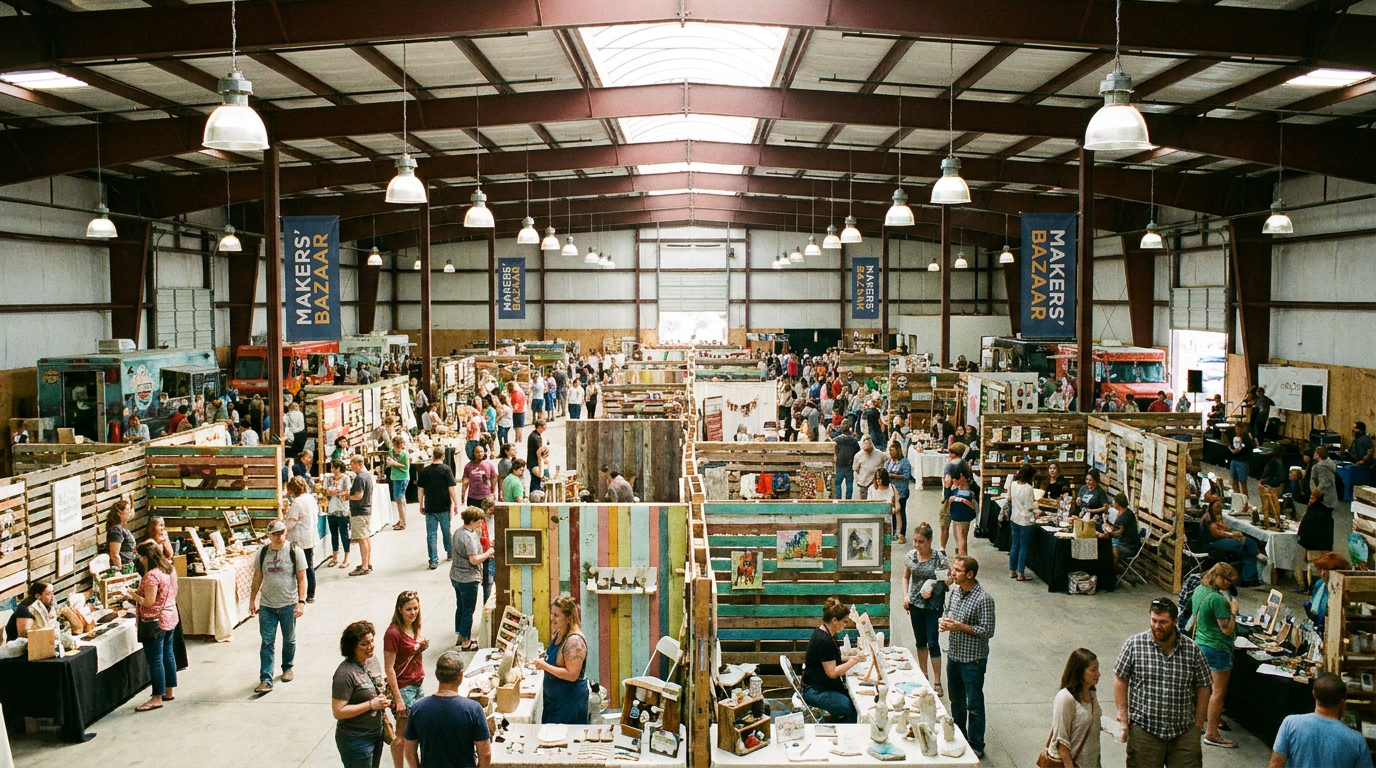
When long-time events producer Tetef looked at an abandoned Joann store, she did not see a casualty of the retail apocalypse. She saw a blank canvas. Saving $24,000 of her own money, she transformed the cavernous, empty fabric store into a bustling craft festival, realizing a lifelong dream of creating a space where people could gather to create together [1].[1]
Tetef’s venture is not an isolated success story, but rather the leading edge of a structural transformation in American commercial real estate. Across the country, independent entrepreneurs are seizing the keys to millions of square feet of vacant big-box retail space, converting former Bed Bath & Beyonds, Toys "R" Us locations, and department stores into vibrant community hubs [7].[7]
This trend, known as adaptive reuse, is fundamentally reshaping the suburban strip mall. Where national chains once relied on standardized, transactional retail models, a new generation of small business owners is introducing experiential, localized commerce that cannot be replicated online [3].[3]
The mechanism driving this shift is a sudden alignment of supply and demand. The United States currently holds an estimated 1.2 billion square feet of vacant retail space, a hangover from decades of overbuilding and the subsequent rise of e-commerce [4].[4]

For years, commercial landlords held out hope that new national chains would absorb these massive 40,000-square-foot footprints. But as the National Retail Federation notes, the era of the monolithic anchor tenant is waning, forcing property owners to rethink their leasing strategies and lower their barriers to entry [4].[4]
Enter the independent entrepreneur. These massive shells offer distinct architectural advantages for experiential businesses: high ceilings, heavy-duty HVAC systems, open floor plans devoid of load-bearing interior walls, and acres of free parking [2].[2]
The Urban Land Institute points out that adaptive reuse of these spaces is often significantly cheaper and more environmentally sustainable than demolishing the structures and building anew [2]. The embodied carbon in the existing concrete and steel is preserved, while the interior can be rapidly customized for new uses.[2]
The embodied carbon in the existing concrete and steel is preserved, while the interior can be rapidly customized for new uses.
However, the economics of leasing a 40,000-square-foot building remain daunting for a single small business. To bridge this gap, a new model of "subdivided commercial footprints" has emerged across the commercial real estate sector [6].[6]

Researchers at the MIT Center for Real Estate have documented how landlords are increasingly willing to partition large boxes into micro-retail stalls, or offer short-term, revenue-sharing leases to event producers who activate the entire space for a weekend [6]. This lowers the financial risk for founders like Tetef, who might not qualify for a traditional ten-year commercial lease [1][6].[1][6]
The shift is also driven by changing consumer psychology. Harvard Business Review analysis indicates that post-pandemic consumers are suffering from "stuff fatigue" and are instead prioritizing the "experiential economy" [3].[3]
People are actively seeking out venues where they can learn a skill, participate in a community, or share an activity with friends. Craft festivals, indoor pickleball arenas, massive maker spaces, and immersive art installations fit perfectly into the cavernous dimensions of a former department store [3][7].[3][7]
"I just want to go to a thing where everyone's sitting down making stuff," Tetef explained, capturing the exact consumer sentiment that is driving the experiential retail boom [1]. The focus is on connection, creation, and shared memory, rather than mere consumption.[1]

Recognizing the economic potential of this trend, policymakers are beginning to offer structural support. The Small Business Administration has expanded its Community Advantage Recovery Loans, specifically targeting projects that revitalize vacant commercial corridors and bring foot traffic back to local neighborhoods [5].[5]
Local governments are also realizing that a thriving craft market or indoor sports complex generates more consistent foot traffic—and consequently, more spillover revenue for adjacent restaurants and shops—than a dark, empty storefront waiting for a corporate tenant that may never arrive [2][5].[2][5]
Despite the momentum, the transition from big-box retail to community hub is not without friction. Zoning laws in many municipalities strictly define what constitutes "retail" versus "entertainment" or "light manufacturing," often requiring entrepreneurs to seek expensive and time-consuming variances [7].[7]

Furthermore, retrofitting a 1990s-era retail shell to meet modern safety codes for high-occupancy events can trigger unexpected costs, particularly regarding fire suppression systems, bathroom plumbing, and ADA compliance [6].[6]
Nevertheless, the momentum appears irreversible. As the traditional retail landscape continues to contract, the empty shells left behind are proving to be fertile ground for a new, more resilient, and deeply localized form of American entrepreneurship [7].[7]
How we got here
2010s
The 'retail apocalypse' accelerates as e-commerce giants capture market share, leading to widespread big-box closures.
2020–2022
Pandemic-era shifts finalize the bankruptcy of several major national anchor tenants, flooding the market with vacant square footage.
2024
Commercial landlords begin pivoting away from waiting for corporate tenants, opting to subdivide spaces for local businesses.
2026
Experiential retail and community hubs become the dominant growth sector in suburban commercial real estate.
Viewpoints in depth
Independent Entrepreneurs
Founders see vacant retail shells as affordable, flexible canvases for community-building.
For small business owners and event producers, the death of the traditional mall is a historic opportunity. Massive square footage that was once exclusively reserved for multinational corporations is now accessible to local founders. By utilizing short-term leases and subdivided spaces, entrepreneurs can launch ambitious, community-focused projects—like massive craft fairs or indoor sports complexes—without taking on millions of dollars in debt to build a facility from scratch.
Commercial Landlords
Property owners are adapting to a new reality where monolithic anchor tenants are a thing of the past.
Landlords are fundamentally rethinking their business models. Holding out for a single corporate tenant to sign a ten-year lease on a 40,000-square-foot box is increasingly viewed as a losing strategy. Instead, property owners are embracing the role of community curators, investing in the subdivision of their properties to attract a diverse mix of experiential tenants. While managing multiple small leases is more operationally complex, it diversifies their risk and brings much-needed foot traffic back to their properties.
Urban Planners
Municipalities view adaptive reuse as a critical tool for preventing suburban decay.
From a civic perspective, an empty big-box store is a liability that depresses surrounding property values and invites vandalism. Urban planners and local governments are increasingly supportive of experiential entrepreneurs because these businesses act as community anchors. A thriving weekend craft market or maker space generates spillover economic activity for nearby restaurants and shops, transforming a dead parking lot into a vibrant neighborhood center.
What we don't know
- Whether short-term experiential leases will provide enough long-term stability for commercial landlords.
- How quickly local municipalities will update outdated zoning laws to accommodate mixed-use entertainment in retail zones.
- If the consumer appetite for experiential retail will sustain its current growth trajectory over the next decade.
Key terms
- Adaptive Reuse
- The process of repurposing an existing building for a use other than what it was originally designed for, preserving its structure while updating its function.
- Experiential Economy
- A shift in consumer behavior where people prefer to spend money on experiences, activities, and community events rather than physical products.
- Subdivided Footprint
- The practice of taking a massive commercial space, like a former department store, and partitioning it into smaller, affordable units for multiple independent tenants.
- Zoning Variance
- A legal exception granted by a local government allowing a property owner to use their land in a way that deviates from current zoning laws, such as hosting entertainment in a retail zone.
Frequently asked
Why are there so many empty big-box stores?
Decades of aggressive retail expansion followed by the rapid rise of e-commerce and the pandemic left the U.S. with an estimated 1.2 billion square feet of vacant retail space.
How do small businesses afford massive retail spaces?
Landlords are increasingly willing to subdivide large 40,000-square-foot shells into smaller micro-retail stalls, or offer short-term, revenue-sharing leases for weekend events.
What is experiential retail?
Experiential retail focuses on offering consumers activities, classes, and community engagement—like craft festivals or indoor sports—rather than just selling physical goods.
Sources
Source coverage
7 outlets
3 viewpoints surfaced







[1]CNBCIndependent Entrepreneurs
She saved $24,000 to launch a craft festival in an old Joann store: 'This is my dream come true'
Read on CNBC →[2]Urban Land InstituteUrban Planners
Adaptive Reuse: Transforming Big-Box Retail into Community Anchors
Read on Urban Land Institute →[3]Harvard Business Review
The Experiential Economy's Next Frontier: Dead Malls
Read on Harvard Business Review →[4]National Retail FederationCommercial Landlords
2026 State of Retail Real Estate
Read on National Retail Federation →[5]Small Business AdministrationUrban Planners
Community Advantage Recovery Loans for Commercial Revitalization
Read on Small Business Administration →[6]MIT Center for Real EstateCommercial Landlords
Economic Viability of Subdivided Commercial Footprints
Read on MIT Center for Real Estate →[7]Factlen Editorial Team
Synthesis by Factlen editorial team
Read on Factlen Editorial Team →
Every angle. Every day.
Get business stories with full source coverage and perspective breakdowns delivered to your inbox.