
How Enhanced Geothermal Systems Are Unlocking 24/7 Clean Energy Anywhere on Earth
By borrowing horizontal drilling techniques from the oil and gas industry, next-generation geothermal projects are manufacturing underground reservoirs to provide limitless, carbon-free baseload power.
By Factlen Editorial Team
- Geothermal Innovators
- Argue that EGS is the missing link for 24/7 clean baseload power, leveraging existing oil and gas workforce skills to scale rapidly.
- Scientific & Government Researchers
- Focus on the technical breakthroughs in drilling and seismic monitoring that are making EGS safe and economically viable.
- Energy Markets & Policy Analysts
- Emphasize the need for regulatory reform and federal support to overcome the high upfront capital costs of first-of-a-kind plants.
What's not represented
- · Local communities near deployment sites
- · Fossil fuel incumbents facing baseload competition
Why this matters
As artificial intelligence and electrification drive unprecedented electricity demand, the grid desperately needs clean power that runs 24/7. Enhanced Geothermal Systems offer a scalable way to replace coal and gas plants without relying on the weather, potentially supplying a fifth of U.S. electricity by 2050.
Key points
- Enhanced Geothermal Systems (EGS) create artificial underground reservoirs in hot, dry rock, bypassing the need for natural hot springs.
- The technology borrows horizontal drilling and hydro-shearing techniques from the oil and gas industry to extract thermal energy.
- Recent field data from Nevada proves the systems can operate continuously for years without mechanical or chemical remediations.
- Drilling costs have plummeted by 70 percent in two years, putting EGS on a path to price parity with fossil fuels.
- If cost reductions continue, EGS could supply up to 20 percent of the United States' total electricity demand by 2050.
The global electrical grid is facing an unprecedented hunger for round-the-clock clean power. Driven by the rapid expansion of artificial intelligence data centers, the reshoring of heavy manufacturing, and the broad electrification of transportation, energy demand is surging. While wind and solar power have become remarkably cheap, their inherent intermittency leaves grid operators scrambling when the sun sets or the wind dies down. Advanced nuclear reactors promise a solution, but they remain years, if not decades, away from widespread commercial deployment. This leaves a critical gap for firm, dispatchable, carbon-free electricity—a gap that engineers are now looking to fill by tapping into the near-limitless heat radiating from the Earth's core.[4][8]
The holy grail of baseload renewable energy has always been beneath our feet, but traditional geothermal power suffers from a fatal geographic flaw. Conventional geothermal plants require a rare geological trifecta to function: extremely hot rock, abundant underground fluid, and naturally permeable pathways that allow that fluid to circulate and carry heat to the surface. Because these three elements rarely occur together, traditional geothermal energy has been largely confined to highly active tectonic regions, such as Iceland, New Zealand, or California's Geysers. For decades, the vast majority of the world's subterranean thermal energy remained locked away in hot, dry, impermeable granite, completely inaccessible to the energy industry.[3][8]
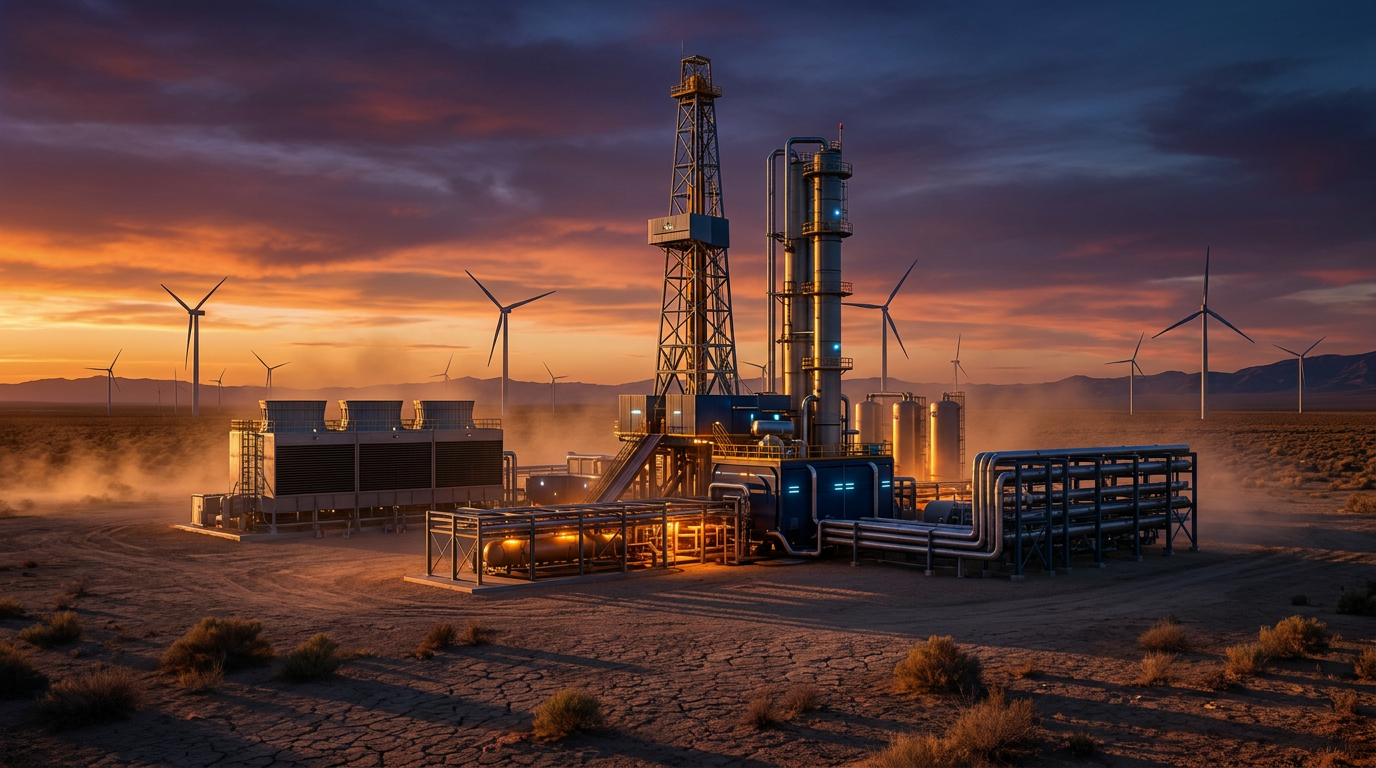
That geographic limitation is now being shattered by a rapidly maturing technology known as Enhanced Geothermal Systems (EGS). Rather than hunting for natural underground hot springs, EGS allows engineers to manufacture their own geothermal reservoirs exactly where they need them. By borrowing, adapting, and refining heavy-duty drilling techniques originally developed during the oil and gas shale boom, energy companies are unlocking the ability to harvest heat from dry rock. This paradigm shift means that geothermal energy is no longer a niche resource tied to volcanic fault lines; it is becoming a scalable technology that can theoretically be deployed anywhere on the planet, provided you can drill deep enough.[4][7]
The mechanism behind Enhanced Geothermal Systems is straightforward in concept but technically daunting in execution. Engineers begin by drilling a well thousands of feet straight down into hot, crystalline bedrock. Once they reach the target depth and temperature, they turn the drill bit and bore horizontally for thousands of feet—a technique perfected by the petroleum industry. High-pressure cold water is then pumped down the well to create a vast network of millimeter-thin fractures in the solid rock. This process, known as hydro-shearing, forces pre-existing microscopic cracks to slip and open, creating a highly permeable artificial sponge of hot rock deep underground.[3][8]

Once the fracture network is established, a second well—the production well—is drilled to intersect the newly created reservoir. The system then operates as a massive, closed-loop subterranean radiator. Cold water is continuously pumped down the injection well, where it sweeps through the artificial fractures, absorbing the intense thermal energy of the surrounding rock. The superheated fluid is then forced up the production well to the surface, where its heat is transferred to a working fluid that flashes to vapor and drives a turbine to generate electricity. The cooled water is then re-injected back into the earth, repeating the cycle endlessly without emitting greenhouse gases.[1][8]
For years, Enhanced Geothermal Systems existed primarily as a theoretical promise and a series of small-scale government research projects. However, recent field data has definitively pushed the technology past the commercial inflection point. Fervo Energy, a leading geothermal developer, recently published the results of its Project Red pilot facility in Nevada, which has now surpassed 600 days of continuous commercial operation. The operational history accumulated at Project Red represents something genuinely new in the energy sector: a rigorous, real-world dataset that validates the fundamental physics and long-term durability of EGS technology at a grid-connected scale.[1][6]
The results from the Nevada pilot have silenced many of the technology's early skeptics. Over its nearly two years of continuous operation, the downhole EGS system performed flawlessly, requiring zero mechanical remediations, workovers, or chemical treatments. This level of subsurface stability is rarely achieved even in conventional hydrothermal operations. The system consistently delivered an average gross power output of roughly 2 megawatts, maintaining a steady flow of fluid heated to 347 degrees Fahrenheit. By proving that horizontal well EGS systems can deliver predictable, stable thermal output over a sustained period, the pilot successfully de-risked the most critical aspects of subsurface geothermal engineering.[1][8]
With the physics proven, the industry is now aggressively scaling up the engineering. At Fervo Energy's massive Cape Station project currently under construction in Beaver County, Utah, next-generation well designs are expected to yield a staggering leap in efficiency. By utilizing larger wellbores, longer horizontal laterals, and optimized fracture spacing, engineers project a seven-fold increase in gross power output per well. Moving from the initial designs used in Nevada to the advanced architectures being deployed in Utah, output is expected to jump from 2 megawatts to approximately 16 megawatts per well, fundamentally altering the unit economics of the power plant.[1][4]
This rapid improvement is being driven by a steep "learning curve" effect, mirroring the early cost-reduction trajectories that eventually made solar and wind power the cheapest forms of electricity on Earth. As drilling crews gain experience with the specific challenges of hard, hot rock, operational efficiencies are compounding. In just two years, the time required to drill these complex geothermal wells has plummeted by 70 percent, while overall drilling costs have been cut nearly in half. These rapid efficiency gains suggest that next-generation geothermal power could reach price parity with fossil fuels much sooner than historical government projections indicated.[4][8]
As drilling crews gain experience with the specific challenges of hard, hot rock, operational efficiencies are compounding.
The U.S. Department of Energy is playing a crucial role in accelerating this timeline through its Frontier Observatory for Research in Geothermal Energy, better known as the FORGE project. Located in Utah, just a short distance from commercial EGS sites, FORGE serves as a dedicated underground field laboratory where researchers can test cutting-edge drilling and stimulation technologies without the immediate pressure of commercial power generation. The data generated at FORGE is entirely open-source, allowing the entire geothermal industry to benefit from the government's foundational research and development investments.[4][5]

One of the most significant breakthroughs emerging from the FORGE initiative involves the drill bits themselves. Drilling through deep, abrasive granite at temperatures exceeding 350 degrees Fahrenheit destroys conventional drilling equipment in a matter of hours. To solve this, researchers at Sandia National Laboratories have been testing advanced polycrystalline diamond compact (PDC) drill bits. The data shows that these diamond-studded bits significantly improve penetration speeds and durability in extreme environments, directly contributing to the massive reduction in drilling costs that the commercial sector is currently experiencing.[5][8]
Beyond drilling speed, monitoring the extreme underground environment is a critical hurdle for the widespread adoption of EGS. Because the technology relies on actively fracturing rock, engineers must be able to "see" exactly where the water is flowing and how the rock is responding thousands of feet below the surface. Recently, scientists from the Lawrence Berkeley National Laboratory achieved a major milestone by deploying a custom-built seismometer nearly 7,000 feet underground at the Cape Station site. The instrument was designed to survive conditions that would melt standard electronics.[2][8]
The Berkeley Lab seismometer successfully operated for seven continuous months at temperatures reaching 338 degrees Fahrenheit—the longest recorded measurement ever achieved under such extreme geothermal conditions. This continuous stream of high-resolution data allows geophysicists to map the microseismic events created during the hydro-shearing process in real-time. Understanding exactly how and where the fracture networks form is vital not only for maximizing the thermal efficiency of the reservoir but also for safely managing the operational risks associated with injecting high-pressure fluids into the Earth's crust.[2][8]
Induced seismicity remains one of the most prominent public relations and regulatory challenges facing the Enhanced Geothermal Systems industry. The process of hydro-shearing inherently creates micro-earthquakes as the rock fractures and slips. While these events are typically of very low magnitude and are rarely felt at the surface, the history of the oil and gas industry's wastewater injection practices has left many communities wary of human-made earthquakes. Continuous, transparent seismic monitoring, like the tools developed by Berkeley Lab, is absolutely essential to ensure that EGS operations do not inadvertently trigger larger, damaging faults.[2][8]
If the industry can successfully navigate these subsurface risks and maintain public trust, the potential upside for the global climate is staggering. A comprehensive analysis recently published in the journal Joule by researchers at Princeton University quantified the massive role EGS could play in a decarbonized grid. The study concluded that if the costs of deploying enhanced geothermal systems continue to fall as more capacity is installed, the technology could emerge as the third most significant clean energy resource in the country, potentially supplying up to 20 percent of the United States' total electricity demand by 2050.[3][8]
Reaching that massive scale, however, will require overcoming significant regulatory and bureaucratic bottlenecks. While the technology is proving itself in the field, the industry faces a daunting permitting landscape, particularly regarding access to federal lands. The highest-quality geothermal resources in the United States—where the hottest rocks are closest to the surface—are predominantly located beneath federally managed lands in the American West. Navigating the complex environmental review processes required to drill on these lands can take years, significantly slowing the pace of commercial deployment.[4][8]

Furthermore, while the long-term unit economics of EGS are rapidly improving, the upfront capital costs required to drill multiple deep wells and construct surface power plants remain exceptionally high. First-of-a-kind commercial plants are inherently expensive. To bridge this gap, early EGS projects are relying heavily on federal subsidies, clean energy mandates, and premium power purchase agreements. Tech giants, desperate to secure firm, carbon-free power for their energy-intensive data centers, have stepped in as early adopters, willing to pay a premium to help EGS developers get their first major projects off the ground.[3][4]
Despite these financial and regulatory hurdles, the convergence of oil and gas drilling expertise with the urgent demand for clean baseload power has created undeniable momentum. This shift is clearly reflected in global intellectual property trends. Patent analysts have noted a massive surge in EGS-related filings over the last few years, particularly concerning horizontal well architectures and the use of supercritical carbon dioxide as an advanced working fluid. This flurry of patent activity is widely recognized as the clearest signal that a technology is transitioning from academic research into a highly competitive commercial industry.[6][8]
The transition of the oil and gas workforce into the geothermal sector is perhaps the most profound secondary benefit of the EGS revolution. For decades, the transition to clean energy was viewed as an existential threat to the millions of workers employed in fossil fuel extraction. Enhanced Geothermal Systems flip that narrative entirely. The roughnecks, directional drillers, reservoir engineers, and seismologists who spent their careers extracting hydrocarbons are discovering that their highly specialized skills are exactly what is needed to unlock the next generation of carbon-free electricity.[7][8]
Enhanced Geothermal Systems are no longer just a promising science experiment confined to government laboratories. With continuous commercial operations proven, drilling costs plummeting, and major utilities signing long-term power contracts, EGS has firmly established itself as a viable, scalable solution to one of the energy transition's hardest problems. By turning the Earth's crust into a limitless, round-the-clock battery, this technology offers a realistic pathway to fully decarbonizing the grid without sacrificing the reliability that modern society demands.[4][8]
How we got here
1970s
Early government-funded experiments at Fenton Hill attempt to extract heat from dry rock, but the technology proves too expensive and inefficient.
2010s
The U.S. shale boom revolutionizes horizontal drilling and hydraulic fracturing, drastically lowering the cost of subsurface engineering.
2023
Fervo Energy successfully completes a 30-day well test at Project Red in Nevada, proving the commercial viability of EGS.
2025
Project Red surpasses 600 days of continuous commercial operation, while drilling times at new sites drop by 70 percent.
2026
Next-generation EGS projects, such as Cape Station in Utah, begin scaling up to provide hundreds of megawatts of baseload power to the grid.
Viewpoints in depth
Geothermal Developers
Argue that EGS is the missing link for 24/7 clean baseload power, leveraging existing oil and gas workforce skills to scale rapidly.
Geothermal developers view EGS as the ultimate solution to the grid's intermittency problem. By utilizing the exact same workforce, drilling rigs, and horizontal boring techniques that powered the shale revolution, they argue that the industry can scale at an unprecedented pace. They point to the dramatic 70 percent reduction in drilling times as proof that the technology is rapidly moving down the cost curve, positioning it to outcompete natural gas and advanced nuclear in the race to power the next generation of data centers.
Grid Operators & Tech Companies
Value EGS for its firm, dispatchable nature, seeing it as essential to power AI data centers without relying on fossil fuels.
For utility operators and major technology companies, the appeal of EGS lies entirely in its reliability. As artificial intelligence drives massive spikes in electricity demand, tech giants are desperate for carbon-free power that doesn't disappear when the sun sets. They view EGS as a critical hedge against the slow deployment timelines of small modular nuclear reactors, leading them to sign premium power purchase agreements to subsidize the high upfront capital costs of early geothermal projects.
Environmental & Community Watchdogs
Cautiously optimistic about the climate benefits but emphasize the need for strict monitoring of induced seismicity.
Environmental groups generally support the decarbonization potential of EGS but remain highly vigilant regarding its subsurface impacts. Their primary concern is induced seismicity—the risk that high-pressure hydro-shearing could trigger larger, damaging earthquakes. They advocate for stringent, transparent, and continuous seismic monitoring by independent bodies like the national laboratories, arguing that the industry must maintain absolute public trust to avoid the community backlash that plagued the oil and gas fracking boom.
What we don't know
- How quickly the federal permitting process can be streamlined to allow rapid deployment on public lands in the American West.
- Whether the massive 7x power output increases projected for next-generation well designs will perfectly materialize in long-term field operations.
- The exact long-term degradation rate of the artificial fracture networks over a 30-to-40-year power plant lifespan.
Key terms
- Enhanced Geothermal Systems (EGS)
- A technology that creates artificial underground reservoirs in hot, dry rock to extract geothermal heat for electricity generation.
- Hydro-shearing
- The process of pumping high-pressure water underground to open and expand pre-existing natural fractures in rock without using chemical proppants.
- Baseload Power
- The minimum amount of electric power needed to be supplied to the electrical grid at any given time, traditionally provided by coal or nuclear plants.
- Induced Seismicity
- Minor earthquakes and tremors that are caused by human activity, such as fluid injection or extraction from the Earth's crust.
- Polycrystalline Diamond Compact (PDC) bits
- Advanced, highly durable drill bits used to cut through hard, abrasive rock formations at extreme depths and temperatures.
Frequently asked
Can EGS be built anywhere?
While EGS can theoretically be deployed anywhere by drilling deep enough, it is currently most cost-effective in regions where hot rock is relatively close to the surface, such as the western United States.
Does EGS cause earthquakes?
The hydro-shearing process creates microseismic events, which are typically too small to be felt at the surface. However, continuous monitoring is required to prevent triggering larger, damaging faults.
How is EGS different from fracking?
While both use pressurized fluid to open rock fractures, EGS typically uses water without chemical proppants (hydro-shearing) and operates in deep crystalline rock rather than sedimentary shale.
Sources
Source coverage
8 outlets
3 viewpoints surfaced








[1]Fervo EnergyGeothermal Innovators
Project Red Operational History and EGS 3.0 Design
Read on Fervo Energy →[2]Lawrence Berkeley National LaboratoryScientific & Government Researchers
Scientists Develop New Technology to Continuously Monitor Geothermal Energy Operations
Read on Lawrence Berkeley National Laboratory →[3]Princeton UniversityScientific & Government Researchers
A pathway to commercialization for enhanced geothermal
Read on Princeton University →[4]Information Technology and Innovation FoundationEnergy Markets & Policy Analysts
Accelerating Advanced Geothermal
Read on Information Technology and Innovation Foundation →[5]U.S. Department of EnergyScientific & Government Researchers
Utah FORGE and Advanced Geothermal Research
Read on U.S. Department of Energy →[6]PatSnap InsightsGeothermal Innovators
EGS Reaches Its Commercial Inflection Point
Read on PatSnap Insights →[7]The Wall Street JournalEnergy Markets & Policy Analysts
Geothermal energy is finally getting its moment
Read on The Wall Street Journal →[8]Factlen Editorial TeamEnergy Markets & Policy Analysts
Synthesis by Factlen editorial team
Read on Factlen Editorial Team →
Every angle. Every day.
Get guides stories with full source coverage and perspective breakdowns delivered to your inbox.