
Digital Weight vs. Free Weights: The Science of Smart Resistance Machines
Digital resistance machines like Tonal and Vitruvian are replacing traditional free weights with electric motors and algorithms. Sports science reveals that this technology's ability to maintain constant tension and generate 'eccentric overload' can make workouts significantly more efficient and safe.
By Factlen Editorial Team
- Biomechanists & Researchers
- Focuses on the measurable neuromuscular adaptations driven by constant tension and eccentric overload.
- Fitness Technology Innovators
- Highlights the safety, time efficiency, and algorithmic personalization of smart home gyms.
- Strength & Conditioning Coaches
- Balances the benefits of new technology with the necessity of traditional free weights for raw power and stability.
What's not represented
- · Physical Therapists
- · Budget-Conscious Consumers
- · Commercial Gym Owners
Why this matters
As smart home gyms become increasingly mainstream, understanding the science behind digital resistance helps consumers decide whether to invest thousands of dollars in new technology or stick to traditional free weights. For anyone looking to build strength, save time, or train safely around injuries, motorized resistance offers a fundamentally different approach to human performance.
Key points
- Smart home gyms use electric servo motors and algorithms to generate resistance, replacing physical iron plates.
- Digital weight removes momentum, forcing muscles to maintain constant tension throughout the entire range of motion.
- Studies show digital resistance feels 16 to 26 percent heavier than traditional free weights due to this lack of inertia.
- Motorized systems can artificially generate 'eccentric overload,' safely applying more weight during the lowering phase of a lift.
- Built-in algorithmic spotters automatically reduce the weight if a user struggles, significantly lowering the risk of injury.
- Critics note that machine-guided cables may not engage stabilizer muscles as effectively as balancing a free-weight barbell.
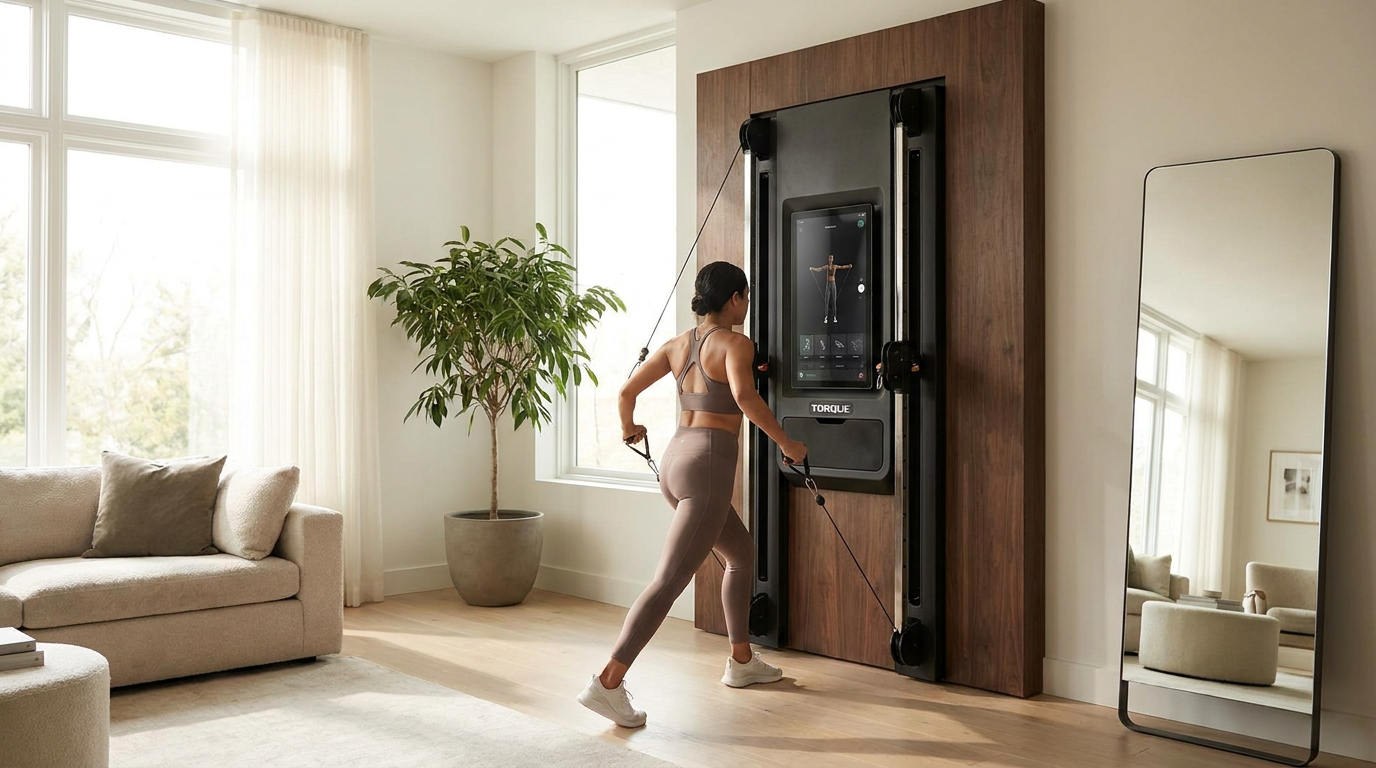
The home fitness landscape is undergoing a quiet but profound revolution, trading bulky iron plates and sprawling power racks for sleek, wall-mounted screens and motorized floor platforms. Brands like Tonal, Vitruvian, and Speediance are leading a massive shift away from traditional dumbbells, replacing gravity-bound metal with digital resistance. This new category of smart equipment promises to deliver a full commercial gym experience in a fraction of the square footage, using complex algorithms and electric servo motors to simulate heavy lifting. For many consumers, the appeal of saving space and accessing on-demand coaching is enough to justify the premium price tags, but the technological shift raises deeper questions about exercise science.[9]
The core question for fitness enthusiasts, professional athletes, and skeptics alike is straightforward: Can a computer-generated magnetic force actually replace the raw, gravity-bound reality of a barbell? For decades, the fitness industry has operated on the assumption that moving heavy physical mass through space is the only true way to build strength and muscle. Digital resistance challenges this fundamental premise, suggesting that the body does not actually care what it is lifting, so long as the mechanical tension is sufficient. The answer to this debate lies deep in the biomechanics of how our muscles perceive load, fatigue, and adaptation.[9]
According to sports scientists and biomechanists, the human body does not know the difference between a cast-iron plate and an electromagnetic field. Associate Professor Kong Pui Wah of the National Institute of Education notes that the physiological principles of resistance training apply universally, regardless of the equipment used. Whether the mechanical load comes from gravity, elastic bands, or a motor-based system, the muscle fibers respond to the tension they are forced to overcome. The benefits of traditional weight training—such as increases in muscle mass, functional performance, and bone density—are entirely applicable to digitally programmed resistance training.[1]
To truly understand why digital weight is so effective, one must look closely at the physics of the lift. Traditional free weights rely entirely on physical mass and gravity. A 20-pound dumbbell always weighs exactly 20 pounds, and it exerts a constant downward force toward the floor. However, the actual tension placed on the muscle changes dramatically throughout the range of motion due to the body's changing leverage, joint angles, and the momentum generated during the exercise. This creates a variable force curve where the exercise feels incredibly heavy at certain points and almost effortless at others.[7]

Motorized resistance machines operate on a completely different mechanical paradigm. Instead of fighting gravity, these systems use advanced servo motors and microprocessors to generate force. The internal computers read the user's physical output thousands of times per second, dynamically adjusting the pull of the cables to maintain constant, unwavering tension. If the user pulls harder, the motor instantly resists with equal force; if the user slows down, the motor adapts to keep the muscle fully engaged without letting the cable go slack.[7]
This constant tension eliminates one of the most common "cheats" in traditional weightlifting: momentum. When lifting a physical weight, accelerating the mass rapidly at the bottom of the movement allows the weight to carry itself through the top of the lift via inertia. Because digital resistance is generated by a motor rather than physical mass, it removes momentum entirely. The user is forced to actively pull or push the weight through every single millimeter of the range of motion, resulting in a significantly more demanding muscular contraction.[1]
This complete lack of momentum explains a phenomenon widely reported by new smart gym users: digital weight feels significantly heavier than traditional iron. A comprehensive study conducted by the Human Biomechanics and Physiology Laboratory at High Point University set out to quantify this exact effect. The researchers wanted to determine if the targeted muscle activation achieved with a digital system could truly match or exceed the stimulus provided by traditional free weights and cable column machines found in commercial gyms.[2]
The research team compared muscle activation across several exercises performed with Tonal's digital weight, standard barbells, and traditional pin-loaded cable machines. They discovered that while the digital resistance provided comparable overall muscle activation, the perceived effort was drastically different. When the muscle activation was equalized, the digital weight felt between 16 and 26 percent heavier than the equivalent free weight, based on both the users' rate of perceived exertion and the objective electromyography data collected during the lifts.[2]
The research team compared muscle activation across several exercises performed with Tonal's digital weight, standard barbells, and traditional pin-loaded cable machines.
To put this into practical terms, the researchers noted that lifting 110 pounds of digital weight produced the exact same electromyography activation as lifting a 135-pound traditional barbell. This increased efficiency means that users can achieve a greater muscle-building stimulus while technically lifting less absolute weight. By maximizing the time spent under tension and eliminating the micro-rests that occur at the top and bottom of a traditional barbell lift, digital systems pack more physiological stress into every single repetition.[2]

Beyond maintaining constant tension, the true superpower of digital resistance lies in its ability to seamlessly manipulate the eccentric phase of a lift. Every dynamic muscle contraction consists of two primary phases: the concentric phase, where the muscle shortens while producing force (such as curling a dumbbell upward toward the shoulder), and the eccentric phase, where the muscle lengthens under tension (such as slowly lowering that same dumbbell back down to the starting position at the hip). Mastering both phases is critical for optimal athletic development.[5]
Human physiology dictates that our muscles are approximately 40 percent stronger during the eccentric phase than they are during the concentric phase. However, when training with traditional free weights, the total load you can use is strictly limited by what you can lift concentrically. If you can only curl 40 pounds upward, you are stuck lowering that same 40 pounds downward. This mechanical limitation means your eccentric strength capacity is chronically under-loaded and under-stimulated during standard training sessions, leaving significant muscle-building potential on the table.[5]
Motorized systems and flywheel devices solve this biological bottleneck by artificially generating what is known as "eccentric overload." Because the resistance is controlled by software, the machine can dynamically add weight the exact moment the user begins to lower the handle. You might lift 100 pounds concentrically, and the machine will instantly increase the resistance to 140 pounds for the eccentric lowering phase. Research published by the National Institutes of Health indicates that this specific type of eccentric overload training yields superior results for muscle hypertrophy, sprint performance, and explosive power.[3][5]

High-performance athletic training facilities and professional sports teams have utilized this concept for years with specialized, commercial-grade equipment like ARX machines. These devices use adaptive resistance to perfectly match the user's force output in real-time, safely overloading the eccentric phase to a degree that would be impossible—or highly dangerous—with free weights. Studies on these adaptive systems have shown massive improvements in time efficiency, with users achieving greater strength gains and cardiovascular improvements in a fraction of the time required for traditional weightlifting protocols.[8]
Safety is another major factor driving the rapid consumer adoption of digital weights, particularly among demographics that have historically avoided heavy lifting. Every year, hundreds of thousands of Americans visit emergency rooms for gym-related injuries, often resulting from dropped weights, pinched fingers, or failed lifts where a user gets pinned under a heavy barbell. For older adults, beginners, or those recovering from orthopedic injuries, the inherent risks of navigating a crowded weight room and maneuvering heavy iron plates can be a massive barrier to entry for strength training.[7]
Smart gyms address this danger by acting as an algorithmic, ever-present spotter. Because the machine is constantly reading the user's output, it knows exactly when a lifter is failing. If the sensors detect the bar slowing down dramatically, or if the user begins to struggle to complete a repetition, the system can instantly reduce the weight by a few pounds. This allows the user to finish the set safely and with proper form, completely eliminating the fear of getting trapped under a heavy load.[7]
This dynamic safety net makes digital resistance particularly appealing for older adults, individuals undergoing physical therapy, and anyone training alone in their living room. It allows users to push themselves to the point of absolute muscular failure—the key driver of muscle growth and strength adaptation—without the inherent risks associated with heavy free weights. The ability to turn the weight off entirely with the click of a button on a smart handle provides a level of security that traditional iron simply cannot match.[7]

Despite the clear technological and physiological advantages, digital resistance is not without its critics and limitations. Traditional strength and conditioning purists argue that machine-guided cables fail to engage the small, stabilizing muscles required to balance a free-weight barbell during complex, multi-joint movements like the back squat or the overhead press. Learning to balance a physical load in three-dimensional space develops proprioception and core stability in a way that a perfectly smooth, motor-driven cable may not fully replicate.[6][9]
Furthermore, hardware limitations remain a factor for elite powerlifters and advanced strength athletes. While heavy-duty floor platforms like the Vitruvian Trainer+ can generate an impressive 440 pounds of digital resistance, popular wall-mounted systems like Tonal max out at 200 pounds. For a competitive lifter performing heavy deadlifts or squats, 200 pounds—even without momentum—may not provide enough absolute stimulus to drive continued adaptation. Additionally, the reliance on mandatory monthly software subscriptions to access the machines' full features remains a point of friction for many consumers.[6]
Ultimately, digital resistance represents a fundamental and permanent shift in the science of strength training. By replacing the static pull of gravity with dynamic, responsive algorithms, these machines offer a highly efficient, data-driven, and exceptionally safe way to build muscle and improve metabolic health. While the traditional barbell will always have its rightful place in commercial gyms and competitive sports, the future of home fitness is undeniably electric, proving that you don't need heavy iron to build serious strength.[9]
How we got here
Early 1900s
Early research on flywheel devices begins, exploring inertia-based resistance.
Late 1980s
NASA begins experimenting with flywheel and adaptive resistance technology to help astronauts maintain muscle mass in zero gravity.
2018
Tonal launches its wall-mounted smart gym, popularizing digital resistance for the consumer home market.
2020-2022
The pandemic accelerates the home fitness boom, leading to the rise of heavy-duty digital platforms like Vitruvian and Speediance.
2026
Digital resistance becomes a mainstream alternative to free weights, backed by extensive biomechanical research and widespread consumer adoption.
Viewpoints in depth
Biomechanists & Researchers
Focuses on the measurable neuromuscular adaptations driven by constant tension and eccentric overload.
Sports scientists and biomechanics researchers emphasize that the body adapts to mechanical tension, regardless of the source. They point to clinical data showing that digital resistance and flywheel devices can safely push muscles past their concentric limits into 'eccentric overload.' This targeted overloading of the lengthening phase is heavily correlated with superior gains in muscle hypertrophy, sprint speed, and overall explosive power compared to traditional gravity-based lifting.
Fitness Technology Innovators
Highlights the safety, time efficiency, and algorithmic personalization of smart home gyms.
Manufacturers and developers of digital resistance platforms view traditional free weights as an outdated, inefficient, and potentially dangerous way to train. By replacing physical mass with servo motors, they argue that users can achieve better results in a fraction of the time. Furthermore, the integration of AI spotters and automatic weight adjustments drastically lowers the barrier to entry, making heavy strength training accessible and safe for older adults and those recovering from injuries.
Strength & Conditioning Coaches
Balances the benefits of new technology with the necessity of traditional free weights for raw power and stability.
While acknowledging the impressive science behind constant tension and eccentric overload, traditional strength coaches caution against abandoning the barbell entirely. They argue that balancing a physical weight in three-dimensional space engages crucial stabilizer muscles and develops core proprioception that machine-guided cables cannot replicate. Additionally, they note that the absolute resistance limits of many smart gyms may not be sufficient for elite powerlifters looking to maximize their absolute strength.
What we don't know
- Long-term epidemiological data comparing the joint health of lifelong digital resistance users versus traditional weightlifters.
- Whether the lack of stabilizer muscle engagement in digital cable systems translates to a higher risk of injury in real-world, unguided physical tasks.
- How the durability and maintenance costs of complex servo motors will compare to traditional iron weights over a 10-to-20-year lifespan.
Key terms
- Digital Resistance
- Resistance generated by electric servo motors and algorithms rather than physical mass and gravity.
- Concentric Contraction
- The phase of an exercise where the muscle shortens while producing force, such as lifting a dumbbell during a bicep curl.
- Eccentric Contraction
- The phase of an exercise where the muscle lengthens under tension, such as slowly lowering a dumbbell.
- Eccentric Overload
- A training technique that applies greater resistance during the eccentric phase of a movement than the concentric phase.
- Electromyography (EMG)
- A diagnostic procedure used to assess the health of muscles and the nerve cells that control them, often used to measure muscle activation during exercise.
Frequently asked
Can digital weights build as much muscle as free weights?
Yes. Studies show that digital resistance provides comparable or even superior muscle activation by maintaining constant tension and eliminating momentum.
Why does digital weight feel heavier than traditional dumbbells?
Digital systems remove the inertia and momentum that naturally occur when lifting physical mass, forcing your muscles to work harder through the entire range of motion.
What is eccentric overload?
It is a training method where the resistance is heavier when you lower the weight (the eccentric phase) than when you lift it, taking advantage of the fact that muscles are naturally stronger while lengthening.
Are smart gyms safe for older adults?
Yes. Many digital resistance machines feature algorithmic spotters that automatically reduce the weight if the user struggles, significantly lowering the risk of injury.
Sources
Source coverage
9 outlets
3 viewpoints surfaced









[1]The Straits TimesBiomechanists & Researchers
No more dumbbells or weight plates: Could a digital home gym replace your gym membership?
Read on The Straits Times →[2]High Point University Biomechanics LabFitness Technology Innovators
You asked, we answered: External research explains how Tonal digital weight compares to free weight
Read on High Point University Biomechanics Lab →[3]National Institutes of HealthBiomechanists & Researchers
Efficacy of resisted sled sprint training compared with unresisted sprint training on acceleration and sprint performance
Read on National Institutes of Health →[4]SimpliFasterStrength & Conditioning Coaches
Building High Total Body Resilience with Eccentric Overload
Read on SimpliFaster →[5]Physical Therapy FirstBiomechanists & Researchers
Flywheel Eccentric Training: How to Effectively Generate Eccentric Overload
Read on Physical Therapy First →[6]Garage Gym ReviewsStrength & Conditioning Coaches
Vitruvian Trainer+ vs Tonal: Which Smart Home Gym is Better?
Read on Garage Gym Reviews →[7]SpeedianceFitness Technology Innovators
What Is Digital Resistance Training and How Does It Work?
Read on Speediance →[8]ARX FitFitness Technology Innovators
The Science of Adaptive Resistance: ARX vs Weights
Read on ARX Fit →[9]Factlen Editorial TeamStrength & Conditioning Coaches
Synthesis by Factlen editorial team
Read on Factlen Editorial Team →

Every angle. Every day.
Get fitness stories with full source coverage and perspective breakdowns delivered to your inbox.