
Developing Neurons Routinely Break and Repair Their Own DNA to Build the Brain
Newborn neurons must squeeze through dense tissue to build the cerebral cortex, routinely sustaining severe DNA double-strand breaks that the brain rapidly repairs.
By Factlen Editorial Team
- Developmental Neurobiologists
- View the break-and-repair cycle as a brilliant evolutionary compromise that allows the mammalian brain to build a massive, complex cortex.
- Neurodegeneration Researchers
- Focus on the long-term risks when this repair mechanism fails, linking unresolved DNA breaks to Alzheimer's and aging.
- Genomic Plasticity Advocates
- Argue that this mechanical damage intentionally introduces genetic diversity, making every neuron computationally unique.
What's not represented
- · Pediatric Neurologists
- · Evolutionary Biologists
Why this matters
This discovery fundamentally rewrites our understanding of brain biology, revealing that the genome is not a fragile, untouchable blueprint, but a dynamic structure that deliberately breaks and repairs itself to build human cognition. Understanding this resilience could unlock new approaches to preventing neurodegenerative diseases like Alzheimer's.
Key points
- Newborn neurons must migrate through dense brain tissue to form the cerebral cortex.
- The mechanical stress of this journey causes severe DNA double-strand breaks.
- An enzyme called Topoisomerase IIβ gets trapped mid-cut due to physical pressure.
- The brain rapidly repairs this damage within 24 hours using non-homologous end joining.
- Unlike cancer cells, neurons confine this damage to non-critical regions of the genome.
- Failure to repair these breaks is linked to neurodegenerative diseases later in life.
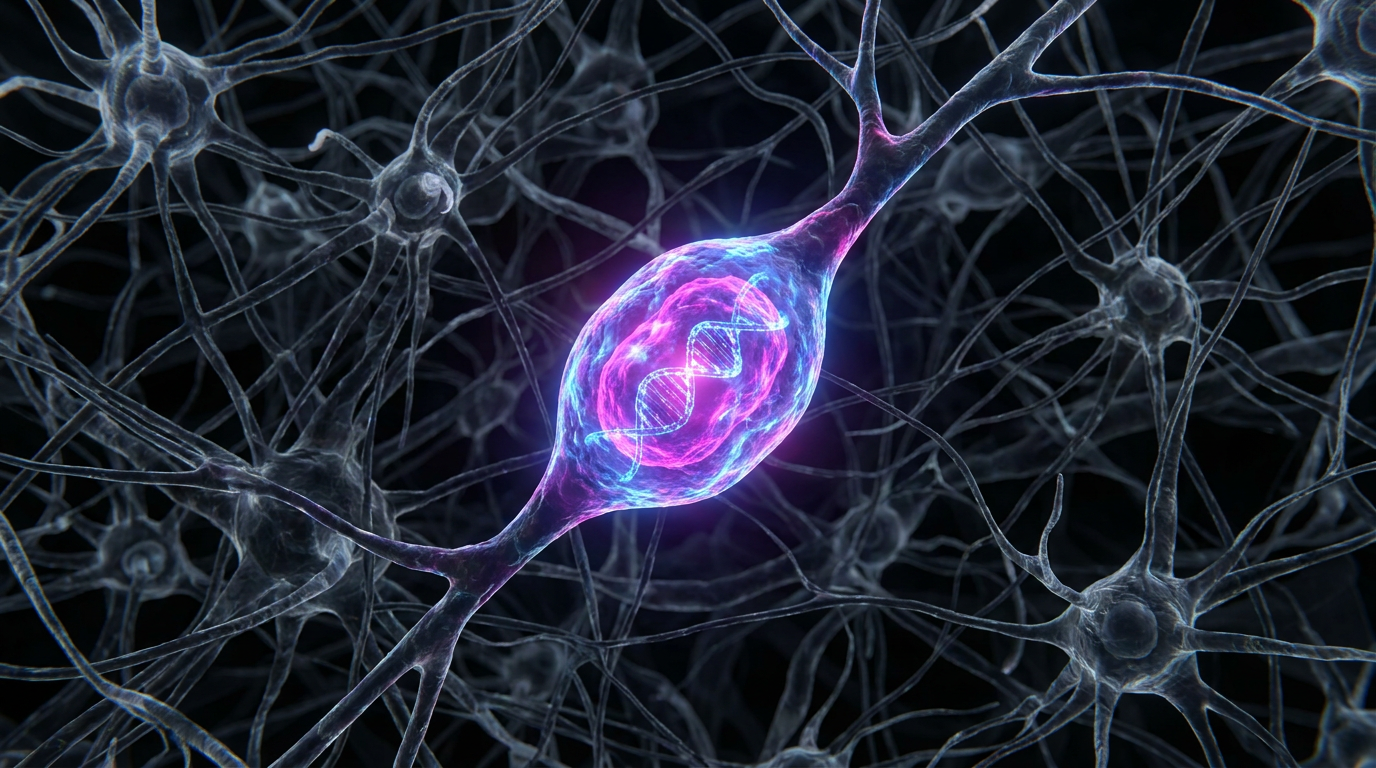
The human brain is arguably the most complex structure in the known universe, but it begins as a single cell. To build the intricate circuitry of the cerebral cortex, roughly 170 billion cells must be generated and precisely positioned. This requires newborn neurons to embark on a massive physical migration from their birthplace deep within the brain to their final destinations in the outer layers. It is a journey fraught with mechanical hazards, as these delicate cells must squeeze through incredibly dense, tightly packed tissue. For decades, biologists assumed this migration was a purely physical challenge. However, emerging evidence reveals that the journey exacts a profound molecular toll, fundamentally altering the genetic blueprint of the cells themselves.[1][2]
As newborn neurons navigate the cramped, narrow spaces of the developing brain, they are subjected to immense mechanical stress. They must push past other cells, navigate between rigid fibers, and deform their own structures to fit through gaps that are often smaller than their own nuclei. The nucleus is the largest and stiffest component of a cell, housing the precious cargo of DNA. When a neuron forces its nucleus through a microscopic bottleneck, the physical strain is transmitted directly to the genome inside. Researchers have now discovered that this mechanical squeezing routinely causes the DNA double helix to snap, resulting in widespread genetic damage.[2][3]
In a landmark study published in the journal Nature, a team of researchers led by neurobiologist Mineko Kengaku at Kyoto University documented this phenomenon in unprecedented detail. By guiding migrating neurons through artificial microchannels designed to mimic the confined spaces of developing brain tissue, the team observed a startling reality. As the cells squeezed through the tightest passages, fluorescent markers lit up, indicating the sudden appearance of DNA double-strand breaks. Rather than being a rare or pathological anomaly, the researchers found that this severe genetic damage is a normal, routine feature of healthy brain cortex formation.[1][4]
To appreciate the gravity of this discovery, one must understand that a double-strand break is widely considered the most dangerous form of DNA damage. Unlike a single-strand break, which leaves the opposite strand intact to serve as a template for repair, a double-strand break completely severs the chromosome. In most cell types, this level of damage is a death sentence. It is the kind of catastrophic injury typically caused by ionizing radiation or toxic chemicals, and it is a primary driver of cancer and cellular aging. Yet, newborn neurons routinely sustain this lethal damage and somehow emerge completely intact.[5][7]

The mechanism behind these breaks involves an enzyme called Topoisomerase IIβ. Under normal circumstances, DNA is tightly coiled and twisted to fit inside the nucleus. When a cell needs to access its genes or replicate its genome, Topoisomerase IIβ acts as a molecular pair of scissors. It makes controlled, temporary cuts in the DNA to relieve torsional strain—much like snipping a twisted telephone cord to let it untangle before splicing it back together. This enzyme is essential for everyday cellular function, but it operates under a delicate balance of tension and release.[1][2]
The Kyoto University team discovered that the intense mechanical pressure of migration disrupts this delicate balance. As the neuron's nucleus is compressed while squeezing through tight spaces, the physical strain alters the DNA's topology. Topoisomerase IIβ attempts to relieve the stress by cutting the strands, but the extreme pressure causes the enzyme to become physically trapped mid-process. It gets stuck on the DNA, leaving the severed ends exposed and resulting in a full double-strand break. The very mechanism designed to protect the DNA from tangling ends up breaking it under the crush of the developing brain.[1][4]
What makes this process truly remarkable is not just the damage, but the brain's astonishing capacity for rapid repair. The researchers found that once the neurons emerged from the tight microchannels and completed their migration, the fluorescent markers indicating DNA damage began to fade. The cells deployed a highly efficient repair pathway known as non-homologous end joining, which rapidly stitches the broken DNA ends back together. In healthy developing brains, the vast majority of these double-strand breaks are perfectly repaired within 24 hours, allowing the neurons to integrate into the cortex and function normally.[1][3]
What makes this process truly remarkable is not just the damage, but the brain's astonishing capacity for rapid repair.
This resilience is unique to neurons. When the researchers subjected migrating cancer cells to the same confined microchannels, the results were drastically different. The mechanical stress caused widespread, random DNA damage across the cancer cells' genomes, frequently impairing their function or triggering cell death. Neurons, however, appear to have evolved a protective strategy. The double-strand breaks in migrating neurons occur predominantly in non-critical, transcriptionally inactive regions of the genome. By confining the damage to areas where it won't disrupt essential gene activity, the neuron preserves its overall function while surviving the mechanical gauntlet.[4][5]
From an evolutionary perspective, this break-and-repair cycle represents a brilliant, if risky, biological compromise. The mammalian brain has evolved to be increasingly large and complex, requiring a thicker, more densely packed cerebral cortex. To build this advanced architecture, neurons must travel longer distances through tighter spaces. Rather than engineering a completely indestructible nucleus—which might be too rigid to migrate at all—the developing brain evolved to tolerate the inevitable mechanical damage and compensate with an incredibly fast and efficient repair system. It is a paradox of extreme vulnerability paired with extreme resilience.[3]
This evolutionary trade-off has profound implications for human biology. While the initial experiments were conducted in mice, researchers suspect the phenomenon is even more pronounced in human brains. Because the human cerebral cortex is vastly larger and more complex than that of a mouse, human neurons must migrate across much greater distances and navigate through significantly more dense tissue. Consequently, human neurons likely generate far more DNA damage during early development. The flawless execution of the repair cycle is therefore even more critical for human cognitive development and overall brain health.[3]

But what happens when this flawless repair cycle fails? To answer this, the researchers engineered mice that lacked Ligase IV, a crucial protein required for the non-homologous end joining repair pathway. Without this protein, the newborn neurons could still migrate, but they were unable to efficiently stitch their broken DNA back together. The breaks persisted long after the cells had reached their final destinations in the cortex. Initially, the mice appeared to develop normally, suggesting that the brain can tolerate a surprising amount of genetic damage in its early stages.[1][5]
However, as the mutant mice reached adulthood, the hidden cost of the unrepaired DNA became apparent. They gradually developed mild, progressive balance difficulties and motor deficits. These symptoms closely mirror certain human genome instability syndromes, which are characterized by neurodegeneration and a loss of motor control. The findings provide compelling evidence that the DNA damage generated during normal brain development poses a latent disease risk. If the rapid repair system is compromised by genetic mutations or environmental factors, the lingering damage can manifest as neurological disorders decades later.[1][2]
This discovery bridges the gap between early brain development and late-life cognitive decline. Persistent DNA double-strand breaks are an early pathological hallmark of neurodegenerative diseases, including Alzheimer's disease. Recent single-nucleus RNA sequencing of human postmortem brains has revealed that neurons in Alzheimer's patients are heavily burdened with somatic genome structural variations and gene fusions—the exact types of errors that occur when double-strand breaks are improperly repaired. The mechanical stress of early development may set the stage for these vulnerabilities, creating fragile points in the genome that degrade over a lifetime.[6][8]
Beyond disease, the routine breaking and repairing of DNA raises a tantalizing question about the nature of the brain itself. Every time a double-strand break is repaired via non-homologous end joining, there is a small chance of a microscopic error—a deleted base pair here, an inserted nucleotide there. If millions of neurons are constantly breaking and repairing their DNA during development, this process could introduce tiny genetic differences between individual cells. This phenomenon, known as somatic mosaicism, means that not every cell in the brain shares the exact same genetic code.[7][8]

Some researchers argue that this somatic mosaicism is not a bug, but a feature. The slight genetic variations introduced by the mechanical journey could contribute to neuronal individuality, ensuring that the brain is populated by a highly diverse array of cells. This diversity might be essential for the complex computational power of the cerebral cortex, allowing different neurons to specialize in subtle ways. In this view, the physical struggle of migration literally writes a unique history into the genome of every single neuron, shaping the ultimate architecture of the mind.[2][4]
Despite these breakthroughs, significant uncertainties remain. Scientists do not yet know the full extent of this DNA damage in living human embryos, nor can they definitively prove whether the breaks are purely a mechanical side-effect or if they serve an active role in turning on specific developmental genes. Furthermore, it remains unclear how environmental factors—such as maternal stress, nutrition, or exposure to toxins—might influence the efficiency of the Topoisomerase IIβ enzyme and the subsequent repair pathways during critical windows of fetal brain development.[3][7]
Ultimately, the discovery that neurons routinely break their own DNA to build the brain forces a paradigm shift in neuroscience. The neuronal genome can no longer be viewed as a pristine, untouchable blueprint locked safely inside the nucleus. Instead, it is a dynamic, physical structure that is subjected to immense stress, deliberately fractured, and meticulously rebuilt. The fact that our most complex organ is constructed through a process of controlled genetic damage is a testament to the astonishing resilience of biology, revealing that the foundation of human cognition is forged in the crucible of cellular survival.[2][9]
How we got here
1990s
Early studies first implicate DNA double-strand breaks in the development of the nervous system.
2015
Researchers discover that stimulating cultured neurons triggers rapid DNA breaks to express learning and memory genes.
2023
Single-nucleus RNA sequencing reveals that persistent DNA breaks in neurons are an early hallmark of Alzheimer's disease.
June 2026
Kyoto University researchers publish evidence in Nature that migrating newborn neurons routinely break and repair their DNA to build the brain cortex.
Viewpoints in depth
Developmental Neurobiologists
View the break-and-repair cycle as a brilliant evolutionary compromise that allows the mammalian brain to build a massive, complex cortex.
For developmental neurobiologists, the discovery highlights the incredible evolutionary trade-offs required to build a complex mammalian brain. Rather than engineering an indestructible nucleus that would be too rigid to migrate through dense tissue, evolution favored a flexible nucleus that can sustain damage, paired with an ultra-fast repair mechanism. This perspective emphasizes that biological systems are often optimized for resilience rather than perfection, allowing the brain to achieve its massive scale and intricate connectivity despite the physical hazards of cellular migration.
Neurodegeneration Researchers
Focus on the long-term risks when this repair mechanism fails, linking unresolved DNA breaks to Alzheimer's and aging.
Researchers studying aging and neurodegeneration view these findings as a critical missing link in understanding cognitive decline. They point out that while the brain's repair mechanisms are highly efficient during youth, they naturally degrade over time. If the mechanical stress of early development creates fragile points in the genome, the gradual failure of repair pathways later in life could allow these double-strand breaks to accumulate. This accumulation is a known hallmark of Alzheimer's disease, suggesting that the seeds of late-life neurodegeneration may be planted during the very formation of the brain.
Genomic Plasticity Advocates
Argue that this mechanical damage intentionally introduces genetic diversity, making every neuron computationally unique.
A growing camp of geneticists and neuroscientists argue that this break-and-repair cycle is not just a side-effect of migration, but a vital feature of brain development. Because the non-homologous end joining repair pathway is prone to tiny errors, the constant breaking and stitching of DNA likely introduces microscopic genetic variations—somatic mosaicism—across the billions of neurons in the cortex. This perspective suggests that the physical struggle of migration literally writes a unique history into the genome of every cell, generating the vast diversity required for the brain's unparalleled computational power.
What we don't know
- Whether the DNA breaks are purely a mechanical side-effect of migration or if they actively help turn on specific developmental genes.
- The exact extent to which this break-and-repair cycle introduces permanent genetic diversity (somatic mosaicism) among individual neurons.
- How environmental factors like maternal stress or toxins might impair the rapid 24-hour repair window during fetal development.
Key terms
- Double-strand break
- The most severe form of DNA damage, where both strands of the double helix are completely severed.
- Topoisomerase IIβ
- An enzyme that normally makes controlled, temporary cuts in DNA to relieve twisting and tension during cellular activity.
- Non-homologous end joining
- A rapid cellular repair pathway that stitches broken DNA ends back together without needing a template.
- Somatic mosaicism
- The presence of small genetic differences between individual cells in the same body, potentially contributing to neuronal diversity.
- Ligase IV
- A crucial protein involved in the final stages of stitching broken DNA strands back together during repair.
Frequently asked
Why do neurons break their own DNA?
As newborn neurons squeeze through dense brain tissue to reach their final positions, the mechanical stress traps an enzyme that normally untangles DNA, causing the strands to snap.
Doesn't DNA damage cause cancer or cell death?
In most cells, double-strand breaks are fatal or cause mutations. However, developing neurons confine this damage to non-critical regions and rapidly repair it.
What happens if the DNA isn't repaired?
Experiments in mice show that if the repair process is interrupted, the animals develop progressive neurological and balance issues later in life.
Does this happen in human brains?
Yes, and researchers suspect it may be even more pronounced in humans than in mice, because human neurons must migrate across much larger distances to build our complex cortex.
Sources
Source coverage
9 outlets
3 viewpoints surfaced









[1]NatureDevelopmental Neurobiologists
Massive DNA double-stranded breaks accompany neuronal migration in the developing brain
Read on Nature →[2]Kyoto UniversityDevelopmental Neurobiologists
Researchers find that neurons routinely sustain DNA breaks during cortex formation
Read on Kyoto University →[3]Science NewsDevelopmental Neurobiologists
Healthy brains may be built through a process of controlled damage and rapid repair
Read on Science News →[4]ScienceDailyGenomic Plasticity Advocates
Scientists discover neurons must break their DNA to build the brain
Read on ScienceDaily →[5]Neuroscience NewsNeurodegeneration Researchers
Building the Brain Means Breaking DNA
Read on Neuroscience News →[6]CellNeurodegeneration Researchers
Neuronal DNA double-strand breaks lead to genome structural variations and 3D genome disruption in neurodegeneration
Read on Cell →[7]National Institutes of HealthNeurodegeneration Researchers
DNA double-strand breaks as drivers of neural genomic change, function, and disease
Read on National Institutes of Health →[8]Quanta MagazineGenomic Plasticity Advocates
Brains Snap Their DNA to Learn and Remember
Read on Quanta Magazine →[9]Factlen Editorial TeamGenomic Plasticity Advocates
Synthesis by Factlen editorial team
Read on Factlen Editorial Team →
More in science
See all 6 stories →Quantum Metrology
First 'Nuclear Clock' Ticks, Ushering in New Era of Precision Measurement and Fundamental Physics
8 sources
Astrophysics
Ultra-High Energy Cosmic Rays Identified as Heavy Atomic Nuclei, Not Protons, Rewriting Their Origin Story
6 sources

Carbon Sink
Climate Models Overestimate Forest Carbon Sink by 30% as Warming Slows Tree Growth
6 sources

Astrophysics
Einstein Probe Captures First Direct Evidence of Intermediate-Mass Black Hole Devouring a Star
5 sources

Every angle. Every day.
Get science stories with full source coverage and perspective breakdowns delivered to your inbox.