
Beyond Sustainable: How Regenerative Tourism is Rewriting the Rules of Global Travel
Destinations are abandoning traditional sustainability in favor of 'regenerative tourism'—a model designed to leave ecosystems and local communities measurably better than before.
By Factlen Editorial Team
- Destination Management Organizations
- Prioritize long-term community resilience and shifting tourism metrics from volume to value.
- Ecological Researchers
- Demand measurable, net-positive impacts on biodiversity and warn against greenwashing.
- Tourism Industry Operators
- Seek to balance ecological restoration with economic viability and consumer demand.
- Local Communities
- Advocate for retaining economic benefits and preserving cultural heritage against overtourism.
What's not represented
- · Budget travelers who may be priced out of high-end regenerative experiences.
- · Aviation industry representatives addressing the inherent carbon cost of reaching remote destinations.
Why this matters
As global travel rebounds, the places we love to visit are under unprecedented strain. The shift to regenerative tourism means your next vacation could actively heal a coral reef or revive a local craft, fundamentally changing the economic and environmental legacy of your leisure time.
Key points
- Regenerative tourism moves beyond traditional sustainability by aiming to leave destinations measurably better than before.
- The model requires a shift from volume-driven metrics (headcount) to value-driven metrics (yield per visitor and local economic retention).
- Destinations like Hawaii and New Zealand are leading the charge by integrating volunteerism and Indigenous ecological stewardship into the visitor experience.
- Despite growing policy support, the industry faces challenges in scaling regenerative practices to mass tourism and avoiding the pitfalls of greenwashing.
For the past two decades, the holy grail of the global travel industry has been "sustainability"—the idea that a destination could host millions of visitors while minimizing the environmental and social damage they leave behind. But as the sheer volume of global travel rebounds past pre-pandemic peaks, a growing coalition of governments, academics, and industry leaders are arguing that doing less harm is no longer sufficient. Enter "regenerative tourism," a paradigm shift that asks not how to maintain a destination's current baseline, but how the act of travel can actively heal and restore the places people visit.[8]
The distinction between the two concepts is fundamental to how destinations will be managed in the coming decades. Sustainable tourism is essentially a minimization framework. It focuses on reducing carbon footprints, limiting water usage, and ensuring that a locale is not degraded by the presence of outsiders. Regenerative tourism, by contrast, is a net-positive framework. It demands that a visitor's presence actively improves the ecological health, cultural vitality, and economic resilience of the host community, leaving the destination measurably better than they found it.[3][5]
This shift in ambition is rapidly moving from niche academic theory to mainstream international policy. UN Tourism has formally endorsed frameworks that link climate action directly to ecosystem restoration and community resilience, pushing destinations to adopt regenerative approaches that strengthen the nexus between biodiversity and tourism economics. At recent global climate summits, including COP30, the integration of tourism into national adaptation processes has been a strategic priority, with a focus on scaling nature-based solutions, stewarding forests, and unlocking innovative finance mechanisms like blue carbon initiatives to crowd in private investment.[1]

The academic community has mirrored this policy momentum, treating regeneration as a necessary evolution of the travel sector. The newly established Journal of Tourism Regeneration, alongside a massive spike in peer-reviewed literature since 2021, highlights the urgent need for actionable metrics that transcend traditional sustainability models. Researchers emphasize that regenerative tourism requires a profound shift in social-ecological consciousness, acknowledging that visitors and destinations are part of a living, interconnected system rather than a transactional supply chain where natural resources are simply consumed for leisure.[2]
The mechanism of regenerative tourism operates by redirecting the flow of visitor capital and attention directly into the restoration of the destination's core assets. Rather than simply taxing tourists to offset carbon, regenerative models integrate the visitor into the solution. This often involves hands-on participation, educational immersion, and a deliberate dispersal of economic benefits away from crowded hotspots and into marginalized or rural communities that serve as the stewards of the local environment.[8]
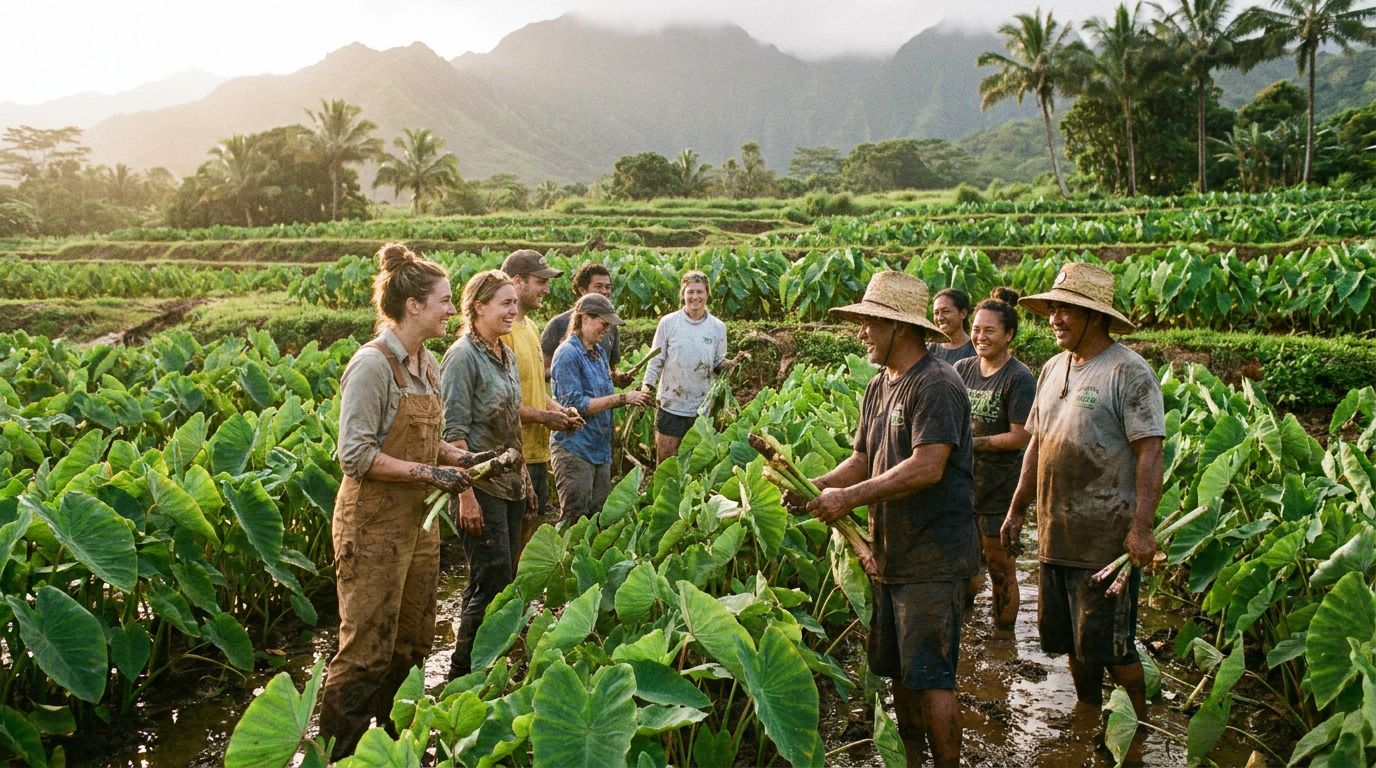
Hawaii offers one of the most prominent real-world applications of this mechanism through its Malama Hawaii initiative. In the Hawaiian language, "malama" means to care for, protect, and preserve. The state's tourism authority has partnered with hotels and local organizations to encourage visitors to engage in volunteer activities—such as clearing invasive species from native forests, restoring ancient fishponds, or participating in beach cleanups. In exchange for their labor and engagement, tourists receive tangible rewards like complimentary hotel nights or significant discounts, fundamentally altering the transactional nature of a vacation.[3][6]
New Zealand has similarly embedded regenerative principles into its national tourism strategy, drawing heavily on Indigenous Māori worldviews that view humans as an inseparable part of the natural environment. The country's Tiaki Promise asks visitors to pledge to care for the land, sea, and culture during their stay. Beyond pledges, New Zealand is investing in infrastructure like the Hinewai Reserve, which allows native forests to regenerate naturally while educating visitors on conservation. The goal is to unlock the potential of all stakeholders—residents, businesses, and tourists—to contribute to the holistic well-being of the destination.[5][6]
The country's Tiaki Promise asks visitors to pledge to care for the land, sea, and culture during their stay.
In Europe, the focus of regenerative tourism often expands beyond ecology to encompass the preservation of intangible cultural heritage. The European Commission has recognized that extractive, volume-driven tourism threatens the social fabric of historic cities, prompting a shift toward inclusive governance and community-led models. The upcoming EU Sustainable Tourism Strategy 2026 is expected to firmly embed regeneration as a long-term goal across all member states, linking EU funding streams to projects that create long-term value for residents.[4]

A striking example of this cultural regeneration can be found in Ljubljana, Slovenia. To combat the hollowing out of its historic center, the city's destination management organization launched a series of creative handicraft workshops. Visitors are directed away from crowded landmarks and into the studios of the city's last remaining umbrella makers, goldsmiths, and traditional weavers. This model not only revives threatened cultural traditions by providing artisans with a new revenue stream, but it also disperses visitor foot traffic and wealth across the community, proving that tourism can be a force for cultural renewal rather than commodification.[4][8]
On a larger, purely ecological scale, developers are attempting to prove that even massive new tourism infrastructure can be net-positive. Red Sea Global, which is developing vast tracts of Saudi Arabia's coastline, has published a Regenerative Tourism Blueprint that aims to achieve a 30 percent net conservation benefit by 2040. Their approach involves large-scale coral relocation, mangrove planting, and seagrass restoration, all powered by 100 percent renewable energy. While critics often view mega-developments with skepticism, the project's reliance on measurable environmental science and data-driven planning represents a bold test of whether luxury tourism can genuinely restore fragile ecosystems.[7]

The economic logic underpinning these initiatives is a deliberate pivot from volume to value. For decades, the success of a destination was measured almost entirely by headcount—how many millions of people crossed the border. Regenerative tourism prioritizes yield per visitor, length of stay, and the percentage of tourism revenue that remains within the local supply chain. By attracting travelers who are willing to spend more time and money on authentic, restorative experiences, destinations can generate higher economic returns with a fraction of the environmental and social strain.[5][8]
Consumer demand appears to be aligning with this shift. Recent industry reports indicate that a growing majority of travelers—up to 58 percent in some 2026 surveys—now prioritize destinations that actively support local ecosystems, and a significant portion are willing to pay a premium for experiences that deliver a real benefit to the environment. The pandemic served as a catalyst for this mindset shift, forcing a global pause that allowed both travelers and host communities to reevaluate the consequences of unchecked tourism and the legacy they wish to leave behind.[6][8]

Despite the optimism, the transition to regenerative tourism is fraught with uncertainty and the ever-present risk of greenwashing. As the term gains traction in marketing materials, there is a danger that it will be diluted into a meaningless buzzword, much like "eco-friendly" before it. Without rigorous, internationally standardized metrics to measure what constitutes a "net-positive" impact, destinations and hotel brands may claim to be regenerative while continuing business as usual under a new label.[2][8]
Furthermore, a profound question of scale remains unresolved. While boutique eco-lodges and carefully managed cultural workshops can clearly operate regeneratively, it is far less certain whether mass tourism—characterized by cruise ships, budget airlines, and all-inclusive mega-resorts—can ever truly leave a destination better than it found it. The physics of moving millions of people across the globe inherently involves carbon emissions and resource consumption that are difficult to fully offset, let alone reverse.[8]
Ultimately, the push for regenerative tourism represents an acknowledgment that the travel industry has reached a critical inflection point. Destinations that fail to protect and restore their core assets—whether pristine beaches, vibrant coral reefs, or authentic local cultures—will inevitably see those assets degrade, taking their tourism economies down with them. By embracing models that actively heal the places we visit, the industry is attempting to ensure that the act of exploring the world preserves it for the generations that follow.[1][8]
How we got here
Pre-2020
The global travel industry primarily focuses on 'sustainable tourism,' aiming to minimize the negative environmental impacts of mass travel.
2020-2021
The COVID-19 pandemic halts global travel, prompting destinations to reevaluate the consequences of overtourism and explore regenerative models.
2021
Hawaii launches the Malama Hawaii initiative, encouraging visitors to volunteer in exchange for travel discounts.
2022
Academic interest surges, with over 240 peer-reviewed papers published on regenerative tourism in a single year.
2024
The UN statistical system endorses a framework for measuring the sustainability and regenerative impacts of tourism globally.
2025
UN Tourism pushes for regenerative approaches to climate action at global summits, linking biodiversity with tourism economics.
Viewpoints in depth
Destination Management Organizations
Focus on long-term community resilience and shifting from volume to value.
For DMOs, the shift to regenerative tourism is fundamentally about protecting the core assets that make a destination appealing in the first place. They argue that the traditional metric of success—maximizing visitor arrivals—has led to overtourism, degraded infrastructure, and resident backlash. By focusing on yield per visitor and encouraging longer, more engaged stays, DMOs believe they can generate the same or greater economic value while drastically reducing the physical strain on local ecosystems and public services.
Ecological Researchers
Focus on measurable net-positive impacts on biodiversity and carbon sinks.
Environmental scientists and academic researchers emphasize that 'sustainability' has failed to halt the degradation of global ecosystems. They advocate for regenerative tourism because it demands measurable, net-positive outcomes, such as increased biodiversity, restored coral reefs, and expanded carbon sinks. However, this camp is also the most vocal about the need for rigorous, standardized metrics, warning that without strict scientific oversight, regenerative claims will quickly devolve into industry greenwashing.
Tourism Industry Operators
Focus on balancing profitability with the new consumer demand for responsible travel.
Hotels, tour operators, and airlines recognize the growing consumer demand for responsible travel, but they face the practical challenge of implementing regenerative practices while maintaining profit margins. Industry leaders argue that regenerative models must be economically viable to scale. They point to initiatives like Hawaii's Malama program—which trades volunteer labor for hotel discounts—as proof that businesses can align their financial incentives with ecological restoration, though they caution that mass-market adoption will require significant upfront investment in local supply chains.
What we don't know
- Whether standardized, internationally recognized metrics will be successfully implemented to prevent 'regenerative' from becoming a diluted marketing buzzword.
- How the inherent carbon emissions of long-haul aviation can be reconciled with the net-positive goals of regenerative destinations.
- If regenerative models can be successfully scaled to accommodate the sheer volume of middle-class global travelers, or if they will remain confined to luxury and boutique sectors.
Key terms
- Regenerative Tourism
- A travel model that seeks to ensure tourism delivers a net-positive benefit to people, places, and nature, actively restoring social and ecological systems.
- Net-Positive Impact
- An outcome where an activity creates more environmental or social benefit than the damage or resources it consumes.
- Destination Management Organization (DMO)
- An entity responsible for promoting a location as an attractive travel destination and managing the long-term impact of tourism on the local community.
- Blue Carbon Initiatives
- Projects focused on conserving and restoring coastal and marine ecosystems, such as mangroves and seagrasses, which capture and store large amounts of carbon dioxide.
- Greenwashing
- The practice of making misleading or unsubstantiated claims about the environmental benefits of a product, service, or company.
Frequently asked
What is the difference between sustainable and regenerative tourism?
Sustainable tourism aims to minimize negative impacts and maintain a destination's current state (doing less harm). Regenerative tourism aims to actively improve and restore the destination's environment and community (leaving it better than you found it).
How can a traveler participate in regenerative tourism?
Travelers can participate by choosing destinations and operators that invest in local supply chains, engaging in volunteer activities like habitat restoration, and respecting local cultural guidelines, such as New Zealand's Tiaki Promise.
Is regenerative tourism more expensive?
It can be, as it often prioritizes longer stays, local artisans, and fair wages over mass-market volume. However, programs like Hawaii's Malama initiative offer hotel discounts in exchange for volunteer work, making it accessible to a wider range of budgets.
Can mass tourism ever be regenerative?
This remains a major point of debate. While boutique eco-lodges can easily implement regenerative practices, applying these principles to large-scale operations like cruise ships and mega-resorts is significantly more challenging due to their inherent resource consumption.
Sources
Source coverage
8 outlets
4 viewpoints surfaced








[1]UN TourismEcological Researchers
Advancing Regenerative Approaches to Climate Action in Tourism
Read on UN Tourism →[2]Journal of Tourism RegenerationEcological Researchers
Embracing forward-thinking and transformative approaches to tourism
Read on Journal of Tourism Regeneration →[3]ForbesTourism Industry Operators
Why Regenerative Travel Is The Future Of Tourism
Read on Forbes →[4]European CommissionDestination Management Organizations
Regenerative Tourism: Leaving a Positive Handprint
Read on European Commission →[5]Destinations InternationalDestination Management Organizations
The Shift from Sustainable to Regenerative Destinations
Read on Destinations International →[6]Hotelier Middle EastTourism Industry Operators
How the pandemic encouraged a new appreciation for travel
Read on Hotelier Middle East →[7]Red Sea GlobalTourism Industry Operators
The Regenerative Tourism Blueprint
Read on Red Sea Global →[8]Factlen Editorial TeamLocal Communities
Synthesis by Factlen editorial team
Read on Factlen Editorial Team →

Every angle. Every day.
Get travel stories with full source coverage and perspective breakdowns delivered to your inbox.