
Apple's Siri AI Hands-On: The iOS 27 Overhaul Finally Delivers on Years of Promises
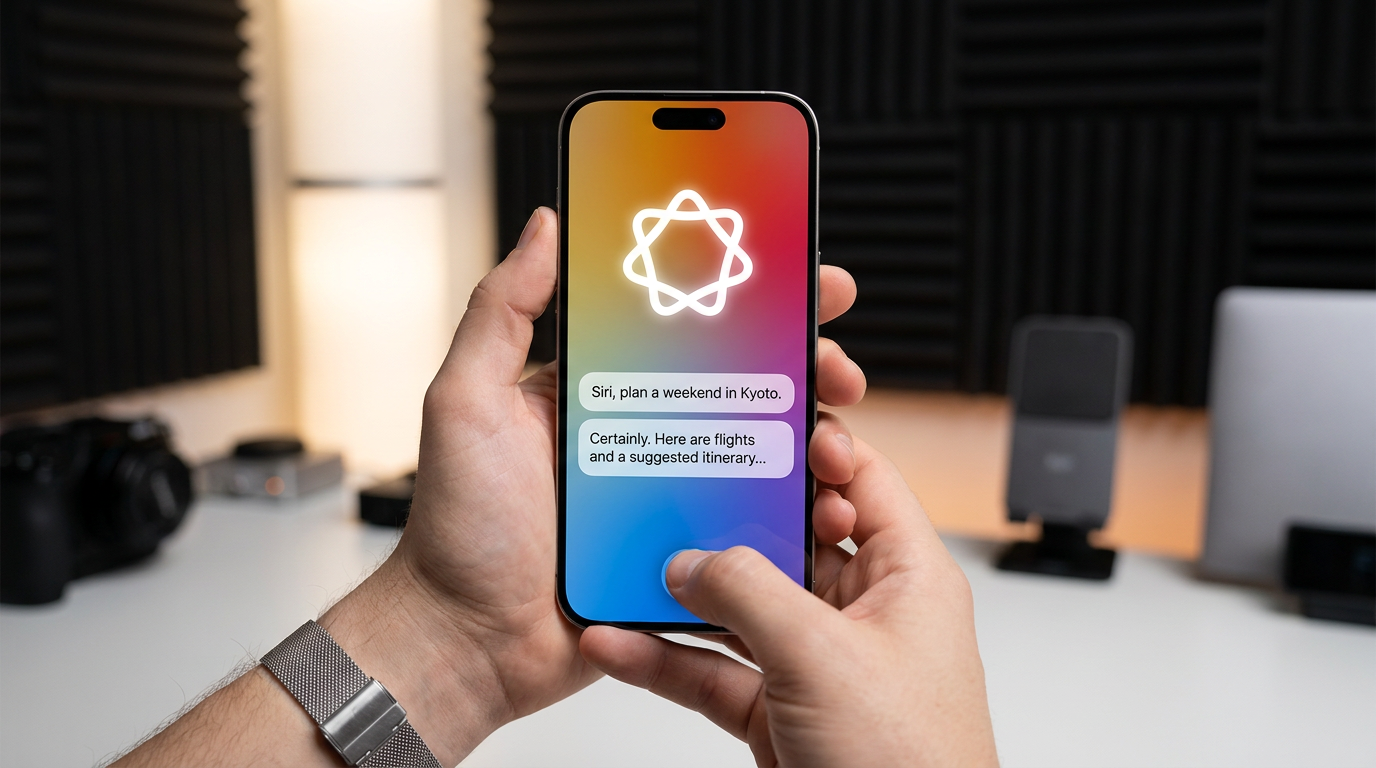
Early testing of the iOS 27 developer beta reveals that Apple's rebuilt Siri AI successfully executes complex, cross-app tasks using personal context and on-screen awareness. The massive upgrade requires 12GB of RAM, limiting the full experience to Apple's newest Pro and Air models.
By Factlen Editorial Team
- Ecosystem Enthusiasts
- Praise Siri AI for finally delivering a unified, context-aware assistant that seamlessly navigates Apple's apps and devices.
- AI Power Users
- Acknowledge the massive OS improvements but note that Siri still trails standalone models like Gemini in raw generative capabilities.
- Architecture Analysts
- Focus on the backend infrastructure, highlighting Apple's strategic use of on-device processing paired with Google Cloud and Nvidia hardware.
What's not represented
- · Android users comparing the ecosystem lock-in
- · Privacy advocates scrutinizing the on-device indexing index backups
Why this matters
For the 1.5 billion people who use an iPhone, Siri is about to transform from a basic voice timer into a deeply integrated digital assistant that can actually manage your digital life. By indexing your personal data locally, it promises to save users countless hours of manual app-switching and searching without sacrificing privacy.
Key points
- Apple's new Siri AI, introduced in iOS 27, is currently available in developer betas and is receiving highly positive early reviews.
- The assistant operates on four layers: personal context, on-screen awareness, broad world knowledge, and cross-app actions.
- Siri can now index personal emails, messages, and photos locally to answer specific user queries without compromising privacy.
- A new dedicated Siri app provides a ChatGPT-style interface and syncs conversation history across all Apple devices.
- The full suite of Siri AI features requires 12GB of RAM, limiting compatibility to the iPhone 16 Pro, iPhone 17 Pro, and iPhone Air.
- While Siri excels at OS integration, power users note it still trails standalone models like Google Gemini in raw generative creativity.
For years, Apple's digital assistant has been the punchline of the artificial intelligence race, a tool better suited for setting kitchen timers than parsing complex queries. But at WWDC 2026, Apple unveiled Siri AI, a ground-up rebuild of the assistant for iOS 27, iPadOS 27, and macOS 27. Now that the developer betas are in the wild, early hands-on testing reveals a surprising consensus: Apple has finally delivered on its AI promises.[1][4]
The new Siri AI is built on four distinct layers of intelligence: personal context, on-screen awareness, broad world knowledge, and cross-app actions. Unlike standalone chatbots that require users to manually upload documents or explain their schedules, Siri AI operates entirely within the user's existing digital footprint.[3][6]
The most striking upgrade is Siri's grasp of personal context. The system quietly indexes a user's emails, messages, calendar events, and photos directly on the device. Reviewers found that asking Siri to find a hotel confirmation number from a recent trip or check the time of an upcoming dentist appointment yields instant, accurate results without requiring the user to open a single app.[3][4][8]

This contextual awareness extends to the screen itself. Siri can now see and interpret whatever is actively displayed on an iPhone or Mac. If a user is looking at a tracking number in an email, they can simply ask the assistant to add the digits to their reminders for Friday, and Siri will extract the information and create the alert. Similarly, if a friend texts a photo of a festival lineup, Siri can identify the event and pull up calendar options.[1][3][7]
Apple has also bridged the gap between its first-party applications, allowing Siri to execute multi-step actions across the operating system. During hands-on testing, reviewers successfully asked the assistant to grab a specific PDF from their Mail inbox and attach it to an ongoing Messages thread, a task that previously required manual file hunting and app-switching.[3][4][8]
Apple has also bridged the gap between its first-party applications, allowing Siri to execute multi-step actions across the operating system.
To house these new capabilities, Apple introduced a dedicated Siri application. Moving away from the ephemeral, floating orb of the past, the new app provides a familiar chat interface with a persistent, card-based conversation history. This allows users to scroll back through previous queries, tap into cited web sources, and seamlessly continue complex research tasks.[3][4]

Crucially, this conversation history and Siri's underlying intelligence now sync across the entire Apple ecosystem. Historically, Siri's capabilities were heavily fractured; the assistant on an Apple Watch could not perform the same tasks as the one on a Mac. Apple engineers confirmed that unifying this experience was a primary goal for the 2026 overhaul, ensuring that users get the exact same assistant whether they are speaking to their wrist, their phone, or their laptop.[2]
Powering this massive leap is a new backend architecture featuring five distinct Apple Foundation Models. While the smaller 3-billion and 20-billion parameter models run entirely on-device to ensure privacy and low latency, Apple has also deployed larger models via Private Cloud Compute. In a major industry shift, the largest of these cloud models is running on Nvidia hardware housed inside Google Cloud data centers.[6][7]
This hybrid approach allows Siri to handle highly personal tasks locally while offloading complex generative requests to the cloud without compromising user data. When Siri encounters a query that requires broad world knowledge or advanced reasoning, it can seamlessly hand the request off to the cloud models, or even route it to third-party integrations like Google's Gemini, provided the user grants permission.[5][7][8]

However, this advanced processing comes with strict hardware limitations. The marquee features of Siri AI, including its on-screen awareness and expressive new voices, require a minimum of 12GB of RAM. This means the full suite of capabilities is restricted to the iPhone 16 Pro, the iPhone 17 Pro line, and the newly introduced iPhone Air, leaving base-model iPhone 17 users without the complete experience.[6]
Despite the glowing reception of Siri's deep system integration, power users note that Apple's assistant still has room to grow. While Siri AI excels at managing a user's personal data and navigating the Apple ecosystem, testers found that it still trails behind standalone models like Google Gemini when it comes to raw generative creativity, such as instantly turning a complex PDF into a clean infographic.[5]
For the vast majority of users, however, Siri AI represents a paradigm shift. By focusing on utility and personal context rather than trying to build an omniscient chatbot, Apple has created an assistant that actually assists. The software is currently available in a developer beta, with a public beta scheduled for July and a full consumer rollout slated for September 2026.[1][6]
How we got here
June 2024
Apple first announces 'Apple Intelligence' at WWDC, promising a major overhaul of Siri that is largely delayed.
June 8, 2026
Apple officially unveils 'Siri AI' and iOS 27 at WWDC 2026, showcasing deep system integration and on-screen awareness.
June 10, 2026
The first developer betas of iOS 27 are released, allowing reviewers to test Siri AI's new capabilities in the real world.
July 2026
Apple is scheduled to release the first public beta of iOS 27 and Siri AI.
September 2026
Siri AI is expected to launch globally alongside the release of the iPhone 17 lineup.
Viewpoints in depth
Ecosystem Enthusiasts' view
Siri AI is the ultimate realization of Apple's walled garden, turning fractured apps into a cohesive, voice-driven experience.
Reviewers deeply embedded in the Apple ecosystem argue that Siri AI is exactly what the platform needed. Rather than trying to build a conversational novelty, Apple focused on utility. By allowing Siri to index personal messages, emails, and photos locally, the assistant becomes a true digital secretary. Enthusiasts highlight that the ability to say 'add the tracking number on my screen to my reminders' without manually copying and pasting fundamentally changes how users interact with their devices. The unification of Siri across the Apple Watch, Mac, and iPhone is seen as the final piece of the puzzle, fixing years of fragmented user experiences.
AI Power Users' view
While Siri AI is a massive leap for iOS, it still lacks the raw generative horsepower of standalone models like Google Gemini.
For users who push artificial intelligence to its creative limits, Siri AI is viewed as a solid foundation rather than a complete replacement for tools like ChatGPT or Gemini. Testers note that while Siri excels at retrieving personal data and executing system-level tasks, it struggles with complex generative requests. For instance, uploading a dense PDF and asking for a highly formatted infographic or a deeply analytical summary is still handled better by Google's dedicated apps. These users appreciate Siri's new on-screen awareness but argue that Apple's cautious, privacy-first approach inherently limits the assistant's ability to perform heavy-duty creative lifting.
Architecture Analysts' view
The real story of Siri AI is its hybrid backend, blending on-device privacy with unprecedented cloud partnerships.
Tech analysts and infrastructure experts are zeroing in on how Apple actually built Siri AI. The introduction of the Apple Foundation Models (AFM 3) showcases a pragmatic approach to the AI race. By keeping 3-billion and 20-billion parameter models strictly on-device, Apple maintains its strict privacy posture for personal context queries. However, analysts are most intrigued by Apple's Private Cloud Compute infrastructure, which utilizes Nvidia GPUs housed within Google Cloud data centers for heavier tasks. This unprecedented collaboration highlights Apple's willingness to leverage external infrastructure to catch up in the AI arms race, ensuring Siri has the compute power it needs without compromising the company's core privacy tenets.
What we don't know
- How third-party app developers will utilize the new Siri AI APIs, and whether non-Apple apps will integrate as seamlessly as native ones.
- The exact battery life impact of running Apple's 3-billion and 20-billion parameter models continuously on-device.
- Whether Apple plans to bring any of the advanced Siri AI features to older devices via cloud processing in the future.
Key terms
- On-Screen Awareness
- A feature that allows an AI assistant to 'see' and understand the text, images, and context of whatever app is currently open on the user's screen.
- Personal Context
- The ability of an AI to draw upon a user's private data—such as emails, text messages, and calendar events—to provide highly personalized and relevant answers.
- Apple Foundation Models (AFM)
- Apple's proprietary suite of artificial intelligence models that power the generative and analytical capabilities of Siri and Apple Intelligence.
- Private Cloud Compute
- Apple's secure cloud infrastructure that processes complex AI requests without storing user data or making it accessible to Apple or third parties.
- Developer Beta
- An early, unfinished version of software released specifically for app developers to test and integrate their products before the public launch.
Frequently asked
When will the new Siri AI be available to the public?
Siri AI is currently in a developer beta. A public beta is scheduled for July 2026, with the full consumer release launching alongside iOS 27 in September 2026.
Which iPhones support the new Siri AI?
The full suite of Siri AI features requires a device with at least 12GB of RAM. This includes the iPhone 16 Pro, the iPhone 17 Pro, the iPhone 17 Pro Max, and the new iPhone Air. The base iPhone 17 does not support the full experience.
Does Siri AI read my personal emails and messages?
Yes, Siri AI indexes your emails, messages, photos, and calendar events to provide personal context. However, Apple states this indexing happens entirely on-device, meaning your personal data is not sent to the cloud for processing.
Is Siri AI just ChatGPT?
No. Siri AI is powered by Apple's own Foundation Models (AFM 3). While it can hand off certain complex queries to third-party models like ChatGPT or Google Gemini, the core assistant and its system integrations are built entirely by Apple.
Sources
Source coverage
8 outlets
3 viewpoints surfaced








[1]WiredEcosystem Enthusiasts
Siri AI Hands On: A Smart, Helpful Assistant
Read on Wired →[2]9to5MacEcosystem Enthusiasts
Siri AI is a major overhaul for Apple's assistant, and so far in the iOS 27 beta, it's very good
Read on 9to5Mac →[3]MacRumorsEcosystem Enthusiasts
Apple's All-New Siri AI in iOS 27: Hands-On!
Read on MacRumors →[4]TechRadarEcosystem Enthusiasts
I tried Siri AI on the iPhone, Mac, and iPad — here's why I'm convinced Apple's long-overdue next-gen assistant will win you over
Read on TechRadar →[5]Tom's GuideAI Power Users
I found the future of Siri in iOS 27, and it's currently an AGI Android app
Read on Tom's Guide →[6]India TimesArchitecture Analysts
Exclusive hands-on with Siri AI inside Apple Park
Read on India Times →[7]BGRArchitecture Analysts
All Apple Intelligence Features Coming In iOS 27
Read on BGR →[8]Apple NewsroomArchitecture Analysts
Apple introduces Siri AI, an entirely new version of Siri
Read on Apple Newsroom →



Every angle. Every day.
Get technology stories with full source coverage and perspective breakdowns delivered to your inbox.