
Trump's Economic Approval Rating Reaches Historic Low in New Quinnipiac Poll
A new Quinnipiac University national poll shows President Trump's approval rating on the economy has dropped to 34%, driven by voter concerns over inflation and the cost of living.
By Factlen Editorial Team
- Polling & Market Analysts
- Focuses on the data showing that inflation and tariffs are driving negative consumer sentiment, particularly among independent voters.
- White House & Allies
- Argues the poll is flawed and points to low unemployment and domestic manufacturing growth as proof of a strong economy.
- Democratic Opposition
- Views the poll as confirmation that the administration's economic policies act as a regressive tax on working-class families.
What's not represented
- · Small Business Owners
- · International Trade Partners
Why this matters
A president's economic approval rating is a historical bellwether for upcoming elections. This sharp decline indicates that inflation and trade policies are actively eroding the administration's core messaging advantage among independent voters.
Key points
- A new Quinnipiac poll shows the president's economic approval rating at an all-time low of 34%.
- Disapproval is driven heavily by independent voters, who cite inflation and the cost of living as top concerns.
- The White House dismissed the findings, emphasizing low unemployment and domestic job growth.
- Democratic leaders argue the poll proves the administration's trade and tariff policies are harming consumers.
- The 61% disapproval rating marks a significant challenge for the administration ahead of the midterm elections.
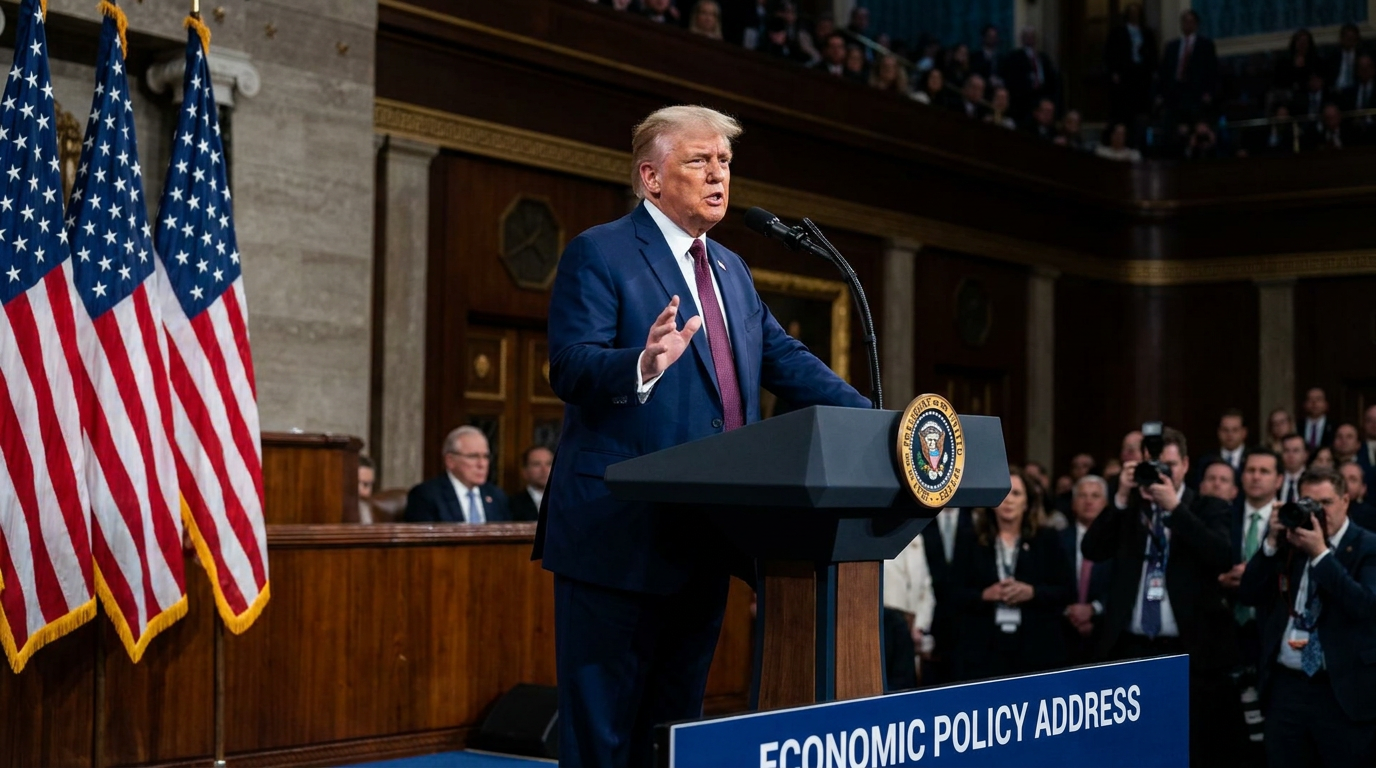
President Donald Trump’s approval rating regarding his handling of the economy has fallen to the lowest point of his presidency, according to a new national poll released by Quinnipiac University. The survey, conducted in late June 2026, indicates a significant shift in public sentiment regarding an issue that has traditionally been a cornerstone of the administration's political messaging and electoral strategy.[1][2]
The poll reveals that only 34% of registered voters approve of the president's economic stewardship, while 61% disapprove. This marks a sharp decline from earlier this year, when his economic approval hovered near 45%. The drop is particularly pronounced among independent voters, a crucial demographic that has shown increasing frustration with the administration's recent trade policies and persistent inflation.[1][5]
Among independents, disapproval of the president's economic performance surged to 65%, up eight points since April. Even within the Republican base, there are signs of softening support; while 78% of Republicans still approve of his handling of the economy, that figure represents a slight dip from the mid-80s recorded consistently throughout 2025. Democratic disapproval remains nearly unanimous at 94%.[1][7]

Polling analysts attribute the decline to a confluence of recent macroeconomic pressures. Despite steady job growth, voters repeatedly cite the rising cost of living and the immediate consumer impacts of the administration's newly implemented tariffs on imported goods. The Quinnipiac survey found that 58% of respondents believe the economy is actively "getting worse," compared to just 22% who feel it is improving.[2][6]
Polling analysts attribute the decline to a confluence of recent macroeconomic pressures.
The White House has aggressively pushed back against the poll's findings. In a statement, administration officials dismissed the Quinnipiac data as an "outlier" and a "flawed survey," pointing instead to robust employment figures and recent gains in domestic manufacturing. The president's economic advisors argue that the long-term benefits of their trade policies have not yet fully materialized for the average consumer, urging patience as global supply chains adjust.[3][4]
Conservative outlets and allied commentators have largely echoed the administration's defense, emphasizing that traditional polling often fails to capture the enthusiasm of the president's base. They highlight that broader macroeconomic indicators, such as the unemployment rate remaining below 4%, tell a more positive story than public sentiment surveys suggest. However, some conservative economists have begun voicing concerns that prolonged trade disputes are beginning to drag on consumer confidence and business investment.[3][6]
Conversely, Democratic leaders and left-leaning networks have seized on the poll as evidence that the administration's economic agenda is failing working-class Americans. Opposition lawmakers argue that the data reflects the reality of wage stagnation relative to inflation, asserting that the president's focus on tariffs acts as a regressive tax on everyday household items and disproportionately harms lower-income families.[4][8]

Historically, a president's economic approval rating is one of the most reliable predictors of their party's performance in upcoming elections. The current 34% approval mark places the administration in precarious territory as both parties begin to ramp up messaging ahead of the late-2026 midterm cycle. Political strategists note that recovering from such a deficit requires either a rapid shift in macroeconomic conditions or a significant pivot in policy messaging.[5][7]
Looking ahead, the administration faces a critical window to reshape the economic narrative. With the Federal Reserve scheduled to meet next month to discuss potential interest rate adjustments, and further trade negotiations on the horizon, the White House is expected to launch a coordinated messaging campaign highlighting domestic investment. Whether these efforts can reverse the current trajectory of public opinion remains a central question for the remainder of the year.[2][5]
How we got here
Early 2026
The administration implements a new round of tariffs on imported goods.
April 2026
National polling shows the president's economic approval rating hovering around 45%.
June 2026
The Quinnipiac University poll reveals economic approval has dropped to 34%.
Viewpoints in depth
White House & Allies
Defends the administration's economic record by highlighting employment metrics.
Administration officials and allied commentators argue that public sentiment surveys are currently lagging behind actual economic performance. They point to a sustained unemployment rate below 4% and significant investments in domestic manufacturing as proof that the core economy is strong. From this perspective, the negative polling is seen as a temporary reaction to the transitional costs of realigning global trade, rather than a fundamental failure of policy.
Polling & Market Analysts
Focuses on the immediate consumer impact of inflation and trade policies.
Economic analysts and nonpartisan pollsters emphasize that voters vote on their immediate reality, which currently involves higher prices at the grocery store and the gas pump. They note that while macroeconomic indicators like job growth are positive, wage growth has struggled to outpace inflation. Analysts warn that the administration's reliance on tariffs is creating a drag on consumer confidence that cannot be easily offset by low unemployment figures alone.
Democratic Opposition
Argues the administration's policies are actively harming working-class families.
Opposition lawmakers view the Quinnipiac poll as a direct repudiation of the president's economic agenda. They argue that the administration's focus on tariffs acts as a regressive tax, disproportionately raising the cost of living for lower- and middle-income households. Democratic strategists are utilizing these numbers to frame the upcoming elections around kitchen-table economics, asserting that the current leadership is out of touch with the financial realities of everyday Americans.
What we don't know
- Whether the Federal Reserve will adjust interest rates in response to current economic pressures.
- How quickly the administration's trade policies might yield the long-term benefits promised by the White House.
- If public sentiment will shift before the upcoming midterm elections as global supply chains adjust.
Key terms
- Approval Rating
- The percentage of respondents in a poll who indicate they approve of a particular political figure or policy.
- Independent Voter
- A voter who does not align themselves with a specific political party, often serving as a crucial swing demographic in elections.
Frequently asked
What is the president's economic approval rating?
According to the latest Quinnipiac University poll, 34% of registered voters approve of the president's handling of the economy, while 61% disapprove.
Why did the approval rating drop?
Voters cited persistent inflation, the rising cost of living, and concerns over the consumer impact of recently implemented tariffs as primary reasons for their negative outlook.
How did the White House respond to the poll?
The administration dismissed the poll as an outlier, pointing instead to low unemployment rates and job creation metrics as evidence of a strong economy.
Sources
Source coverage
8 outlets
3 viewpoints surfaced








[1]Quinnipiac UniversityPolling & Market Analysts
Trump Economic Approval Drops to 34%, Voters Cite Inflation Concerns
Read on Quinnipiac University →[2]ReutersPolling & Market Analysts
Trump's economic approval rating hits lowest point of presidency in new poll
Read on Reuters →[3]Fox NewsWhite House & Allies
White House dismisses 'flawed' Quinnipiac poll, points to strong job growth under Trump
Read on Fox News →[4]CNNDemocratic Opposition
Voters sour on Trump's economy as approval rating plunges to 34%
Read on CNN →[5]PoliticoPolling & Market Analysts
Warning signs flash for GOP as Trump's economic approval tanks
Read on Politico →[6]The Wall Street JournalPolling & Market Analysts
Inflation and Tariffs Weigh on Trump's Economic Approval Rating
Read on The Wall Street Journal →[7]The HillPolling & Market Analysts
Trump hits all-time low on economy in Quinnipiac poll
Read on The Hill →[8]MSNBCDemocratic Opposition
Democrats seize on devastating new poll showing voters rejecting Trump's economy
Read on MSNBC →

Every angle. Every day.
Get news politics stories with full source coverage and perspective breakdowns delivered to your inbox.