
DOE Launches 'Quantum Genesis' Initiative for Fault-Tolerant Quantum Computing
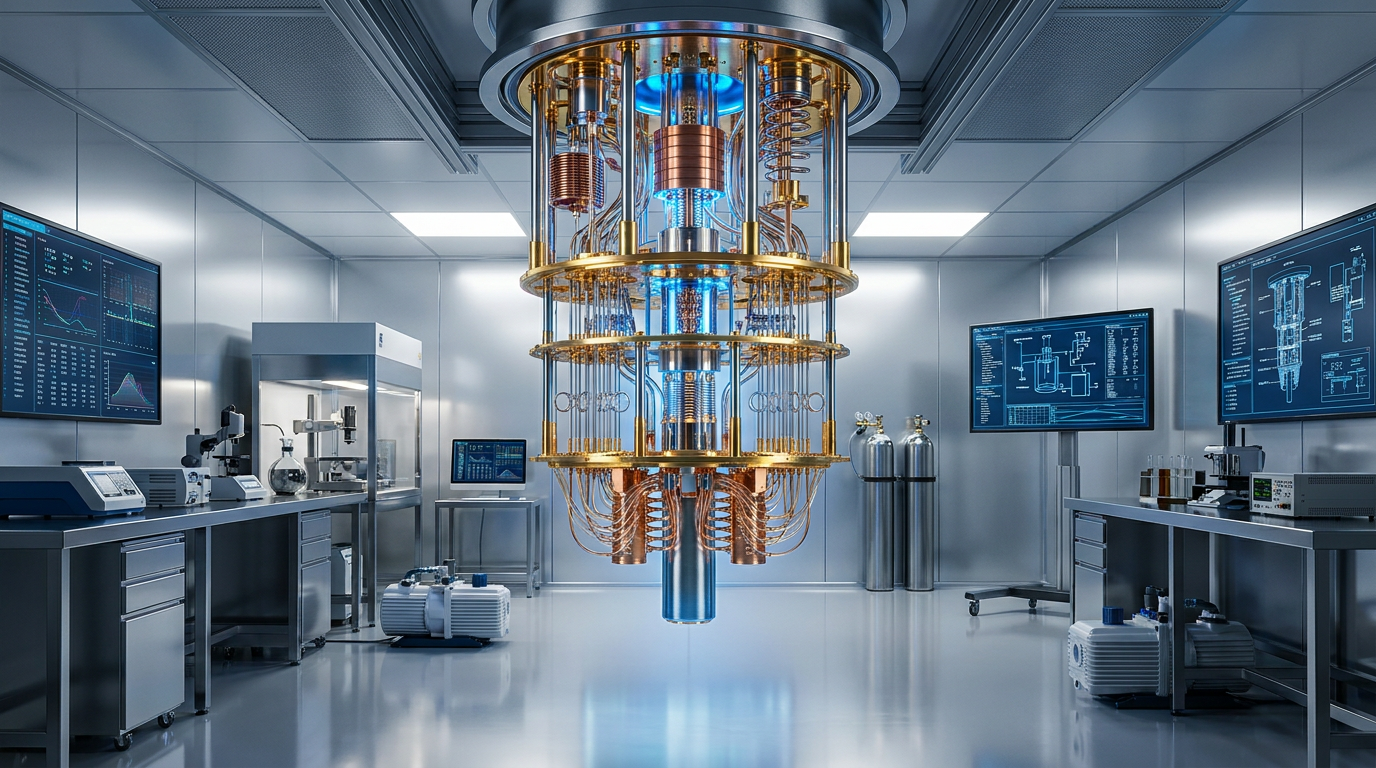
The U.S. Department of Energy has launched an aggressive initiative to deploy the world's first scientifically relevant, fault-tolerant quantum computer by 2028.
By Factlen Editorial Team
- Quantum Hardware Developers
- Focus on the engineering milestones, error correction architectures, and the feasibility of the aggressive 2028 timeline.
- Federal Policymakers
- View the initiative as a critical national security and economic imperative to maintain U.S. leadership in advanced technology.
- Scientific End-Users
- Anticipate the ability to simulate complex molecules and materials that are currently impossible to model on classical supercomputers.
- Cybersecurity Experts
- Emphasize the urgent need to transition to post-quantum cryptography before these machines scale enough to break current encryption.
What's not represented
- · International quantum researchers and competing state-sponsored quantum programs
- · Commercial industries outside of energy and materials science that could benefit from quantum simulation
Why this matters
The Quantum Genesis initiative marks a historic pivot from theoretical quantum research to applied engineering, backed by massive federal resources. If successful by 2028, this fault-tolerant computer will unlock discoveries in battery technology, materials science, and medicine that are mathematically impossible for today's most powerful supercomputers to achieve.
Key points
- The DOE launched the Quantum Genesis initiative to build a fault-tolerant quantum computer by 2028.
- The system must feature 150 to 250 logical qubits and an ultra-low error rate of 10^-8.
- The computer will be used to solve complex problems in chemistry, materials science, and plasma physics.
- A companion executive order mandates that federal agencies transition to post-quantum cryptography by 2030.
- The initiative marks a shift from noisy quantum prototypes to highly stable, application-driven engineering.
The U.S. Department of Energy (DOE) has officially launched an aggressive new initiative designed to develop and deploy the world's first scientifically relevant, fault-tolerant quantum computer by the year 2028. The program, dubbed "Quantum Genesis," follows a pair of executive orders signed on June 22, 2026, which mandate accelerated American leadership in quantum information science and establish a coordinated federal effort to build a discovery-grade quantum machine. Unlike previous federal quantum investments that focused heavily on theoretical exploration or noisy, error-prone prototypes, Quantum Genesis represents a hard pivot toward application-driven engineering. The ultimate goal is a dedicated, highly stable machine capable of solving grand challenges in chemistry, materials science, and high-energy physics that remain entirely intractable for classical supercomputers.[1][2][6][7]
For the past decade, the quantum computing industry has operated in the "noisy intermediate-scale quantum" (NISQ) era. In this paradigm, quantum processors are highly susceptible to environmental interference, such as minute temperature fluctuations or stray electromagnetic radiation. These disturbances cause the delicate quantum states to collapse—a process known as decoherence—before complex calculations can be completed. The Quantum Genesis initiative explicitly signals the end of the NISQ era for federal research, demanding a leap directly into fault tolerance. By mandating a system that can detect and correct its own errors in real-time, the DOE is forcing the industry to prioritize stability and reliability over simply increasing the raw number of unstable physical qubits.[3][7]
At the core of the Quantum Genesis initiative is the "DOE Q Competition," which sets a rigid, milestone-driven timeline for hardware developers to deliver this functional, error-corrected system. The evidence supporting this accelerated 2028 timeline stems from a May 2026 Request for Information (RFI) issued by the DOE, which rigorously assessed the private sector's readiness to transition to fault-tolerant architectures. The technical specifications outlined by the agency are highly specific: the DOE requires a system operating with 150 to 250 logical qubits. This represents a massive leap in capability, as most current commercial systems operate with zero or only a handful of logical qubits.[1][3][4]

Understanding the magnitude of this requirement requires distinguishing between physical and logical qubits. A logical qubit is not a single physical object; rather, it is a highly stable computational unit created by networking dozens or even hundreds of fragile physical qubits together. Through complex error-correction algorithms, this ensemble of physical qubits works collectively to monitor the quantum state, identify errors as they occur, and correct them without disrupting the ongoing calculation. The DOE's demand for up to 250 logical qubits means the winning contractor will likely need to successfully entangle and control thousands of physical qubits with unprecedented precision.[3][4][7]
To be deemed "scientifically relevant," the DOE mandates that the winning system must execute complex circuits comprising 100,000 hard operations with a logical error rate of 10^-8. This specific error rate represents a critical inflection point in quantum computing, ensuring the computer can sustain long, complex algorithms without the quantum state degrading. Evidence from recent Defense Advanced Research Projects Agency (DARPA) benchmarking initiatives suggests that novel error-correction architectures are maturing much faster than anticipated. These independent benchmarks provided the DOE with the confidence that achieving a 10^-8 error rate is a plausible, albeit highly aggressive, target for the 2028 deadline.[3][4][7]

The DOE asserts that a fault-tolerant machine in the 200-logical-qubit range will definitively surpass the capabilities of classical exascale supercomputers in specific scientific domains. The primary evidence for this claim lies in the mathematics of quantum simulation. Simulating the exact electron interactions of complex molecules scales exponentially on classical hardware. Adding just a few atoms to a simulated molecule doubles or quadruples the computational power required, quickly overwhelming even the most powerful supercomputers. By contrast, quantum computers simulate nature natively, mapping the quantum states of the molecule directly onto the quantum states of the processor, allowing for linear scaling.[1][5][7]
The primary evidence for this claim lies in the mathematics of quantum simulation.
Because of this native simulation capability, the DOE has identified plasma physics, advanced materials design, and complex chemistry as the keystone applications where this system will be deployed first. In materials science, researchers anticipate using the Quantum Genesis computer to design room-temperature superconductors or highly efficient battery cathodes by modeling atomic interactions with perfect accuracy. In chemistry, the system could unlock new catalysts for carbon capture or nitrogen fixation, processes that currently consume massive amounts of global energy because classical computers cannot accurately model the quantum mechanics of the required chemical reactions.[1][5][7]
To maximize the impact of this hardware, Quantum Genesis establishes a new National Quantum Supercomputing User Facility to provide open access to researchers across academia and industry. Crucially, this facility will not operate the quantum computer in isolation. Instead, it will integrate the quantum hardware directly with the DOE's existing high-performance computing (HPC) networks and artificial intelligence platforms, creating a unified hybrid ecosystem. This hybrid approach is supported by evidence showing that quantum computers are best utilized as specialized accelerators—handling the intractable quantum mechanics calculations while classical supercomputers manage the massive data processing, error tracking, and AI models required to interpret the results.[1][4][6][9]

Despite the aggressive federal backing and optimism, the 2028 timeline faces significant skepticism within the broader physics community regarding the physical scaling ratio. Depending on the underlying hardware architecture—whether superconducting circuits, trapped ions, or neutral atoms—creating 250 logical qubits could require tens of thousands, or even hundreds of thousands, of physical qubits. Managing a system of that size introduces massive engineering bottlenecks. Researchers must overcome unprecedented challenges in cryogenics, microwave cabling density, and the classical control electronics required to read and write quantum states in real-time without introducing excess heat that would destroy the delicate quantum states.[3][4][7]
The push for fault-tolerant quantum computing is also intrinsically linked to national security. A companion executive order signed alongside the quantum development mandate requires federal agencies to transition to post-quantum cryptography (PQC) by 2030. While a 250-logical-qubit machine cannot break modern RSA encryption—which would require thousands of logical qubits—the DOE's aggressive timeline signals that cryptographically relevant quantum computers may arrive sooner than previously forecast. This realization necessitates immediate defensive measures across government networks to prevent adversaries from harvesting encrypted data today to decrypt it once larger quantum systems come online in the next decade.[2][8][9]

The immediate next steps for the Quantum Genesis initiative involve finalizing the exact technical specifications for the planned quantum computer, with a strict deadline set for September 2026. Following that, the DOE and the Office of Management and Budget will establish private-sector partnership frameworks by December 2026 to outline the manufacturing and delivery pipelines. By forcing the transition from theoretical research to concrete, milestone-driven engineering, the federal government is attempting to ensure that the United States remains the undisputed leader in the next era of global computational supremacy.[2][4][6]
How we got here
2024
NIST releases the first finalized post-quantum cryptography standards to protect against future quantum threats.
May 2026
The DOE issues a Request for Information (RFI) to assess the private sector's readiness for fault-tolerant quantum systems.
June 22, 2026
President Trump signs two executive orders accelerating quantum development and mandating post-quantum cryptography migration.
June 23, 2026
The DOE officially launches the Quantum Genesis initiative to build a fault-tolerant quantum computer.
September 2026
Deadline for the DOE to finalize and release the exact technical specifications for the planned quantum computer.
2028
Target year for the DOE Q Competition to demonstrate a fault-tolerant system with up to 250 logical qubits.
Viewpoints in depth
Federal Policymakers
View the initiative as a critical national security and economic imperative to maintain U.S. leadership in advanced technology.
For the White House and the Department of Energy, the Quantum Genesis initiative is fundamentally about geopolitical and economic sovereignty. Policymakers argue that quantum computing will be the defining technology of the 21st century, akin to the space race or the development of the atomic bomb. By heavily subsidizing the transition from theoretical research to applied engineering, the federal government aims to prevent adversarial nations from achieving quantum supremacy first. This perspective emphasizes that the massive upfront costs are justified by the long-term strategic advantages in national security, advanced manufacturing, and energy independence.
Quantum Hardware Developers
Focus on the engineering milestones, error correction architectures, and the feasibility of the aggressive 2028 timeline.
The private sector and hardware engineering community view the 2028 deadline as a monumental, albeit necessary, challenge. While some developers express skepticism about scaling physical qubits rapidly enough to meet the 250-logical-qubit threshold, others see the DOE Q Competition as the exact catalyst needed to break through current bottlenecks. This camp points to recent breakthroughs in error-correction codes and DARPA benchmarking as evidence that the timeline is technically feasible. Their primary concern revolves around supply chain constraints, specifically the availability of specialized cryogenic systems and high-density microwave cabling required to operate massive quantum arrays.
Scientific End-Users
Anticipate the ability to simulate complex molecules and materials that are currently impossible to model on classical supercomputers.
Chemists, materials scientists, and physicists view Quantum Genesis as a paradigm-shifting tool that will unblock decades-old research bottlenecks. Classical supercomputers, despite their immense power, fail to accurately simulate the quantum mechanical interactions of large molecules due to exponential scaling limits. End-users argue that a 250-logical-qubit machine will allow them to natively simulate these interactions, leading to rapid discoveries in room-temperature superconductors, highly efficient battery materials, and novel catalysts for carbon capture. For this camp, the integration of the quantum system with existing AI and HPC networks is the most critical feature.
Cybersecurity Experts
Emphasize the urgent need to transition to post-quantum cryptography before these machines scale enough to break current encryption.
The cybersecurity community views the rapid acceleration of quantum hardware through a lens of defensive urgency. While a 250-logical-qubit machine is designed for scientific simulation and cannot break modern RSA encryption, experts warn that the underlying technology is scaling faster than anticipated. This camp strongly supports the companion executive order mandating a federal transition to post-quantum cryptography (PQC) by 2030. They argue that adversaries are already engaging in 'harvest now, decrypt later' attacks—stealing encrypted data today with the intention of breaking it once cryptographically relevant quantum computers come online in the next decade.
What we don't know
- Which specific hardware architecture (superconducting, trapped ion, neutral atom) will ultimately win the DOE Q Competition.
- Whether the global supply chain can produce enough specialized cryogenic equipment to support the massive physical qubit scaling required.
- The exact total cost of the Quantum Genesis initiative over its multi-year lifespan.
Key terms
- Logical Qubit
- A highly stable, error-corrected computational unit made by grouping multiple unstable physical qubits together.
- Fault Tolerance
- The ability of a quantum computer to detect and correct its own errors in real-time, allowing for long, complex calculations without crashing.
- Post-Quantum Cryptography (PQC)
- New encryption standards designed to be secure against future quantum computers that could otherwise break current encryption methods.
- Decoherence
- The process by which a quantum computer loses its fragile quantum state due to environmental interference, causing calculations to fail.
- Exascale Supercomputer
- A classical computer capable of calculating at least one quintillion (10^18) operations per second, currently the fastest class of traditional computers in the world.
Frequently asked
Why is the 2028 timeline for this computer significant?
It represents a highly aggressive acceleration of quantum development. Many industry roadmaps previously targeted the early 2030s for fault-tolerant systems of this scale.
What will the Quantum Genesis computer be used for?
The DOE plans to use it for fundamental scientific research, including discovering new materials, simulating complex chemical reactions, and advancing plasma physics.
Will this quantum computer break current encryption?
Not immediately. While it is a step toward cryptographically relevant quantum computers, the 150-250 logical qubit range is primarily for scientific simulation. However, a companion executive order mandates a shift to post-quantum cryptography by 2030 to prepare for future threats.
What is the difference between a physical and logical qubit?
A physical qubit is a single, fragile quantum component. A logical qubit is a stable computational unit created by networking many physical qubits together to detect and correct errors.
Sources
Source coverage
9 outlets
4 viewpoints surfaced









[1]U.S. Department of EnergyFederal Policymakers
DOE Announces Quantum Genesis Initiative for Fault-Tolerant Quantum Computing
Read on U.S. Department of Energy →[2]The White HouseFederal Policymakers
Executive Order on Ushering in the Next Frontier of Quantum Innovation
Read on The White House →[3]NextgovScientific End-Users
Energy Department aims to bring a fault-tolerant quantum computer to life via the new Quantum Genesis mission
Read on Nextgov →[4]Quantum Computing ReportQuantum Hardware Developers
DOE Announces Quantum Genesis, Targeting 250 Logical Qubits by 2028
Read on Quantum Computing Report →[5]American Institute of PhysicsScientific End-Users
DOE Launches 'Quantum Genesis' Initiative
Read on American Institute of Physics →[6]FedScoopFederal Policymakers
DOE kickstarts quantum computing effort tied to Genesis Mission
Read on FedScoop →[7]Quantum Intelligence NetworkQuantum Hardware Developers
The U.S. DOE's 'Quantum Genesis Initiative' marks a pivotal shift
Read on Quantum Intelligence Network →[8]Post-QuantumCybersecurity Experts
White House Issues Quantum Executive Orders
Read on Post-Quantum →[9]ExecutiveGovFederal Policymakers
DOE Launches 'Quantum Genesis' Initiative for Fault-Tolerant Quantum Computing
Read on ExecutiveGov →

Every angle. Every day.
Get science stories with full source coverage and perspective breakdowns delivered to your inbox.