
The Rise of Large Action Models: How AI Agents Are Automating the Digital World
Large Action Models (LAMs) are transforming AI from passive chatbots into autonomous digital workers capable of navigating websites, managing files, and executing complex workflows.
By Factlen Editorial Team
- Productivity Advocates
- Believes AI agents will fundamentally elevate human potential by eliminating digital chores.
- Privacy & Security Proponents
- Argues that true automation must happen locally to protect sensitive personal and corporate data.
- Enterprise Automation Leaders
- Focuses on the operational efficiency and cost savings of replacing rigid scripts with adaptive AI.
- AI Safety Researchers
- Focuses on alignment, auditability, and preventing runaway actions in autonomous systems.
What's not represented
- · Entry-level knowledge workers whose routine tasks may be fully automated.
- · Customer support representatives facing displacement by autonomous agents.
Why this matters
The transition from passive chatbots to autonomous AI agents means you will soon be able to delegate hours of digital chores—from booking flights to organizing files—directly to your computer. Understanding how these systems work allows you to reclaim your time while protecting your personal data.
Key points
- Large Action Models (LAMs) transform AI from passive text generators into active systems that execute multi-step tasks.
- Modern AI agents use a planner-grounder architecture to break down complex goals and interact with software interfaces.
- Agentic browsers can visually navigate websites, bypass pop-ups, and extract data without relying on brittle code scripts.
- Local AI agents running on consumer hardware offer a secure, offline alternative for privacy-conscious users.
- The agentic AI market is projected to grow from $5.2 billion in 2024 to $200 billion by 2034.
For years, artificial intelligence has been confined to a chat box. Users typed a prompt, and the AI generated text, code, or images in response. But while these Large Language Models (LLMs) excelled at understanding and brainstorming, they remained fundamentally passive. They could draft an email, but they could not open an inbox and send it. They could write a Python script, but they could not execute it, debug the errors, and deploy the final product.[1][3]
In 2026, that paradigm has shifted entirely. The industry has moved from passive assistants to autonomous digital teammates, driven by the rise of Large Action Models (LAMs). Unlike their predecessors, LAMs are designed not just to predict the next word in a sentence, but to predict and execute the next action in a software environment.[2][8]
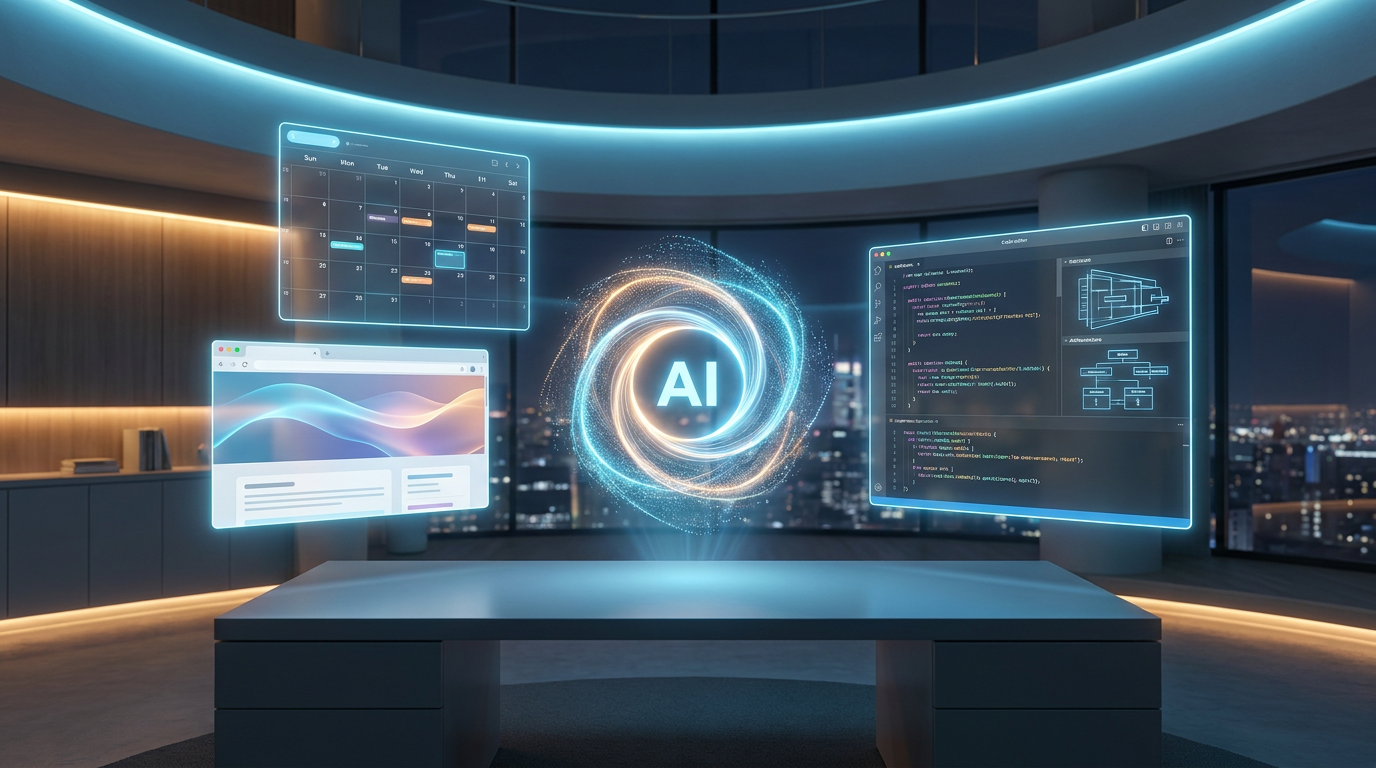
This transition represents a fundamental leap in how humans interact with computers. Instead of micromanaging every click and keystroke, users can now delegate high-level goals. An instruction like "research the top five AI coding tools, compile their pricing into a spreadsheet, and save it to my desktop" is no longer a futuristic concept—it is a routine operation that modern agents can complete in minutes.[5][7]

To understand how LAMs achieve this, it is necessary to look under the hood at their neuro-symbolic architecture. Most modern agents rely on a "planner-grounder" framework. When a user submits a request, the planner agent intercepts it. This component acts as the system's brain, using natural language understanding to decompose a complex, ambiguous goal into a structured sequence of actionable steps.[3][4]
Once the plan is formulated, it is handed off to the grounder agent. The grounder is the system's hands. It interfaces directly with the digital environment using a suite of tools, such as the Model Context Protocol (MCP), Python interpreters, or virtual browsers. The grounder executes the steps one by one, reporting progress back to the planner and dynamically adjusting the strategy if it encounters an error, such as a broken link or a changed website layout.[3][7]

Web automation is one of the most visible arenas where LAMs are outperforming traditional software. Historically, automating web tasks required brittle, code-heavy scripts that broke the moment a website updated its user interface. Today's agentic browsers use computer vision and spatial reasoning to navigate the web exactly like a human would, adapting to visual changes on the fly.[2][7]
These agents can visually identify login buttons, interpret complex forms, bypass pop-ups, and extract structured data from unstructured pages. Tools like OpenAI's ChatGPT Agent Mode, Perplexity Comet, and Skyvern have turned the browser into an active execution environment, capable of conducting deep research and compiling fully cited reports without human supervision.[7][8]
These agents can visually identify login buttons, interpret complex forms, bypass pop-ups, and extract structured data from unstructured pages.
But the capabilities of LAMs extend far beyond the web browser. In 2026, AI agents are increasingly integrating directly into desktop operating systems. Applications like Manus My Computer and Claude Cowork establish secure bridges between cloud-based AI and local file systems, allowing agents to organize messy download folders, process bulk PDF documents, and manage calendar events natively.[5]
For software developers, the impact has been even more profound. AI coding agents like Gemini CLI, Claude Code, and Codex have moved out of the IDE and into the terminal. These agents can autonomously navigate codebases, run test suites, debug failures, and submit pull requests, dramatically accelerating the software development lifecycle and allowing engineers to focus on system architecture.[6]
As these tools become more powerful, a parallel movement is prioritizing privacy and data sovereignty: the rise of local AI agents. For professionals handling sensitive client data, intellectual property, or personal finances, sending every keystroke to a cloud server is a non-starter. The demand for offline, secure automation has birthed an entirely new ecosystem of localized tools.[4]

Local agents solve this privacy dilemma by running quantized, highly optimized models—such as Llama 3 or Mistral—directly on consumer-grade hardware. Using orchestration frameworks like Ollama or LM Studio, users can deploy autonomous agents that operate entirely offline. These systems offer zero latency, absolute privacy, and immunity to cloud outages or API rate limits.[4][8]
Security remains a central focus across both cloud and local deployments. To prevent runaway operations—where an agent might accidentally delete a crucial database or send an unintended email—most platforms employ an approval-based execution model. The agent pauses before taking destructive or irreversible actions, requiring a human-in-the-loop to click "approve" before proceeding.[4][5]
In the enterprise sector, LAMs are rapidly replacing traditional Robotic Process Automation (RPA). Where RPA required rigid rules and structured data, LAMs can handle ambiguity. They are being deployed to reconcile complex invoices, audit compliance documents, and manage cross-application HR onboarding workflows, often reducing task completion times by up to 95%.[3][6]

The economic implications are massive. Industry analysts project the agentic AI market will grow from $5.2 billion in 2024 to $200 billion by 2034. This growth is fueled by the realization that AI's true value lies not in generating more content, but in executing the mundane, repetitive tasks that drain human productivity and creativity.[7][8]
We are entering an era where the computer is no longer just a tool, but an active participant in the workflow. As Large Action Models continue to mature, the defining skill of the next decade will not be how fast a person can type or navigate a spreadsheet, but how effectively they can manage and delegate to their digital teammates.[2][8]
How we got here
2023-2024
Large Language Models dominate the AI landscape as passive chatbots and text generators.
Mid-2025
Major AI labs introduce native tool-use and computer control, allowing models to interact with software.
Late-2025
Local AI frameworks enable users to run autonomous agents entirely offline on consumer hardware.
2026
Large Action Models become mainstream, automating complex web and desktop workflows for general users.
Viewpoints in depth
Productivity Advocates
Believes AI agents will fundamentally elevate human potential by eliminating digital chores.
This camp views Large Action Models as the ultimate equalizer for knowledge workers. By delegating inbox triage, data entry, and web research to autonomous agents, individuals can focus entirely on high-level strategy and creative problem-solving. They argue that the friction of modern software—navigating endless tabs and copying data between silos—is a bottleneck that LAMs will permanently remove.
Privacy & Security Proponents
Argues that true automation must happen locally to protect sensitive personal and corporate data.
For this group, the convenience of cloud-based agents is overshadowed by the risk of feeding personal files, financial records, and proprietary code into external servers. They champion open-source models and local orchestration frameworks that run entirely on consumer hardware. Their ideal future is one where every user has a highly capable, offline digital assistant that guarantees absolute data sovereignty.
Enterprise Automation Leaders
Focuses on the operational efficiency and cost savings of replacing rigid scripts with adaptive AI.
Corporate IT and operations teams view LAMs as the long-awaited successor to Robotic Process Automation (RPA). Traditional RPA breaks when a website updates its layout or an invoice changes format. Enterprise leaders value LAMs for their resilience and computer vision capabilities, allowing businesses to automate complex, unstructured workflows like compliance auditing and cross-platform data reconciliation without constant maintenance.
What we don't know
- How regulatory frameworks like the EU AI Act will govern autonomous agents executing financial transactions.
- The long-term impact of agentic automation on entry-level knowledge-worker jobs.
Key terms
- Large Action Model (LAM)
- An AI system designed to perceive, plan, and execute multi-step tasks autonomously within software environments.
- Planner-Grounder Architecture
- A system where one AI component breaks a goal into steps (the planner) and another executes them using tools (the grounder).
- Model Context Protocol (MCP)
- A standardized framework allowing AI models to securely connect to external tools, APIs, and local file systems.
- Local AI Agent
- An autonomous AI system running entirely on a user's own hardware, ensuring complete data privacy and offline capability.
Frequently asked
What is the difference between an LLM and a LAM?
A Large Language Model (LLM) generates text and answers questions, while a Large Action Model (LAM) takes action—like navigating a website, clicking buttons, or organizing files on your computer.
Do I need to know how to code to use AI agents?
No. Modern agents use natural language commands to automate tasks, allowing anyone to delegate digital chores just by typing out what they want done.
Are local AI agents secure?
Yes, because they run entirely on your own hardware, your data never leaves your machine. Many systems also require explicit user approval before executing sensitive or irreversible actions.
Sources
Source coverage
8 outlets
4 viewpoints surfaced








[1]DataCampAI Safety Researchers
What Are Large Action Models (LAMs)?
Read on DataCamp →[2]Gradient FlowEnterprise Automation Leaders
LAMs represent a shift in AI from passive content generation to active task execution
Read on Gradient Flow →[3]UniphoreEnterprise Automation Leaders
Large Action Models vs. Large Language Models
Read on Uniphore →[4]AI GrantsPrivacy & Security Proponents
Local AI agents personal automation
Read on AI Grants →[5]Manus AIProductivity Advocates
The 5 Best AI Agents for Your Desktop in 2026
Read on Manus AI →[6]MightyBotProductivity Advocates
Best AI Coding Agents in 2026, Ranked
Read on MightyBot →[7]Bright DataEnterprise Automation Leaders
Agentic Browsers and the Future of Web Automation
Read on Bright Data →[8]Factlen Editorial TeamProductivity Advocates
Synthesis by Factlen editorial team
Read on Factlen Editorial Team →


Every angle. Every day.
Get ai stories with full source coverage and perspective breakdowns delivered to your inbox.