
The Modern Guide to Tipping Etiquette: Navigating Digital Screens and Tipflation in 2026
As digital payment screens push suggested gratuities higher, etiquette experts are drawing clear lines on when to tip generously and when it’s perfectly acceptable to press 'no tip.'
By Factlen Editorial Team
- Consumer Etiquette Advocates
- Argue that tipping should remain a reward for personal service, not a default tax on every transaction.
- Financial Planners
- Focus on the economic impact of tipflation on personal budgets, advising consumers to plan ahead.
- Hospitality Operators
- View digital tipping prompts as a necessary tool to retain staff and manage rising labor costs.
What's not represented
- · Retail Cashiers
- · Point-of-Sale Software Developers
Why this matters
As digital payment screens push suggested gratuities into almost every daily transaction, consumers are experiencing widespread 'tipping fatigue.' Understanding the modern rules of etiquette allows you to confidently support service workers who rely on tips while guiltlessly declining prompts at self-checkout kiosks and retail counters.
Key points
- Digital payment screens have expanded tip requests into non-traditional areas like self-checkout and retail.
- Etiquette experts confirm it is perfectly acceptable to decline tipping when no personalized service is provided.
- The baseline for traditional sit-down dining remains steady at 15% to 20%.
- Delivery drivers and gig workers still rely heavily on tips to offset their vehicle and fuel expenses.
- Consumers are encouraged to set personal tipping budgets to combat "tipping fatigue."
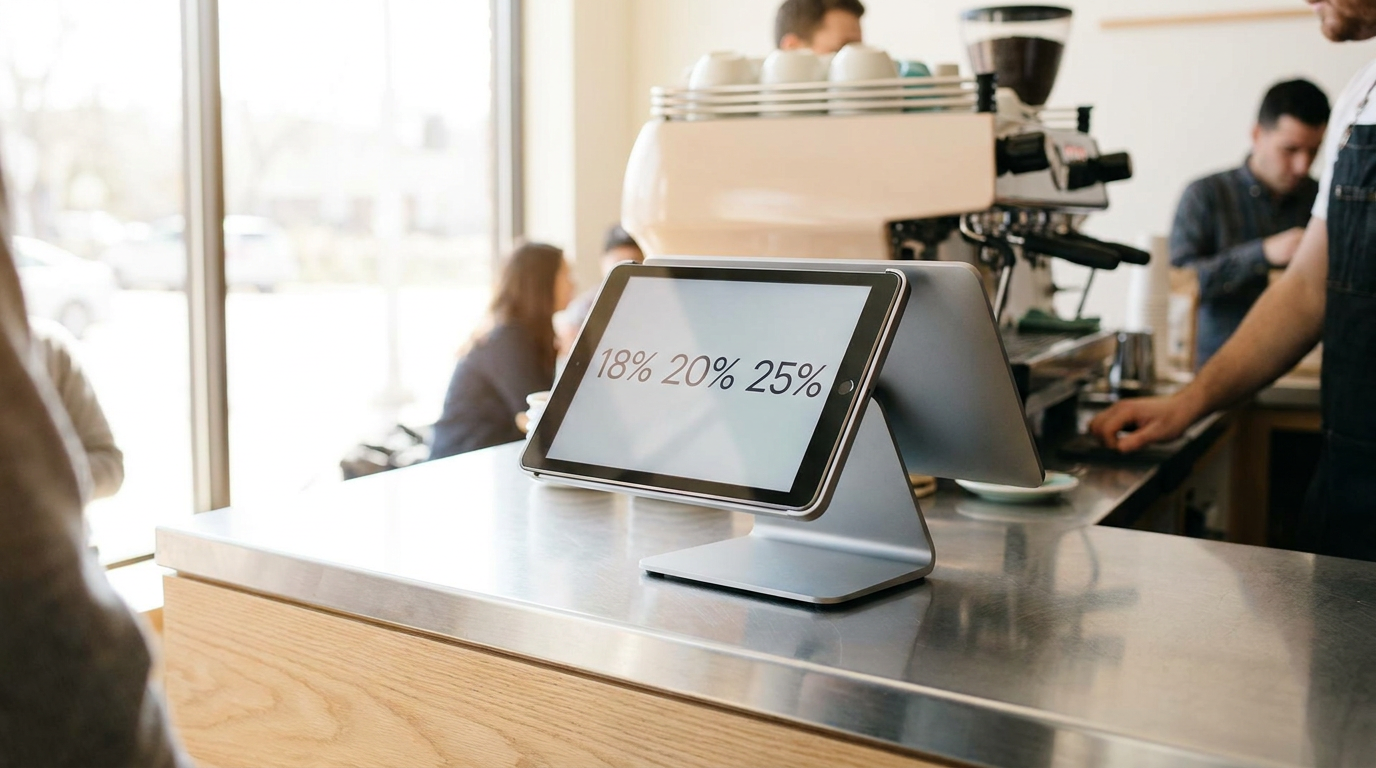
The modern coffee run often ends with a familiar, slightly uncomfortable ritual: the barista spins a tablet around, revealing a screen that asks for an 18%, 20%, or 25% tip. For a simple drip coffee, the prompt can feel disproportionate, leaving the customer hovering over the screen while the line behind them grows. This phenomenon, driven by the ubiquity of digital point-of-sale systems, has fundamentally altered the landscape of American gratuity. What was once a straightforward, analog reward for personalized service has morphed into a ubiquitous checkout requirement, blurring the lines between genuine hospitality and routine retail transactions.
According to recent financial surveys, nearly 90% of consumers feel that tipping culture has spiraled out of control, a widespread sentiment fueled by the sheer volume of daily requests. The appearance of tip prompts at self-checkout kiosks, retail clothing stores, and fast-casual counters has created what industry analysts call "tipping fatigue." Consumers are experiencing the mental and emotional exhaustion of making micro-moral decisions during every transaction, often wondering if they are subsidizing a business's payroll rather than rewarding a worker's exceptional effort. This fatigue has led to a growing resentment toward the screens themselves.[2][4]
But etiquette experts and financial advisors are pushing back against this digital pressure, offering a clear, guilt-free framework for 2026: consumers are absolutely allowed to say no. The core principle of modern tipping etiquette relies on distinguishing between genuine personal service and a simple retail transaction. The phenomenon of "tipflation"—the creeping upward of suggested minimums—relies heavily on the psychological "anchoring effect." When a payment screen defaults to 18% as its lowest option, it sets a new psychological baseline for the buyer, making a standard 15% tip feel inadequate or cheap by comparison.[1][2][5]

Consumers often feel pressured to select these higher anchored options while the cashier is watching, even if they would have historically left a smaller amount or nothing at all. Experts advise buyers to ignore the screen's aggressive suggestions and rely on their own predetermined tipping rules. For traditional, full-service dining, those rules remain largely unchanged and deeply entrenched in American culture. The baseline expectation for a sit-down meal, where a server takes your order and attends to your table, sits firmly between 15% and 20%.[1][3][4][5]
Data from restaurant technology platforms shows that the average tip at full-service establishments actually hovers around 19.4%, reflecting a sustained generosity for traditional waitstaff. These workers often rely on gratuities to bridge the gap between the tipped minimum wage and the actual cost of living. However, the etiquette rules diverge sharply when it comes to counter service and takeout. Etiquette professionals emphasize that tipping a barista, a baker, or a cashier who simply hands over a pre-packaged item is entirely discretionary, and consumers should not feel obligated to participate.[3][4][5]
These workers often rely on gratuities to bridge the gap between the tipped minimum wage and the actual cost of living.
While dropping a dollar or two for a complex, custom-made espresso drink or a large, complicated takeout order is a welcome gesture of appreciation, pressing "no tip" for a basic transaction is perfectly acceptable. If a transaction involves zero personalized service—such as scanning your own groceries at a self-checkout kiosk, grabbing a bottled water from a lobby fridge, or buying a t-shirt at a merchandise stand—experts are unequivocal. No human service means no tip is required, and buyers should tap the zero-percent option without a second thought.[1]

Delivery drivers and gig workers, on the other hand, operate under a vastly different economic reality that necessitates consistent tipping. Because these workers bear the out-of-pocket costs of their own fuel, vehicle maintenance, and navigation through unpredictable traffic and inclement weather, tipping remains an essential part of their livelihood. For food and grocery delivery, a tip of 15% to 20%—or a flat $4 to $6 minimum—is the standard expectation. If the driver navigates a severe storm or hauls heavy items up multiple flights of stairs, etiquette dictates bumping that amount higher to reflect the added physical effort.[1][3]
The travel and hospitality sector is also undergoing a tipping evolution, particularly regarding hotel housekeeping. Leaving $2 to $5 per day for housekeeping is the established norm, but the rapid decline of physical cash has left many workers unrewarded for their labor. In response, 2026 has seen a surge in frictionless digital tipping solutions designed to bridge this gap. Hotels are increasingly deploying NFC tags and QR codes directly in guest rooms, allowing travelers to tip housekeepers directly via smartphone without the friction of downloading a dedicated app or carrying small bills.[1][6]

Another point of modern confusion for diners is the increasingly common "service fee" or "living wage surcharge." Many restaurants have begun adding mandatory 18% or 20% service charges to the final bill to cover rising labor costs and back-of-house wages. Legally, a service charge belongs to the business, not the server, meaning it may or may not be distributed directly to the waitstaff. Experts recommend asking the server directly if the fee goes to them; if the bill already includes a gratuity or staff-directed fee, an additional tip is not expected unless the service was truly exceptional.[1][7]
Ultimately, navigating the new world of tipping requires setting personal boundaries and budgeting ahead of time. Financial planners suggest factoring the cost of standard gratuities into your dining and travel budget before you even leave the house, ensuring you are prepared to reward good service. By understanding when a tip is a vital part of a worker's livelihood and when it is merely a software default designed to maximize revenue, consumers can tip generously where it truly matters and tap "no" without guilt where it doesn't.[1][2]
How we got here
Pre-2020
Tipping in the United States is largely confined to sit-down restaurants, bars, salons, and delivery services.
2020–2021
Pandemic-era generosity sees consumers tipping higher amounts to support struggling essential workers in the hospitality industry.
2022–2024
Digital POS systems rapidly expand, introducing default tip screens to counter service, retail, and self-checkout kiosks.
2025–2026
Widespread 'tipping fatigue' prompts etiquette experts to redefine boundaries and normalize the 'no tip' option for non-service transactions.
Viewpoints in depth
Consumer Etiquette Advocates
Argue that tipping should remain a reward for personal service, not a default tax on every transaction.
Etiquette experts emphasize that consumers must reclaim their agency at the checkout counter. They argue that the proliferation of digital tip screens has weaponized social guilt, tricking buyers into subsidizing wages for non-service roles. By establishing firm personal boundaries—such as strictly refusing to tip at self-checkout kiosks or for pre-packaged retail goods—consumers can alleviate 'tipping fatigue' while preserving their generosity for the waitstaff and delivery drivers who genuinely rely on it.
Hospitality Operators
View digital tipping prompts as a necessary tool to retain staff and manage rising labor costs without drastically raising prices.
For restaurant and cafe owners, the digital tip screen is a survival mechanism in a tight labor market. Facing rising supply costs and wage demands, operators use point-of-sale tip prompts to boost their employees' take-home pay without having to print higher menu prices. They note that while some consumers complain about the prompts, the data shows that digital anchoring successfully increases overall staff compensation, which is critical for reducing turnover in a notoriously grueling industry.
Service Workers & Gig Drivers
Rely on consistent gratuities to survive, viewing tips as an essential component of their income rather than an optional bonus.
From the perspective of those working in the gig economy and traditional hospitality, the debate over 'tipflation' often misses the reality of their compensation. Delivery drivers bear the brunt of vehicle depreciation, gas prices, and weather hazards, making a 15% to 20% tip the difference between a profitable hour and a loss. For these workers, a tip is not merely a polite gesture for exceptional service; it is the fundamental economic engine that makes their labor viable.
What we don't know
- Whether consumer pushback will eventually force point-of-sale software companies to lower their default tip percentages.
- How upcoming labor legislation might alter the tipped minimum wage, potentially shifting the burden of compensation back to employers.
Key terms
- Tipflation
- The phenomenon where suggested minimum tip percentages on digital payment screens have crept upward, often starting at 18% or 20% instead of the traditional 15%.
- Tipping Fatigue
- The mental and emotional exhaustion consumers feel from being constantly prompted to leave a gratuity across a widening variety of daily transactions.
- Anchoring Effect
- A psychological bias where the first numbers presented on a tip screen (e.g., 18%, 20%, 25%) heavily influence the amount a customer ultimately decides to give.
- Point-of-Sale (POS) System
- The digital hardware and software, such as a tablet or card reader, used by businesses to process customer payments and display tip prompts.
Frequently asked
Do I need to tip at a self-checkout kiosk?
No. Etiquette experts agree that if no human provided a personalized service, a tip is not required.
How much should I tip for food delivery in 2026?
The standard expectation is 15% to 20% of the total bill, or a flat minimum of $4 to $6, to account for the driver's vehicle and fuel costs.
Does a restaurant's mandatory service fee go to the server?
Not always. Legally, a service charge belongs to the business. You should ask your server if they receive a portion of it before deciding whether to leave an additional tip.
Is it rude to press 'no tip' while the cashier is watching?
No. Experts emphasize that consumers should not feel pressured by digital screens to tip for basic retail or counter-service transactions.
Sources
Source coverage
7 outlets
3 viewpoints surfaced







[1]KiplingerConsumer Etiquette Advocates
To Tip or Not to Tip: Updated Guidelines
Read on Kiplinger →[2]Fidelity InvestmentsFinancial Planners
Tipflation: How to handle tip fatigue
Read on Fidelity Investments →[3]theSkimmConsumer Etiquette Advocates
Tipping Guidelines From an Etiquette Expert
Read on theSkimm →[4]Men's HealthConsumer Etiquette Advocates
A Guide to the Ridiculous New World of Tipping
Read on Men's Health →[5]GoFoodserviceHospitality Operators
Restaurant Tipping Guide | What Operators Need to Know
Read on GoFoodservice →[6]Hotel ExecutiveHospitality Operators
The Tipping Point: Why Digital Tipping Has Stalled and How 2026 Changes Everything
Read on Hotel Executive →[7]Quorum Federal Credit UnionFinancial Planners
The Year-Round Guide to Tipping
Read on Quorum Federal Credit Union →
Every angle. Every day.
Get lifestyle stories with full source coverage and perspective breakdowns delivered to your inbox.