
The Great Office Reset: How Empty Commercial Towers Are Becoming 2026's Housing Boom
With office vacancy rates hovering near 20%, developers are converting obsolete commercial buildings into residential apartments at a record pace. Over 90,000 units are currently in the pipeline, fundamentally reshaping American downtowns.
By Factlen Editorial Team
- Urban Planners & Developers
- Focuses on revitalizing downtowns, overcoming structural hurdles, and creating vibrant 24/7 mixed-use neighborhoods.
- Commercial Real Estate Investors
- Views conversions as a financial strategy to reposition distressed assets and mitigate losses from obsolete Class B and C office spaces.
- Housing Advocates
- Emphasizes the potential to ease housing shortages but cautions that high conversion costs often prevent the creation of truly affordable units without subsidies.
Why this matters
The transformation of millions of square feet of empty office space into housing is fundamentally reshaping the American downtown, turning 9-to-5 business districts into 24/7 residential neighborhoods. For renters, it promises an influx of unique, amenity-rich housing options, while for cities, it offers a critical lifeline to salvage local tax bases and revitalize struggling urban economies.
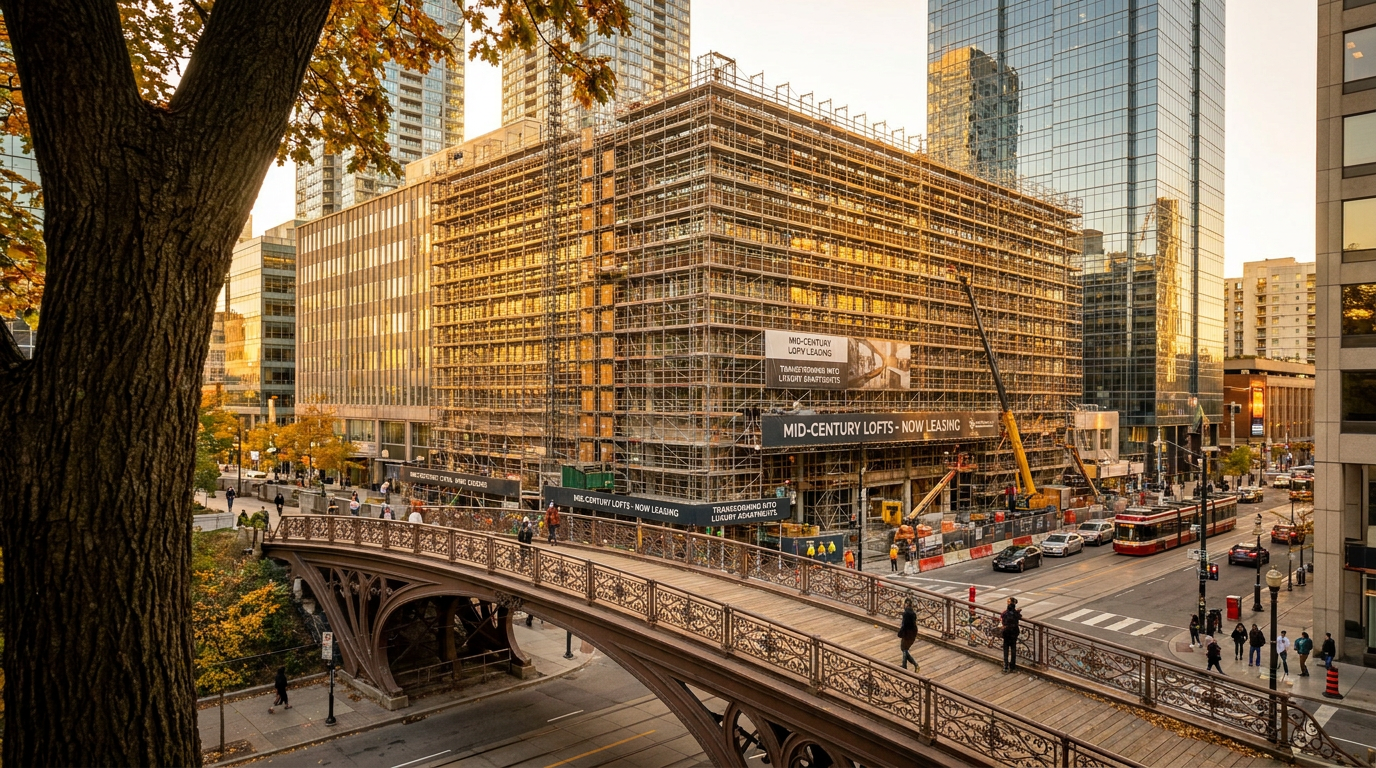
As remote and hybrid work models solidify their permanence in 2026, central business districts across the United States are undergoing their most profound physical transformation in decades. The towering glass-and-steel structures that once defined corporate productivity are being stripped to their concrete bones and reimagined as residential communities. This shift is not merely a temporary pandemic hangover; it is a structural realignment of urban real estate. The era of the cubicle farm is rapidly giving way to the apartment complex, breathing new life into neighborhoods that had grown eerily quiet.[8]
The catalyst for this architectural metamorphosis is a stark economic reality: the American office market has bifurcated. While premium, amenity-rich "Class A" towers continue to attract tenants in a widespread flight to quality, older Class B and C properties have been left behind. National office vacancy rates have hovered near 20% since early 2025, leaving millions of square feet functionally obsolete. Rather than allowing these aging assets to languish as empty monoliths, developers are increasingly viewing them as the raw material for a new era of urban housing.[2][3]
The sheer scale of this transition is breaking historical records. At the start of 2026, there were 90,300 office-to-apartment conversion units actively in the pipeline across the United States. This represents a 28% year-over-year jump and is nearly four times the volume recorded just four years ago in 2022. Office buildings have now eclipsed hotels and historic warehouses to become the undisputed engine of urban redevelopment, accounting for 47% of all future adaptive reuse projects nationwide.[1][2]

Geographically, the movement is heavily concentrated in major metropolitan areas that suffer from acute housing shortages. New York City leads the nation by a massive margin, boasting over 16,000 conversion units currently underway. Washington, D.C., follows with nearly 8,500 units, while Chicago ranks third with over 4,300. However, the trend is rapidly decentralizing. Mid-sized markets like Denver, Philadelphia, and St. Louis have all seen their conversion pipelines more than double over the past year as the financial models for these complex projects become more standardized.[1][6]
Yet, transforming a mid-century commercial tower into a livable residential community is a complex engineering puzzle. Unlike residential buildings, which are designed with relatively narrow footprints to ensure every bedroom has a window, commercial office buildings often feature massive, deep "floor plates." A typical 1980s office tower might stretch 200 feet across, leaving a vast, dark interior core that is legally and practically unsuitable for bedrooms or living spaces.[6][7]
To solve the "dark core" problem, architects are deploying highly creative spatial strategies. Developers are carving massive light wells down the center of buildings or removing entire sections of the facade to create internal courtyards. In other projects, the windowless interior spaces are being transformed into sprawling, multi-level amenity zones. What was once a maze of interior cubicles is now being repurposed into indoor pickleball courts, double-height fitness centers, music practice rooms, and co-working lounges that serve the building's new residents.[7][8]

To solve the "dark core" problem, architects are deploying highly creative spatial strategies.
Plumbing and mechanical systems present another formidable hurdle. An office floor designed to accommodate 100 workers typically features a single centralized bank of restrooms. Converting that same floor into a dozen individual apartments requires coring through thick concrete slabs to install new water lines, sewage pipes, and individual HVAC systems for every unit. These structural complexities mean that retrofitting an office building can cost anywhere from $100 to $500 per square foot, depending heavily on the age and layout of the property.[6]
Because of these steep capital requirements, the funnel of viable conversion candidates is surprisingly narrow. Industry analysts estimate that out of the roughly 800,000 office buildings in the United States, less than 1%—approximately 7,000 properties—are currently plausible candidates for residential conversion without massive public subsidies. The ideal candidate is typically a pre-1980s building with a smaller floor plate, operable windows, and a concrete frame that is significantly easier to modify than modern steel structures.[4][7]
However, the profile of the convertible office is beginning to expand. While developers historically targeted pre-war buildings with classic architectural details, newer offices constructed between the 1990s and 2010s are increasingly entering the mix. These modern Class B assets now account for 6.4% of the future conversion pipeline, signaling that even relatively recent commercial developments are being repositioned as the financial calculus of the real estate market shifts.[6]

To bridge the financial gap and accelerate these projects, local governments are stepping in with aggressive policy interventions. In New York, the "City of Yes for Housing Opportunity" initiative has relaxed zoning restrictions and introduced tax abatements specifically designed to make conversions pencil out for developers. Similarly, California has allocated hundreds of millions of dollars in grants to subsidize the adaptive reuse of commercial spaces, recognizing that private capital alone cannot solve the dual crises of empty downtowns and housing scarcity.[4][7]
Beyond the immediate economic benefits, the environmental case for adaptive reuse is overwhelmingly positive. The construction and real estate sectors are massive contributors to global greenhouse gas emissions. By choosing to retrofit an existing structure rather than demolishing it and building from scratch, developers preserve the "embodied carbon" already locked into the building's concrete and steel. This approach significantly reduces the environmental footprint of adding new housing stock to dense urban cores.[7]
The societal impact of this trend extends far beyond the walls of the converted buildings. By injecting thousands of new residents into traditionally single-use commercial districts, cities are fostering the creation of vibrant, 24/7 neighborhoods. The influx of full-time residents provides a crucial lifeline to local restaurants, coffee shops, and retail stores that previously relied entirely on the Monday-through-Friday commuter lunch rush, fundamentally revitalizing the urban streetscape.[5][8]

Despite the optimism surrounding these projects, housing advocates caution that office conversions are not a silver bullet for the national affordability crisis. Because of the high costs associated with structural retrofits, the vast majority of these new apartments are priced at market or luxury rates. Without targeted government subsidies, historic tax credits, or specific inclusionary zoning requirements, it remains exceedingly difficult for developers to deliver affordable or low-income housing through adaptive reuse.[7][8]
Looking ahead, the pace of office-to-residential conversions is widely expected to accelerate. With nearly one-third of all U.S. commercial office loans set to mature by 2027, a wave of distressed properties will likely change hands at significantly reduced valuations. As the acquisition cost of obsolete office buildings drops, the financial barrier to conversion will lower, unlocking a new tier of properties and ensuring that the reimagining of the American downtown remains a defining architectural trend of the decade.[3][5]
Viewpoints in depth
Urban Developers' View
Conversions are a complex but necessary architectural evolution to save downtowns.
For developers and architects, the challenge lies in the physical constraints of commercial buildings. Deep floor plates, centralized plumbing, and massive concrete cores make retrofitting expensive and technically demanding. However, they view these constraints as opportunities for innovation—turning windowless interior spaces into sprawling amenity decks and cutting light wells into massive structures to create unique, highly desirable residential communities that bring 24/7 foot traffic back to city centers.
Commercial Investors' View
Adaptive reuse is a financial lifeline for stranded, underperforming assets.
Institutional investors and lenders are facing a wave of maturing loans on Class B and C office buildings that no longer attract corporate tenants. From their perspective, conversions are less about urban idealism and more about asset stabilization. By taking obsolete square footage off the commercial market and repositioning it for the high-demand multifamily sector, investors can salvage value from distressed properties, provided they can secure the necessary capital and navigate local zoning laws.
Housing Advocates' View
Conversions add much-needed supply, but rarely address the affordable housing crisis directly.
While housing advocates welcome any addition to the national housing stock, they remain cautious about the office-to-residential boom. Because retrofitting costs can exceed $300 per square foot, developers are heavily incentivized to price the resulting apartments at luxury rates to recoup their investments. Advocates argue that without aggressive government intervention—such as tax abatements tied to inclusionary zoning or direct public subsidies—these projects will do little to help low- and middle-income renters.
What we don't know
- How the impending wave of commercial real estate loan maturities in 2026 and 2027 will impact the availability of capital for new conversion projects.
- Whether secondary and tertiary markets can sustain the high rental rates required to make expensive structural retrofits profitable without state subsidies.
- The long-term impact of these luxury-leaning conversions on the overall affordability of downtown neighborhoods.
Sources
Source coverage
8 outlets
3 viewpoints surfaced








[1]RentCafeHousing Advocates
Office-to-Apartment Conversions Hit Record 70,000+ Units
Read on RentCafe →[2]Construction DiveUrban Planners & Developers
Office-to-housing conversions grew 28% last year
Read on Construction Dive →[3]ForbesCommercial Real Estate Investors
Navigating The Office Real Estate Market In 2026
Read on Forbes →[4]BrookfieldCommercial Real Estate Investors
The Actionable Universe of Office-to-Residential Conversions
Read on Brookfield →[5]Cushman & WakefieldCommercial Real Estate Investors
New York City Office-to-Residential Conversions Hit Post-2008 High
Read on Cushman & Wakefield →[6]CRE DailyUrban Planners & Developers
Office conversions hit 90K units in 2026, led by New York
Read on CRE Daily →[7]Center for American ProgressHousing Advocates
Adaptive Reuse of Office Buildings to Housing
Read on Center for American Progress →[8]Factlen Editorial TeamUrban Planners & Developers
Synthesis by Factlen editorial team
Read on Factlen Editorial Team →
Every angle. Every day.
Get real estate stories with full source coverage and perspective breakdowns delivered to your inbox.