
Stablecoins Are Quietly Revolutionizing Global Remittances and Cross-Border Trade
Digital dollars are rapidly transitioning from speculative trading tools to mainstream financial infrastructure, drastically lowering the cost of international money transfers for households and businesses.
By Factlen Editorial Team
- Global Financial Institutions
- View stablecoins as a necessary upgrade to legacy banking infrastructure, enabling cheaper settlement and programmable corporate treasury operations.
- Emerging Market Users
- Rely on stablecoins as a practical lifeline to hedge against local currency inflation and to access the global U.S. dollar economy without traditional bank accounts.
- Blockchain Infrastructure Builders
- Focus on creating the regulatory and technical bridges that make digital dollars usable for everyday merchants and remittance senders.
What's not represented
- · Legacy wire transfer operators facing disruption
- · Local central banks concerned about dollarization
Why this matters
For decades, sending money internationally has been slow and expensive, disproportionately affecting migrant workers and small enterprises. The shift to blockchain-based stablecoins is finally making instant, low-cost global money transfers a reality for millions.
Key points
- Stablecoins are rapidly replacing traditional banking rails for cross-border remittances, drastically lowering fees and settlement times.
- Japan's SBI Remit partnered with Fasset to route its massive international payment network over blockchain infrastructure.
- Trace Finance secured $32 million to expand regulated stablecoin settlement across Brazil and the U.S.
- The IMF reports that stablecoins have become a vital economic lifeline in Nigeria, facilitating billions in cross-border trade.
- Corporate treasuries are increasingly adopting tokenized dollars for instant, programmable business-to-business payments.
For years, the cryptocurrency industry promised a revolution in how money moves around the globe, yet mainstream headlines remained fixated on the speculative rollercoaster of token prices. But beneath the surface of market volatility, a quiet, profound transformation has taken hold in 2026.[6][7]
Digital assets are finally delivering on their original utility: cheap, instant, borderless payments. The vehicle for this shift is not Bitcoin, but stablecoins—cryptocurrencies pegged to the value of traditional fiat currencies like the U.S. dollar.[5][7]
This week, the integration of stablecoins into traditional finance accelerated significantly. SBI Remit, the overseas money transfer subsidiary of Japanese financial giant SBI Group, announced a major partnership with digital asset platform Fasset.[1]
The collaboration aims to route cross-border payments, treasury management, and settlement services over stablecoin rails. By combining SBI Remit's massive JP¥2.5 trillion remittance network with Fasset's blockchain infrastructure, the initiative targets faster and lower-cost money transfers across more than 50 international payment corridors.[1]

The push to modernize financial plumbing is attracting serious institutional capital. On the same day, Trace Finance, a regulated financial infrastructure provider, closed a $32 million Series A funding round led by CoinFund.[3]
Trace Finance is building the critical bridge infrastructure that connects stablecoin settlement with local banking systems. The new capital will fund the expansion of its regulated payment rails across Brazil, the United States, and other high-growth emerging markets.[3]
The appeal of this technology is rooted in its stark contrast to the legacy correspondent banking system. Traditional international wire transfers often take days to clear, pass through multiple intermediary banks, and incur high percentage-based fees that disproportionately impact small transactions.[4][7]
The appeal of this technology is rooted in its stark contrast to the legacy correspondent banking system.
Stablecoins, by contrast, operate on decentralized blockchain networks that run around the clock. A digital dollar can be sent halfway across the world in less than a second, often costing a fraction of a cent in network fees, completely bypassing the friction of legacy banking hours and intermediaries.[6][7]
The real-world impact of this efficiency is most visible in emerging markets. A new report from the International Monetary Fund details how stablecoins have become a vital cross-border channel for households and small firms in Nigeria.[2]
Facing a sharp depreciation of the naira, high domestic inflation, and constrained access to foreign exchange, Nigerian citizens have turned to U.S. dollar-pegged stablecoins. These digital assets serve a dual purpose: a hedge against local currency risk and a practical tool for paying overseas suppliers.[2]
The scale of adoption is staggering. The IMF notes that Nigeria received approximately $59 billion in crypto-asset inflows over a recent twelve-month period, with stablecoins accounting for roughly 60 percent of those inflows across sub-Saharan Africa since 2019.[2]

What began as a niche technology has become a meaningful cross-border payments channel, the IMF report states, acknowledging that stablecoins are easing long-standing frictions in international trade and remittances for populations with limited access to formal banking.[2]
This grassroots adoption is now being matched by corporate integration. Silicon Valley Bank's 2026 outlook highlights that corporate treasuries are increasingly treating tokenized dollars as highly liquid cash, utilizing them for programmable business-to-business payments.[4]
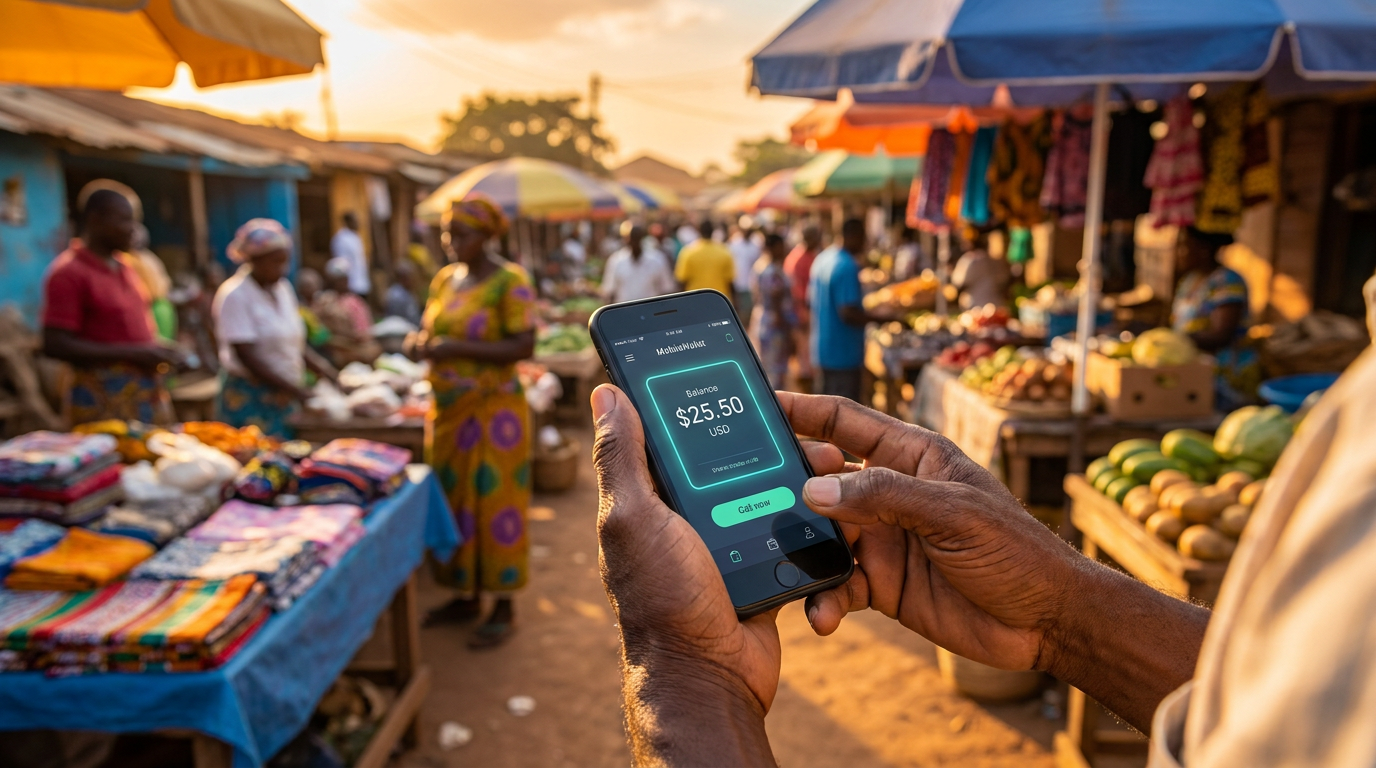
The missing link has long been the on-ramps and off-ramps—the mechanisms that convert local fiat currency into stablecoins and back again. A new generation of startups is solving this by linking digital dollars directly to familiar regional payment systems, QR codes, and merchant tools.[6]

As these bridges mature, the user experience is changing. Workers can receive cross-border payroll in real time, and merchants can accept global digital dollars without needing complex international bank accounts, effectively democratizing access to the global economy.[6][7]
How we got here
2009-2020
Cryptocurrencies emerge primarily as speculative assets with limited real-world payment utility due to high volatility.
2021-2023
Stablecoins gain traction as a safe haven for crypto traders and begin seeing grassroots adoption in high-inflation emerging markets.
2024-2025
Major payment networks like Visa and PayPal begin integrating stablecoin settlement on high-speed blockchains.
June 2026
Traditional remittance giants like SBI Remit and regulated infrastructure providers like Trace Finance deploy institutional-grade stablecoin rails for global payments.
Viewpoints in depth
Emerging Market Consumers
For households in countries experiencing high inflation, stablecoins are not a speculative investment but a necessary tool for survival.
Citizens in nations with volatile local currencies utilize stablecoins to preserve their purchasing power in U.S. dollars. Beyond acting as a digital savings account, these tokens allow small business owners to participate in global commerce, paying overseas suppliers instantly without relying on restrictive or inaccessible local banking systems.
Institutional Treasuries
Large corporations and financial institutions view stablecoins as a massive efficiency upgrade.
By settling cross-border transactions on blockchain rails, multinational companies can bypass the slow, expensive correspondent banking network. This frees up trapped capital and enables real-time, programmable business-to-business payments, turning the internet into a native financial settlement layer.
Global Regulators
Regulatory bodies emphasize the need to bring stablecoin activity into the formal financial system.
While acknowledging the clear benefits for financial inclusion and payment efficiency, central banks and regulators are focused on mitigating risks. Their goal is to foster innovation by establishing clear rules for stablecoin issuers, ensuring that these digital dollars are fully backed and that the infrastructure complies with anti-money laundering standards.
What we don't know
- How quickly legacy banking giants will fully transition their core cross-border settlement to public blockchain rails.
- Whether emerging market central banks will attempt to restrict stablecoin usage to protect their sovereign currencies from digital dollarization.
- Which specific blockchain networks will ultimately capture the majority of global stablecoin transaction volume.
Key terms
- Stablecoin
- A type of cryptocurrency designed to maintain a steady value by being pegged to a traditional asset, most commonly the U.S. dollar.
- Remittance
- Money sent by a person in a foreign country to their home country, often a vital source of income for developing economies.
- Correspondent Banking
- The traditional network of financial institutions that provide services on behalf of another, often requiring multiple hops to move money internationally.
- On-ramp / Off-ramp
- Services or infrastructure that allow users to exchange traditional fiat currency for cryptocurrency, and vice versa.
Frequently asked
Why are stablecoins better than traditional wire transfers?
Stablecoins operate on blockchain networks that run 24/7, allowing funds to settle in seconds for fractions of a cent, bypassing the delays and high fees of intermediary banks.
Are stablecoins safe to use?
Regulated stablecoins are backed 1:1 by secure assets like U.S. Treasury bills and cash. However, users must ensure they use reputable issuers and secure digital wallets.
How are businesses using this technology?
Companies are using stablecoins for instant cross-border payments to suppliers, real-time payroll for international workers, and efficient corporate treasury management.
Sources
Source coverage
7 outlets
3 viewpoints surfaced







[1]crypto.newsBlockchain Infrastructure Builders
SBI Remit taps Fasset for cross-border stablecoin infrastructure
Read on crypto.news →[2]International Monetary FundEmerging Market Users
Stablecoins in Nigeria: A Growing Cross-Border Channel
Read on International Monetary Fund →[3]FinTech GlobalGlobal Financial Institutions
Trace Finance raises $32m to bridge stablecoin and banking rails
Read on FinTech Global →[4]Silicon Valley BankGlobal Financial Institutions
How crypto will rewire finance in 2026
Read on Silicon Valley Bank →[5]ForbesGlobal Financial Institutions
Top Five Crypto Predictions For 2026
Read on Forbes →[6]a16z cryptoBlockchain Infrastructure Builders
The Year Ahead: Crypto Predictions for 2026
Read on a16z crypto →[7]Factlen Editorial TeamBlockchain Infrastructure Builders
Synthesis by Factlen editorial team
Read on Factlen Editorial Team →

More in finance
See all 6 stories →Student Debt
Federal Student Loan Borrowers Can Now Quadruple Their Auto-Pay Interest Discount
7 sources

Assumable Mortgages
How Assumable Mortgages Allow Homebuyers to Inherit 3% Interest Rates
8 sources

Asset Tokenization
How Tokenized Real-World Assets Are Quietly Rewiring Global Finance
7 sources

Retirement Strategy
The 2026 Roth 401(k) Catch-Up Mandate: How the SECURE 2.0 Act Changes Late-Career Retirement Strategy
6 sources

Every angle. Every day.
Get finance stories with full source coverage and perspective breakdowns delivered to your inbox.