
Inside Spain's 2026 World Cup Tactical Evolution Under Luis de la Fuente
Spain has abandoned traditional tiki-taka for a vertical, transition-heavy system, but a frustrating opening draw against Cape Verde has immediately tested their new blueprint.
By Factlen Editorial Team
- Tactical Analysts
- Focus on Spain's structural evolution and the shift toward vertical, transition-based attacking.
- Tournament Skeptics
- Highlight Spain's vulnerability to low blocks and the physical toll of their pressing system.
- Data Forecasters
- Rely on predictive models and Elo rankings to project Spain as the statistical favorites.
What's not represented
- · Cape Verde National Team Analysts
- · Uruguayan Tactical Scouts
Why this matters
Understanding Spain's tactical shift reveals the broader trends defining the 2026 World Cup, where physical endurance and vertical transitions are replacing the possession-heavy dominance of the previous decade.
Key points
- Spain entered the 2026 World Cup as statistical favorites based on predictive models.
- Manager Luis de la Fuente has transitioned the team away from traditional tiki-taka toward a vertical, direct attacking style.
- The system relies on a 3-2-5 possession shape designed to isolate wingers in one-on-one matchups.
- A 0-0 opening draw against Cape Verde exposed Spain's ongoing difficulties in breaking down compact low blocks.
- The physical demands of Spain's high-intensity counter-pressing may prove unsustainable over an expanded eight-match tournament.
Spain arrived at the 2026 FIFA World Cup in North America as the undisputed analytical darlings of the tournament. A comprehensive forecasting model from Goldman Sachs, which analyzed nearly 20,000 competitive international matches played since 1978, placed La Roja as the outright tournament favorites ahead of defending champions Argentina and recent finalists France. The banking giant's model projected a 19 percent probability of Spain lifting the trophy, noting that their prediction aligns perfectly with the historical pattern that the World Cup almost always returns to a European nation after being won by a South American team.[6]
This mathematical optimism was not built on historical pedigree alone, but rather on a profound tactical revolution engineered by manager Luis de la Fuente. Following the sterile, possession-heavy exits of the 2018 and 2022 World Cups—where the team famously completed thousands of passes without generating meaningful scoring opportunities—Spain has deliberately abandoned the rigid dogma of traditional tiki-taka. In its place, the coaching staff has installed a much more vertical, aggressive system that prioritizes rapid transitions and direct attacking play over the mere accumulation of possession statistics.[2]
But tournament football is famously unforgiving, and theoretical dominance was immediately challenged in Spain's opening Group H match. A deeply frustrating scoreless draw against Cape Verde saw La Roja revert to some of their most passive historical habits. The team struggled immensely to break down a resolute, highly organized low block, raising immediate questions across the footballing world about their tactical adaptability when Plan A fails to produce an early breakthrough on the grandest stage. The performance was widely criticized as stagnant, proving that while the tactical theory is sound, executing it against opponents who refuse to engage remains a significant hurdle.[4]
To truly understand Spain's 2026 identity is to understand their use of the ball not as a defensive shield, but as an offensive trap. De la Fuente's philosophy centers on positional fluidity and quick vertical transitions, using controlled possession deep in their own third to deliberately draw the opposition forward. By baiting the opponent into a high press, Spain creates the artificial space necessary to launch devastating attacks the moment the first line of pressure is bypassed. This represents a fundamental philosophical shift: possession is no longer the ultimate goal, but rather a specialized tool utilized specifically to manipulate the opponent's defensive structure and open up passing lanes.[2][3]

Tactical analysts observing De la Fuente's tenure have noted that the core tenets of Spanish football have not been entirely discarded, but rather weaponized for the modern era. The intricate passing networks remain, but they are now deployed with a ruthless forward momentum. The team seeks to impose themselves to achieve control and dominance, but the explicit instruction from the touchline is to be significantly more direct, ensuring that every sequence of possession is designed to actively damage the opponent rather than merely control the match clock.[3]
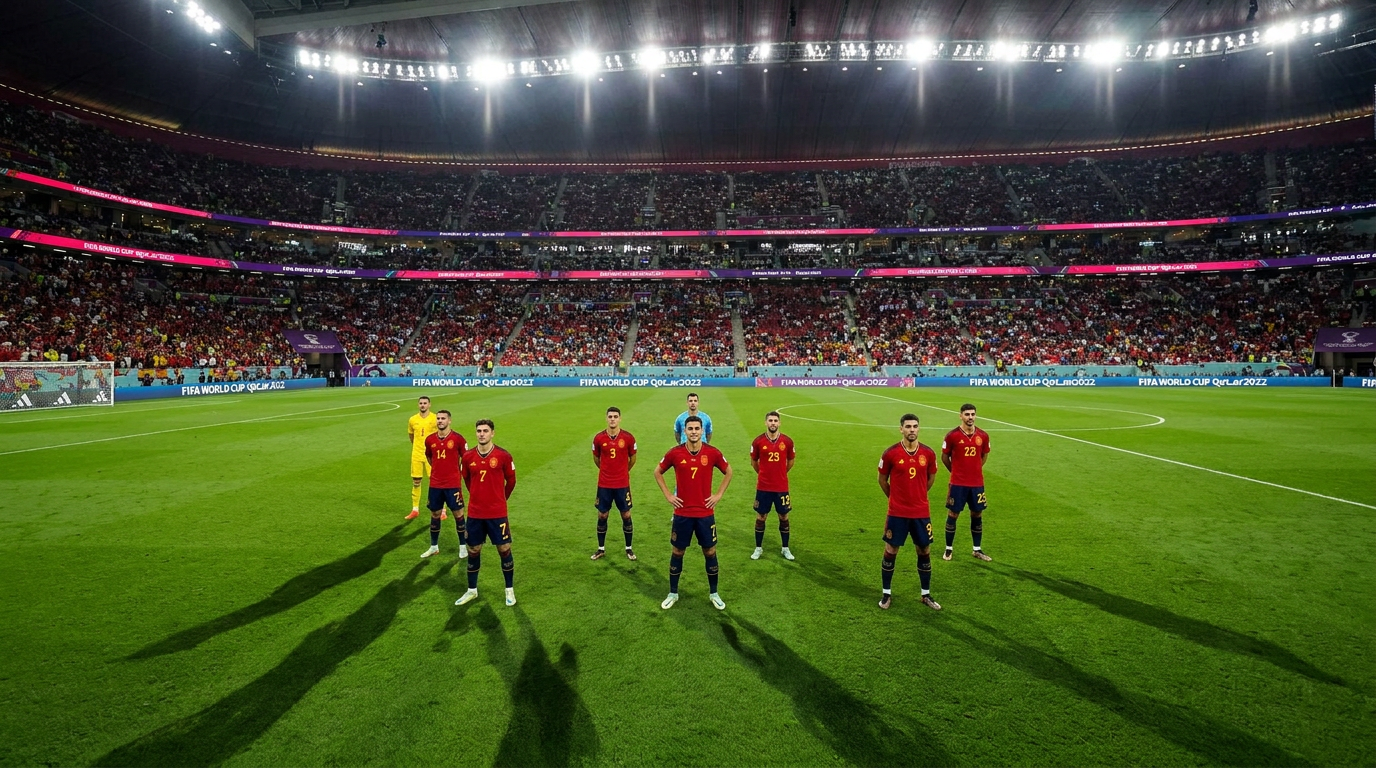
When the opponent finally commits to the press, the Spanish tactical machine springs into action. The base formation, which typically looks like a standard 4-3-3 or a 4-2-3-1 on paper, rapidly morphs into an aggressive 3-2-5 attacking shape the moment the team secures sustained possession. This fluid structural shift allows Spain to commit an overwhelming number of players into the final third, overwhelming traditional defensive lines and creating complex passing triangles across every sector of the attacking half.[1]
At the very heart of this structural metamorphosis is the holding midfielder, a role defined by absolute technical security and spatial awareness. The pivot player frequently drops deep between the two center-backs, creating a temporary back three that provides numerical superiority and immense composure during the initial build-up phase. This subtle movement not only stabilizes the defense against potential counter-attacks but also dictates the entire tempo of the match, serving as the central nervous system for Spain's forward progression.[3]
This deliberate structural shift in the center of the pitch liberates the fullbacks to operate with unprecedented attacking freedom. With traditional defensive responsibilities temporarily covered by the midfield pivot, the fullbacks are explicitly instructed to push high up the pitch. Depending on the specific personnel deployed on the flanks, these wide defenders will either provide aggressive overlapping runs to stretch the opposition horizontally, or invert tightly into the midfield to overload the central channels and confuse marking assignments.[2][3]

The ultimate goal of this complex, highly choreographed machinery is surprisingly simple in its execution: isolate the wingers. The entirety of Spain's build-up play and positional rotation is engineered to create isolated, one-on-one situations for their most dynamic attackers on the flanks. By drawing the opponent's defensive block toward the center of the pitch through intricate passing, Spain manufactures the exact scenarios where their explosive wide players can receive the ball with time, space, and a single defender to beat.[3][5]
The ultimate goal of this complex, highly choreographed machinery is surprisingly simple in its execution: isolate the wingers.
This reliance on wide isolation represents a stark departure from the classical positional play that defined the previous generation of Spanish dominance. Tactical breakdowns of the 2026 tournament trends highlight that the current crop of wingers create the kind of chaotic, individualistic one-on-one isolations that traditional possession systems specifically designed to avoid. The modern Spanish winger is not a facilitator, but a direct, lethal threat tasked with breaking defensive lines through pure individual brilliance and sheer athletic verticality.[5]
The midfield trio supports this wide threat with relentless, box-to-box energy that was largely absent in previous iterations of the national team. The central midfielders are no longer tasked with purely circulating the ball in safe areas; instead, they press with ferocious intensity and are expected to arrive late into the penalty area to finish cut-backs. This dynamic movement ensures that when the wingers inevitably break through the defensive line, there are multiple targets flooding the box to convert the resulting opportunities.[5]
When this system functions as intended, the results are undeniably devastating. Spain's triumphant run through Euro 2024 and their utterly dominant, unbeaten World Cup qualifying campaign served as undeniable proof of concept. During qualification, La Roja scored a staggering 21 goals and kept five clean sheets in just six matches, demonstrating that this direct, transition-heavy iteration of Spanish football possesses the firepower to completely dismantle elite international opposition when given the opportunity to play on their own terms.[2]

However, the opening World Cup stalemate against Cape Verde brutally exposed the system's inherent vulnerabilities. When faced with a deep, incredibly compact defensive block that entirely refuses to press, Spain's vertical triggers completely disappear. Without the space behind the defense to exploit, the team is forced back into the exact slow, methodical possession they have spent the last three years desperately trying to leave behind, leading to long stretches of sterile ball circulation without any meaningful penetration.[4]
Observers in Arlington, Texas, noted that the team's tactical patience quickly devolved into visible stagnation. With Cape Verde intelligently double-teaming the Spanish wingers and stubbornly refusing to vacate the critical half-spaces, Spain's ball circulation became highly lateral and entirely predictable. The team lacked the clinical edge and improvisational creativity required in the final third, highlighting a concerning over-reliance on individual magic from the flanks to solve complex defensive puzzles when the collective structural plan is neutralized.[4]
Furthermore, the aggressive 3-2-5 attacking shape carries severe, potentially tournament-ending risks in defensive transition. When the fullbacks are caught high up the pitch participating in the attack, the wide channels and half-spaces are left dangerously exposed to rapid counter-attacks. Opponents with fast, direct forwards can easily bypass the Spanish counter-press and exploit the massive expanses of green grass left behind the advancing defensive line, turning Spain's greatest attacking strength into a glaring structural weakness that savvy managers will undoubtedly target in the knockout rounds.[1][5]
To mitigate this immense transitional risk, De la Fuente's side relies heavily on immediate, suffocating counter-pressing. Spain attempts to regain possession in the attacking third an astonishing average of 7.8 times per match, a high-wire tactical act that demands immense physical exertion from every player on the pitch. The moment the ball is lost, the nearest players must swarm the opponent to force a turnover or commit a tactical foul before the counter-attack can truly materialize, requiring absolute collective synchronization.[2]

The expanded 48-team tournament format, however, casts serious doubt on the long-term viability of this approach. Analysts warn that maintaining such high-intensity pressing is physically unsustainable across a potential eight-match run to the final, especially when factoring in the grueling North American summer heat and the compressed recovery times between group stage fixtures. Fatigue will inevitably accumulate, and a pressing system executed at anything less than maximum intensity is easily bypassed by elite international midfields, leaving the defense completely stranded.[5]
Squad rotation and in-game tactical flexibility will therefore be paramount to Spain's survival in the tournament. De la Fuente has shown a willingness to adapt his game model, occasionally deploying a traditional, physical target man to bypass the midfield entirely when intricate passing fails to break the lines. Yet against Cape Verde, critics widely felt his substitutions came far too late to alter the momentum of the match, suggesting a stubborn adherence to the primary game plan even when it was clearly malfunctioning.[4]
Spain now faces a critical, potentially defining juncture in Group H. They must quickly navigate a crucial fixture against Saudi Arabia before a highly anticipated, high-stakes clash with Marcelo Bielsa's Uruguay. Bielsa's chaotic, man-to-man high-pressing style will test Spain's build-up play and composure to its absolute limits, providing the ultimate stress test for De la Fuente's modernized tactical blueprint in an environment where any further dropped points could prove disastrous for their tournament seeding and overall confidence.[4]
The stakes for these upcoming group stage matches could not be higher. If La Roja fail to secure the top spot in their group, they risk a daunting, premature Round of 32 matchup against Lionel Messi and defending champions Argentina. The tactical blueprint for a second World Cup title is clearly drawn, beautifully blending the technical mastery of Spain's past with the athletic verticality of the modern game. But as the opening week emphatically proved, brilliant theory means nothing without flawless execution under the immense pressure of the World Cup stage.[4]
How we got here
Dec 2022
Luis de la Fuente is appointed manager, signaling a shift away from the possession-heavy tactics of the past.
July 2024
Spain wins Euro 2024, validating the new vertical tactical approach on the continental stage.
Nov 2025
La Roja completes an unbeaten World Cup qualifying campaign, scoring 21 goals in six matches.
June 2026
Spain opens their 2026 World Cup campaign with a frustrating 0-0 draw against Cape Verde.
Viewpoints in depth
Tactical Analysts
Focus on the structural evolution from tiki-taka to verticality.
Tactical purists applaud Luis de la Fuente's modernization of the Spanish game model. They argue that the shift to a 3-2-5 attacking shape brilliantly weaponizes possession, using it as bait to draw opponents forward before striking with rapid vertical transitions. By isolating dynamic wingers in one-on-one situations, analysts believe Spain has solved the sterile possession problem that plagued their 2018 and 2022 World Cup campaigns.
Data Forecasters
Highlight the Elo ratings and historical models that place Spain as the tournament favorites.
Statistical models, such as the one produced by Goldman Sachs, view Spain as the most complete team in the tournament. Forecasters point to La Roja's dominant underlying metrics—including their high rate of attacking third ball recoveries and their unbeaten qualification run—as empirical evidence that their tactical system is mathematically superior to their rivals, granting them a 19 percent probability of lifting the trophy.
Tournament Skeptics
Point to the 0-0 draw against Cape Verde as proof that Spain still struggles against low blocks.
Skeptics argue that theoretical dominance means little if a team cannot break down a resolute defense. They point to the Cape Verde stalemate as evidence that Spain's vertical triggers disappear against opponents who refuse to press. Furthermore, critics worry that the immense physical exertion required to maintain Spain's counter-pressing system is entirely unsustainable across the grueling, expanded 48-team format in the North American summer heat.
What we don't know
- Whether Spain's high-intensity pressing system can physically endure the demands of an expanded eight-match tournament.
- How Luis de la Fuente will adjust his tactics if opposing teams consistently double-team Spain's wingers.
- If Spain can maintain their composure against the chaotic, man-to-man pressing style of their upcoming group stage opponent, Uruguay.
Key terms
- Low Block
- A defensive strategy where a team positions all its players deep in their own half to restrict space and frustrate the attacking side.
- Half-spaces
- The vertical channels on the pitch between the wide wing areas and the center, often exploited by attacking midfielders.
- Counter-pressing
- A tactical approach where a team immediately attempts to win the ball back high up the pitch the moment they lose possession.
- Inverted Fullback
- A wide defender who moves centrally into the midfield when their team has the ball, creating numerical superiority in the middle of the pitch.
Frequently asked
How has Spain's style changed since the 2022 World Cup?
Under Luis de la Fuente, Spain has moved away from slow, possession-heavy tiki-taka toward a more vertical, direct system that uses quick transitions and isolates wingers in one-on-one situations.
What is Spain's attacking formation?
While they line up in a 4-3-3 or 4-2-3-1, Spain's shape morphs into an aggressive 3-2-5 in possession, with the holding midfielder dropping deep and the fullbacks pushing high.
Why was Spain's opening match against Cape Verde a concern?
The 0-0 draw highlighted Spain's lingering struggles to break down deep, compact defensive blocks, as the team looked stagnant when their wingers were double-teaming.
Sources
Source coverage
6 outlets
3 viewpoints surfaced






[1]Tactical Football AnalysisTactical Analysts
FIFA World Cup 2026: Comparing Europe's Top 5 Teams & Tactical Systems
Read on Tactical Football Analysis →[2]The Hard TackleTactical Analysts
The Architect: Luis de la Fuente and his tactics
Read on The Hard Tackle →[3]The IndependentTactical Analysts
How Luis de la Fuente evolved Spain's tiki-taka for the 2026 World Cup
Read on The Independent →[4]Fox SportsTournament Skeptics
Spain's 2026 World Cup debut dampened by Cape Verde stalemate
Read on Fox Sports →[5]KharasportsdailyTactical Analysts
The 5 Tactical Trends That Will Decide the 2026 World Cup
Read on Kharasportsdaily →[6]Spain in EnglishData Forecasters
Goldman Sachs model tips Spain to win 2026 World Cup
Read on Spain in English →

More in sports
See all 13 stories →NBA Finals
New York Knicks Celebrate First NBA Championship in 53 Years with Historic Canyon of Heroes Parade
6 sources

Sports Biomechanics
The 'Fifth Stroke': The Physics and Evolution of Swimming's Fastest Technique
5 sources

Standings
CFL 2026 Early Standings: Alouettes Surge to 2-0 as Defending Champion Roughriders Hold Top Spot
8 sources

Snowboard Tech
The Airbag Revolution: How Snowboarding Safely Reached the 2340-Degree Spin
7 sources
Every angle. Every day.
Get sports stories with full source coverage and perspective breakdowns delivered to your inbox.